https://www.instagram.com/p/BK1D-bjjX8Y/
Thank you Nicole Duckworth for the photo caption 🙂

https://www.instagram.com/p/BK1D-bjjX8Y/
Thank you Nicole Duckworth for the photo caption 🙂
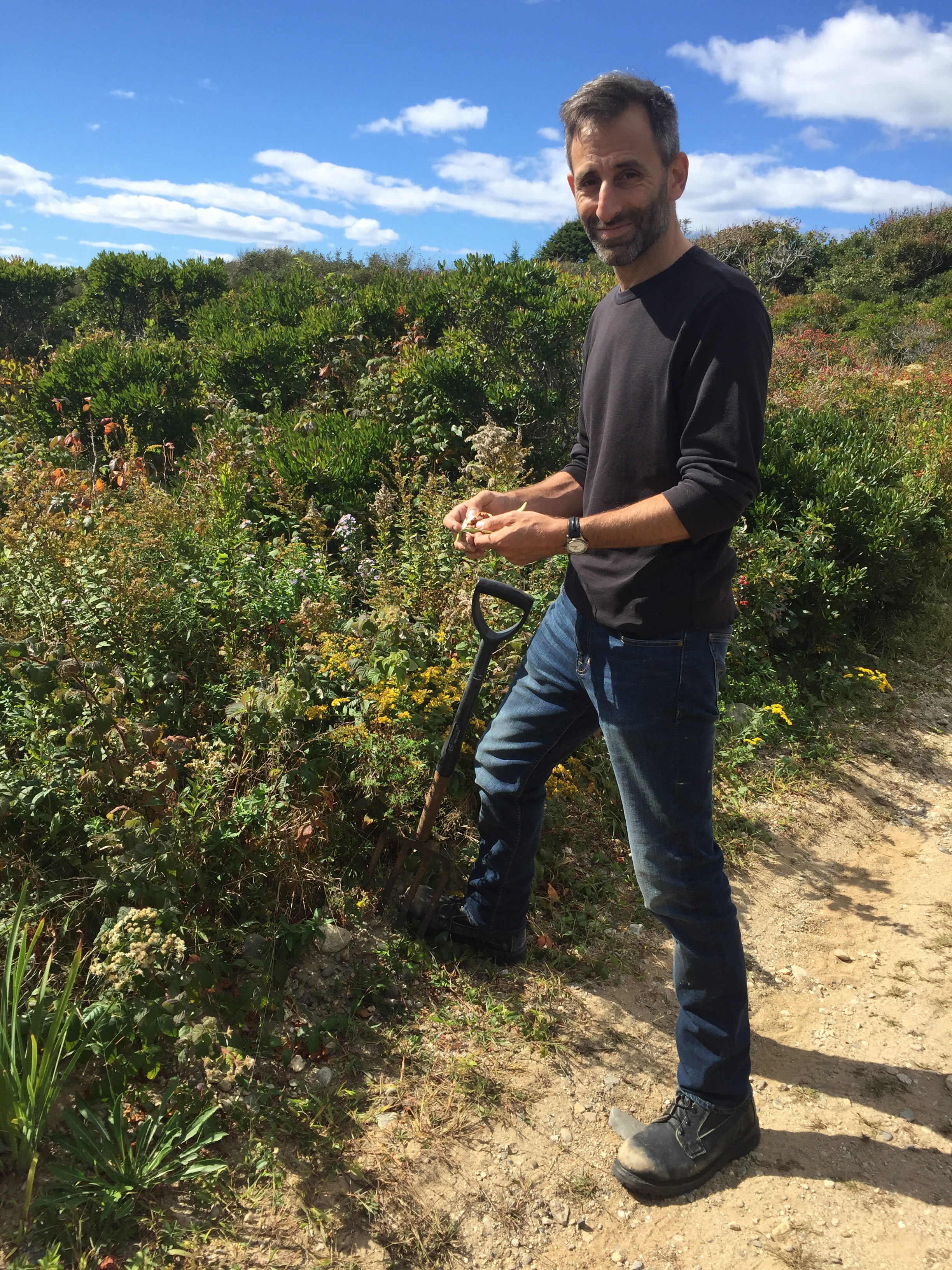
 Thank you to Dawn and John Sarrouf for sharing their milkweed planting photos. They are visiting their friend Camilla at her family home in Small Point Maine, which sounds like, from Dawn’s description, a gorgeously beautiful location, and ideal Monarch habitat. There are fields of wildflowers, and Seaside Goldenrod grows just as easily in the rocky outcroppings there as it does on Eastern Point. After looking at maps, it appears as if you could draw a virtual straight line from Small Point to Eastern Point. Dawn and friends spotted about ten butterflies yesterday. Perhaps we’ll be the next stop (after the predicted rainfall).


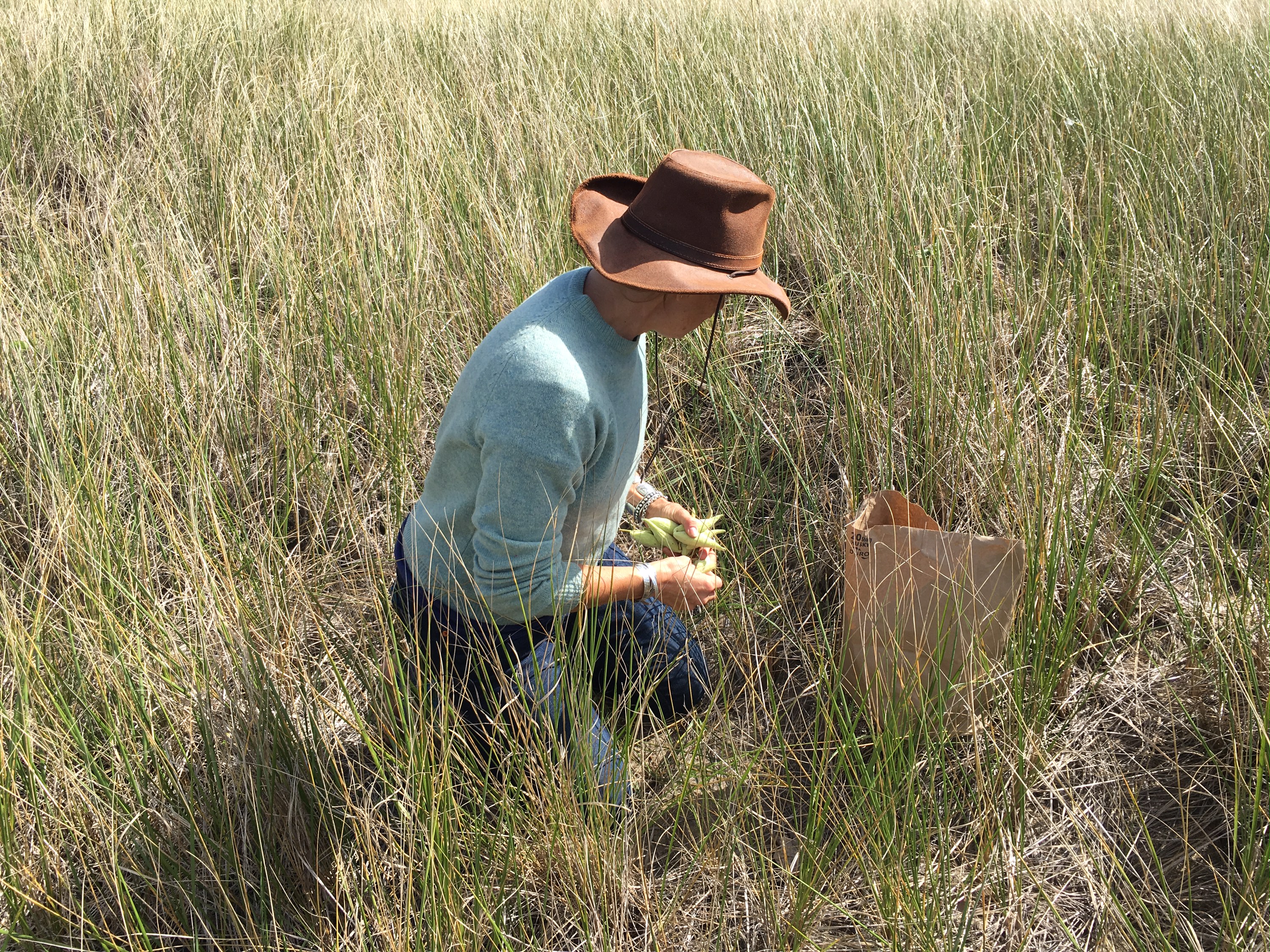 Camilla collected milkweed seed pods and enlisted the Sarroufs to help plant.
DAWN SARROUF PHOTOS
There have been few Monarch sightings this summer but I have been hoping for a strong fall migration. The migration is peaking in Kansas and we are always a little bit behind. Please let me know if you see a Monarch, and where. Thank you very kindly!
https://www.instagram.com/p/BKqhTISjOjG/
Monarchs are emerging daily in my garden, from eggs collected at my friend Nancy’s field in Salem. This too would be an indication that we may be seeing them soon.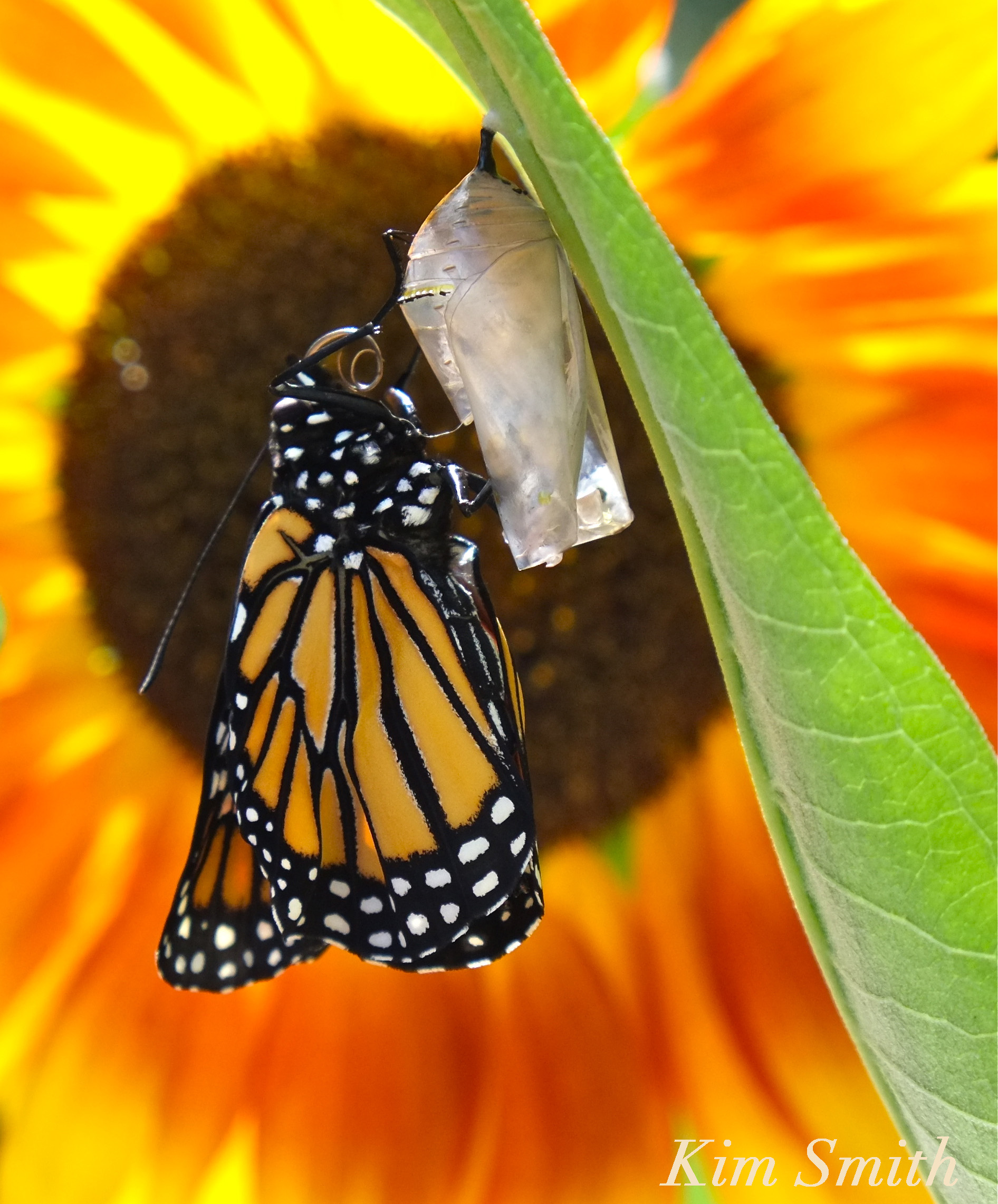
This newly eclosed Monarch is clinging to its chrysalis case. Within moments of emerging, the two-part Monarch proboscis must zip together to form a siphoning tube. If the two parts do not join, the butterfly will not be able to drink nectar. In this photo, you can see the proboscis is not yet fully zipped.
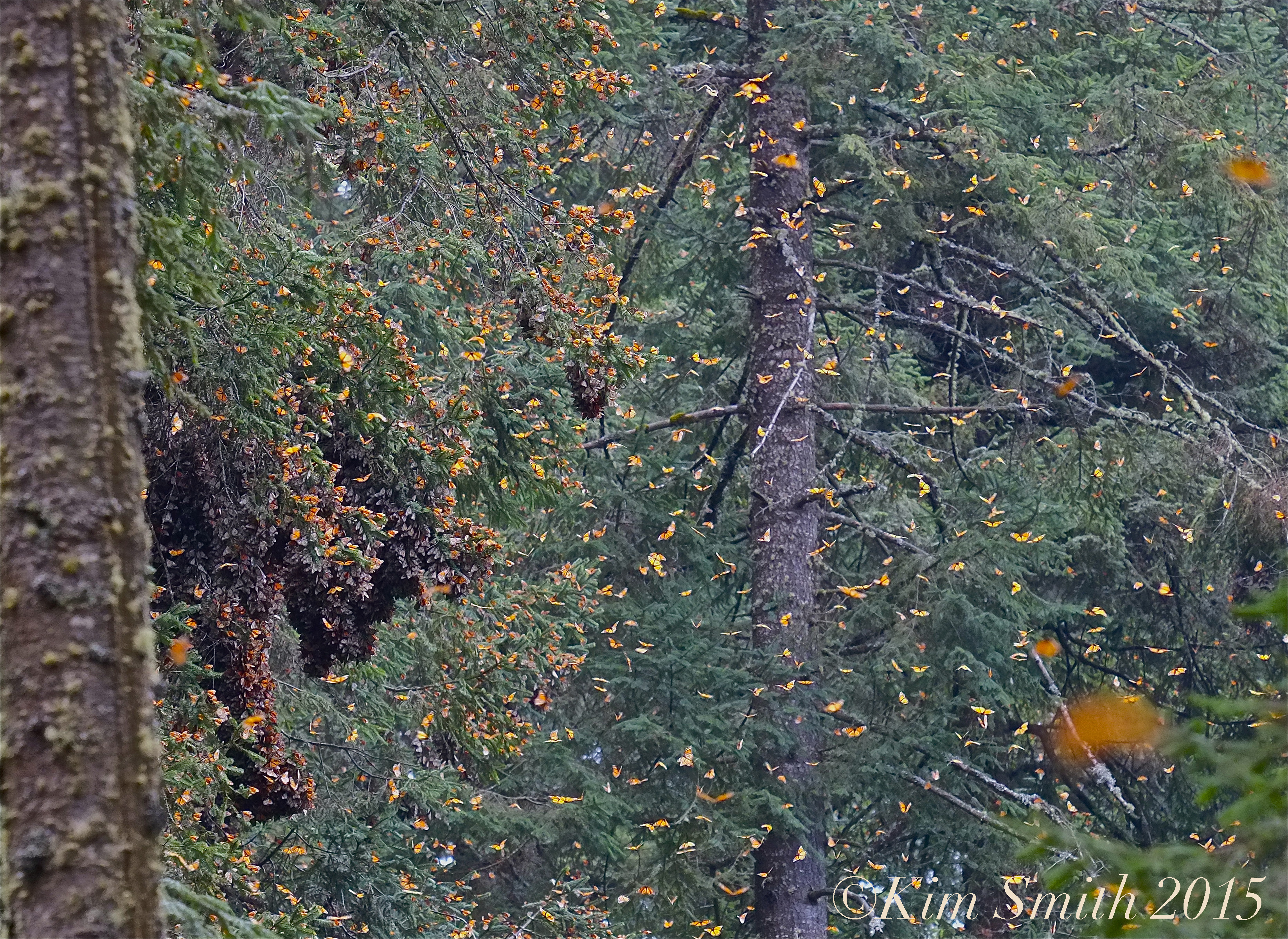 Monarch Butterfly Explosion
What is a Monarch Butterfly explosion? The butterflies migrate to Mexico to keep from freezing to death in northern climates. The air is cool and moist in the trans-Mexican volcanic mountains, cool enough to keep them inactive and in a state of sexual immaturity, called diapause, but not so cold that they will freeze. As spring approaches and the Earth’s temperature begins to rise, the butterflies sleeping in the oyamel fir forests need to get out of the hot sun. Millions explode from the trees, drink water from nearby mountain streams, and move to a cooler, shadier spot on the mountain.
I hope you’ll come join our program Thursday night at 7pm at the Sawyer Free Library. We’ll be talking all things Monarchs including the current status of the butterfly’s migration, habitat destruction here in our own community, and most importantly, ways in which we can all help the Monarch possibly survive the warming of the earth.
We will be premiering the trailer for my forthcoming film about the Monarchs, too (also titled Beauty on the Wing). I hope to see you there!
For more information, visit the Programs page of my website and the Sawyer Free Library Facebook page.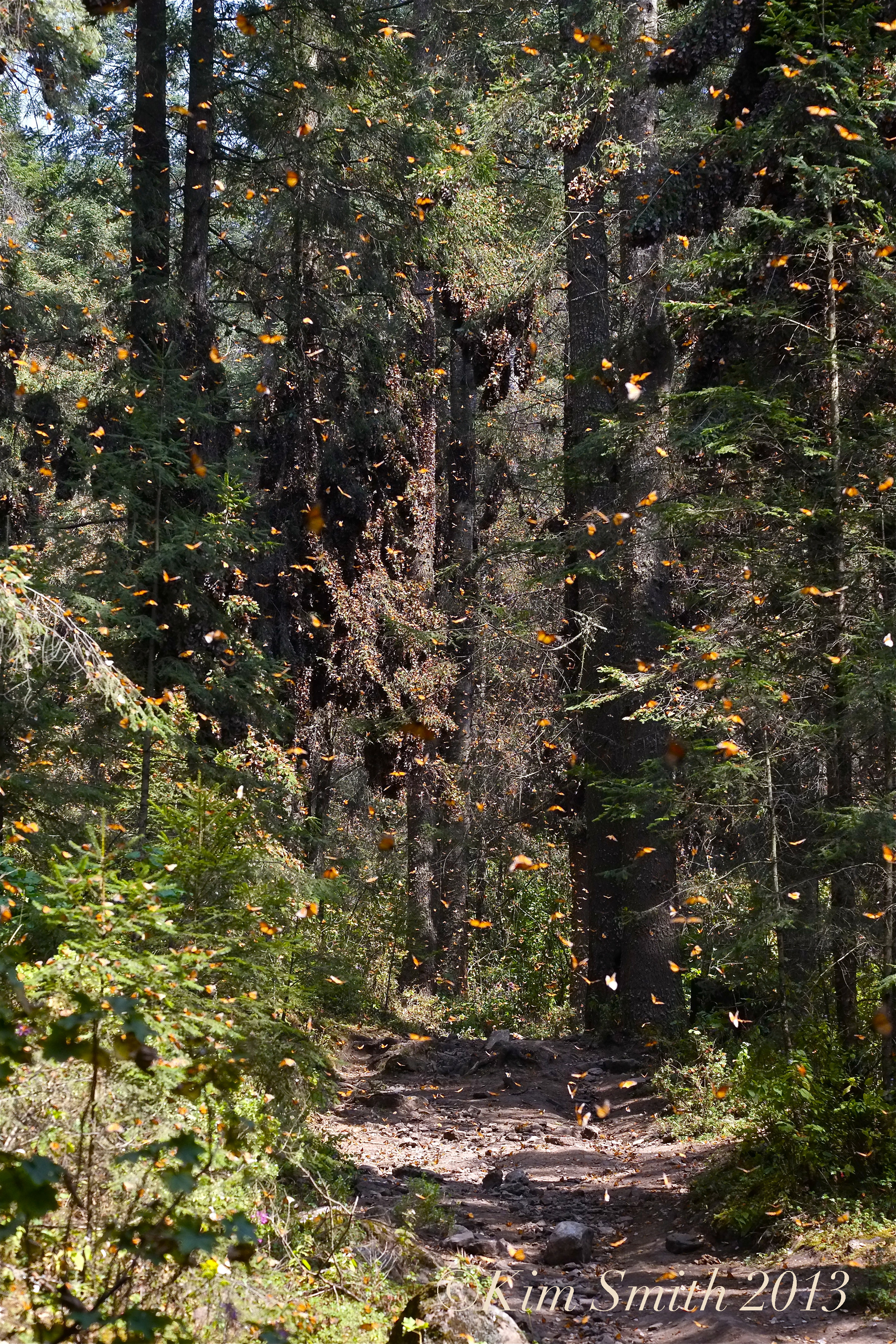
Dear Friends,
Please join us at the Sawyer Free Library on Thursday November 12th at 7:00 pm for my Monarch butterfly program. I am especially, especially excited to present to our community. I hope to see you there! Please note that this is my photo and lecture program, not the new film, which will be coming soon.
For more information visit my website Kim Smith Designs.

Thank you so much to my friends Charles and George Ryan and Mom Catherine for helping with the Monarch film project. 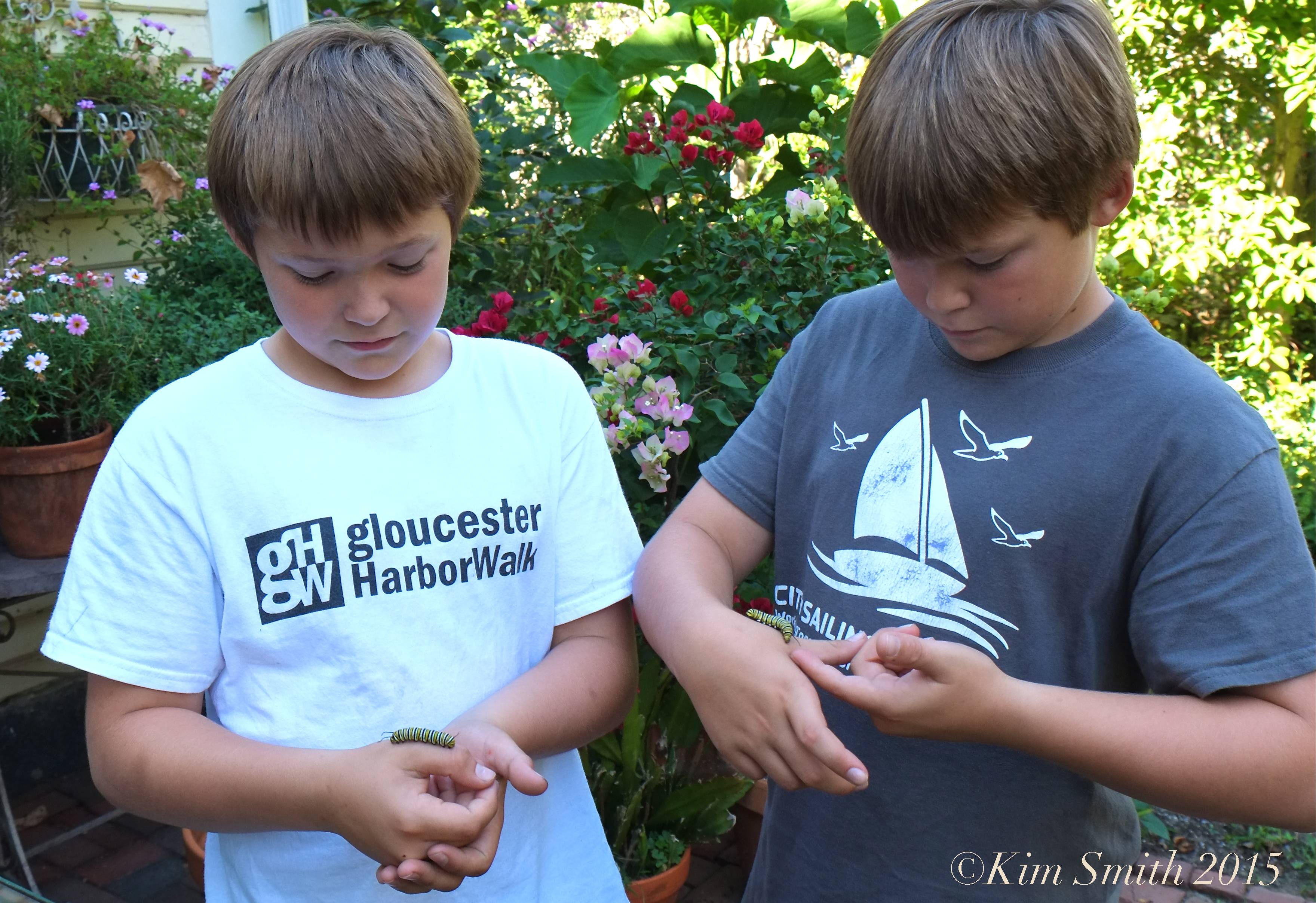
Nature’s Compass ~ My current group of nine Monarchs are synchronized, all lined up on a north-south axis and pupating within moments of each other.
From the moment a caterpillar emerges, internally it begins to form the adult parts of its body. Adult Monarchs have magnetic receptors along the inner margins of their thorax, which help guide them on their south to north, north to south migration. I wonder if the magnetic receptors are here at work in the caterpillars north-south pattern of pupating.
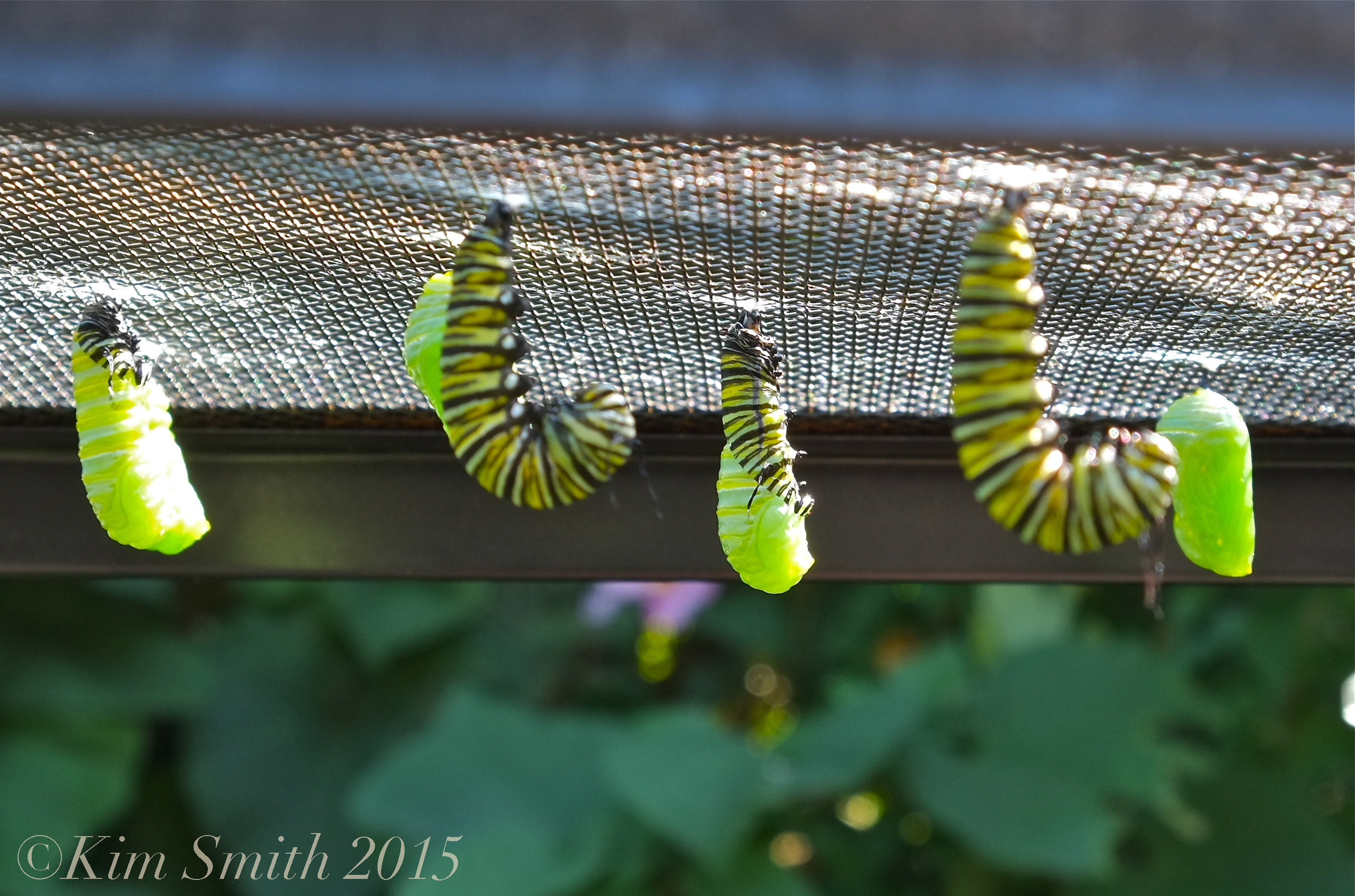 All nine hung in a J-shape on the north-south axis as well. Since I took this photo three more have also pupated on the north-south axis. In the above photo, you can see the center caterpillar and caterpillar to the far left are in the midst of changing from a caterpillar to a chrysalis (pupating).
 Female Monarch Butterfly Necating at Red Clover, Waring Field, Rockport
I am looking for Monarch eggs and will travel! Monarch eggs are found on the upper leaves of milkweed plants. The eggs are tiny and dome-shaped, only as large as a pinhead, and are a pale golden yellow color.
 Monarch Butterfly Egg
Waring Field supports myriad species of pollinators and is simply a fantastic place to explore. Although I didn’t find any eggs on my search on the leaves at the Common Milkweed patch at Waring this morning, I did see four adult Monarchs, three male and one female, along with fritillaries, a Common Ringlet, a bevy of Pearly Cresentspots, Blue Azures, and Yellow Sulphurs. The Monarchs, Ringlet, and Sulphurs were nectaring at the great field of Red Clover and the Pearl Crescents at the milkweed.
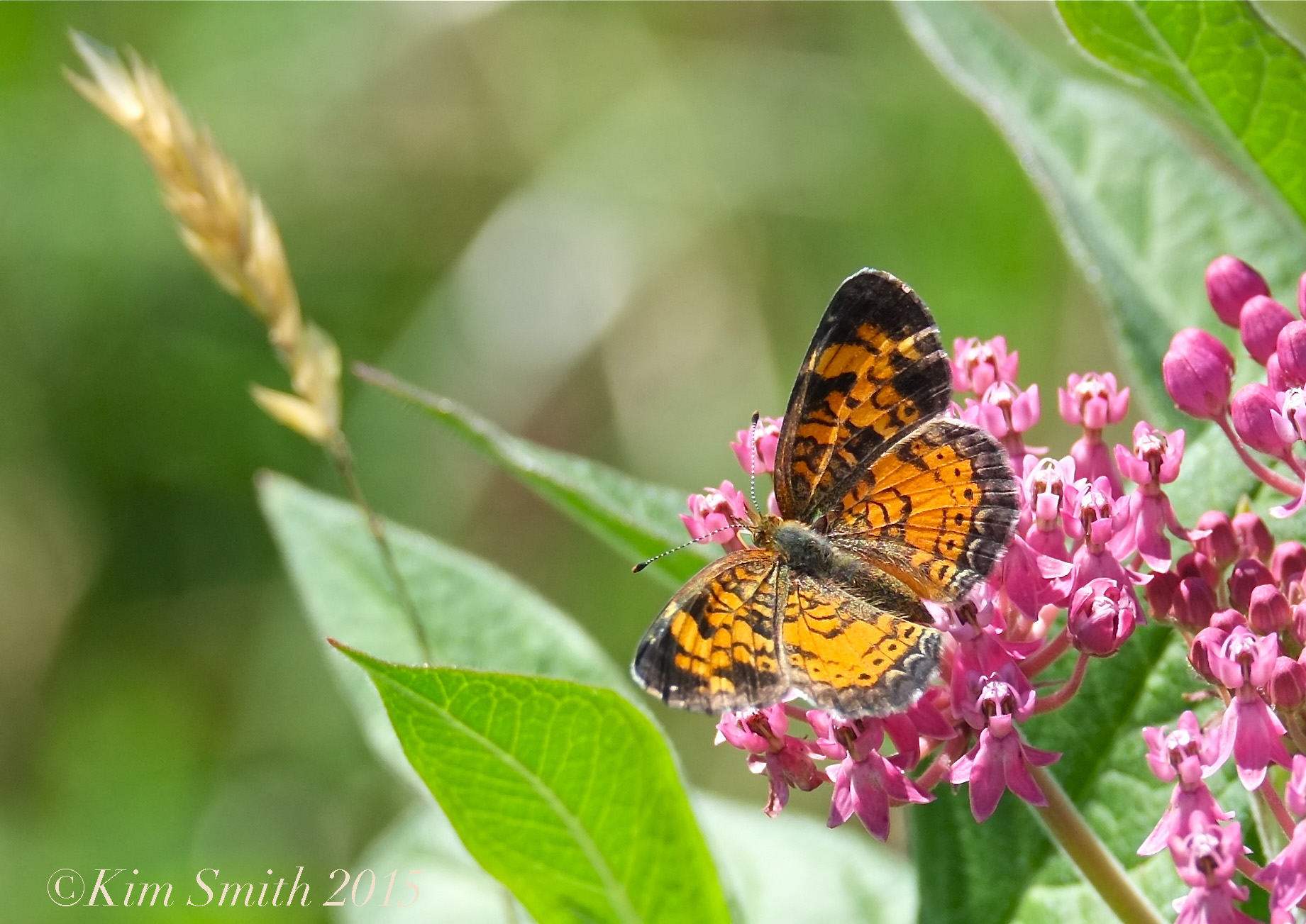 Female Pearl Crescent Nectaring at Marsh Milkweed
 Common Ringlet
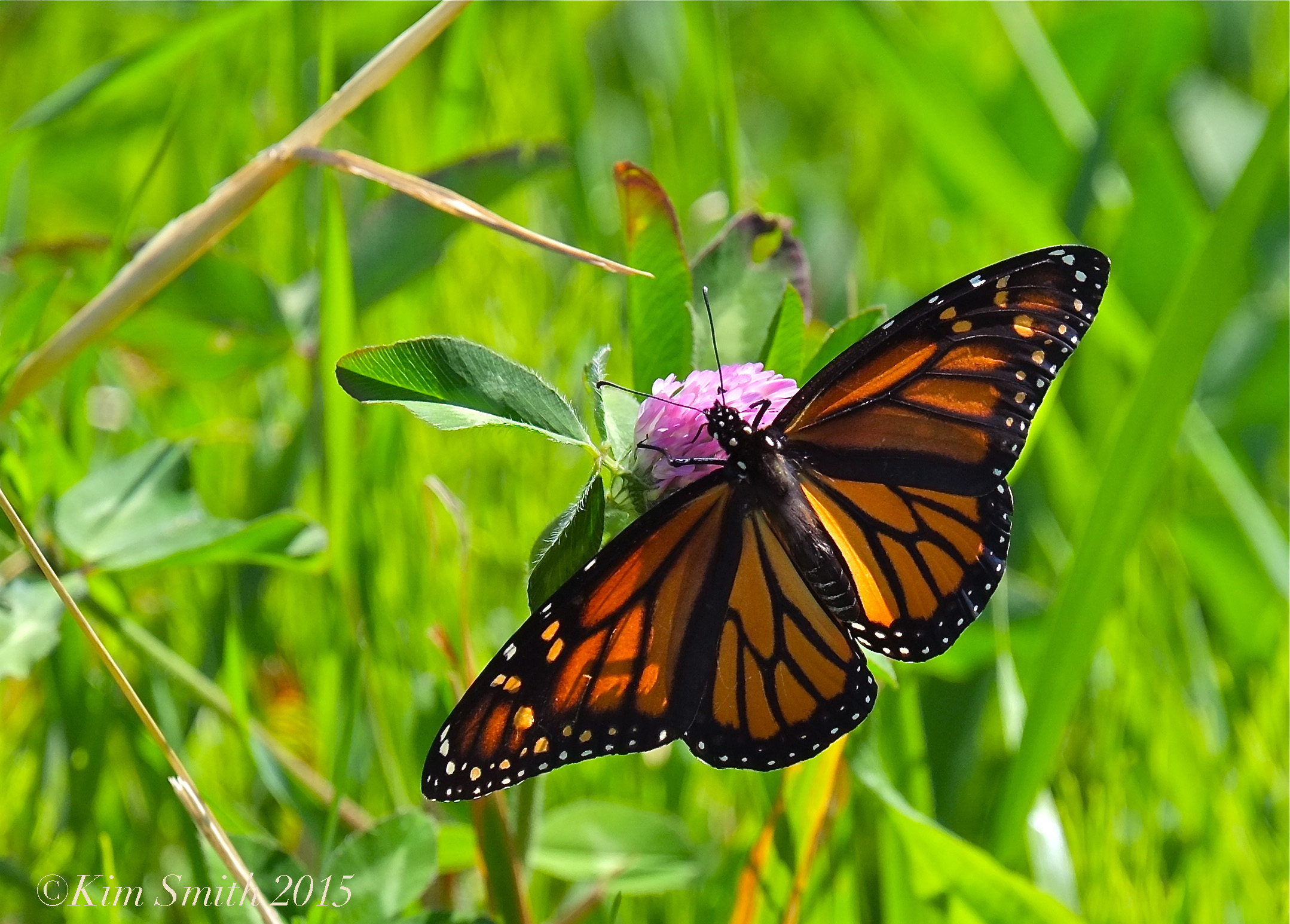 Newly Emerged Female Monarch Butterfly
Please email me at kimsmithdesigns@hotmail.com or leave a comment in the comment section if you have Monarch eggs you’d like to share. Thank you!
* * *
Emerging from the woods onto the sunny lower field, I startled a small herd of White-tailed Deer foraging. If you click on the photo to enlarge, you can see the male deer antlers are covered in velvet. Antlers are true bone structures and are an extension of the skull. The velvet provides blood flow that supplies nutrients and oxygen.
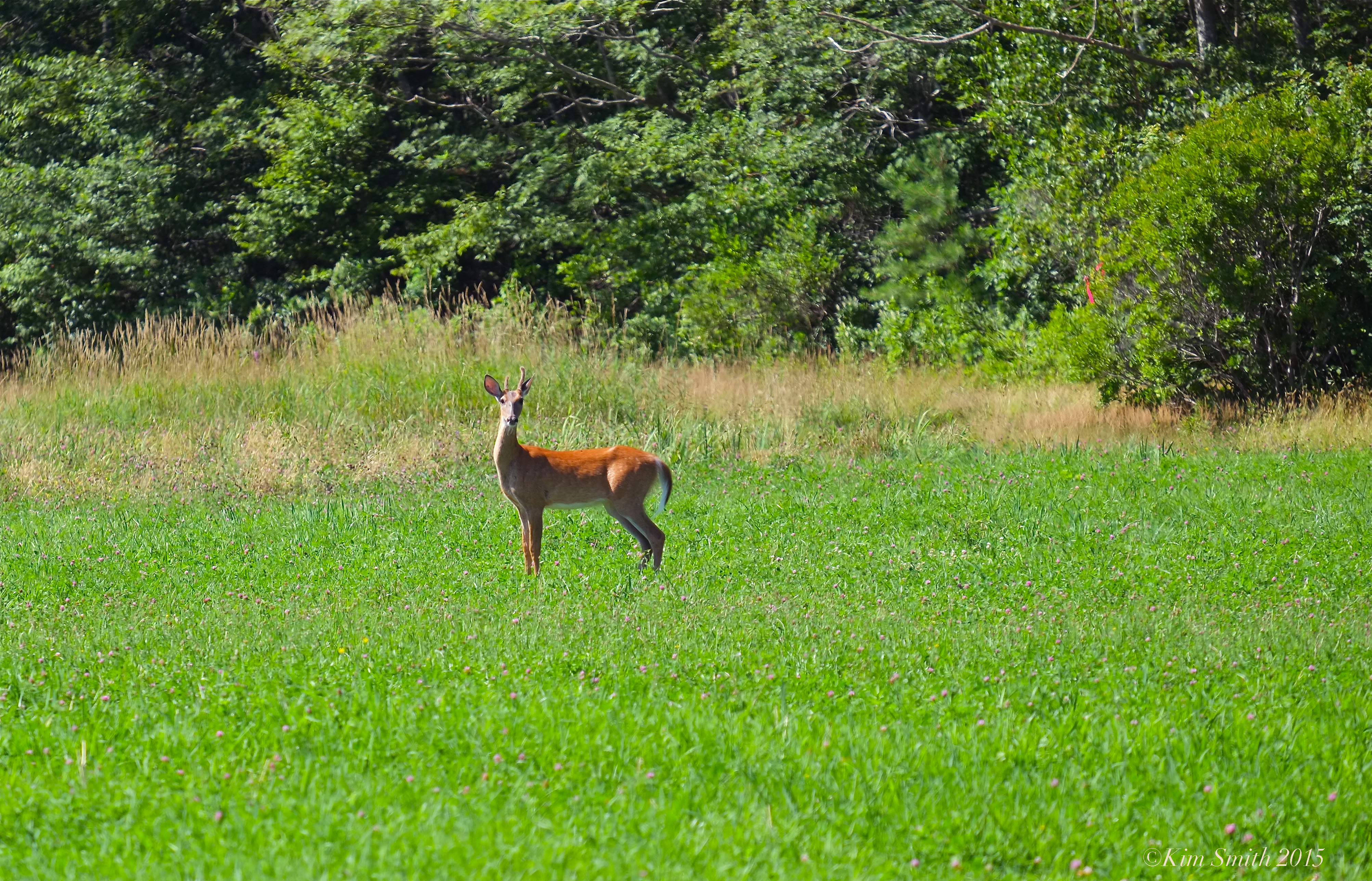 White-tailed Deer
Cape Ann Milkweed and Monarch Habitat, Eastern Point
The U.S. Fish and Wildlife Service is considering adding Monarchs as a threatened species under the Endangered Species Act. A one-year review is underway to monitor the butterfly’s status. Since the 1990s the population has plummeted from about one billion to approximately 35 million. That may seem like a substantial number, but the Monarchs need stronger numbers to be resilient to other threats such as harsh weather.
The reason for the decline is primarily because of loss of milkweed habitat in the agricultural heartland of the United States. With the development of Monsanto’s Roundup and Roundup Ready (glyphosate resistant) seed, farmers are now able to spray glyphosate directly on their corn, soybean, and sorghum crops. Roundup also destroys milkweed. Secondly, with the push for ethanol, farmers have begun to plant corn on conservation land.
If the Fish and Wildlife Service determines that the Monarchs are threatened, they will set aside land for milkweed.
You can read more about the the Monarch Butterfly Endangered Species Act here:
FAQs on the Monarch Butterfly Endangered Species Act Petition
 Monarch Butterfly Drinking Nectar from Native Wildflower Joe-pye Weed
You can learn more about the Monarch migration and the loss of Monarch habitat from Professor Tom Emmel here ~
When watching, know that the first two minutes of the film were shot in Gloucester. I think you will be dazzled by the sheer numbers of Monarchs that travel through Cape Ann’s backyards and meadows during the peak of migration.
I began photographing the Monarchs in 2006, which was a year when we had an extraordinary number of Monarchs visiting our shores. At that time, I became determined that if ever again this phenomenon were to occur on Cape Ann, I was going to have the ability to document on film, rather than only through still images, this beautiful event for my community. It’s hard to imagine without observing and here you can see what I have wanted to share.
A Flight of Monarchs begins on a September day as first one and then passels of Monarchs begin to arrive to the fields and meadows of Cape Ann, carried across Massachusetts Bay on a tailwind. By the early evening light they begin to pour into the surrounding trees, clustering to stay warm in the branches furthest away from the prevailing breezes. The following morning as the sun begins to touch their wings, they alight from the trees, seeking the freshest wildflowers from which to drink nectar to help build their lipid reserves for the several thousand mile journey south. They drink and drink until the last of the sun’s rays dip below the tree line. As they arrived on a tailwind, they again depart, and are carried to the next gathering area. For coastal Monarchs, Allens Pond, which is located in Westport, Massachusetts is often the next stop.
In the next scene, the butterflies have arrived to the sacred oyamel fir forests of Angangueo, Michoacán, deep in the heart of the Trans-Mexican Volcanic Belt. It’s early morning and the butterflies are suspended in great primordial branched clusters that may become so heavy from the weight of so many butterflies the boughs of the trees bend to the breaking point. Later in the day, as the sun begins to warm their wings, the butterflies begin to stir. During the winter, it is imperative that the Monarch’s body temperature remains relatively low. They leave the sunniest branches in search of shade and a drink of water from nearby mountain streams. Occasionally in late February, as the air temperatures begin to warm with the coming springtime, for a short period during the day, the butterflies leave the trees all at once. This phenomenon is called a butterfly “explosion,” and is a truly magnificent event to observe.
A Flight of Monarchs is set to the evocative and tender “Fields of Blue,” written and performed by composer and guitarist Jesse Cook and his band, to which permission was granted by the artist for the purpose of this short film. Here is a link to Cook’s website. I highly, highly recommend attending a live performance of Jesse Cook and Company. As was I, you will be completely taken by their gorgeous music, exquisite artistry, and with Cook’s songwriting, will travel in beautiful melodies inspired from around the world.
I am currently editing my feature length documentary, Beauty on the Wing, which after months and months of organizing and editing three years of footage, is currently running at approximately twelve hours in length. At eleven hours too long, I have a great deal of editing to accomplish in the coming winter months!
A Flight of Monarchs presented here is the shorter version of the film that I created for the Berkshire Museum’s “Butterflies” exhibit. The first version is six minutes long and played on a continuous loop in the main gallery of the exhibit hall. The longer version will soon be posted on Vimeo.
April 14, 2014
President Barack Obama The Honorable Tom Vilsack, Secretary of Agriculture The Honorable Sally Jewell, Secretary of the Interior
Dear Mr. President, Mr. Secretary of Agriculture, and Madam Secretary of the Interior,
In light of the severe decline of both the eastern and western monarch butterfly populations that has occurred since the late‐1990s, we are writing to ask you to establish a multi‐agency monarch butterfly recovery initiative to restore the habitats that support the extraordinary migrations of this iconic species. We encourage you to direct the Natural Resources Conservation Service (NRCS), Farm Service Agency (FSA), and Forest Service (USFS) of the U.S. Department of Agriculture and the Fish and Wildlife Service (USFWS) and Bureau of Land Management (BLM) of the U.S. Department of the Interior to develop a cooperative, landscape‐ level initiative with the many stakeholders willing to help foster significant monarch recovery.
These migrations can be saved for future generations by restoring to the landscape milkweeds, the host plants for monarch caterpillars, and nectar plants that sustain the adult butterflies. These habitats would support pollinators and a large number of other species as well. The federal agencies that incentivize conservation of wildlife habitat on private lands and that directly manage wildlife habitat on public lands can play key roles in this effort by targeting funding and technical support for such an initiative.
As you know, the eastern monarch population has been declining for more than a decade, and this year scientists observed the lowest numbers ever documented, representing a 90% drop from population numbers recorded in the mid‐1990s. Since then, there has been a significant loss of milkweeds in agricultural areas of the Midwest, which is directly correlated with the declining monarch population. Monarch habitat has also declined sharply in the West.
 Paul Mirocha Illustration for Monarch Watch
A landscape‐level monarch butterfly recovery initiative led by the NRCS and FSA on private lands would incentivize the planting of native milkweeds and butterfly nectar sources in places that are protected from pesticide and herbicide use.
 Beauty on the Wing