Tag Archives: Monarch Butterfly (Danaus plexippus)

MONARCH EGGS UPDATE

Dear Friends,

There has been more interest than anticipated in Monarch eggs. Thank you to everyone for writing!

At present, Jane has over 100 caterpillars in her kitchen terrariums. These will become butterflies within the month, and each female that emerges will lay between 300 to 700 eggs. I’ve compiled a list of everyone who left a comment. We are thrilled and grateful readers are so interested in helping raise Monarchs this summer. I will contact all as soon as Jane has a new batch of freshly laid Monarch eggs.

In the meantime, I am going to type up some FAQs. I also suggest using a glass rectangular fish tank/terrarium, with a fitted screen top, for rearing the caterpillars. If you don’t have one, they are available at our local pet stores. Also, a package of cheese cloth. Along with a plentiful supply of milkweed, that’s all you will need.

Thank you again and we’ll be in touch. ❤

HOME FROM BEAUTIFUL MEXICO AND FILMING THE MAGNIFICENT MONARCHS AT CERRO PELON!

https://www.instagram.com/p/BuzarKoHM3m/

My husband Tom and I returned from filming Monarchs in Mexico very late Monday night. The first day back was pasta making for Saint Joseph Day at the Groppos and spending time with our son Alex and granddaughter Charlotte. Yesterday and today I’ve been pouring through the footage to add to the film. I’ll write some posts about beautiful Mexico, the fantastic JM Butterfly B and B, and the magnificent Monarchs as soon as I have time to sort through the photos. It was an adventure of a lifetime!

https://www.instagram.com/p/BuzbLSGngGn/

I was most worried about torturing Tom and wasn’t entirely sure we would have uninterrupted internet access so he could work remotely, but he had the best time meeting new people, riding horses up the mountain, climbing Cerro Pelon, and practicing his Spanish!

https://www.instagram.com/p/Buzv5WxnJJm/

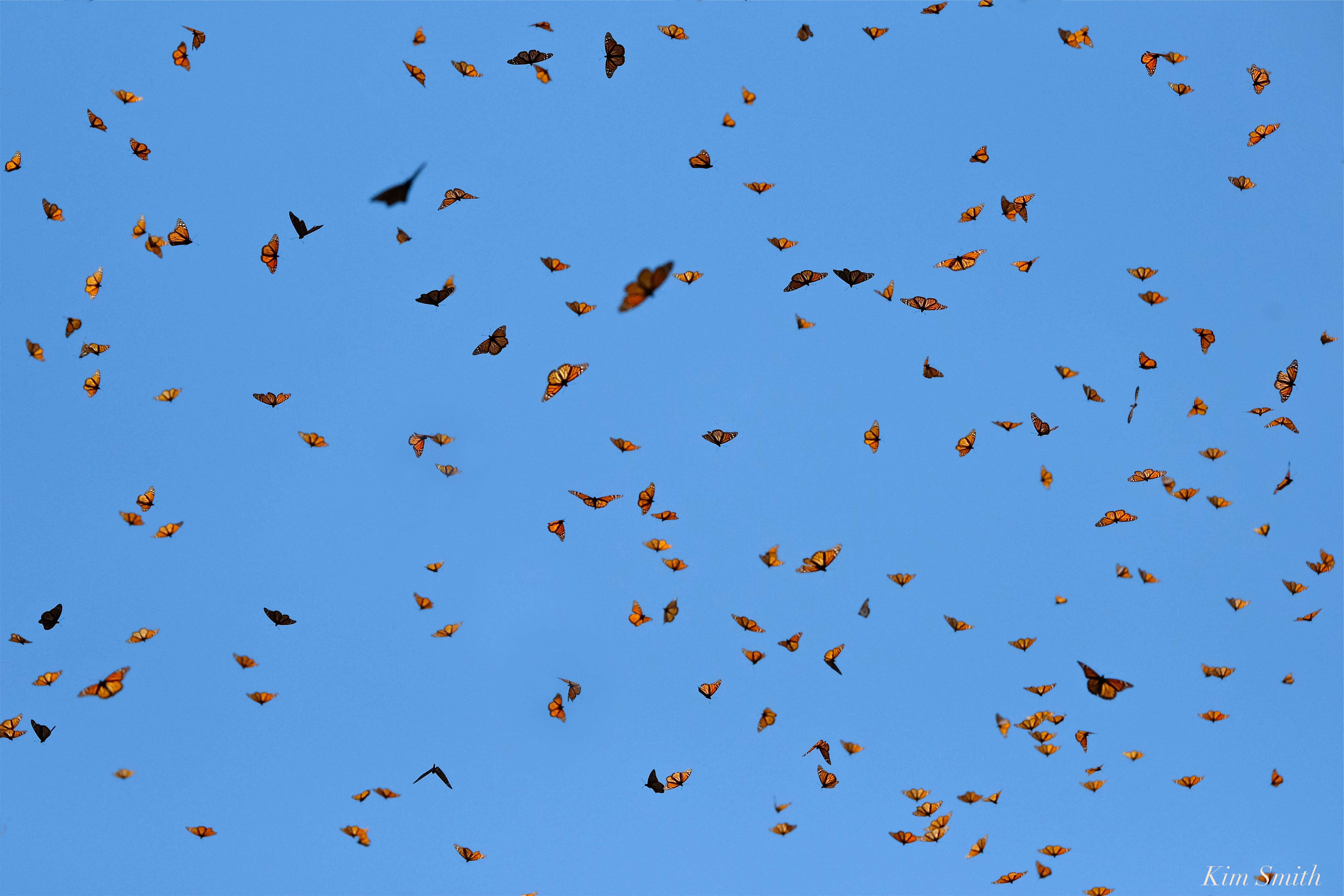
Monarch flakes fill the sky 

Film Update

HAPPY NEW YEAR!

 Dear Friends,

I have so much to be thankful for – my family, friends, work, film projects, and all of you for your generous donations to the documentary Beauty on the Wing: Life Story of the Monarch Butterfly.

 If we’ve spoken recently, then you know that over the past months I have been adding new scenes, from the Monarch migration of 2017, and from our most recent beautiful fall migration of 2018. This past week we screened the film for my two amazing producers Lauren and Susan (they both loved it and provided excellent feedback!). In the coming weeks the film next goes to an audio engineer and to a film “finisher,” with the goal of having a final cut in hand by the end by spring. I’ll be sending updates more frequently now that the project is beginning to spread her wings.

My sincerest thanks to you for being part of the wonderful journey of Beauty on the Wing.

Wishing you much love, joy, and beauty in the coming year.

Kim


Salem State University Keynote Speaker Kim Smith Spotlights Plight of the Monarch Butterflies

Salem State keynote spotlights beauty, plight of monarch butterflies

Smith, who spoke on campus Thursday, April 12, makes nature films and contributes to the daily blog Good Morning Gloucester. She also helps communities and individuals build gardens specifically aimed at attracting butterflies, bees and beneficial bugs.

On behalf of the Earth Days Planning Committee, Carol Zoppel, a campus librarian and co-chair of Earth Days Week, presented Smith with the Friend of the Earth Award.

“Salem State University’s Earth Days committee would like to recognize Kim Smith for her artistic and advocacy work on behalf of wildlife through her films, photo, gardens, and writings,” said Zoppel. Smith received her award and a framed poster of her program.

READ COMPLETE ARTICLE HERE


…Smith also reflected on our involvement with these creatures.

“I think compassion for all living creatures is really important,” said Smith. “Right here in our own backyards and beaches we have small winged creatures like Monarchs and Piping Plovers that are struggling to survive.”

She added, “Our actions and how we chose to live our lives has tremendous impact.”

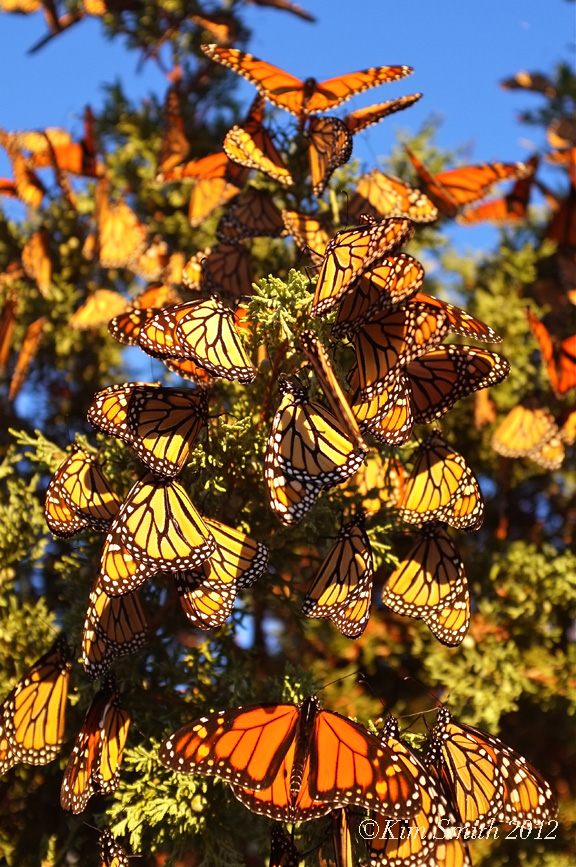
Monarch Butterflies Dawn Awakening Gloucester MAssachusetts

WHEN A WEED IS NOT A WEED and Why Joe-Pye is So Darn Lovable!

A bodacious beauty possessing the toughest of traits, Joe-Pye Weed (Eutrochium) is the stalwart star of the eastern native plants garden. Large, airy dome-shaped flowerheads blooming in a range of shades from pink to lavender to purple provide food, by way of nectar, foliage, and seed heads to myriad species of bees, butterflies, and songbirds. Beginning in mid-July and continuing through mid-October, pollinators on the wing can find sustenance in a garden planted with Little Joes and Big Joes.

Joe Pye, the person, is thought to have been a North Carolina Native American medicine man who used these wildflowers to cure many ailments, including typhoid fever. The plants became know as Joe Pye’s weed.

A name changer from weed to wildflower would be a game changer for numerous species of native plants. Why do so many native wildflowers have the suffix weed? Because when the colonists arrived from Europe, they wanted their crops, as well as European cultivated flowers, to grow in their new gardens. Anything native that interfered with their plans was deemed a “weed.” Examples of beautiful and invaluable North American native pollinator plants with the name given weed are milkweed (Asclepias), sneezeweed (Helenium), ironweed (Veronia), and jewelweed (Impatiens capensis).

Three favorite and fabulous species for the New England landscape are Eutrochium purpureum, E. maculatum, and E. dubium. Joe-pye grows beautifully in average to moist soil, in full sun to light shade. Plant Joe-pye in the back of the border. E.purpurem grows five to seven feet tall, while Little Joe grows three to five feet. With their beautiful blossoms, robust habit, winter hardiness, and disease resistance, these long blooming members of the sunflower family are treasured for their ability to attract an array of butterflies, bees, and songbirds to the garden during the mid- to late-summer season.

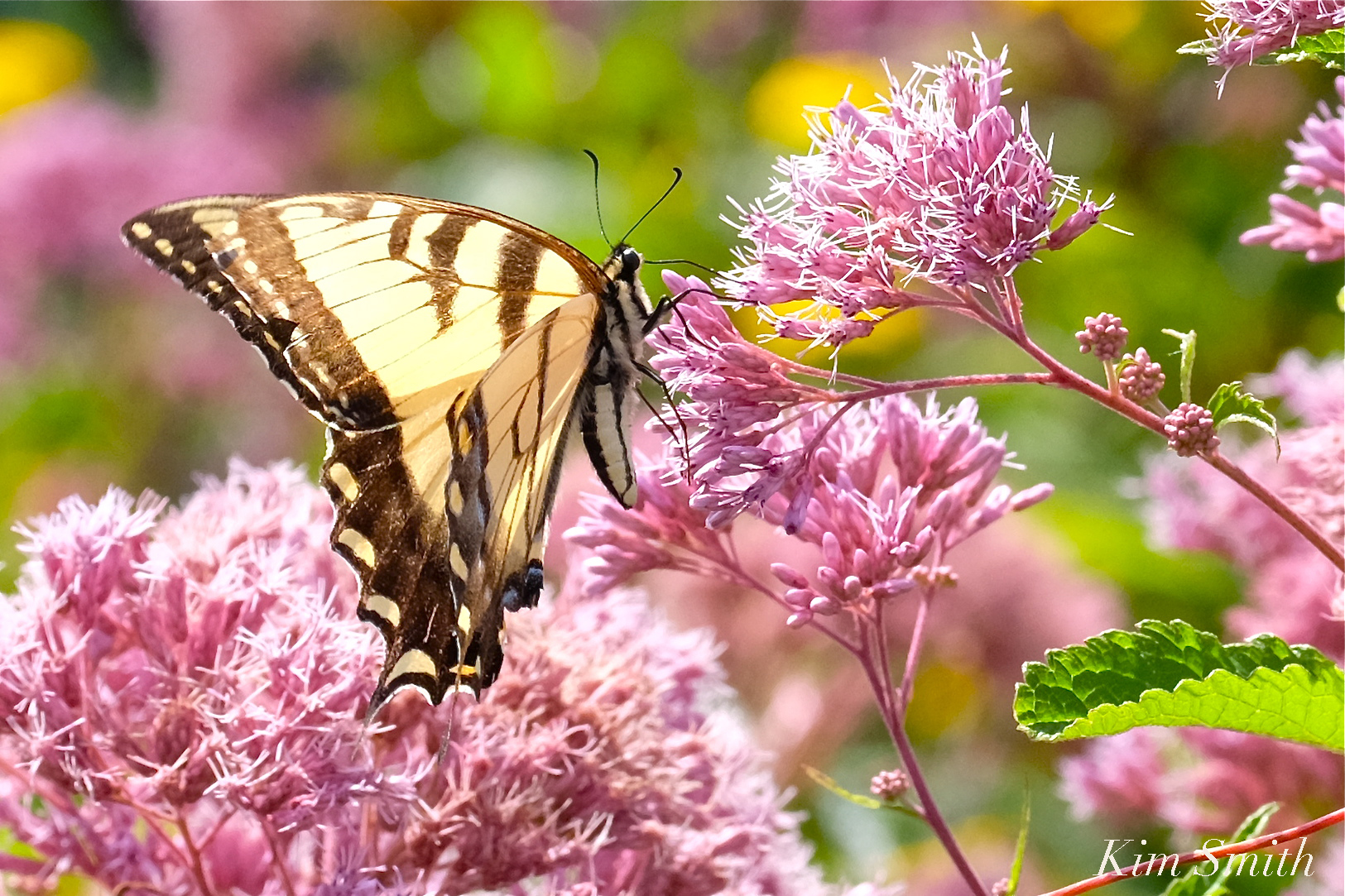
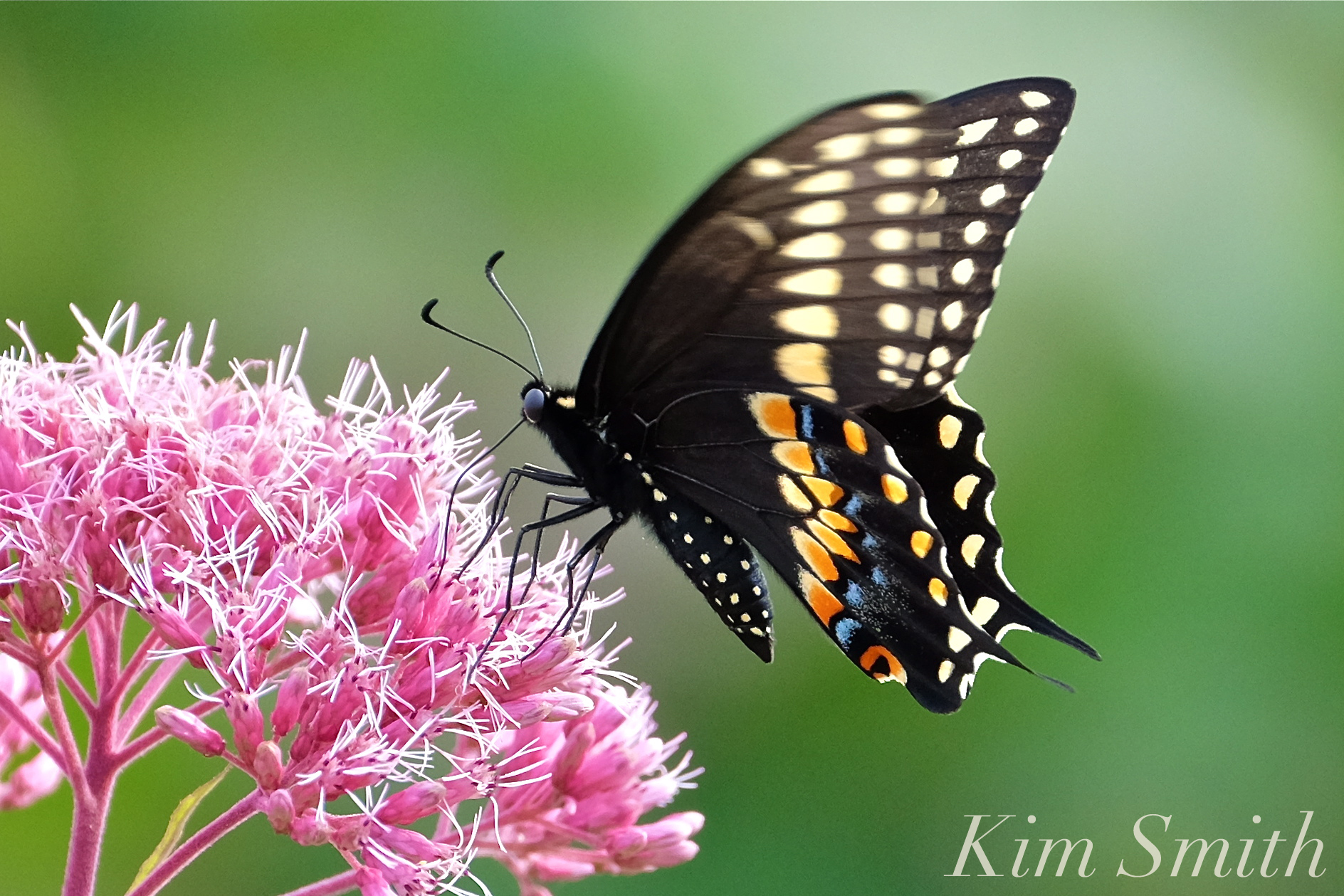
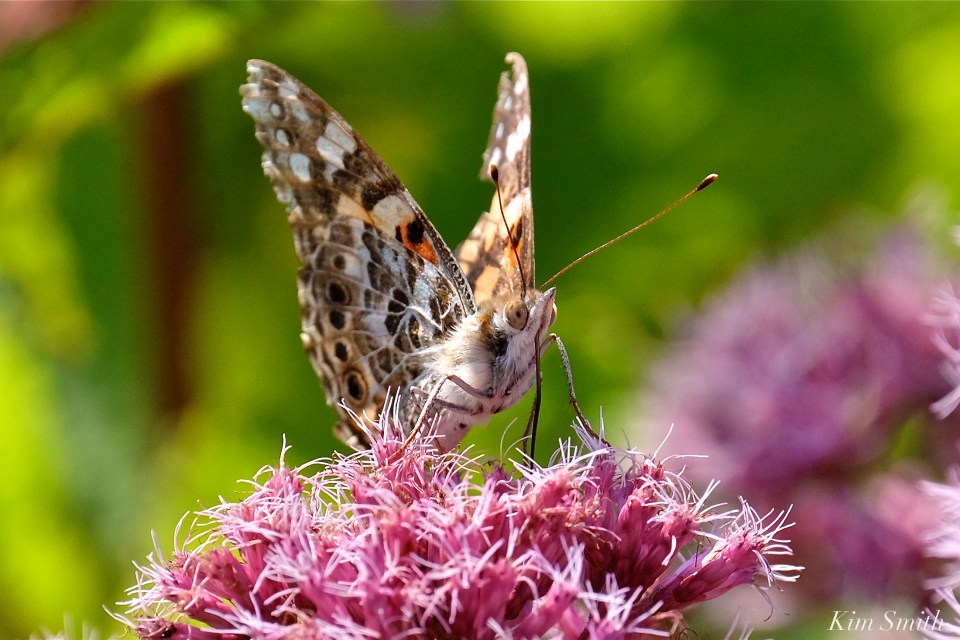
Just look at this sampling of the different species of Lepidoptera finding noursihment from the blossoms of Joe-pye!

Tiger Swallowtail

Painted Lady

Black Swallowtail

Monarch

Joe-Pye does especially well in a coastal native plants garden.

PATTI’S CATTIES AND OTHER TALES FROM THE PAPOWS BEAUTIFUL GARDEN

My friend Patti Papows very thoughtfully invited me to come film and take photos in her gorgeous garden, especially her milkweed patch. Patti purchased milkweed plants from our Cape Ann Milkweed Project several years ago, both the Common and Marsh Milkweed that we offered.

Patti’s Common Milkweed has really taken off this year. The plants are about five feet tall, lush and healthy, and bursting with sweetly fragrant blossoms. The Monarchs are daily visitors, coming not by the ones and twos, but by the dozen. Not only are her milkweed blossoms beckoning to the Monarchs, but the plants are also attracting every bee species imaginable found in a Cape Ann garden, as well as myriad other pollinating insects.

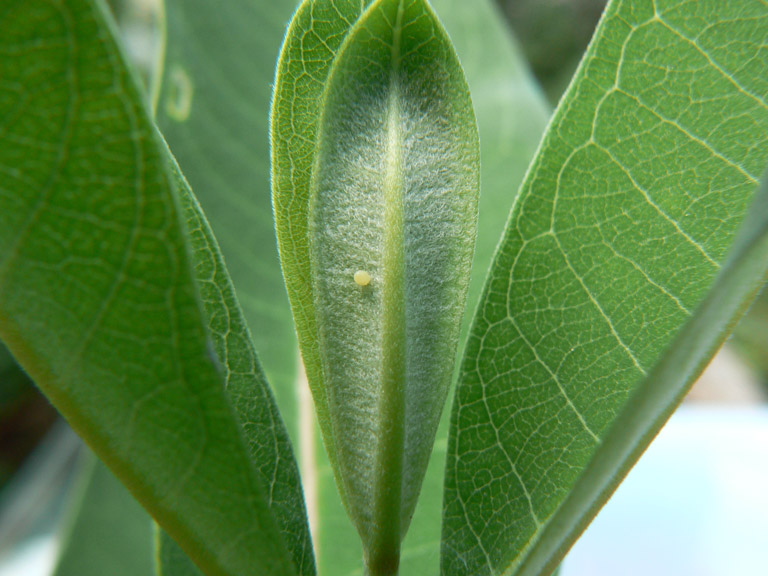
I showed Patti how to find Monarch caterpillars. She found three in about three minutes; we weren’t even trying that hard! They are safer from spiders in my terrariums, so I brought her tiny caterpillars home where they are developing nicely alongside a dozen Monarch eggs. These eggs were discovered in my garden, and at the Common Milkweed plants growing along the edges of the Good Harbor Beach parking lot.

https://www.instagram.com/p/BW7y-ywl3kb/
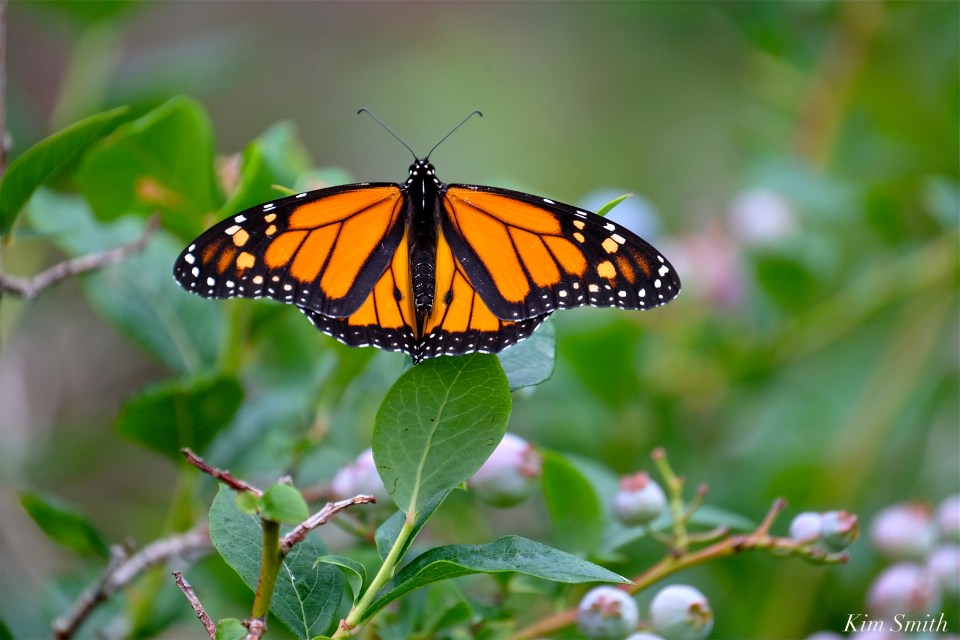
 

Patti’s patch of native high bush blueberries attracts loads of Catbirds, and dozens more species of songbirds and small mammals. This morning the foliage made a perfect perch for a male Monarch butterfly.

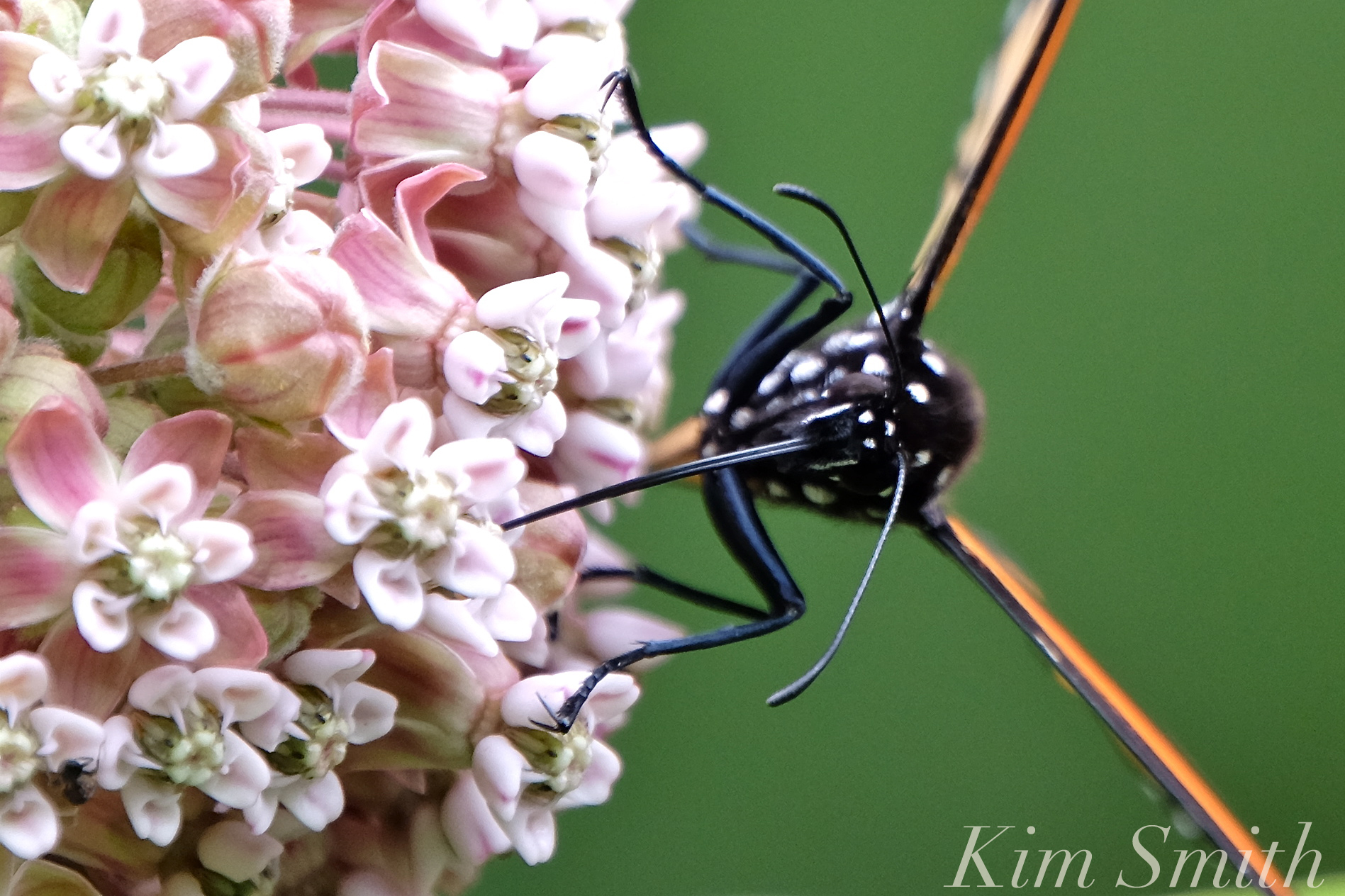
In the above photo you can clearly see the Monarch’s two-part tubular drinking straw, called a proboscis. The Monarch is probing deep into the Milkweed floret for a sip of sweet nectar.
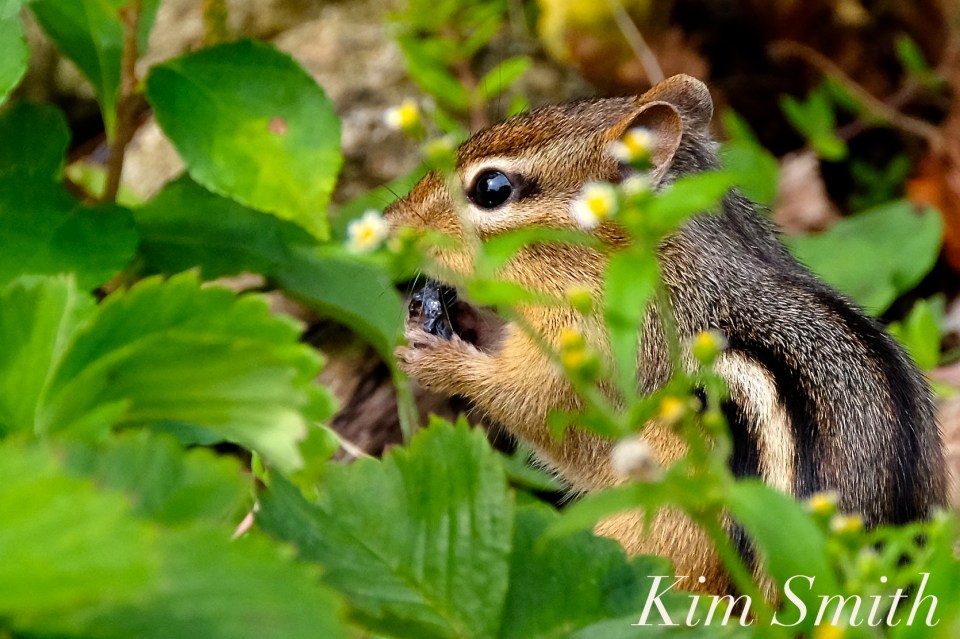
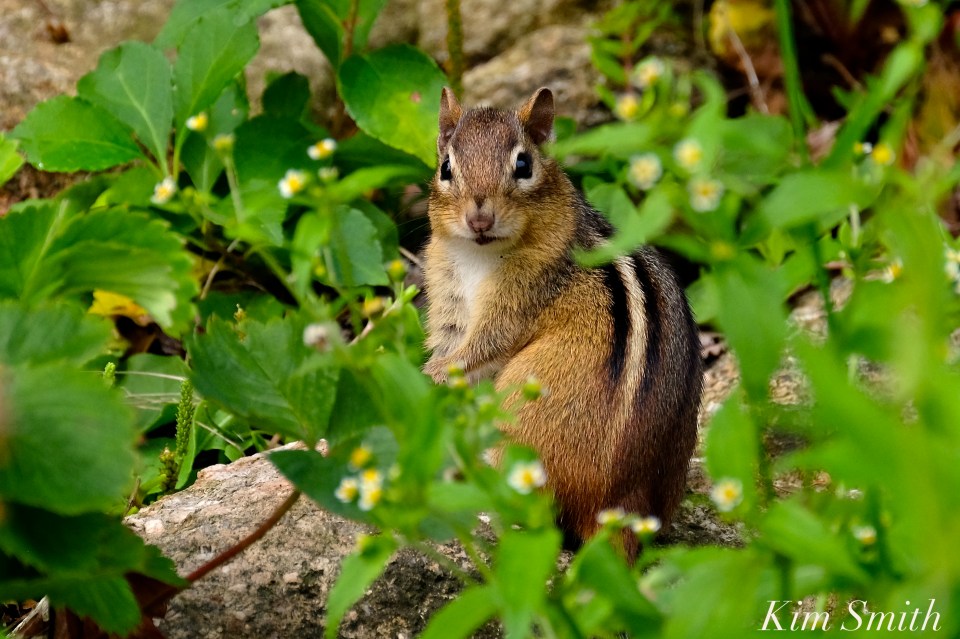
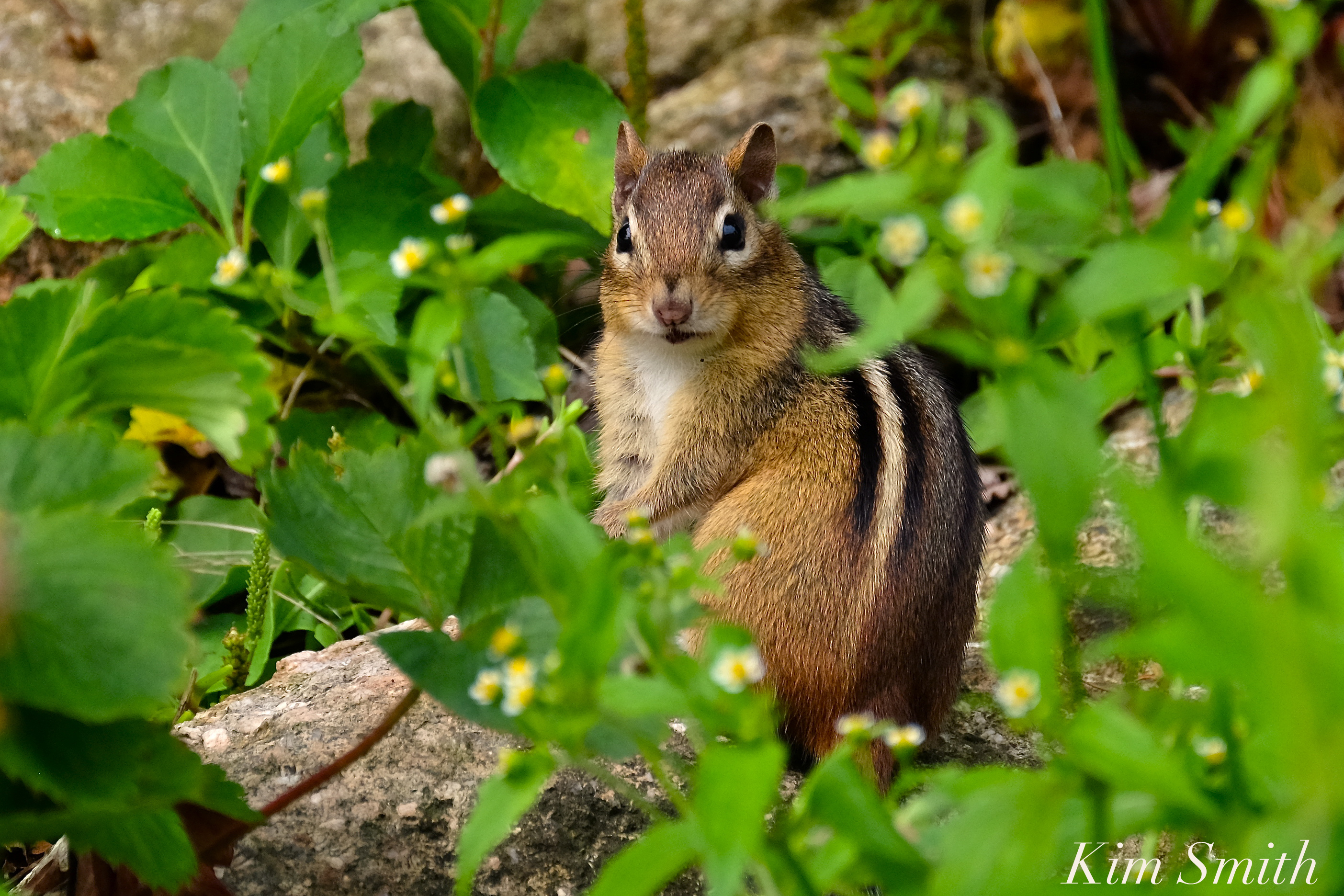
Who, me? I’m innocent! Chipmunk snacking at the buffet-of-plenty in Patti’s garden. 

Patti placed the purple chair in the midst of the milkweed patch so that visitors can enjoy being surrounded by the beautiful pollinators buzzing all around and the delightful fragrance emitted by the Common Milkweed. I tried it out and her plan worked, it is pure Heaven!
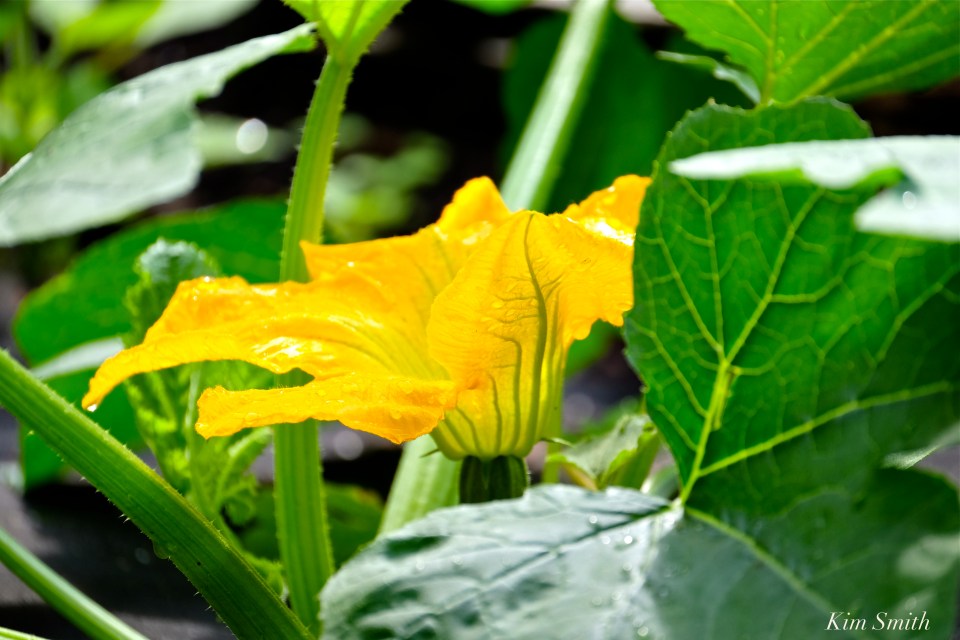
I had an absolutely wonderful morning filming and photographing, despite the limiting overcast skies, and plan to return on a sunnier day, hopefully this week while the Monarchs are here on Cape Ann busy egg-laying and pollinating our gardens!


Save the Date for My Upcoming Program “Beauty on the Wing: Life Story of the Monarch Butterfly”

On Thursday, May 4th at 7pm, I am giving my lecture with photos, “Beauty on the Wing: Life Story of the Monarch Butterfly,” along with several short film screenings, for the Salem Garden Club. For more information, see the events page of my website. I hope to see you there!

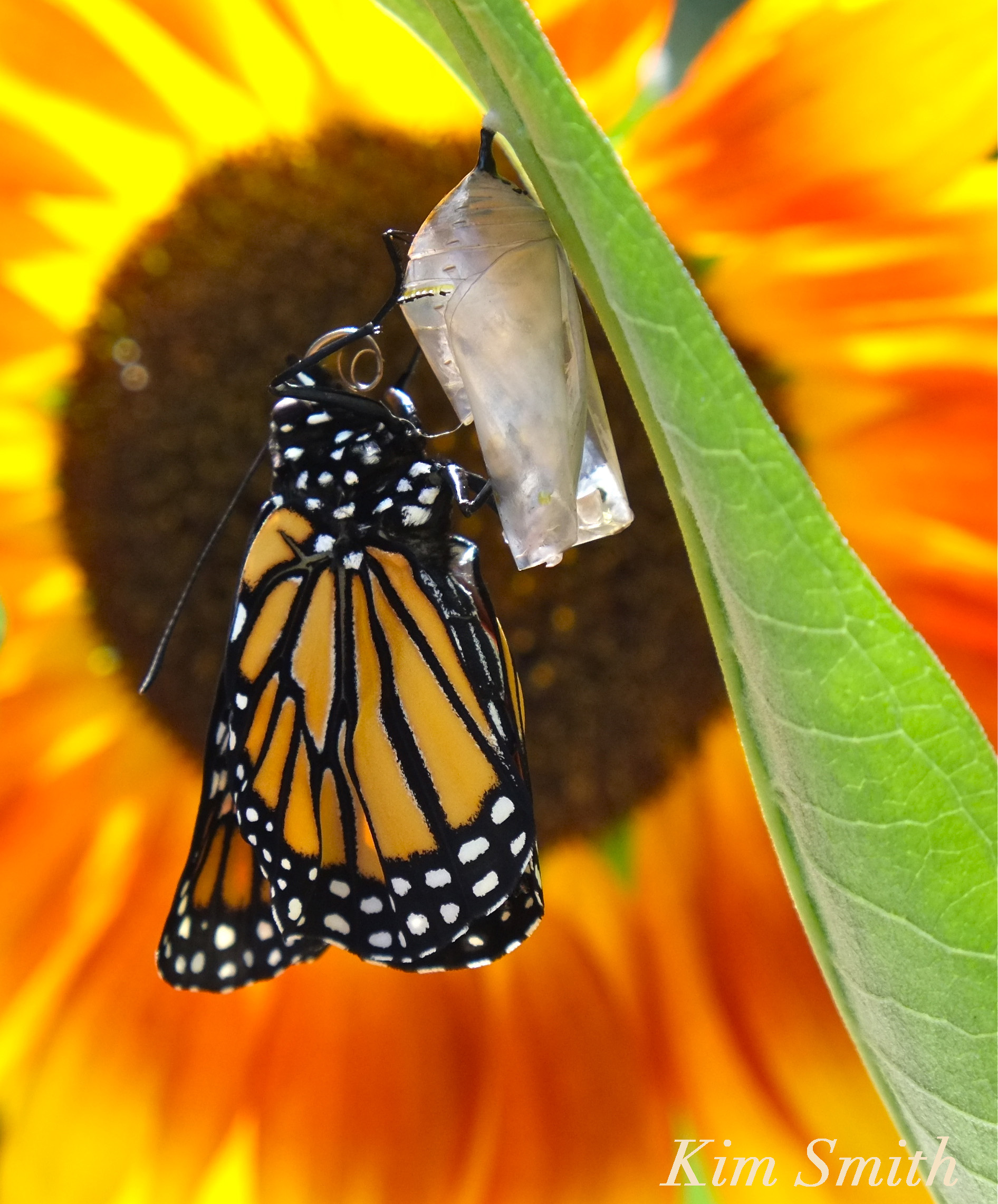
Newly Emerged Monarch Butterfly and Sunflower, Gloucester

Beauty on the Wing ~ Life Story of the Monarch Butterfly

The Monarch’s life story is one of nature’s most incredible examples of adaptation and survival. But the Monarch migration is in great peril. Learn how you can help. Through photographs and discussion, Beauty on the Wing tells the life story of the Monarch Butterfly, the state of the butterflies migration and why they are in sharp decline, and the positive steps we can take as individuals and collectively to help the Monarchs recover from the devastating effects of habitat loss and climate change.  (1-1.5 hours).

Monarch Butterfly Chrysalis and Marsh Milkweed

Monarchs Awakening

MONARCHS WEAPONIZE MILKWEED TOXINS

Monarch Caterpillars Eating Common Milkweed ©Kim Smith 2012JPGMilkweed Munching Monarchs

Although scientists have long known that the toxic sap that flows through milkweed veins, called cardenolides, can make a bird very sick if it attempts to eat a Monarch caterpillar, it was unclear whether the butterfly’s acquired adaption to the toxicity was a side effect that allowed the caterpillar to eat the milkweed or had developed separately as a defensive mechanism against predators. A Cornell University study recently published in Proceedings B of The Royal Society Publishing reveals that they have indeed evolved to weaponize milkweed toxins! Thank you so much to Maggie Rosa for sharing “The Scientist” article and you can read more about it here. 

“Monarch butterfly caterpillars have evolved the ability to store toxins known as cardenolides, obtained from their milkweed diet, specifically to make themselves poisonous to birds, as has at least one other species of milkweed-munching caterpillar, according to a study published Wednesday (November 4) in Proceedings of the Royal Society B.

“This finding is fascinating and novel,” Stephen Malcolm, a professor at Western Michigan University who studies cardenolides but was not involved in the new research, wrote in an email to The Scientist. “It is exciting to have evidence for the importance of top-down influences from predators.” Continue Reading

Please join me Thursday evening, November 12th, at 7pm at the Sawyer Free Library for my illustrated talk, Beauty on the Wing ~ Life Story of the Monarch Butterfly. Looking forward to seeing you there!Meadow monarch caterpillar ©Kim Smith 2015
Meadow Anderson and Milkweed Caterpillar

SAFE TRAVELS MONARCHS!

Cape Ann Monarch Butterfly Migration Update

Monarch Butterfly bougainvillea ©Kim Smith 2015Female Monarch and Bougainvillea

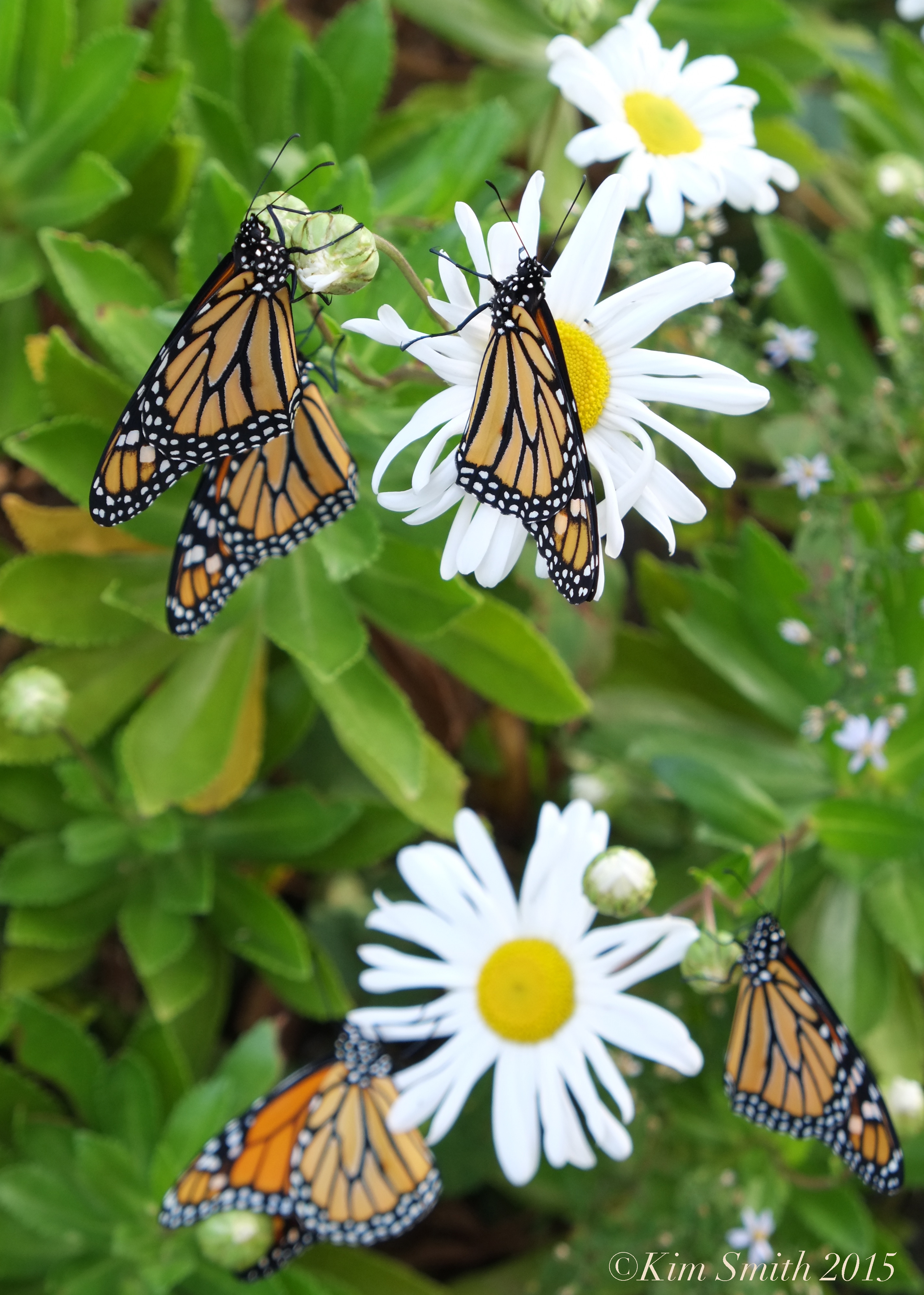
Monarch Butterflies Daisies ©Kim Smith 2015Methuselah Monarchs Heading to Mexico

Our last batch of Monarchs emerged from their chrysalides, dried their wings, and caught the tailwinds to Michoacán. I hope they arrive to their winter roosting sites at the trans-Mexican volcanic mountaintops safely!
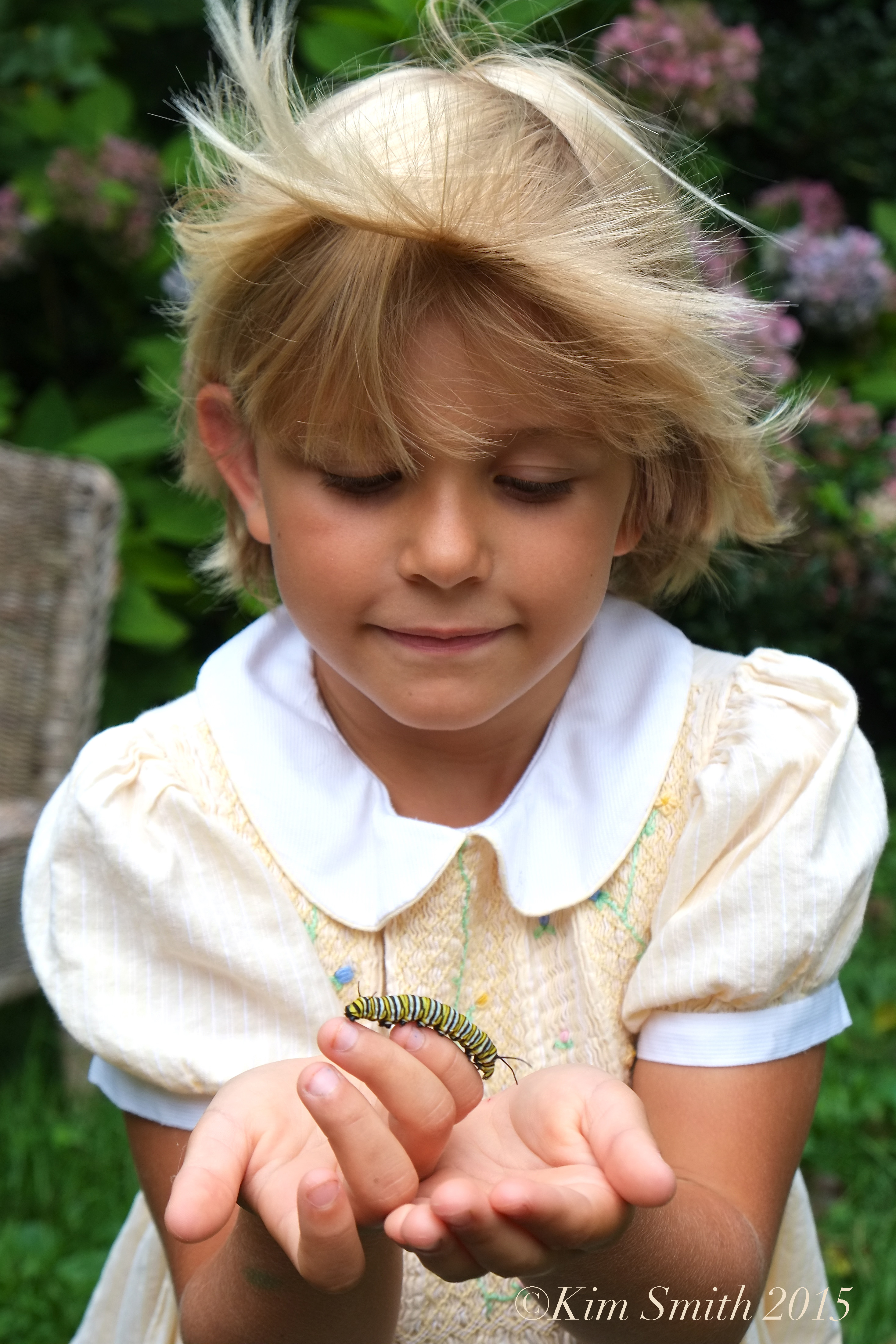
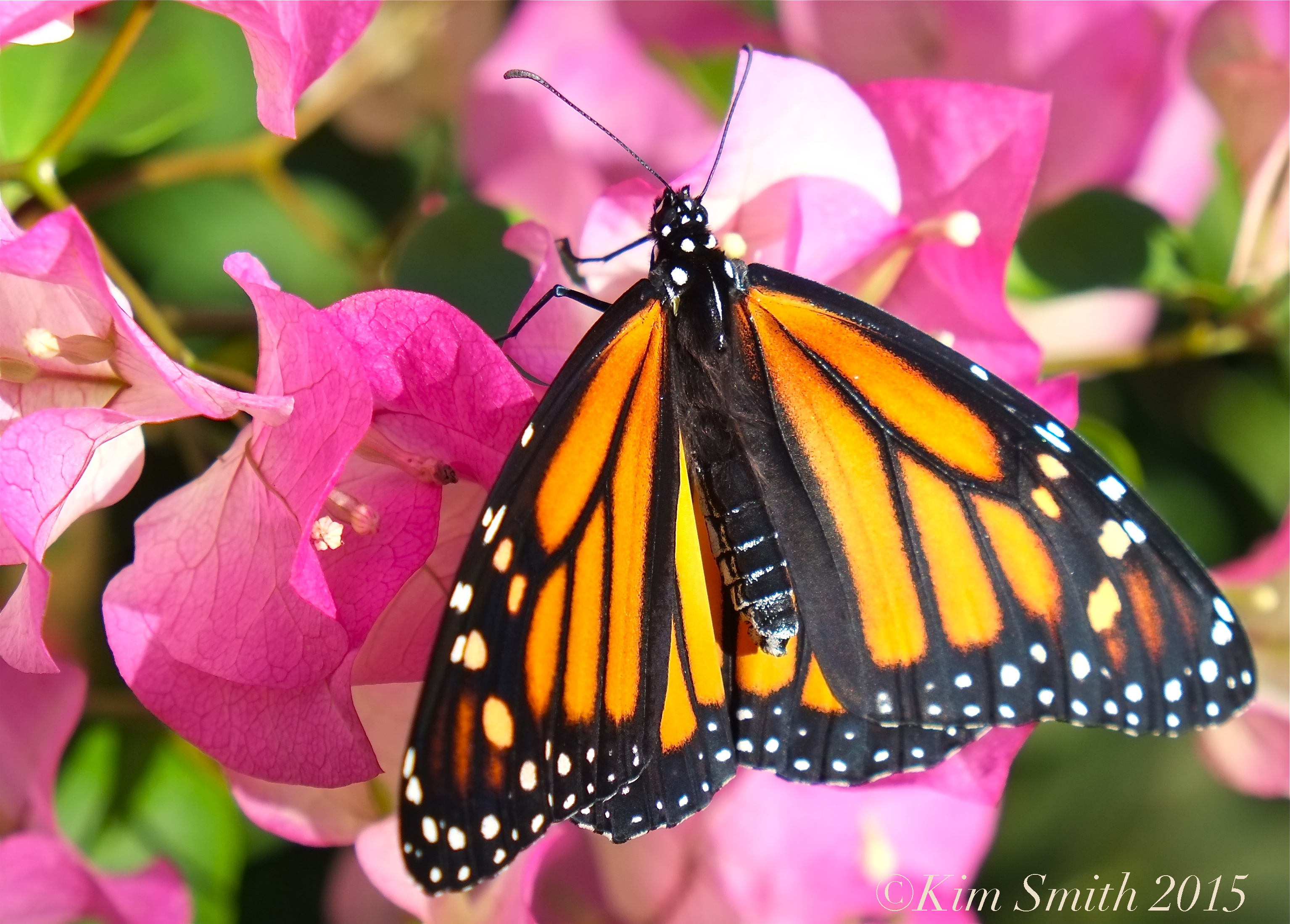
Although not many migrating Monarchs were reported on the shores of Cape Ann, a great batch was seen migrating over Lake Erie in late summer. Cape May, which is 400 miles south of Cape Ann, also had a strong showing. Keep on the lookout though because on Election Day in 2007, I photographed a Monarch refueling at Korean Daisies.

The Monarchs are counted by the Mexican scientists in December and the numbers released in January. Last year a tiny increase from 2013 was noted (2013 was the year the lowest numbers were ever recorded). Lets keep our hopes up that the population will continue to improve.

Monarch Butterfly sunflower ©Kim Smith 2015Last Sunflowers of the Season

Monarch Butterfly daisy ©Kim Smith 2015Monarch Butterfly pink bougainvillea ©Kim Smith 2015