Tag Archives: Danaus plexippus

HIGHER NUMBERS GIVE HOPE FOR MONARCHS

By Kim Smith

January 31, 2019

The World Wildlife Fund Mexico and Monarch Butterfly Biosphere Reserve (MBBR) announced on January 30th that this year the Monarch Butterfly population has increased significantly.

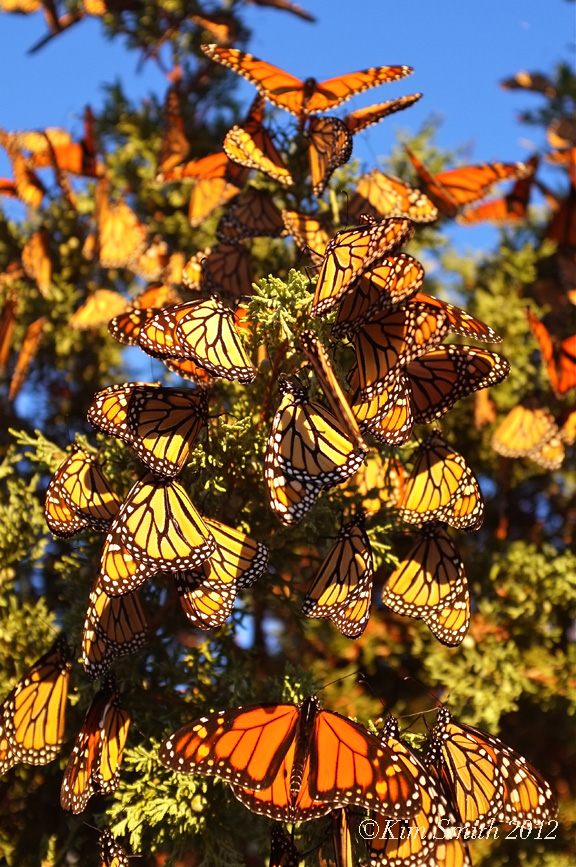
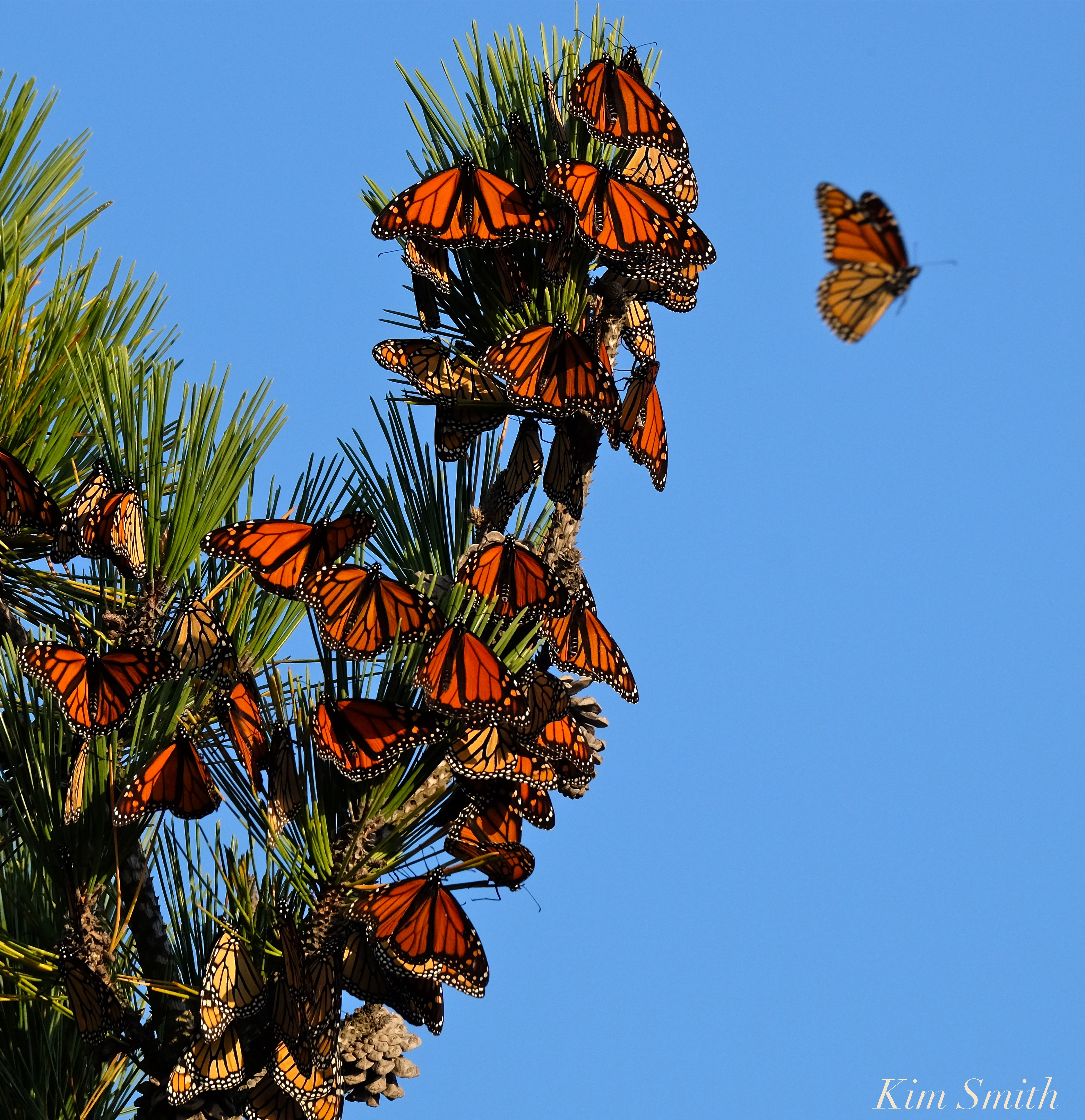
Each year the orange and black winged beauties return to the oyamel fir and pine tree forests, which are located in the heart of Mexico’s trans volcanic mountain belt. In December and January, Lepidoptera population specialists and citizen scientists measure the area the Monarch colonies cover at their over wintering sites. This year (2018-2019) the butterflies are blanketing 6.05 hectares (approximately 15 acres), up from an all-time low of only 0.67 hectares (1.65 acres) during the winter of 2013-2014.

Not since 2006-2007 has this great an area been covered by the butterflies, although the numbers are still quite low when compared to the numbers recorded in the late 1970s when the butterfly’s winter roosts were first discovered by Dr. Fred Urquhart.

I have been following the butterfly counts around the US as they were reported. The Monarch population has been decimated in California. This year only about 30,000 butterflies were counted, down from several million just two decades ago. There is the very real possibility that the Monarch butterfly will become extirpated (extinct from an area) on the West coast. The winter count is down drastically in Florida as well.

It was clear though that east of the Rockies–the Midwest and Northeast regions of the US, as well as southern provinces of Canada–there were many more Monarchs in gardens and on the wing than in recent previous summers.

Leading Monarch scientists are reluctant to become excited about the increase, and justifiably so. Last spring the weather was slightly cooler in Texas, which allowed more Monarch eggs to hatch, which in turn allowed more caterpillars to mature. A greater number of butterflies emerged and set the stage for a strong breeding season throughout the summer. That scenario, along with the overall good weather during the summer of 2018, also helped create ideal conditions. It was a true “goldilocks” summer, not too hot, not too cold, but just right.

In autumn of 2018, the Monarchs arrived to Mexico about a week later than usual, but once they began to arrive, a kaleidoscope of butterflies poured into their winter roosting grounds.

The 2018-2019 Eastern population count is a reprieve from the past ten years of heartbreaking news, but one good year does not change what the butterflies need most, which is protection for the Monarchs under the Endangered Species Act.

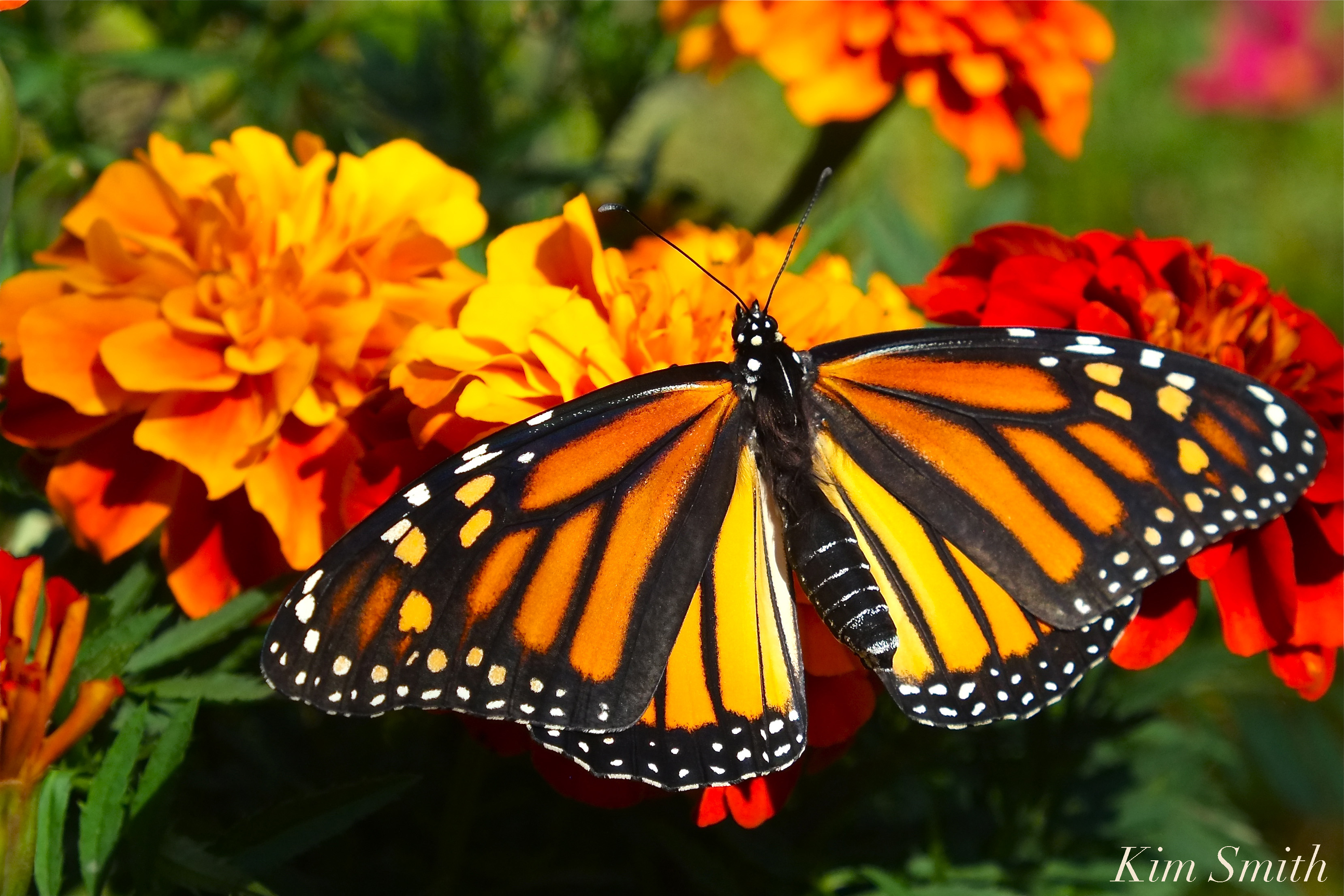
Monarch and Mexican Sunflower (Tithonia)

There is disagreement among scientists whether planting milkweed has any bearing on the health of the Monarch butterfly population. Does creating corridors of Monarch habitat help mitigate the death and destruction caused by climate change, modern agricultural practices, the devastating use of pesticides and herbicides, and the planting of GMO crops (corn, sorghum, and soybeans, for example) that were engineered to withstand the deadly poisons, but which wildflowers and caterpillars cannot?

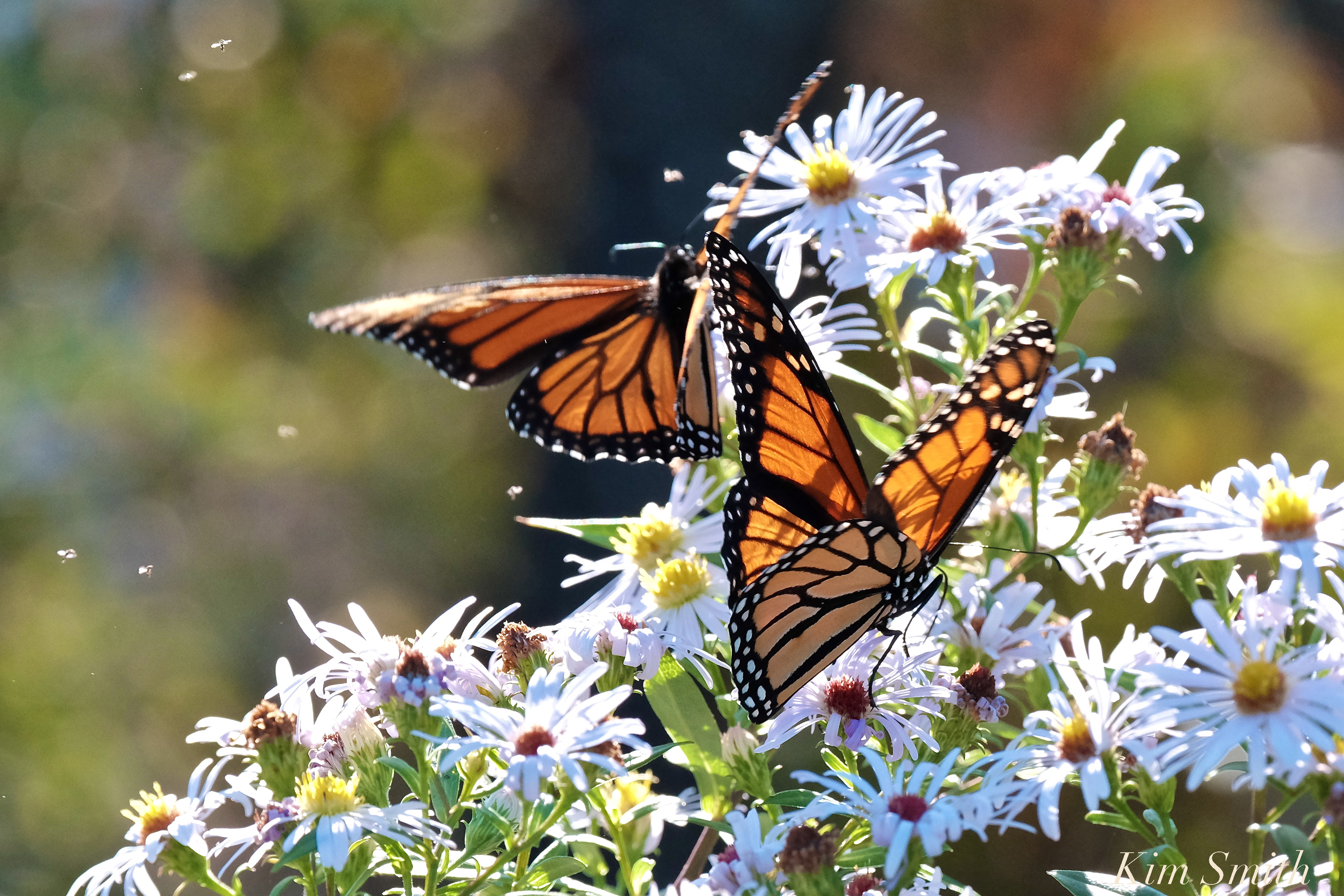
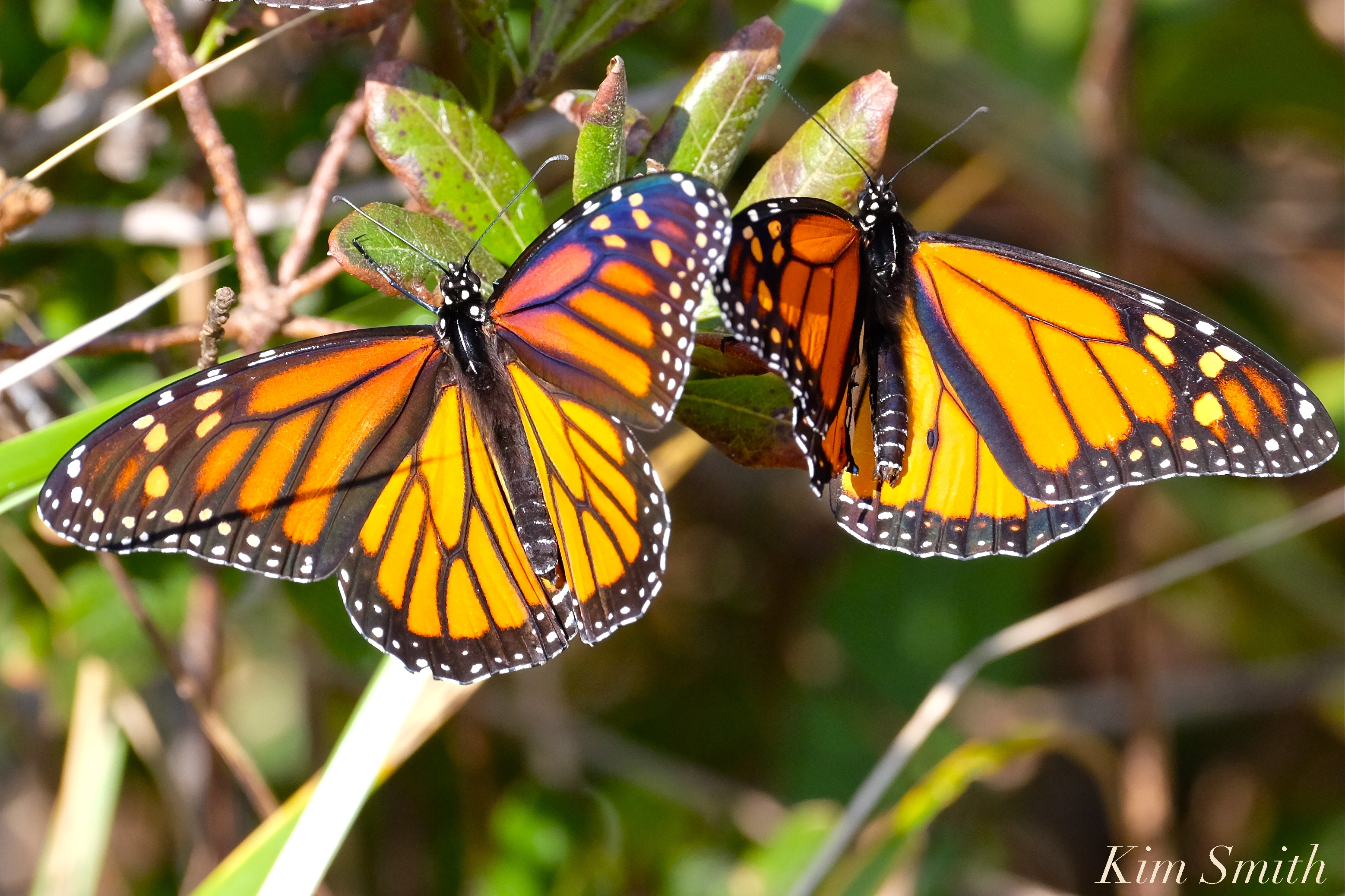
Monarch Butterflies and New England Aster, Gloucester, 2018

The answer to that question is a resounding yes! Monarchs are a bellwether species. The love for this one butterfly has helped shape a consciousness towards all species at risk. An uncomplicated stand of milkweed and asters can make every public walkway, park, community center, church, school, and backyard a haven for Monarchs and together we can bring about a conservation victory for the pollinators.
MONARCHS AND LADIES – LAST OF THE SEASON’S BUTTERFLIES

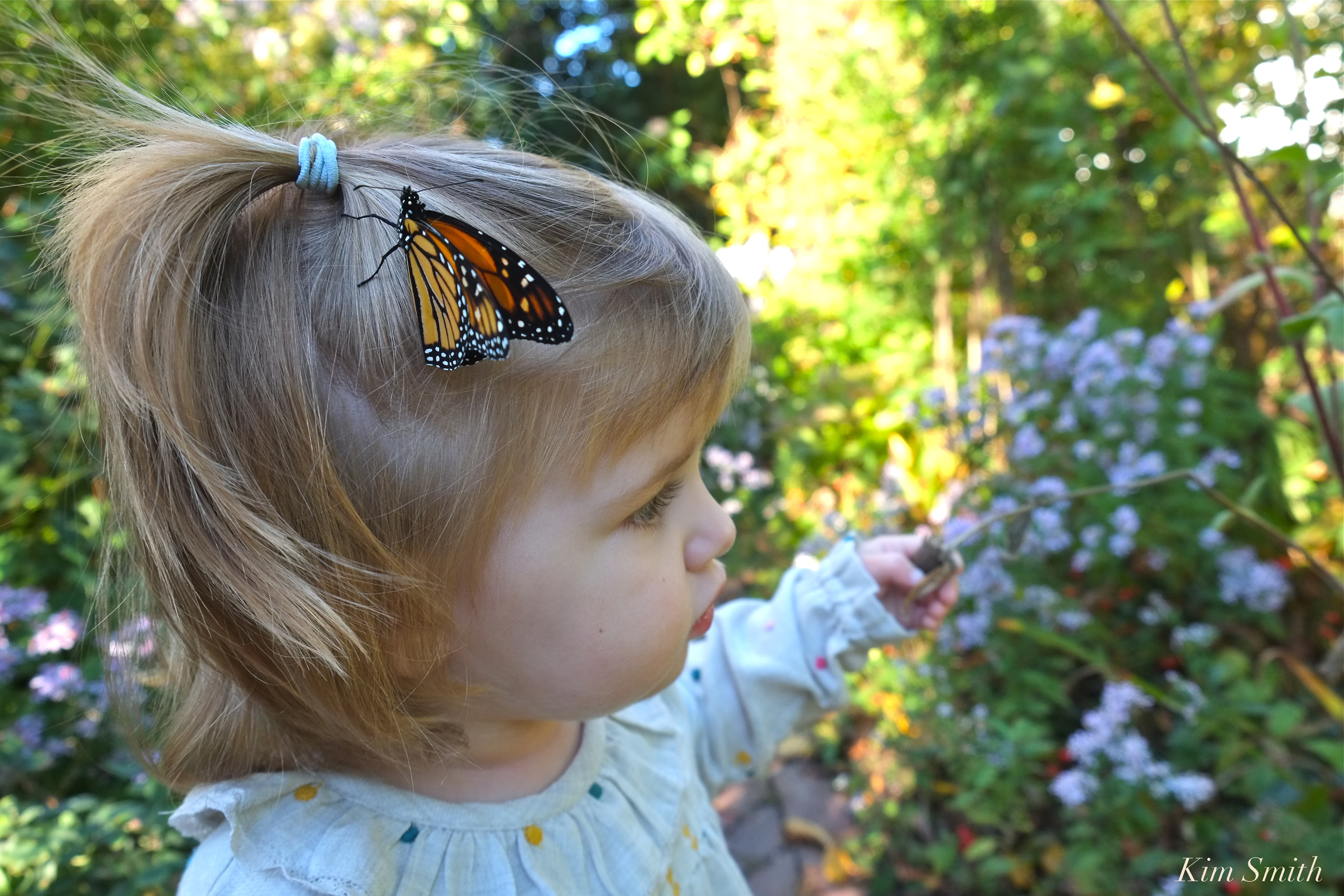
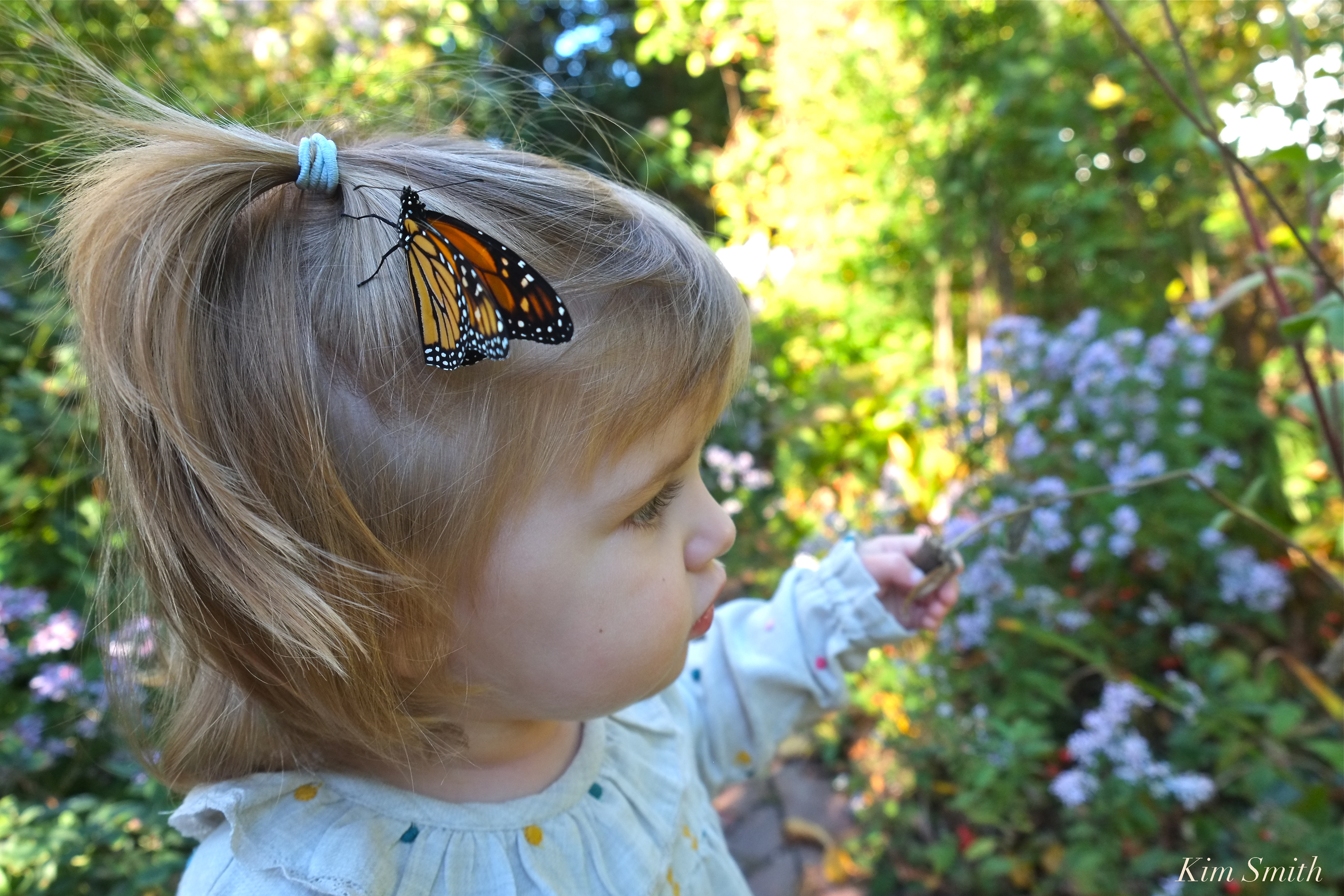
While releasing the last Monarchs of the season with Charlotte, one landed on her hair and stayed for few moments, just long enough to capture a minute of footage and to take a photo.

Thank you to Patti Papows for our little straggler. Patti’s chrysalis was attached to a plant in her garden, an aster, which had lost all its leaves. She was worried a predator might eat it, so we scooped up the chrysalis and placed it in a terrarium at my home, where the butterfly emerged on October 17.

Will these last of the season’s Monarchs that are migrating along the Atlantic Coast make it to Mexico? Some will follow a path along the coastline, where when they reach the Delaware Bay, winds will begin to funnel them towards Mexico, between the Appalachian and Rocky Mountains. Some will continue on down the coast all the way to Florida. Some of these Atlantic Coast Monarchs will live their days out in Florida, and some will cross the Gulf of Mexico on their journey to Mexico.

Please join me on Wednesday, November 7th, from 1:00 to 5:00pm where I am one of three presenters for the Massachusetts Horticultural Society at Elm Bank. I hope to see you there!

Discover new ways to garden, and new plants to select to make your home more sustainable in three presentations that address methods and plantings that you can adopt to improve your local environment and welcome more wildlife to your gardens. Presentations will review methods of ecological landscaping, introduce you to native shrubs, and share what you can plant to support pollinators.

Register Now!

October Monarchs
American Ladies on the wing during the month of October

BBC AND PBS AUTUMN WATCH: NEW ENGLAND CAPE ANN MONARCH EPISODE AIRS FRIDAY NIGHT

Dear Friends of Beauty on the Wing,

My friend Patti Papows shares that she heard a promo on PBS for the Autumnwatch Cape Ann Monarch migration episode, which we believe airs Friday night at 8pm. The BBC team is still editing the segment so if anything changes, we will let you know.

The Monarch migration interview was filmed at Patti’s beautiful garden in Gloucester, at Good Harbor Beach, and the episode includes footage from my forthcoming film Beauty on the Wing: Life Story of the Monarch Butterfly.

Patti is a fantastic hostess and the producer Sophie, cameraman Bobby, and his wife Gina were thrilled with her warm hospitality and the refreshments she provided. It was cold and damp and drizzly, yet despite that, half a dozen Monarchs emerged from the chrysalises I had brought to the interview. Everyone was excited to see this and I think it was all meant to be.

The three night series airs Wednesday, Thursday, and Friday at 8pm (October 17th-19th).

Photos from an October passel of Monarchs migrating along our shores and nectaring at the late blooming asters.

FILMING WITH THE BBC FOR THE MONARCHS!

Good news for my Monarch Butterfly documentary!

Dear Friends of Beauty on the Wing,

The past two summers we have seen a mini boom of Monarchs in gardens and meadows. Hopefully this will translate to a greater number of butterflies overwintering in Mexico, but we’ll only know after the annual count that takes place during December of 2018. I have been able to capture some wonderful footage and carve out good chunks of time time for editing.
I have some exciting news to share and that is over the past month I have been in discussion with producers from a BBC nature program. They found the trailer for Beauty on the Wing and contacted me for help writing the story about the Monarch migration through New England. Yesterday, I spent the day with the BBC film crew for my interview, and then showed them all around Cape Ann’s beautiful Monarch habitat. It was a very rewarding day and we covered much ground. The show is being produced in conjunction with PBS and will air in the US sometime in October. For myriad reasons, this is fantastic news for my film!

That’s all for now but I’ll keep you posted when I know more details.

Thank you Friends for your continued support and interest in Beauty on the Wing: Life Story of the Monarch Butterfly!

Warmest wishes,

Kim

The interview took place at the lovely home and garden of my friend and East Gloucester resident Patti Pappows. When I met Patti, she already had a gorgeous established garden however, over the past few years, she has been adding great patches of milkweed and many species of native New England wildflowers. Just ask her how many butterflies (and hummingbirds) visit her garden daily! Patti’s garden made the most beautiful setting to showcase Cape Ann’s butterflies and wildflowers, despite the clouds and drizzle.

The cameraman Bobby and producer Sophie were absolutely delighted and amazed to see half a dozen Monarchs emerging yesterday during shooting! 

Monarch Madness!

Four Monarchs eclosing and nineteen caterpillars becoming chrysalises, all in a day! And we have a new batch of caterpillars, just in time for my program tomorrow morning at the Cape Ann Museum. I hope to see you there!

Many thanks to my friend Jan Crandall for the caterpillars. She has a gorgeous butterfly garden and this morning there were dozens and dozens of caterpillars on her Common Milkweed plants.

Velvet wings drying in the morning sun.

Monarch Conference

https://www.instagram.com/p/BnWjaQjnipZ/

https://www.instagram.com/p/BnWkKo9HEz2/

CATERPILLAR CONDO

Caterpillar Condo

Several readers have written to ask how do I manage to have so many Monarch Butterfly caterpillars and chrysalises. The answer is very simple–because we have planted a wonderful little milkweed patch! We grow both Common Milkweed (Asclepias syriaca) and Marsh Milkweed (Asclepias incarnata) side-by-side. Our milkweed patch is planted near our kitchen. When washing the dishes, I can look out the window and watch all the pollinators and fabulous activity that takes place at the milkweed patch.

Several weeks ago, a Mama Monarch arrived and I watched as she gently floated from leaf to leaf, and bud to bud, ovipositing one golden egg at a time. She went back and forth between the Common and Marsh, depositing eggs on both the tender upper foliage as well as the more sturdy lower leaves. I waited for her to leave, but not too long (because the eggs are quickly eaten by spiders) and collected the sprigs with the eggs. I thought I had scooped up about eight eggs and you can imagine our surprise when 19 caterpillars hatched, all within the same day! Female Monarchs like to deposit eggs around the tiny buds of Marsh Milkweed and many of the eggs were hidden within the buds.

Here’s a video of a Mama depositing eggs on our Marsh Milkweed buds. Charlotte was with me that day and we were dancing to the song “There She Goes” as the butterfly was depositing her eggs and it was too perfect not to include in the video.

Our garden is postage stamp size, but I have managed to fill it with a wide variety of songbird, butterfly, bee, and hummingbird attractants. The great majority of plants are North American native wildflowers and shrubs, and we also include a few nectar-rich, non-native, but not invasive flowering plants. Plant, and they will come 🙂

I am super excited to give my children’s program at the Cape Ann Museum on Saturday morning. The program is free and open to the public. I hope to see you there!

Save the Date: Kim Smith at the Cape Ann Museum!

Join documentary filmmaker and photographer Kim Smith, creator of Beauty on the Wing: The Life Story of the Monarch Butterfly on Second Saturday Cape Ann Museum Kids. Learn all about the life story of the Monarch and how you can help the butterfly on its migration. The program runs from 10am to noon. To register, contact courtneyrichardson@capeannmuseum.org

Families of school aged children visit free on Second Saturday mornings. Visit the galleries, join a workshop, and more!

Monarch Butterfly Emerging

Salem State University Keynote Speaker Kim Smith Spotlights Plight of the Monarch Butterflies

Salem State keynote spotlights beauty, plight of monarch butterflies

Smith, who spoke on campus Thursday, April 12, makes nature films and contributes to the daily blog Good Morning Gloucester. She also helps communities and individuals build gardens specifically aimed at attracting butterflies, bees and beneficial bugs.

On behalf of the Earth Days Planning Committee, Carol Zoppel, a campus librarian and co-chair of Earth Days Week, presented Smith with the Friend of the Earth Award.

“Salem State University’s Earth Days committee would like to recognize Kim Smith for her artistic and advocacy work on behalf of wildlife through her films, photo, gardens, and writings,” said Zoppel. Smith received her award and a framed poster of her program.

READ COMPLETE ARTICLE HERE


…Smith also reflected on our involvement with these creatures.

“I think compassion for all living creatures is really important,” said Smith. “Right here in our own backyards and beaches we have small winged creatures like Monarchs and Piping Plovers that are struggling to survive.”

She added, “Our actions and how we chose to live our lives has tremendous impact.”

Monarch Butterflies Dawn Awakening Gloucester MAssachusetts

CHASING MONARCHS ~ WHIRLWIND TRIP TO STONE HARBOR AND CAPE MAY PART TWO

Read Part One Here

Google maps sent me back to Cape May via a different route and I did not again pass the one gas station that appeared to be open for business. Concerned though that the Jetty Motel’s office would close for the night before I had checked in, I headed straight there, passing several closed gas stations along the way.  Not looking good in the refueling department. I arrived just in time, moments before the front desk closed, and was helped tremendously by the receptionist. She pointed me in the direction of the one and only gas station open and provided great advice for dinner, The Lobster House, located on Schellengers Landing Road, Fisherman’s Wharf at Cape May.

My dinner of chowder and oysters was fabulous! I met a super nice guy  at the bar and he shared lots of information about the area. He is marine biologist on one of the local whale boats, which is actually a schooner! He was headed the next morning to the Keys to help a friend rebuild his campgrounds.

The Lobster House is open seven days a week, all year round, and includes several restaurants, a coffee shop-lunch counter style diner, fish market, and dining on the Schooner American, which is moored dockside. The commercial fishing fleet at the Lobster House offloads millions of pounds of seafood and supplies much of the fresh seafood on the Lobster House menu.

The following morning I had checked out by daybreak, filled with anticipation to return to Stone Harbor Point to see the Monarchs departing the trees at first light. First though I headed to the beach across from the hotel for a very quick glimpse. The wide sandy beach has a perfect view of the Cape May Lighthouse. You can walk along the beach and through the trails of the Cape May State Park for direct access to the Lighthouse.

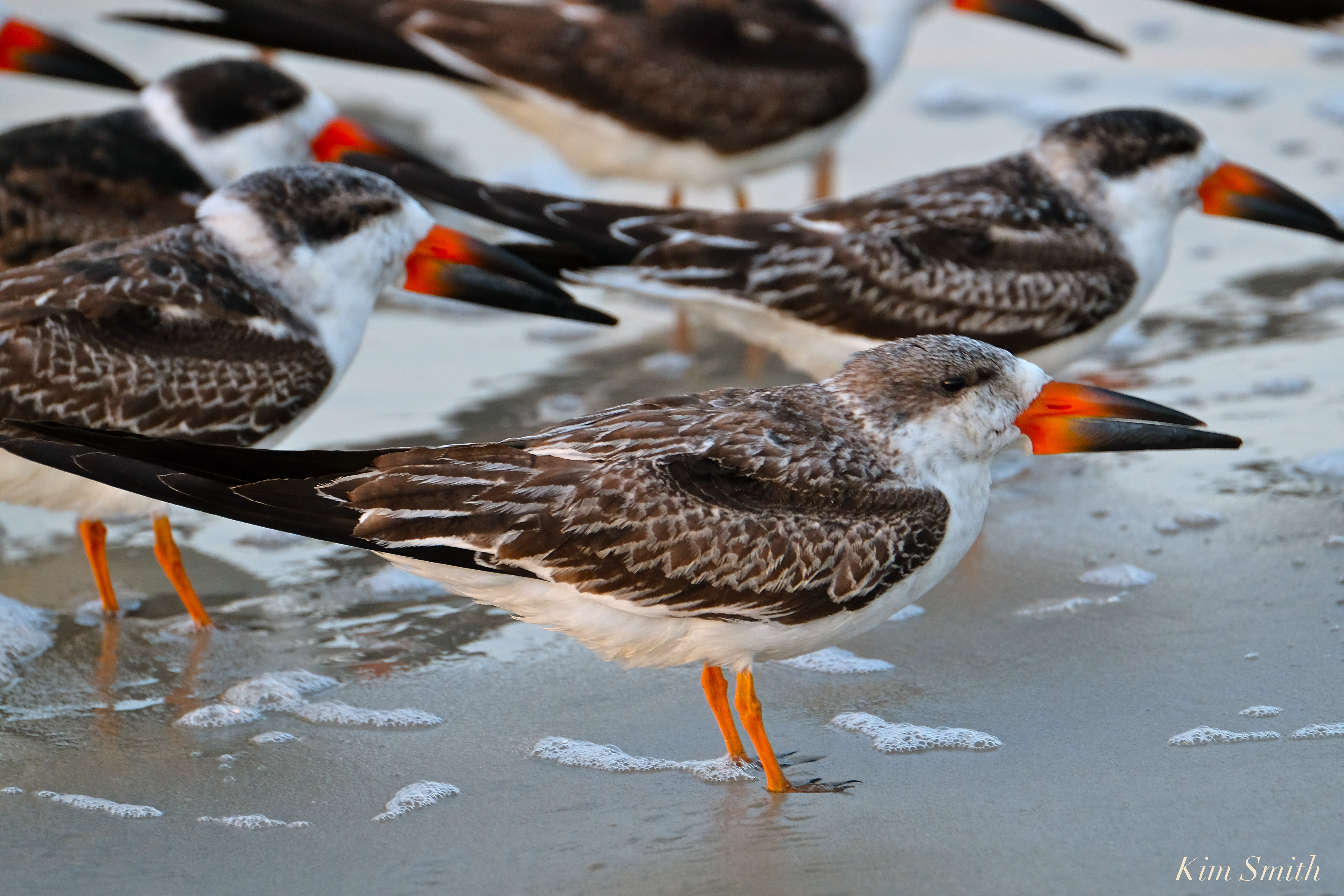
At the shoreline were poised to cross the Bay a great flock of Black Skimmers. Overnight the wind had picked up tremendously and the flock were aligned in perfect soldier-like order, all facing into the strong gusts. Oh how I wished I could have spent more time there exploring this area so rich in fabulous creatures and wildlife. Most definitely on my next visit!

Notice the amazing lower mandible of the Black Skimmer. While flying, the Skimmers use their bill to skim small fish along the surface of the water. The Skimmers pictured here are mostly young Black Skimmers in plumage mottled brown and white.

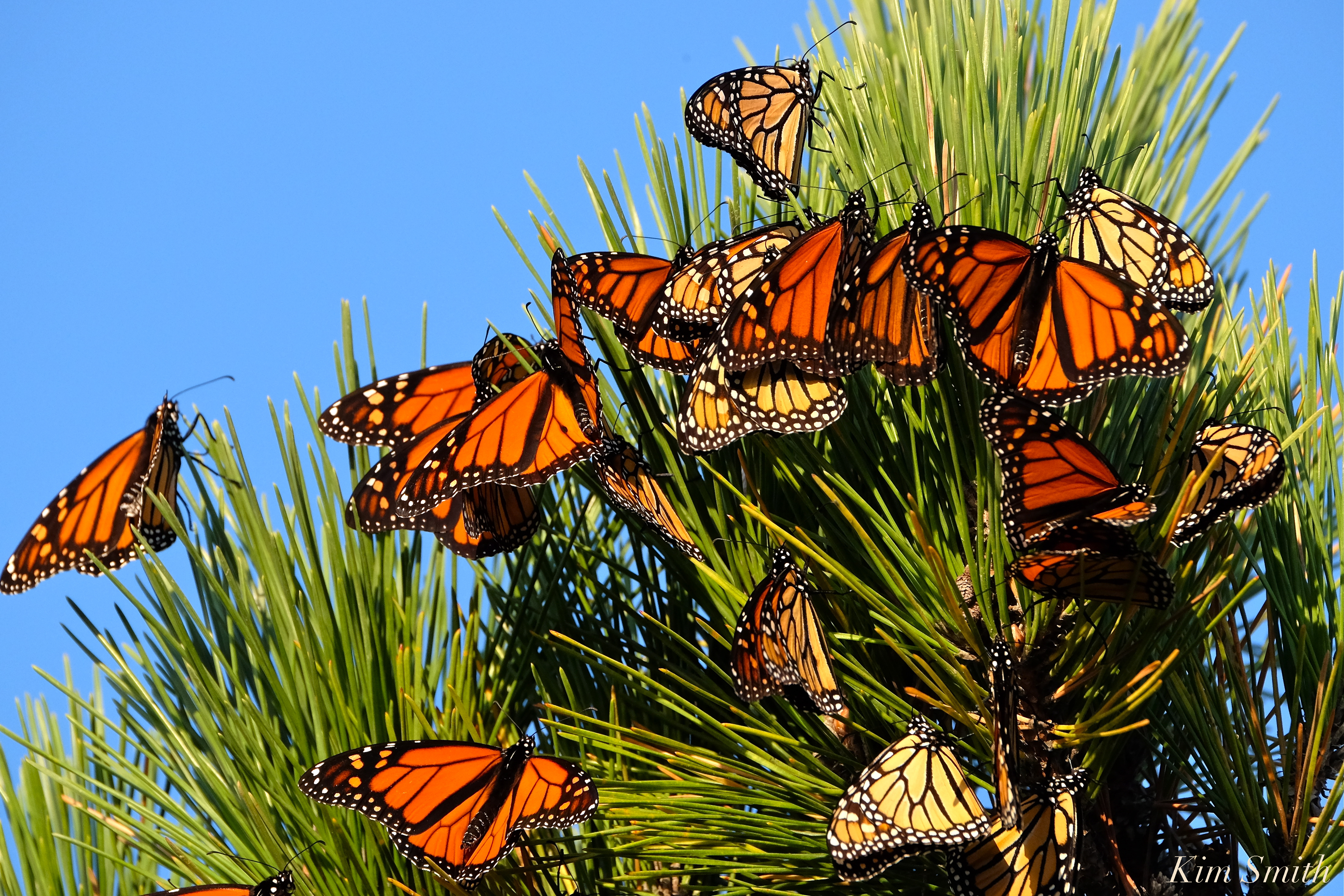
I arrived at Stone Point Harbor just as the butterflies were awakening. When butterflies roost in trees, they will often situate themselves so that the eastern light of the early morning sun rays warm their wings. They will also typically (but not always) choose overnight sleeping areas that are out of the way of the of the prevailing winds.

Because of the strong wind, instead of leaving the trees all at once, as I have often observed, the Monarchs would take off, have difficulty navigating the wind, and then return to the trees. These attempts lasted several hours as the Monarchs tried again and again to negotiate the harsh wind.

In the mean time, the Monarchs that weren’t as intuitive as the ones that were roosting in trees had roosted overnight on the dried out stalks of wildflowers. They were having an extremely tough time, clinging with all their might to the stalks or getting pulled down to the sand. This was challenging to observe as there was nothing that could be done to help the butterflies expending so much energy to stay grounded.

https://www.instagram.com/p/BawAbPmljVHAnGl29-fn5xh5kmFBKUEtsG6s6o0/

Monarchs Clinging to Dry Stalks of Seaside Goldenrod and Beach Grass in the Sand

Time was spent between the trees and the dunes. After several hours there were still a number of butterflies warming in the trees, barberry bushes, and wildflowers when I had to leave Stone Harbor Point to return to Cape May Point to investigate any migrating butterflies that may have been there.

Female (left) and Male Monarch Butterfly warming their wings on a barberry bush.

None were roosting at the Cape May Lighthouse and few were on the wing.  With the wind blowing in precisely the opposite direction for safe travel across the Delaware Bay, the Monarchs were waiting yet another day to take the next leg of their journey. Looking towards a nine hour drive ahead of me, I couldn’t stay a moment longer. Except to grab a bowl of chowder at the Lobster House and have a quick glimpse in the daylight hours at the Fisherman’s Wharf at Cape May.

Sea Bass fishing season was open and fisherman Jim is cutting up squid for bass bait.

Monarchs began arriving in Angangueo several days ago. And in much greater numbers than have been seen in recent years. Barring any huge weather events, this late, great batch of migrants will make it too. Friends are reporting that there are Monarchs in their gardens still, and I have one of Patti Papows caterpillars in its chrysalis, yet to emerge.

Eggs, caterpillars, chrysalides, and butterflies that would have been killed by more seasonable colder temperatures are able to survive in the unusually warm weather we are experiencing on the East Coast. However, most of the wildflowers that provide fortification to the Monarchs on their southward journey have withered. You can help late stragglers by keeping nectar producing flowers in your garden going as long as possible. In our garden, it is the old passalong Korean Daisy that is providing nectar to bees and butterflies, and it will bloom until the first hard frost.

Friends of the Monarch Butterfly: If you would like to help towards the completion of the documentary filmBeauty on the Wing: Life Story of the Monarch Butterfly, please consider making a tax deductible donation here:

DONATE HERE

Donors contributing over $5,000. will be listed in the credits as a film producer.

For more information, visit the film’s website here: Monarch Butterfly Film

For an overview of the film’s budget, please go here: Budget

Thank you so very much for your help.

With gratitude,

Kim