Category Archives: Monarch Butterfly Film

COMMUNITY MILKWEED SEED POD PROJECT FOR THE POLLINATORS!

MILKWEED SEED COLLECTION AND DISTRIBUTION PROJECT SUNDAY OCTOBER 15TH

Collect ripe milkweed seed pods (only Common Milkweed and Marsh Milkweed please). Place in a paper bag, not plastic, as plastic can cause the seed pods to become damp and moldy.

Bring seedpods to Captain Joe and Sons on Sunday morning between 10:30 and noon. Captain Joes is located at 95 East Main Street, East Gloucester.

If you’d like to distribute seeds, meet at the dock between 10:30 and noon and I will show you what to do.

NOTE: It is easy to tell when milkweed seedpods are ripe. The seeds inside turn brown. Do not collect the pods when the seeds are white or green. If you pick them too soon, they will never be viable. You can check the seed pods by slitting the pod a tiny bit and peeking inside.

Any questions, please comment in the comment section or email me at kimsmithdesigns@hotmail.com. Thank you and I hope to see you Sunday morning!

To learn more about how you can help fund the documentary Beauty on the Wing and the Monarch Butterfly Film Online Fundraising event, please visit the film’s website at monarchbutterflyfilm.com.

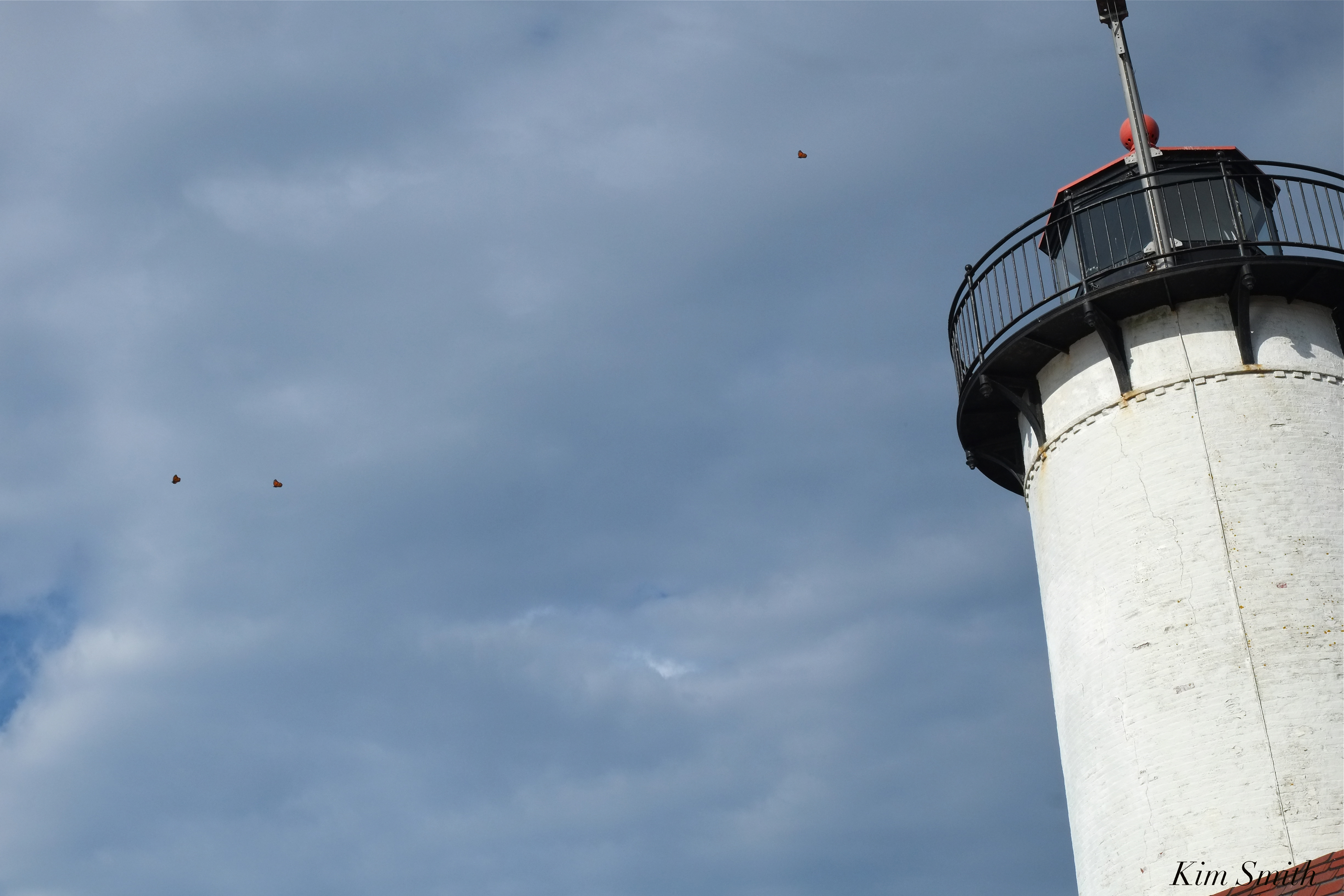
THANK YOU! AND MONARCH FLAKES AT EASTERN POINT LIGHTHOUSE

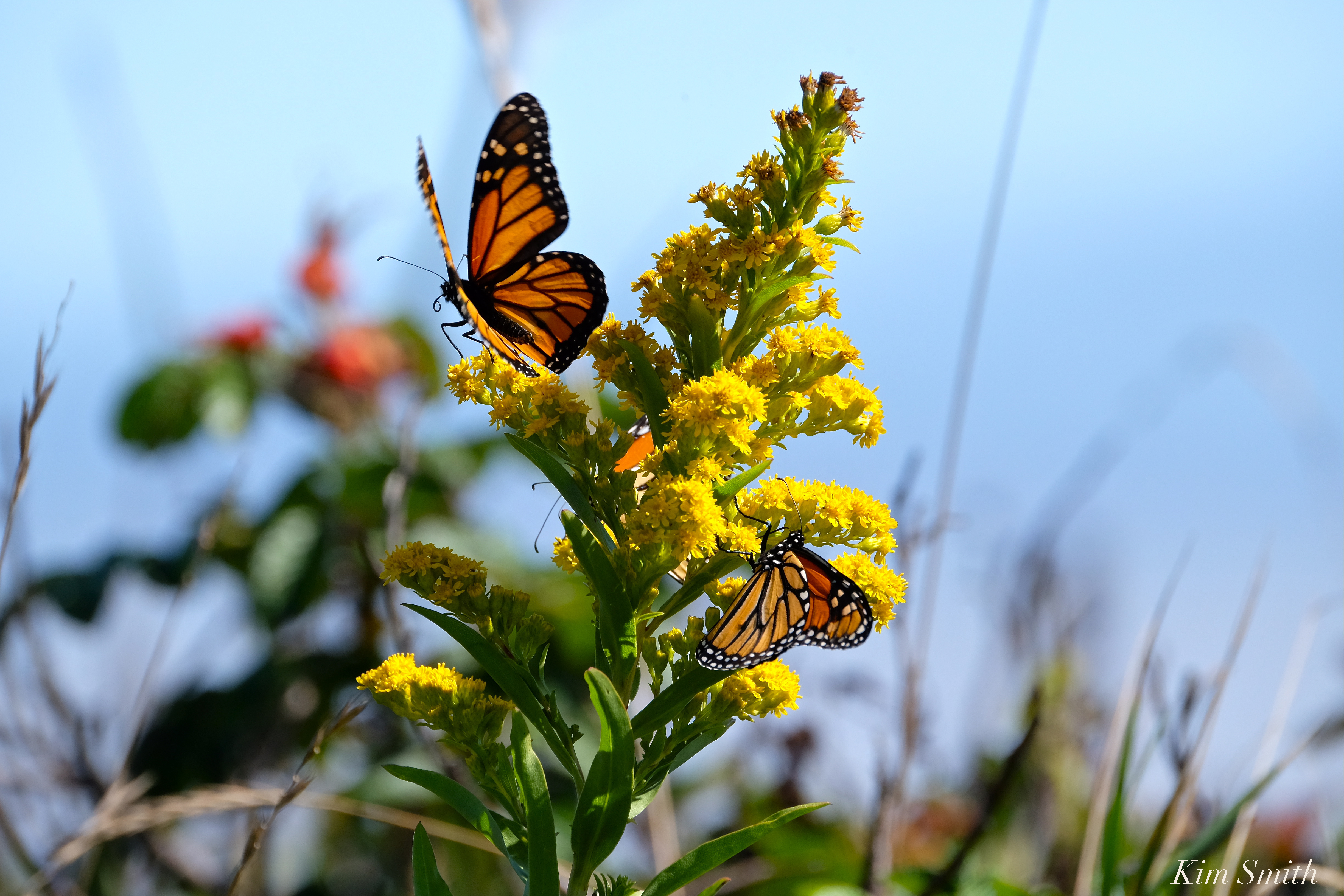
 Monarchs were streaming all along the coast of Cape Ann yesterday and it was a beautiful sight! 

I AM OVERJOYED TO SHARE THAT WE HAVE RAISED 800.00 IN 24 HOURS!!! MY DEEPEST THANKS TO LAUREN M. FROM MANCHESTER, DONNA STOMAN AND PEGGY O’MALLEY FROM GLOUCESTER, JOEY C, AND ANONYMOUS FOR THEIR GENEROUS HELP. 

Please help towards the completion of my documentary film Beauty on the Wing: Life Story of the Monarch Butterfly, filmed in the wilds of Cape Ann and Angangueo. Thank you! DONATE HERE.

MONARCH FILM FUNDRAISING SCREENING PARTY

Dear Friends,

This past spring I had a tremendously inspirational experience. Out of the blue, a lovely woman from Concord, Laura Stevens, contacted me about the possibility of viewing my documentary film about the Monarch butterflies, Beauty on the Wing: Life Story of the Monarch Butterflies. I was reluctant at first, explaining that the film was in a rough cut form. Although the rough cut features the butterflies and Cape Ann in the most beautiful light, the film does need finessing.

Laura comes from a wonderful family and they all love Monarchs! Every year, she and her family gather together for a reunion based around a weekend of learning. Laura explained that it would be an extra special treat for the 27 women and children who attend the reunion to see the film. The more I thought about it the more I thought it would be a super idea, and sent her access to the film.

Several weeks passed when in the mail I received the most heartfelt thank you letters from Laura and her family members who had attended the screening, from the ninety-five year old great auntie to the youngest child there. And soon after that, donations towards the film’s completion arrived from this most generous family. I am so grateful to Laura and her family for the donations, and for their kind encouragement and enthusiasm.

At that time the thought crossed my mind that this would be a wonderful way to continue to raise funds for the documentary. Landscape design work and the story of Little Chick and the Piping Plovers has kept me from doing any recent fundraising, but my work typically slows for a brief period during the end of August and beginning of September.
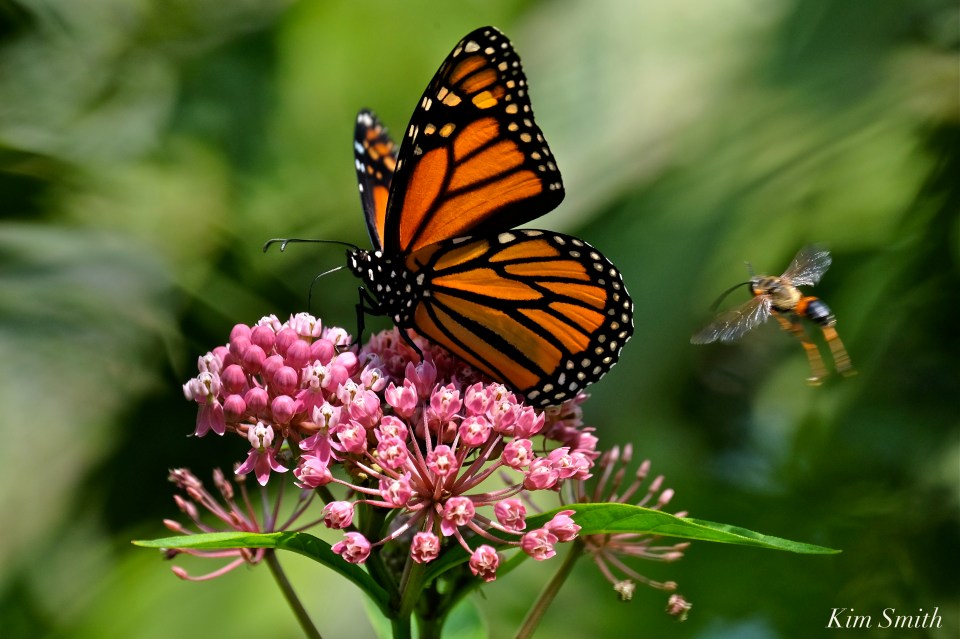
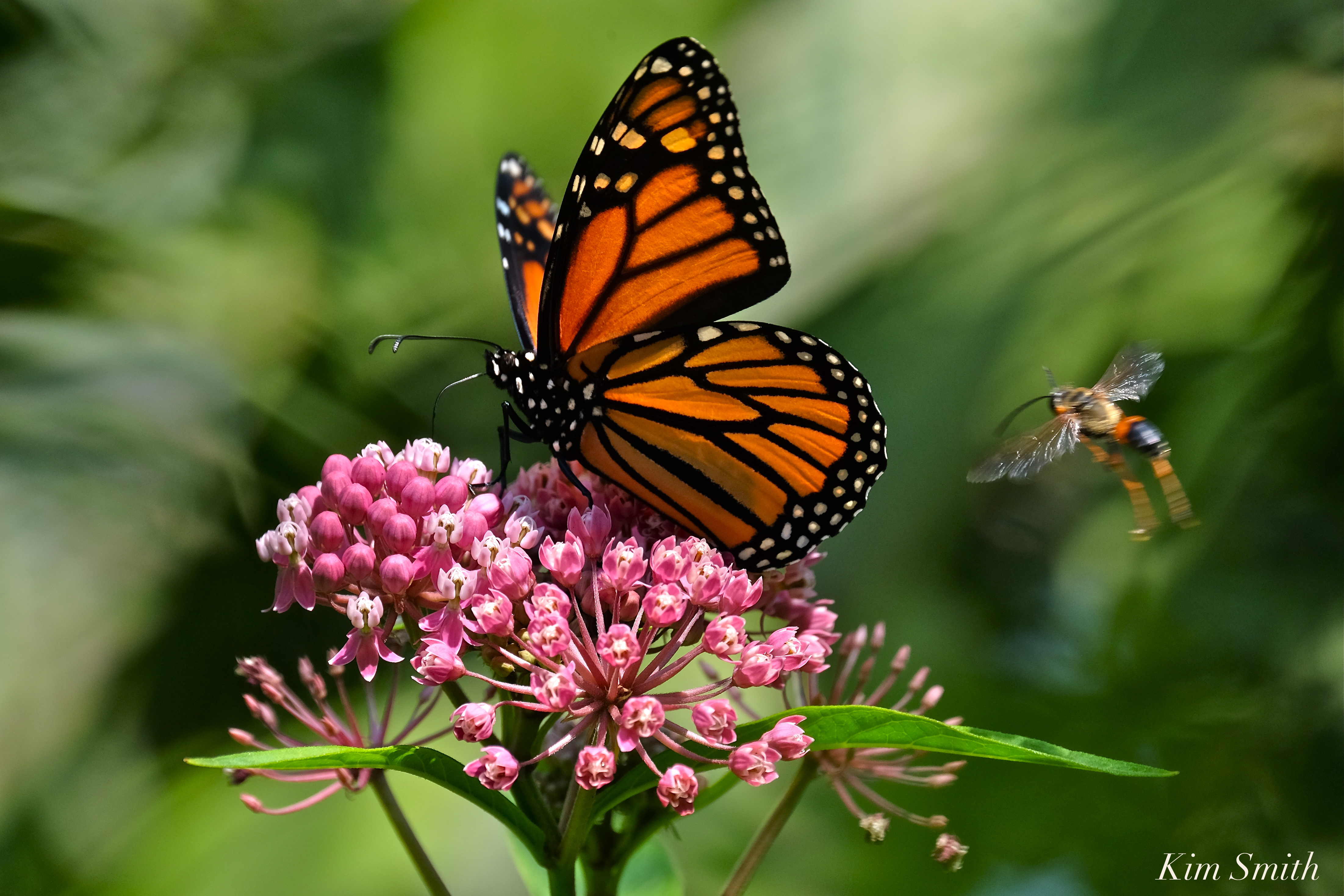
Female Monarch Butterfly and Marsh Milkweed, 2017

Don’t you think it auspicious for my film project that we are seeing so many butterflies this summer? I began documenting the Monarchs in our region in 2006, which was a tremendous year for the Monarch migration through Cape Ann. The year 2012 was quite strong as well, but in the past four years, as the worldwide population has plummeted, so have the Monarchs migrating through our area. Imagine that in 1977 when the Monarchs were first discovered at their winter sleeping grounds, the butterflies were counted by the billions, while today only by the millions.

My hope for Beauty on the Wing is that it will travel to the various conservation and environmental festivals, and then be made available to classrooms around the nation. Another dream for the film is that it will be translated into Spanish and French. Just as American and Canadian children are curious about the butterflies’ winter home after departing their northern breeding grounds, Mexican children are equally curious as to the butterflies’ destination after they leave the butterfly sanctuaries in central Mexico.

The intent of this letter is to learn if amongst our readers there is interest in hosting a screening of the film in its not quite completed form. The purpose of the screening would be to raise money towards the film’s completion and distribution. And, too, I thought it would be a more fun, educational, and personal way to fundraise. To date I have received over $5,000 in generous donations. I am working with the non-profit filmmaker’s assistance group, the Filmmakers Collaborative. Donations made through FC are tax deductible. An itemized budget is available upon request. Beauty on the Wing is 54 minutes long. I thought we could show twenty minutes of highlights and then discuss the current state of the butterflies. Viewer feedback would also be of tremendous help. Screening parties could be so much fun, especially at this time of year during the butterfly’s migration, and especially in 2017 while we are seeing so many Monarchs on the wing.

Readers, what do you think? Please comment on this post or write me at kimsmithdesigns@hotmail. Thank you so very much for your time, thoughts, and interest.

Warmest wishes,

Kim


Links:

Beauty on the Wing: Life Story of the Monarch Butterfly film website

A Flight of Monarchs

Trailer

Film Interview with Doctor Thomas Emmel at the Monarch Butterfly Biosphere Reserve at Sierra Chinqua

https://instagram.com/p/BW7wfw-F5o9/

https://instagram.com/p/BXjLQjZleLY/

https://instagram.com/p/BXjL7HgF2p2/
MONARCHS HERE, THERE, AND EVERYWHERE! PLEASE REPORT YOUR MONARCH BUTTERFLY SIGHTINGS (EDITED)

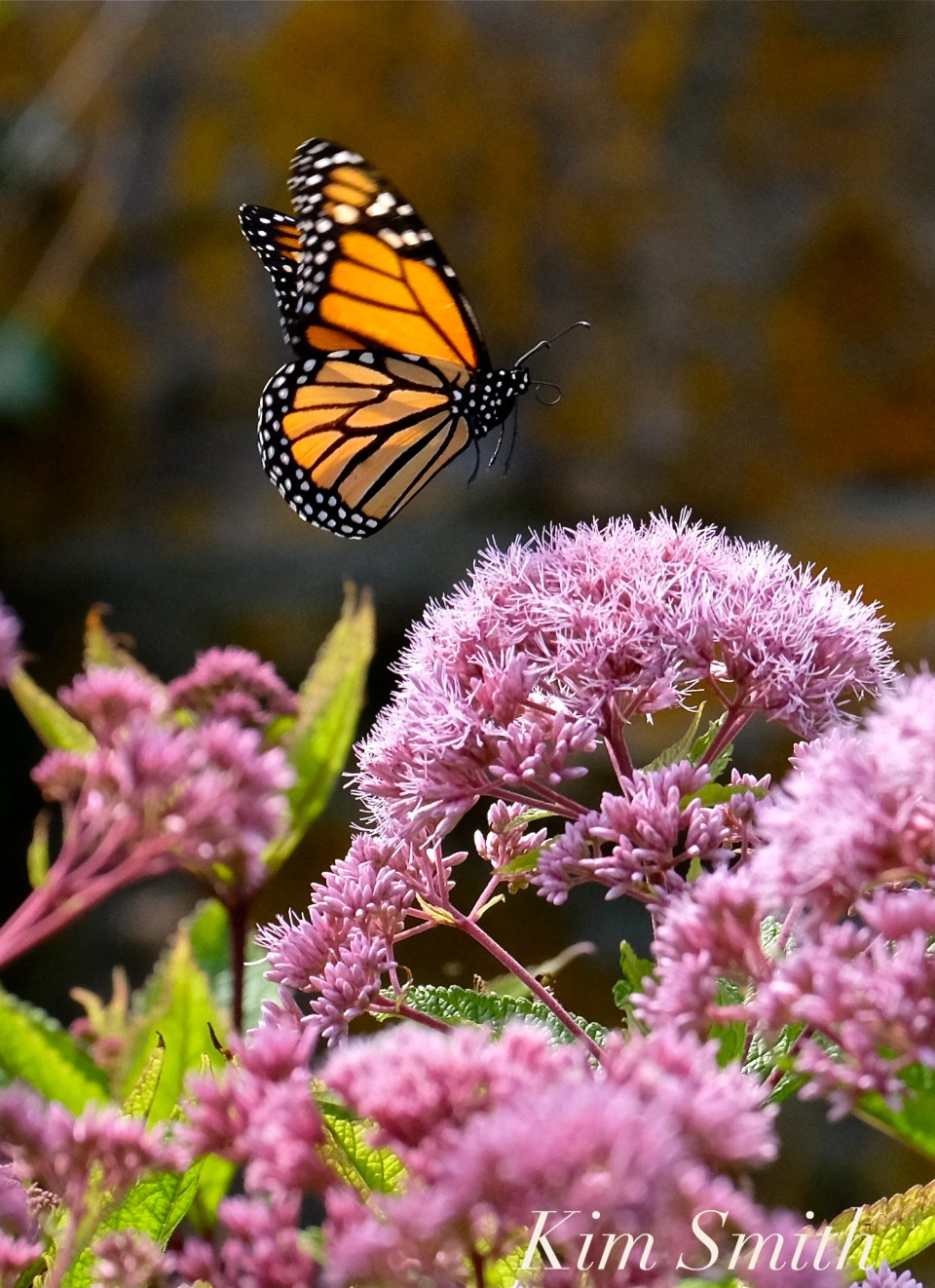
Reports of Monarch Butterfly sightings are coming in from all around Cape Ann, and beyond. I have seen more this this year than in recent summers. I wonder if higher numbers in July indicates a stronger migration in September. We can hope!

At this time of year, the females are depositing the eggs of the next generation.  You can find Monarchs at wildflower meadows, dunes, and gardens, where ever milkweed and nectar-rich flora grow. Typically, the eggs and caterpillars are found on the undersides of the uppermost leaves.

If you would, please report any Monarch activity that you have seen–eggs, flight, caterpillars, nectaring, mating, whatever you discover. Please share the approximate date and place. Even if you have shared previously in a comment, I hope to keep all the sightings in one place, so please re-comment. Thank you! 

*EDIT:

Thank you everyone for writing! How exciting that so many are being spotted, many more than the past several years. One was in my garden this morning, again, and two at Good Harbor Beach dunes earlier this morning.

Adding JoeAnn Hart, Susan Burke and Michele Del, as they commented on Facebook.

Patti, do you have caterpillars?? I’d love to stop by and see.

Please keep your comments coming. Thank you!!!!

When watching, note that the first two minutes of the film were shot in Gloucester. I think you will be dazzled by the numbers of Monarchs that travel through Cape Ann’s backyards and meadows during the peak of migration.

Please Share Your Monarch Sightings – Thank you!

There have been few Monarch sightings this summer but I have been hoping for a strong fall migration. The migration is peaking in Kansas and we are always a little bit behind. Please let me know if you see a Monarch, and where. Thank you very kindly!

https://www.instagram.com/p/BKqhTISjOjG/

Monarchs are emerging daily in my garden, from eggs collected at my friend Nancy’s field in Salem. This too would be an indication that we may be seeing them soon.newly-emerged-monarch-butterfly-copyright-kim-smith-jpg

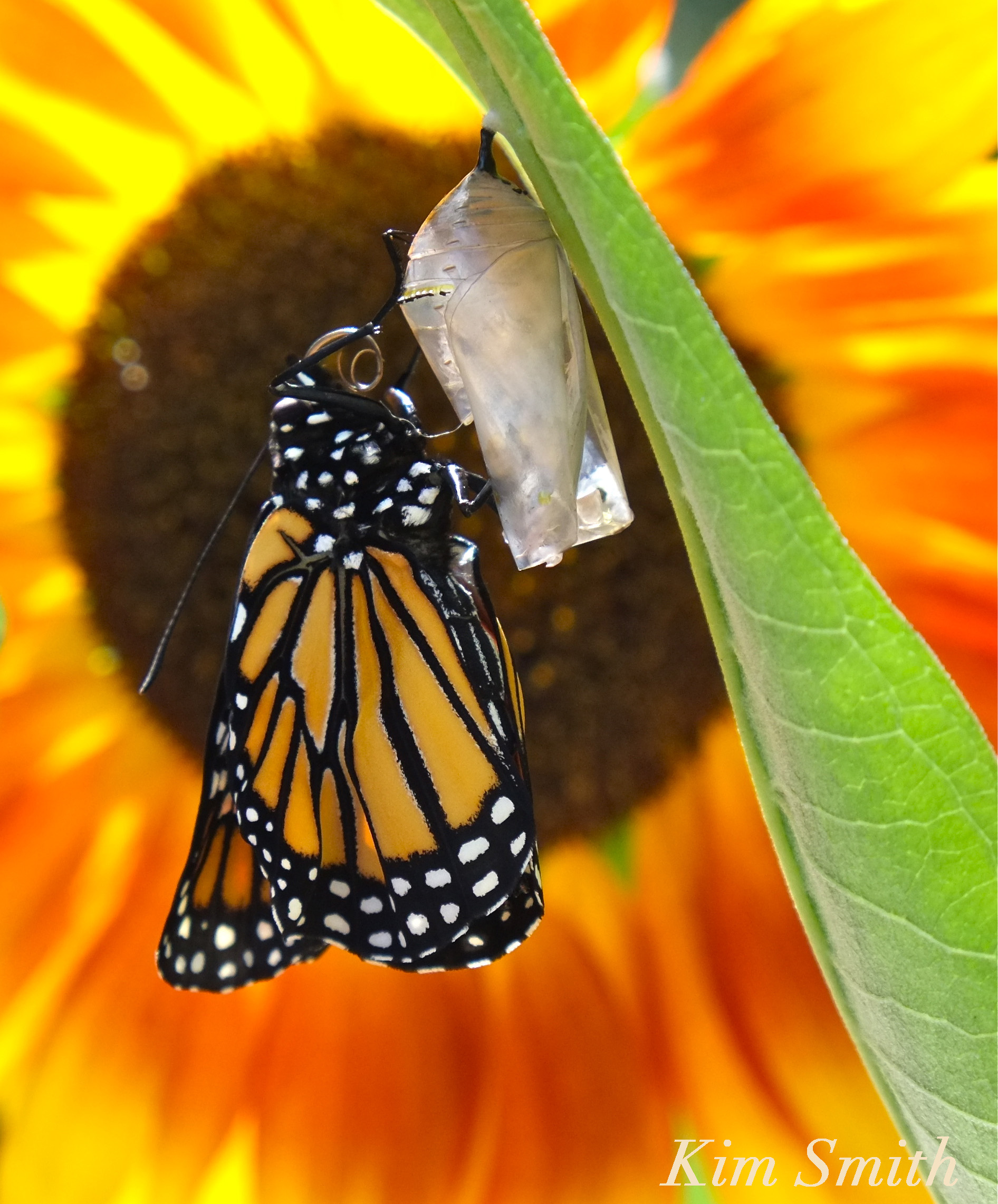
This newly eclosed Monarch is clinging to its chrysalis case. Within moments of emerging, the two-part Monarch proboscis must zip together to form a siphoning tube. If the two parts do not join, the butterfly will not be able to drink nectar. In this photo, you can see the proboscis is not yet fully zipped.

Hello Mama Monarch

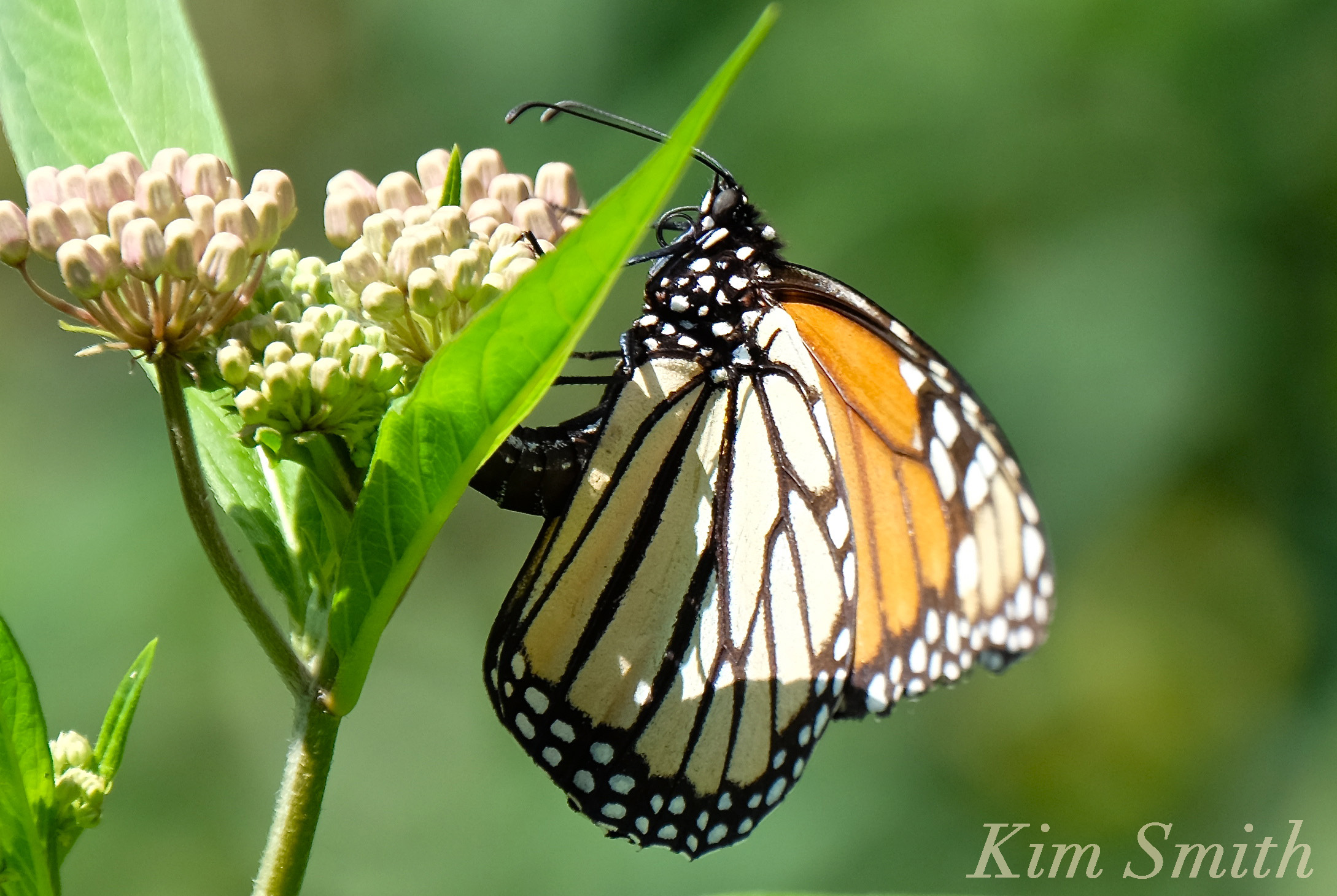
Plant and they will come! Female Monarch depositing eggs -1 copyright Kim Smith Alighting on the buds of our Marsh Milkweed plants, you can see in these photos that the female Monarch is curling her abdomen to the underside to deposit eggs. She will go from bud to bud and leaf to leaf ovipositing one egg at a time. A female, on average, deposits 700 eggs during her lifetime, fewer in hot, dry weather.

Female Monarch depositing eggs copyright Kim SmithFemale Monarch Butterfly and Marsh Milkweed (Asclepias incarnata)

Butterflies do not “lay” eggs; web would say oviposit or deposit. And you wouldn’t describe a caterpillar as hatched, but that it has emerged or eclosed.

Grow Marsh Milkweed and Common Milkweed and you most definitely will have female Monarchs calling your garden home!

Female Monarch depositing eggs -2 copyright Kim Smith
In the above photo you can see how she is contorting her abdomen to correctly position the eggs.

LECTURE BEAUTY ON THE WING ~ THURSDAY NOVEMBER 12TH AT THE SAWYER FREE LIBRARY!

Monarch Butterfly Exposion -2 ©Kim Smith 2014 300dpi copyMonarch Butterfly Explosion

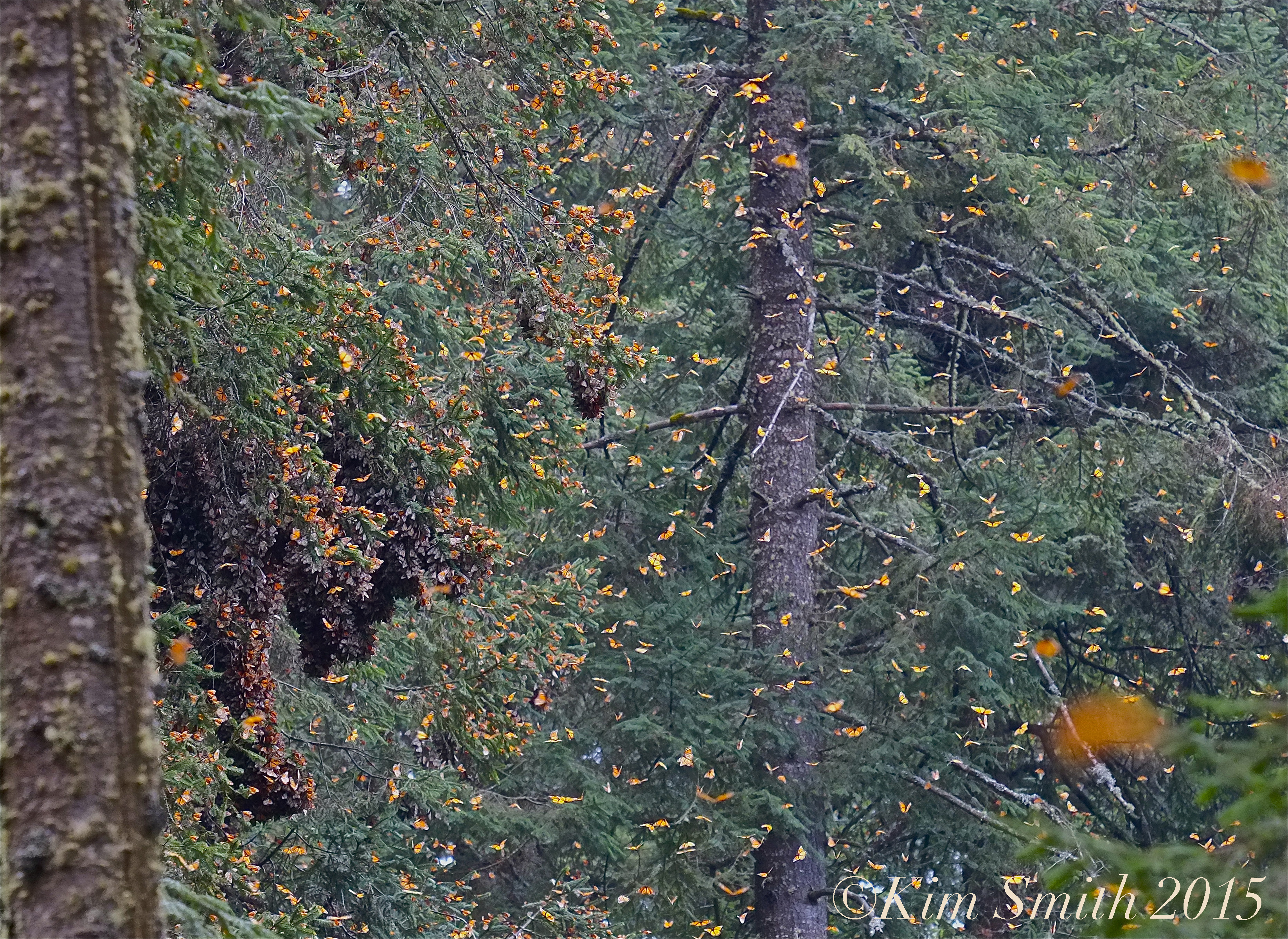
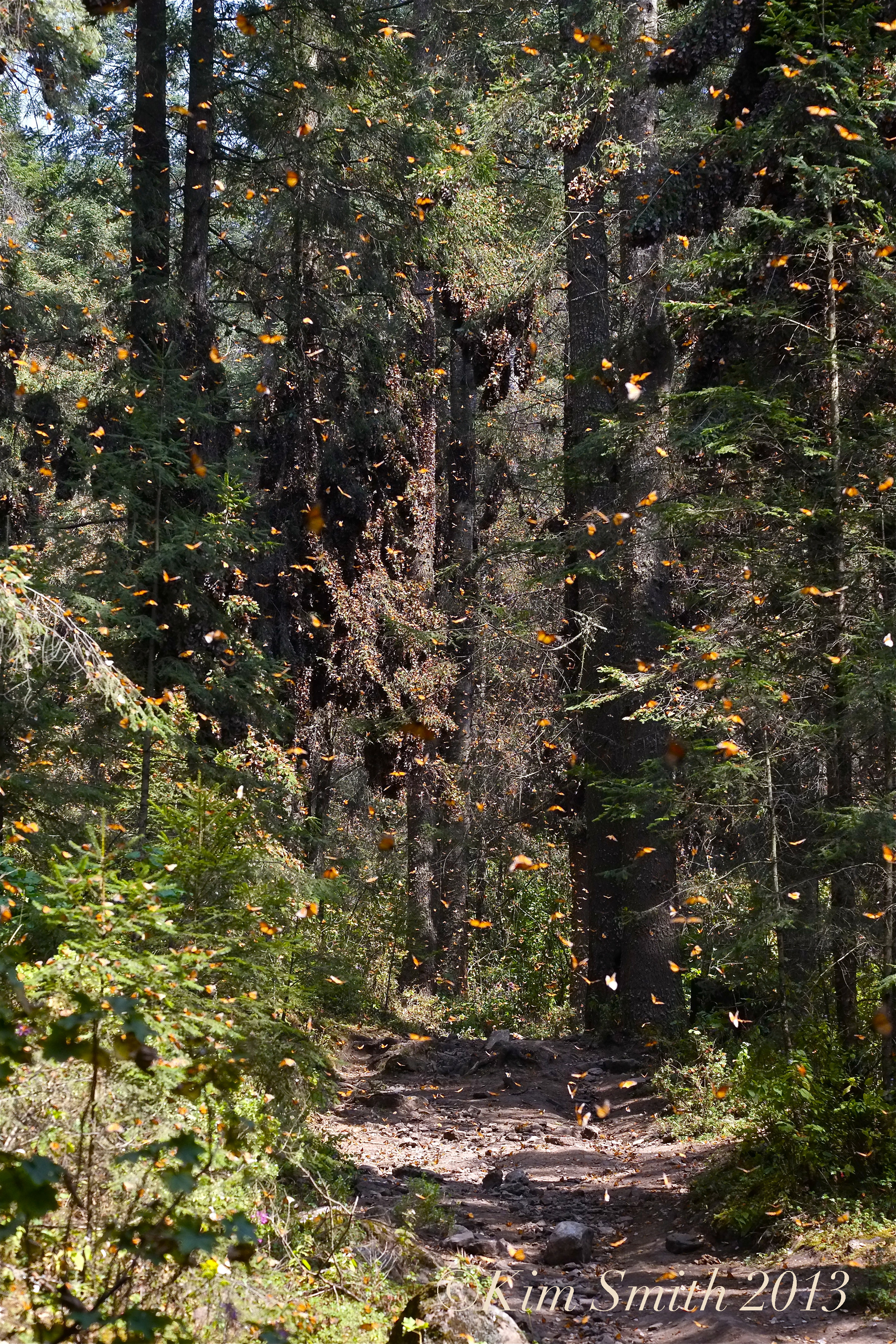
What is a Monarch Butterfly explosion? The butterflies migrate to Mexico to keep from freezing to death in northern climates. The air is cool and moist in the trans-Mexican volcanic mountains, cool enough to keep them inactive and in a state of sexual immaturity, called diapause, but not so cold that they will freeze. As spring approaches and the Earth’s temperature begins to rise, the butterflies sleeping in the oyamel fir forests need to get out of the hot sun. Millions explode from the trees, drink water from nearby mountain streams, and move to a cooler, shadier spot on the mountain.

I hope you’ll come join our program Thursday night at 7pm at the Sawyer Free Library. We’ll be talking all things Monarchs including the current status of the butterfly’s migration, habitat destruction here in our own community, and most importantly, ways in which we can all help the Monarch possibly survive the warming of the earth.

We will be premiering the trailer for my forthcoming film about the Monarchs, too (also titled Beauty on the Wing). I hope to see you there!

For more information, visit the Programs page of my website and the Sawyer Free Library Facebook page.Monarch Butterfly Explosion -1 ©Kim Smith 2014 300dpi copy

MONARCH DAY! STARRING THE EAST GLOUCESTER NEIGHBORHOOD GANG

Pilar Monarch Day ©Kim Smith 2015Pilar has started a new fashion trend, Monarchs as hair accessory.

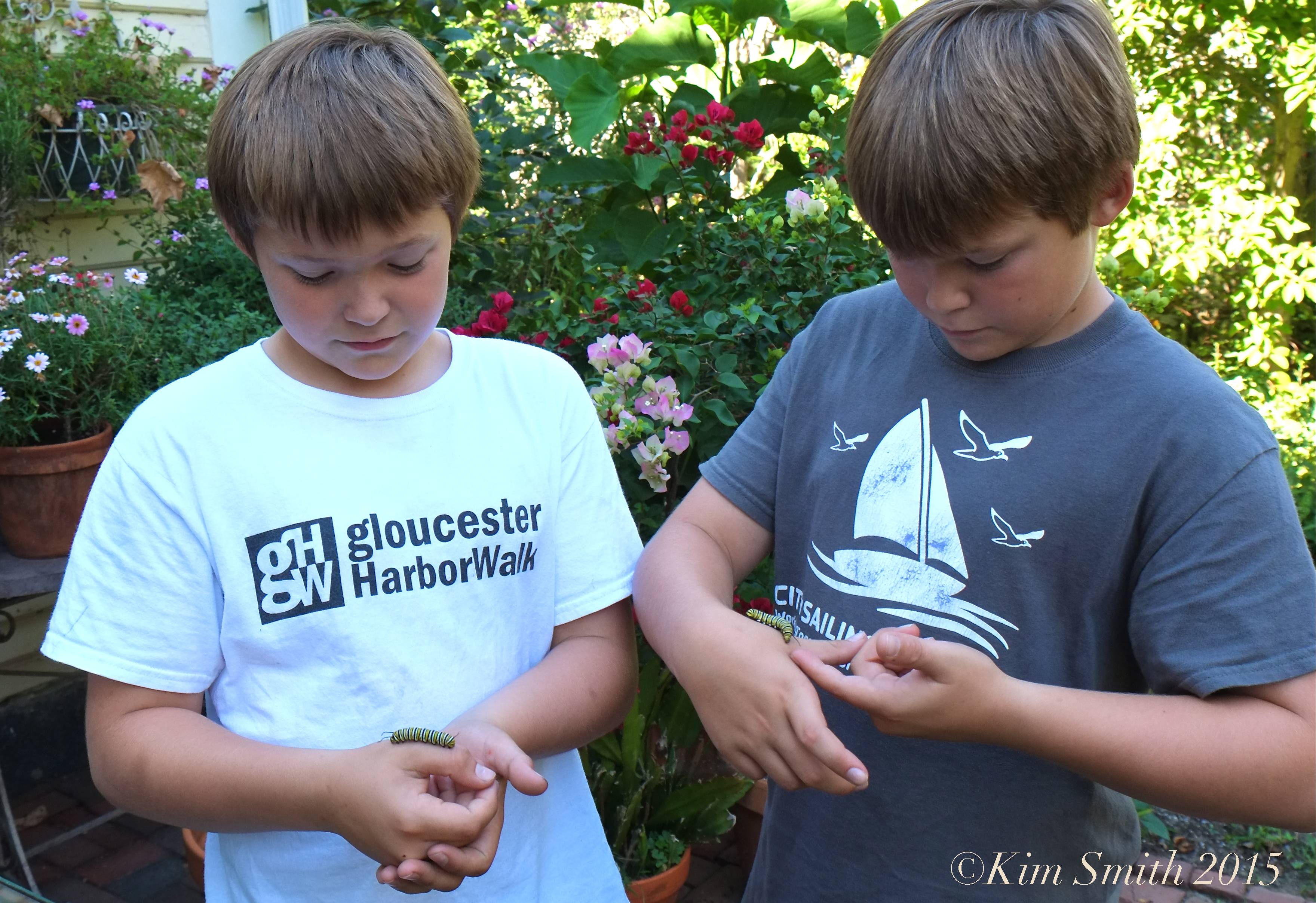
Enchanted by Monarchs!  We had a fantastic day filmmaking, thanks to Emma, Pilar, Frieda, Annie Kate, Lotus, April, Elijah, Esme, Charlie, Atticus, and last but not least, Meadow. And an extra huge thank you to all the moms and dads for not minding the early morning wake up calls and texts to let the kids know the butterflies were emerging! I was tied up filming and so wish I’d taken more stills.

Annie kate, Emma, Pilar Monarch Day ©kim Smith 2015 copyAnnie Kate, Emma, and Pilar

Meadow Monarch Day ©Kim Smith 2015 copyMeadow

See More Photos Here Continue reading

MONARCH CATERPILLAR NONUPLETS

Thank you so much to my friends Charles and George Ryan and Mom Catherine for helping with the Monarch film project. Charles and George Ryan Monarch caterpillars ©Kim Smith 2015

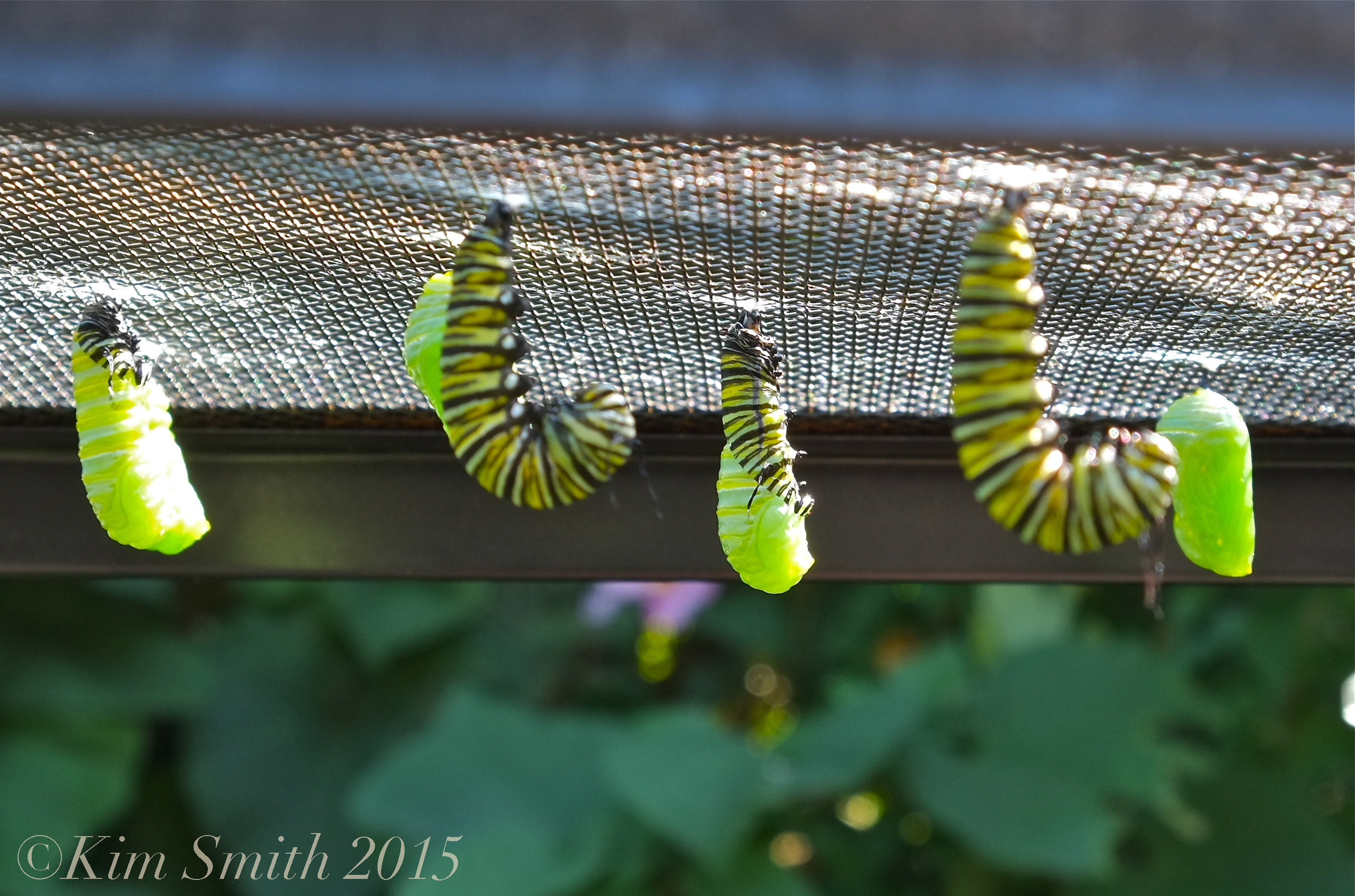
Nature’s Compass ~  My current group of nine Monarchs are synchronized, all lined up on a north-south axis and pupating within moments of each other.Monarch caterpillars north south ©Kim Smith 2015JPG

From the moment a caterpillar emerges, internally it begins to form the adult parts of its body. Adult Monarchs have magnetic receptors along the inner margins of their thorax, which help guide them on their south to north, north to south migration. I wonder if the magnetic receptors are here at work in the caterpillars north-south pattern of pupating.

Monarch caterpillars J-shape, pupating ©Kim Smith 2015All nine hung in a J-shape on the north-south axis as well. Since I took this photo three more have also pupated on the north-south axis. In the above photo, you can see the center caterpillar and caterpillar to the far left are in the midst of changing from a caterpillar to a chrysalis (pupating).