Author Archives: Kimsmithdesigns

Unknown's avatar

About Kimsmithdesigns

Documentary filmmaker, photographer, landscape designer, author, and illustrator. "Beauty on the Wing: Life Story of the Monarch Butterfly" currently airing on PBS. Current film projects include Piping Plovers, Gloucester's Feast of St. Joseph, and Saint Peter's Fiesta. Visit my websites for more information about film and design projects at kimsmithdesigns.com, monarchbutterflyfilm.com, and pipingploverproject.org. Author/illustrator "Oh Garden of Fresh Possibilities! Notes from a Gloucester Garden."

SAFE TRAVELS MONARCHS!

Cape Ann Monarch Butterfly Migration Update

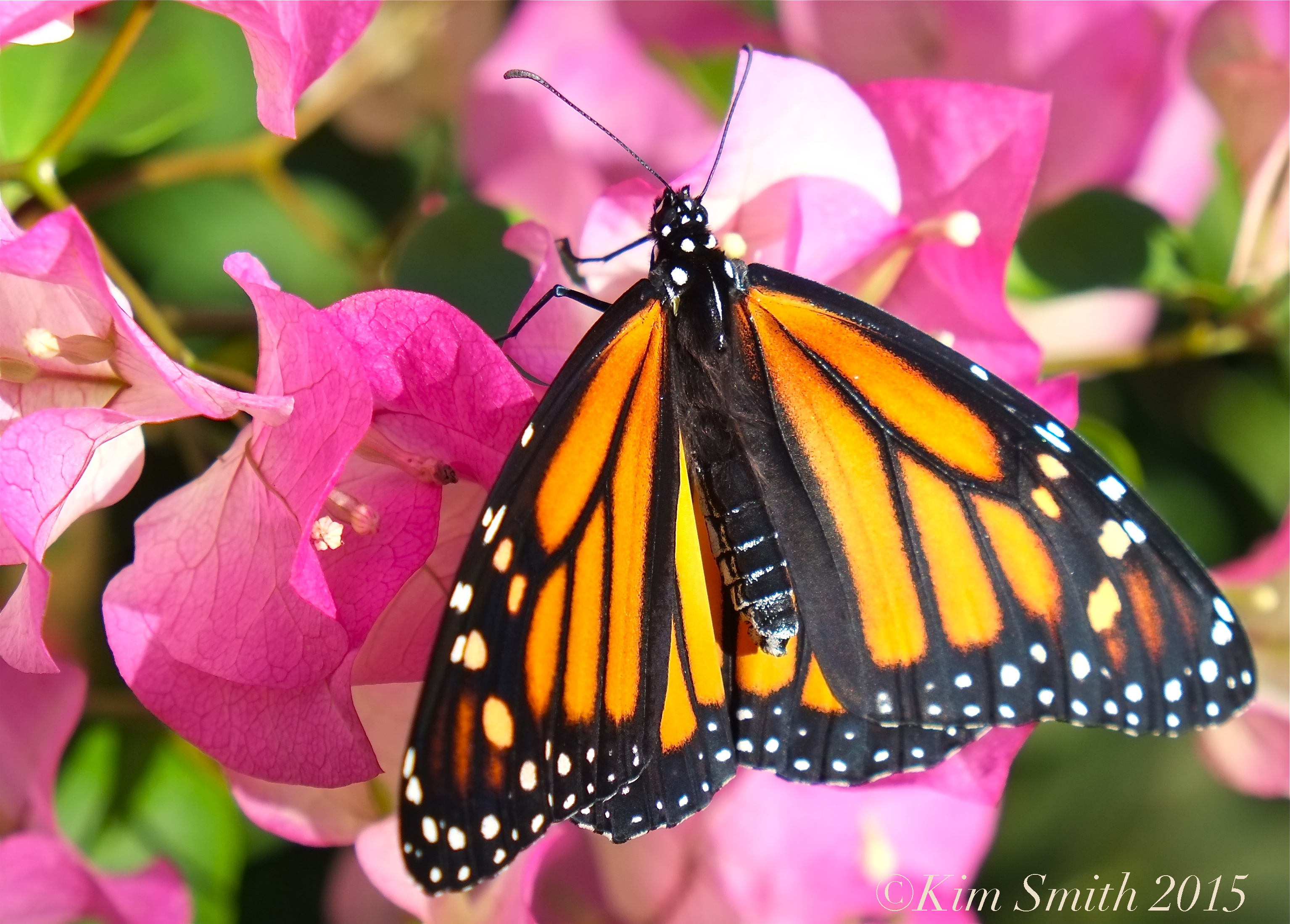
Monarch Butterfly bougainvillea ©Kim Smith 2015Female Monarch and Bougainvillea

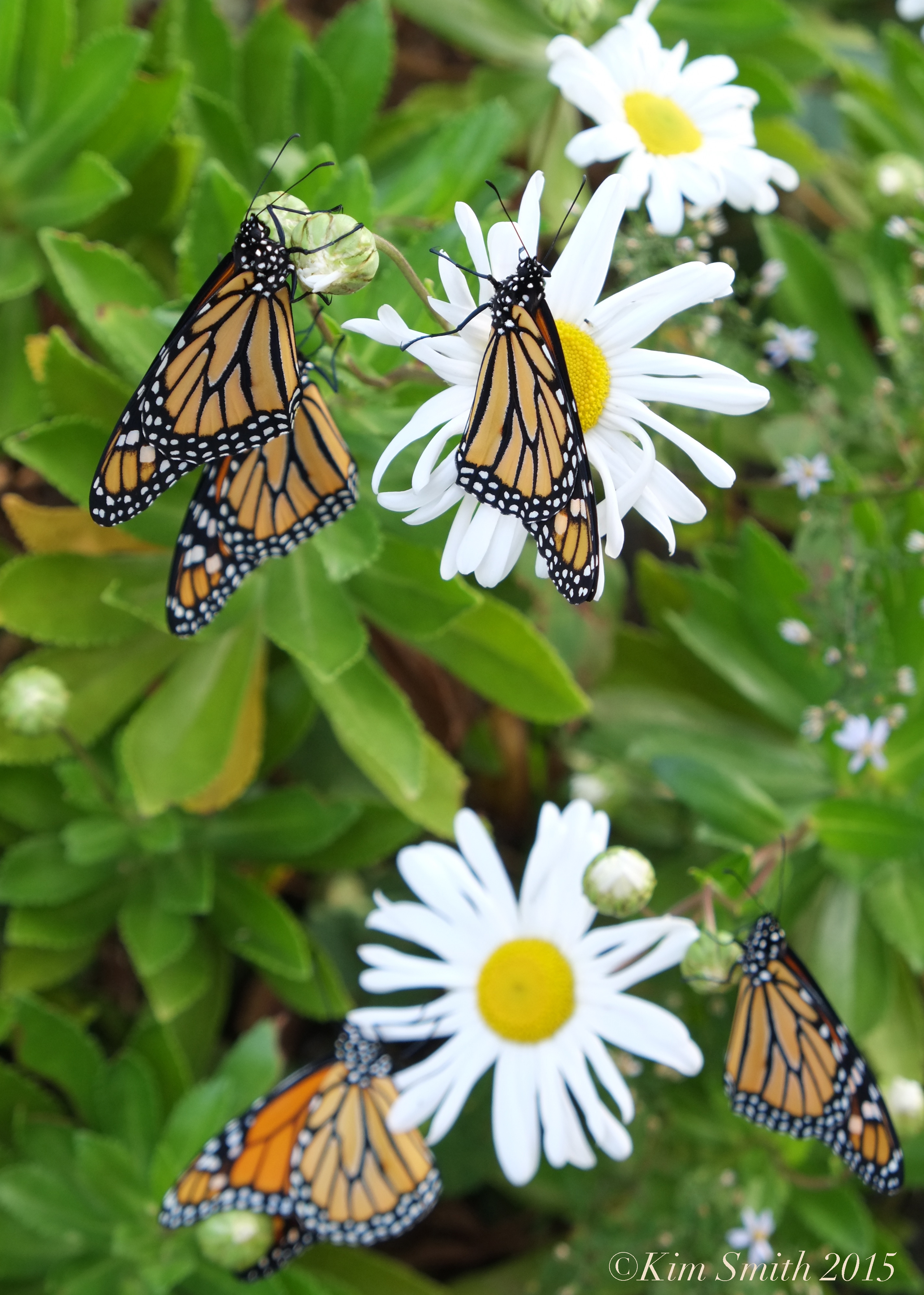
Monarch Butterflies Daisies ©Kim Smith 2015Methuselah Monarchs Heading to Mexico

Our last batch of Monarchs emerged from their chrysalides, dried their wings, and caught the tailwinds to Michoacán. I hope they arrive to their winter roosting sites at the trans-Mexican volcanic mountaintops safely!

Although not many migrating Monarchs were reported on the shores of Cape Ann, a great batch was seen migrating over Lake Erie in late summer. Cape May, which is 400 miles south of Cape Ann, also had a strong showing. Keep on the lookout though because on Election Day in 2007, I photographed a Monarch refueling at Korean Daisies.

The Monarchs are counted by the Mexican scientists in December and the numbers released in January. Last year a tiny increase from 2013 was noted (2013 was the year the lowest numbers were ever recorded). Lets keep our hopes up that the population will continue to improve.

Monarch Butterfly sunflower ©Kim Smith 2015Last Sunflowers of the Season

Monarch Butterfly daisy ©Kim Smith 2015Monarch Butterfly pink bougainvillea ©Kim Smith 2015

MY MONARCH BUTTERFLY PROGRAM AT THE SAWYER FREE LIBRARY

Dear Friends,

Please join us at the Sawyer Free Library on Thursday November 12th at 7:00 pm for my Monarch butterfly program. I am especially, especially excited to present to our community. I hope to see you there! Please note that this is my photo and lecture program, not the new film, which will be coming soon.

For more information visit my website Kim Smith Designs.

2- Monarch New England Aster ©Kim Smith 2013


MONARCH DAY! STARRING THE EAST GLOUCESTER NEIGHBORHOOD GANG

Pilar Monarch Day ©Kim Smith 2015Pilar has started a new fashion trend, Monarchs as hair accessory.

Enchanted by Monarchs!  We had a fantastic day filmmaking, thanks to Emma, Pilar, Frieda, Annie Kate, Lotus, April, Elijah, Esme, Charlie, Atticus, and last but not least, Meadow. And an extra huge thank you to all the moms and dads for not minding the early morning wake up calls and texts to let the kids know the butterflies were emerging! I was tied up filming and so wish I’d taken more stills.

Annie kate, Emma, Pilar Monarch Day ©kim Smith 2015 copyAnnie Kate, Emma, and Pilar

Meadow Monarch Day ©Kim Smith 2015 copyMeadow

See More Photos Here Continue reading

MONARCH CATERPILLAR NONUPLETS

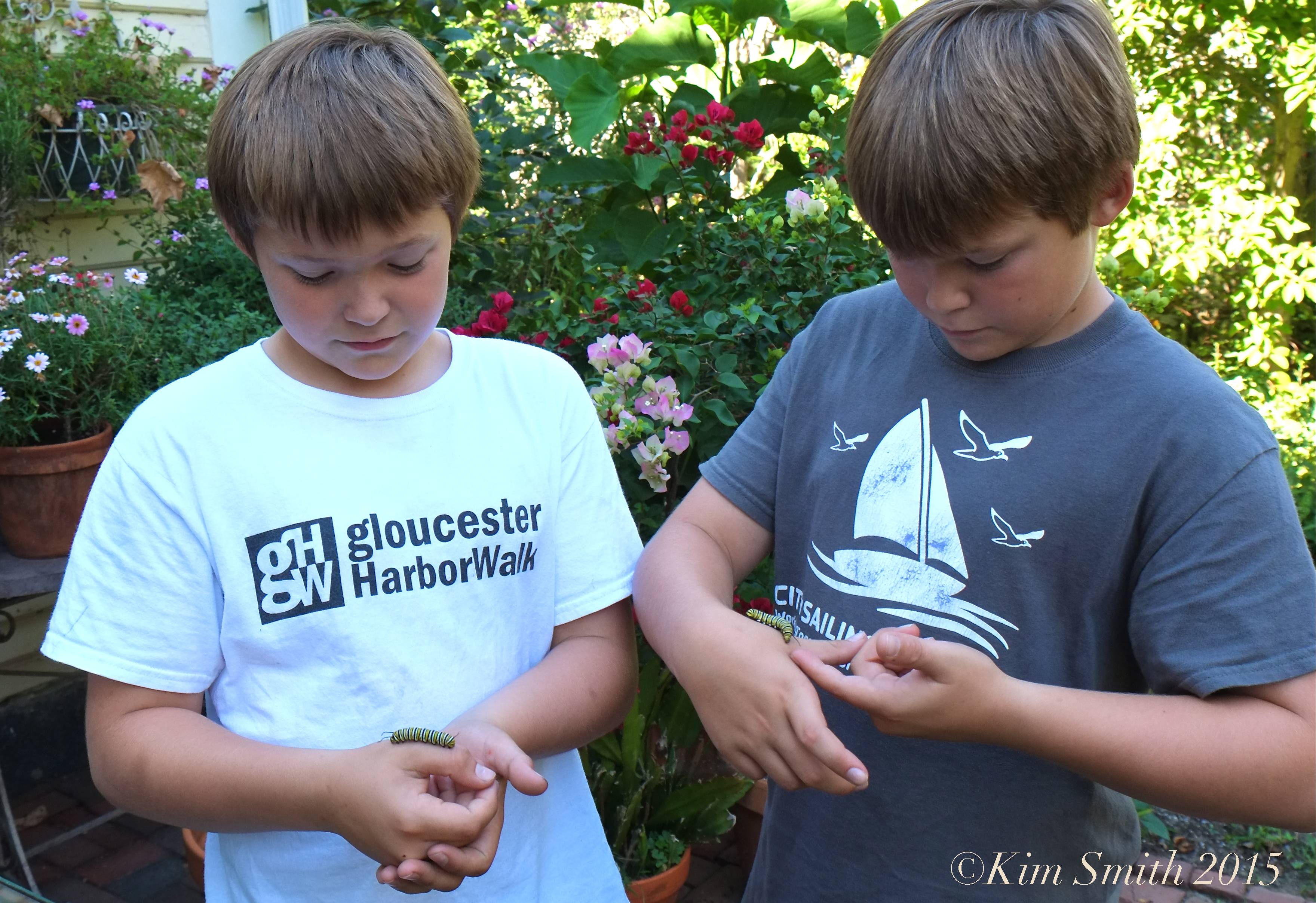
Thank you so much to my friends Charles and George Ryan and Mom Catherine for helping with the Monarch film project. Charles and George Ryan Monarch caterpillars ©Kim Smith 2015

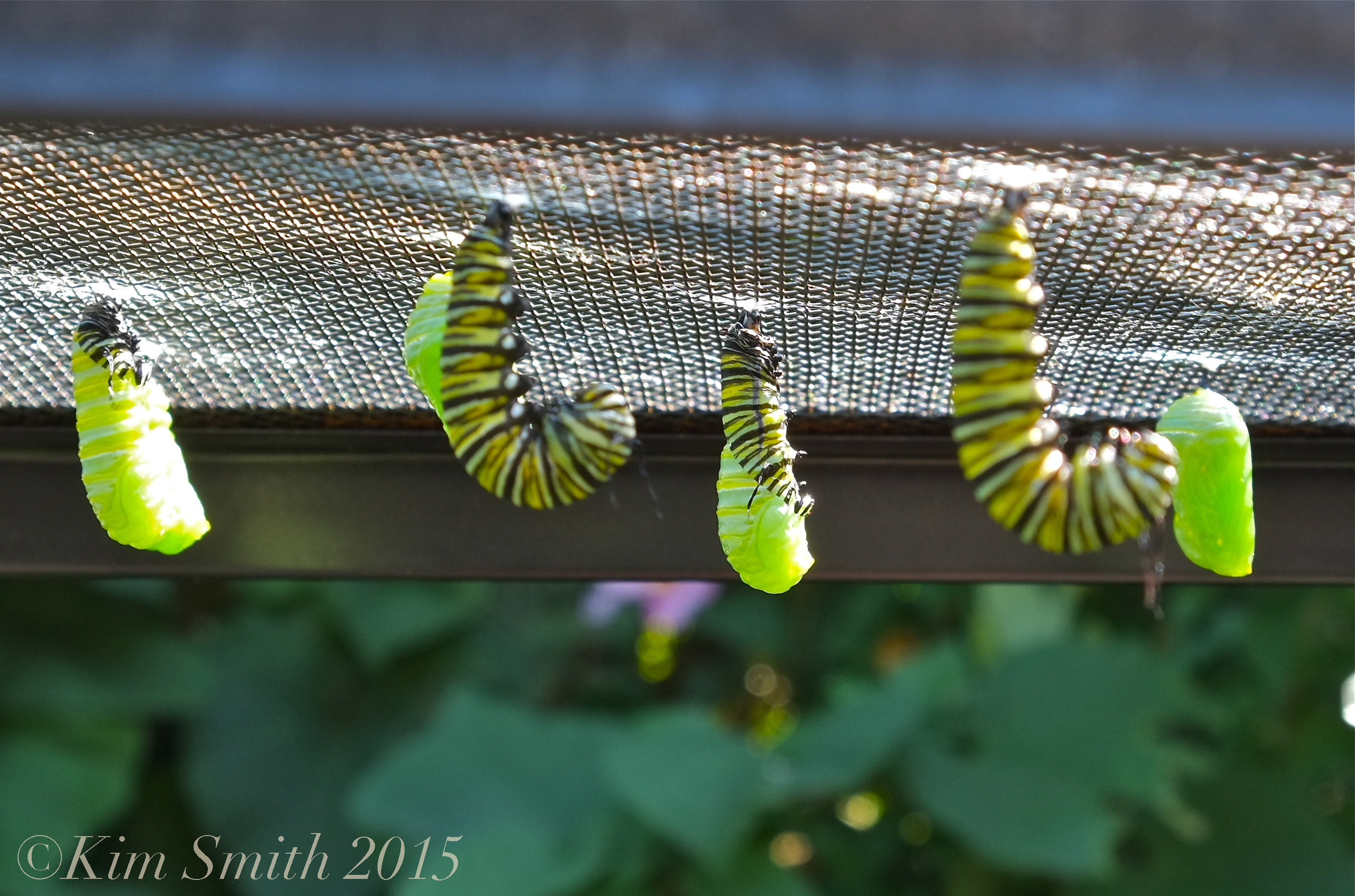
Nature’s Compass ~  My current group of nine Monarchs are synchronized, all lined up on a north-south axis and pupating within moments of each other.Monarch caterpillars north south ©Kim Smith 2015JPG

From the moment a caterpillar emerges, internally it begins to form the adult parts of its body. Adult Monarchs have magnetic receptors along the inner margins of their thorax, which help guide them on their south to north, north to south migration. I wonder if the magnetic receptors are here at work in the caterpillars north-south pattern of pupating.

Monarch caterpillars J-shape, pupating ©Kim Smith 2015All nine hung in a J-shape on the north-south axis as well. Since I took this photo three more have also pupated on the north-south axis. In the above photo, you can see the center caterpillar and caterpillar to the far left are in the midst of changing from a caterpillar to a chrysalis (pupating).

MONARCH BUTTERFLY HELP NEEDED!

Butterfly Days are Here!

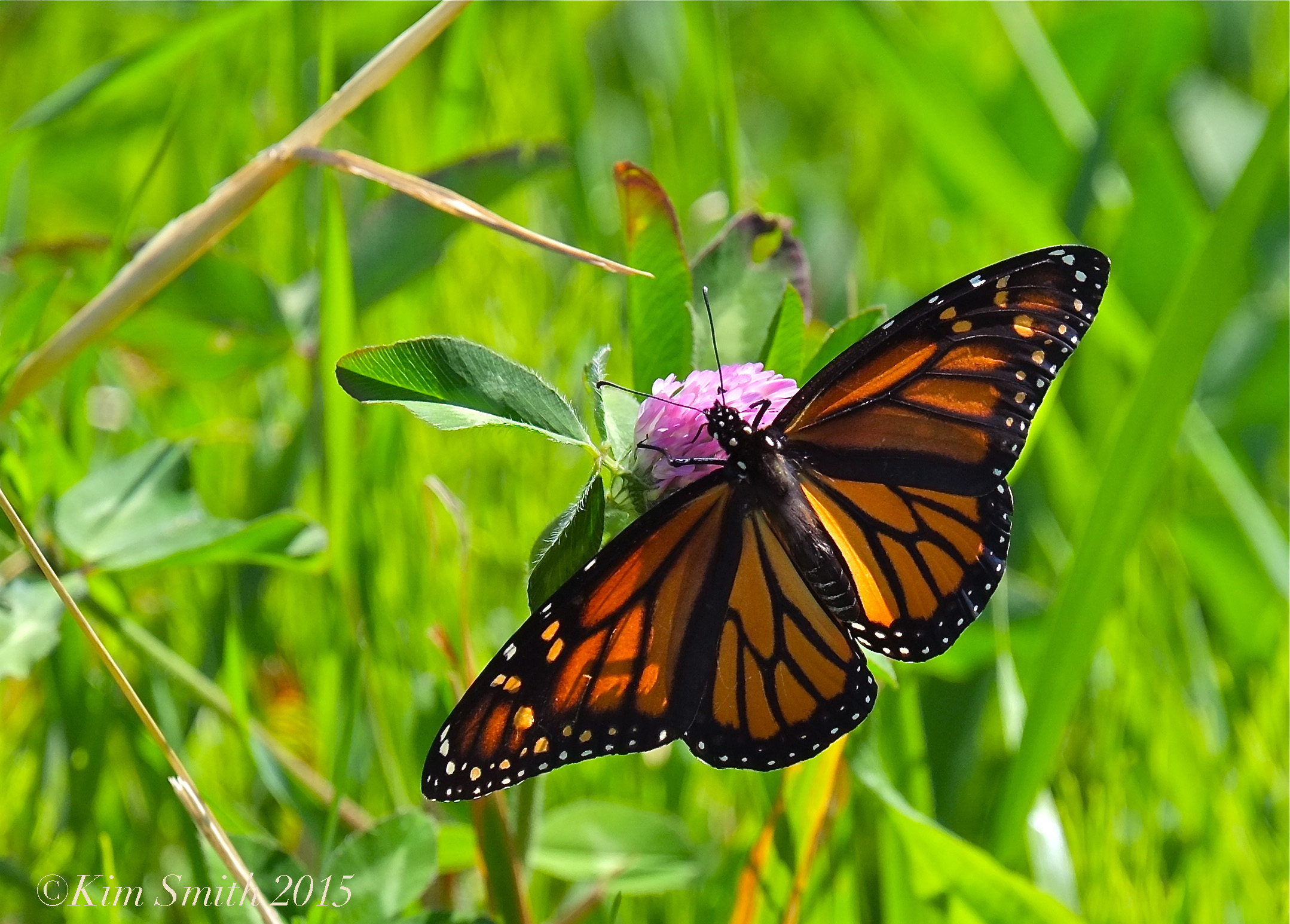
Monarch Butterfly Female -2 ©Kim Smith 2015Female Monarch Butterfly Necating at Red Clover, Waring Field, Rockport

I am looking for Monarch eggs and will travel! Monarch eggs are found on the upper leaves of milkweed plants. The eggs are tiny and dome-shaped, only as large as a pinhead, and are a pale golden yellow color.

Monarch Butterfly Egg ©Kim Smith 2015Monarch Butterfly Egg

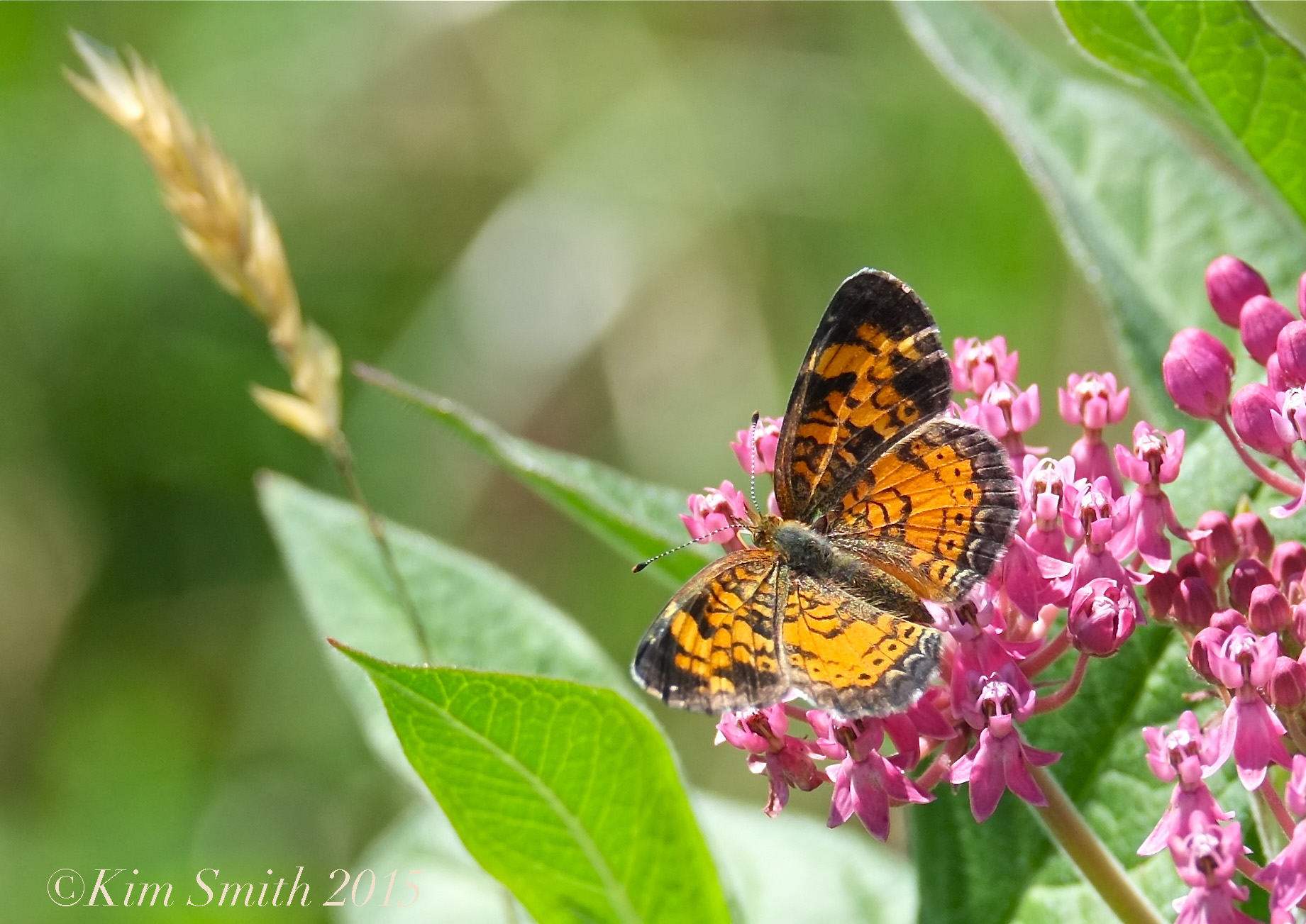
Waring Field supports myriad species of pollinators and is simply a fantastic place to explore. Although I didn’t find any eggs on my search on the leaves at the Common Milkweed patch at Waring this morning, I did see four adult Monarchs, three male and one female, along with fritillaries, a Common Ringlet, a bevy of Pearly Cresentspots, Blue Azures, and Yellow Sulphurs. The Monarchs, Ringlet, and Sulphurs were nectaring at the great field of Red Clover and the Pearl Crescents at the milkweed.

Pearl Crescent  Butterfly Female Milkweed ©Kim Smith 2015Female Pearl Crescent Nectaring at Marsh Milkweed

Common Ringlet Butterfly Waring Field Rockport ©Kim Smith 2015Common Ringlet

Monarch Butterfly Female -3 ©Kim Smith 2015Newly Emerged Female Monarch Butterfly

Please email me at kimsmithdesigns@hotmail.com or leave a comment in the comment section if you have Monarch eggs you’d like to share. Thank you!

   *    *    *

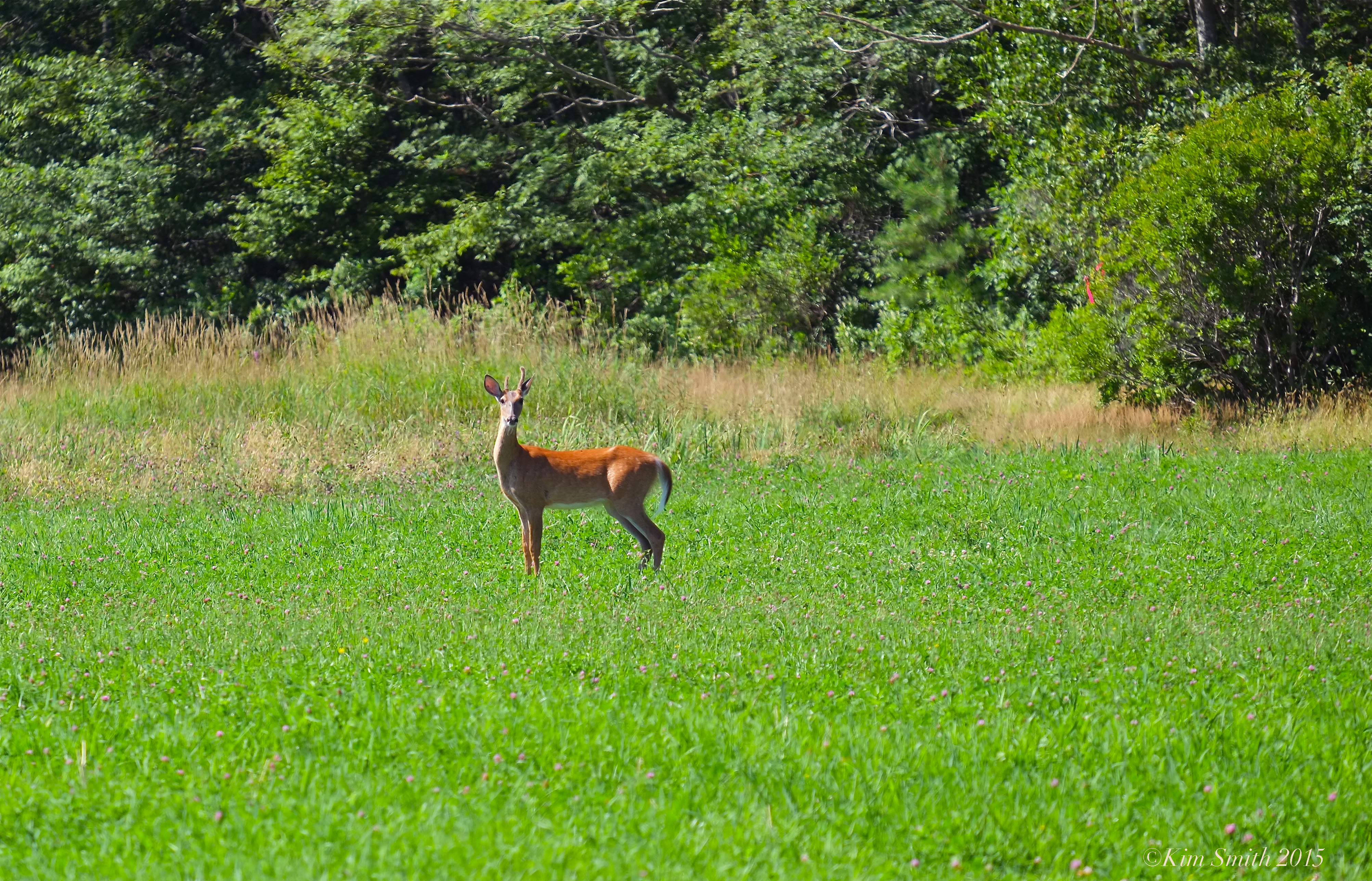
Emerging from the woods onto the sunny lower field, I startled a small herd of White-tailed Deer foraging. If you click on the photo to enlarge, you can see the male deer antlers are covered in velvet. Antlers are true bone structures and are an extension of the skull. The velvet provides blood flow that supplies nutrients and oxygen.

Waring Field Deer ©Kim Smith 2015White-tailed Deer

Common Milkweed Abloom, Here, There, and Everywhere!

Common Milkweed and Bee Asclepias syriaca ©Kim Smith 2015A patch of Common Milkweed (Asclepias syriaca) in bloom has a wonderfully sweet honey-hay scent. Look for it growing along the sand dunes, roadside edges, fields, meadows, and where ever there is a neglected patch. And keep your eyes peeled for Monarchs; the earliest arrivals (for the most part) are synchronized to the flowering of Common Milkweed.

https://instagram.com/p/4opJl6DyjS/

Friend me on Facebook and follow me on TwitterInstagram, and Vine. You can also subscribe to my design website at Kim Smith Designs, and film’s websites at Beauty on the Wing ~ Life Story of the Monarch Butterfly, Gloucester’s Feast of Saint Joseph Community Film Project, and Life Story of the Black Swallowtail Butterfly.

Rain Forest Publications and Mourning Cloak Butterflies

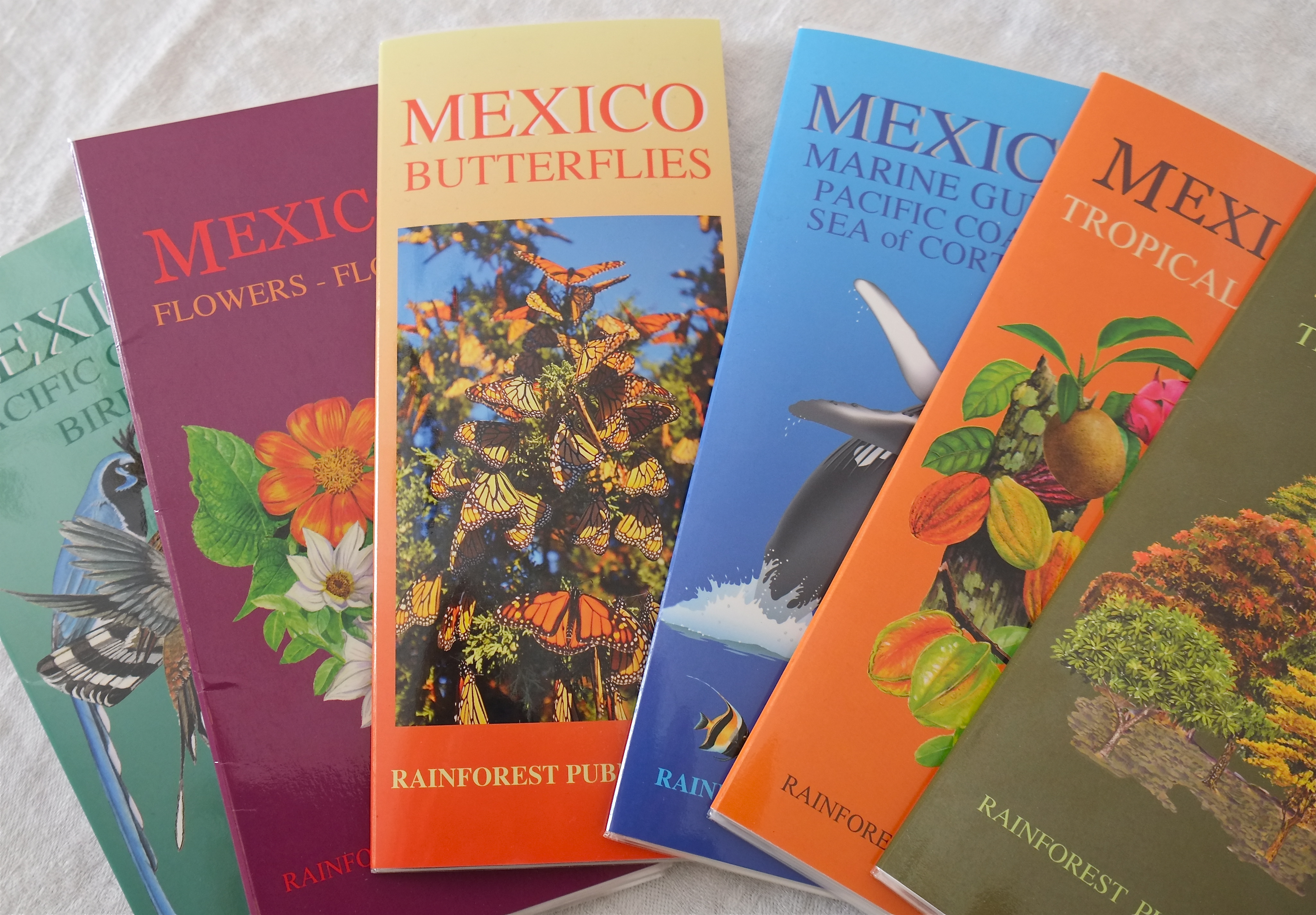
Recently brochures from Rain Forest Publications arrived. Don’t you love pocket guides, for the very reason the name infers–so easy to tuck along when traveling and hiking. That’s my photo on the cover of “Mexico Butterflies.” The photo was taken not in Mexico, but in Gloucester!

Rain Forest Publications Butterfies of Mexico Guide Kim Smith cover photo ©Kim Smith 2015Be on the lookout for the first butterfly of spring, which will most likely be the Mourning Cloak Butterfly. Mourning Cloaks do not spend the winter in the cool volcanic mountains of Mexico as do the Monarchs, or as a chrysalis in our gardens, like the Black Swallowtail, or as a caterpillar rolled up in a tight little ball under a leaf, as does the Wooly Bear, but as an adult butterfly!

Pussy Willows, Salix discolor ©Kim Smith 2014Pussy Willow (Salix discolor)

During the winter months Mourning Cloaks live tucked away in cracks and crevices, between chinks of tree bark, for example. At the first warm breath of spring they begin to take flight, searching for a mate. You’ll often see them on the wing around Pussy Willows, one of the Mourning Cloak caterpillar’s food plants.

Mourning_Cloak_Butterfly_in_South_Central_Alaska

Mourning Cloak image courtesy wiki commons media

Monarchs Eyed for Possible Inclusion Under US Endangered Species Protection

Cape Ann Milkweed and Monarch Habitat, Eastern Point

The U.S. Fish and Wildlife Service is considering adding Monarchs as a threatened species under the Endangered Species Act. A one-year review is underway to monitor the butterfly’s status. Since the 1990s the population has plummeted from about one billion to approximately 35 million. That may seem like a substantial number, but the Monarchs need stronger numbers to be resilient to other threats such as harsh weather.

The reason for the decline is primarily because of loss of milkweed habitat in the agricultural heartland of the United States. With the development of Monsanto’s Roundup and Roundup Ready (glyphosate resistant) seed, farmers are now able to spray glyphosate directly on their corn, soybean, and sorghum crops. Roundup also destroys milkweed. Secondly, with the push for ethanol, farmers have begun to plant corn on conservation land.

If the Fish and Wildlife Service determines that the Monarchs are threatened, they will set aside land for milkweed.

You can read more about the the Monarch Butterfly Endangered Species Act here:

FAQs on the Monarch Butterfly Endangered Species Act Petition

Monarch Butterfly Wildflower Joe-pye ©Kim Smith 2012Monarch Butterfly Drinking Nectar from Native Wildflower Joe-pye Weed

You can learn more about the Monarch migration and the loss of Monarch habitat from Professor Tom Emmel here ~ 

NEW FILM: A FLIGHT OF MONARCHS

When watching, know that the first two minutes of the film were shot in Gloucester. I think you will be dazzled by the sheer numbers of Monarchs that travel through Cape Ann’s backyards and meadows during the peak of migration.

I began photographing the Monarchs in 2006, which was a year when we had an extraordinary number of Monarchs visiting our shores. At that time, I became determined that if ever again this phenomenon were to occur on Cape Ann, I was going to have the ability to document on film, rather than only through still images, this beautiful event for my community. It’s hard to imagine without observing and here you can see what I have wanted to share.

A Flight of Monarchs begins on a September day as first one and then passels of Monarchs begin to arrive to the fields and meadows of Cape Ann, carried across Massachusetts Bay on a tailwind. By the early evening light they begin to pour into the surrounding trees, clustering to stay warm in the branches furthest away from the prevailing breezes. The following morning as the sun begins to touch their wings, they alight from the trees, seeking the freshest wildflowers from which to drink nectar to help build their lipid reserves for the several thousand mile journey south. They drink and drink until the last of the sun’s rays dip below the tree line. As they arrived on a tailwind, they again depart, and are carried to the next gathering area. For coastal Monarchs, Allens Pond, which is located in Westport, Massachusetts is often the next stop.

In the next scene, the butterflies have arrived to the sacred oyamel fir forests of Angangueo, Michoacán, deep in the heart of the Trans-Mexican Volcanic Belt. It’s early morning and the butterflies are suspended in great primordial branched clusters that may become so heavy from the weight of so many butterflies the boughs of the trees bend to the breaking point. Later in the day, as the sun begins to warm their wings, the butterflies begin to stir. During the winter, it is imperative that the Monarch’s body temperature remains relatively low. They leave the sunniest branches in search of shade and a drink of water from nearby mountain streams. Occasionally in late February, as the air temperatures begin to warm with the coming springtime, for a short period during the day, the butterflies leave the trees all at once. This phenomenon is called a butterfly “explosion,” and is a truly magnificent event to observe.

A Flight of Monarchs is set to the evocative and tender “Fields of Blue,” written and performed by composer and guitarist Jesse Cook and his band, to which permission was granted by the artist for the purpose of this short film. Here is a link to Cook’s website. I highly, highly recommend attending a live performance of Jesse Cook and Company. As was I, you will be completely taken by their gorgeous music, exquisite artistry, and with Cook’s songwriting, will travel in beautiful melodies inspired from around the world.

I am currently editing my feature length documentary, Beauty on the Wing, which after months and months of organizing and editing three years of footage, is currently running at approximately twelve hours in length. At eleven hours too long, I have a great deal of editing to accomplish in the coming winter months!

A Flight of Monarchs presented here is the shorter version of the film that I created for the Berkshire Museum’s “Butterflies” exhibit. The first version is six minutes long and played on a continuous loop in the main gallery of the exhibit hall. The longer version will soon be posted on Vimeo.


Check Out Rainforest Publications

Rainforest Publications recently licensed one of my Monarch photos, which was shot on Eastern Point, for the cover of their newest pocket field guide, Butterflies of Mexico. You can get a preview of the new field guide by clicking here; look towards the bottom of the page.

Monarchs Gloucester MA ©Kim Smith 2012 -1269I requested their field guide on Mexican Flowers, which Larry, the publisher, kindly sent along. I love it–the guide is beautifully illustrated, and well, just so pocketable! I wished I had it on my trip last winter to Agangueo to film the Monarchs and especially appreciate how the guide is organized by plant family as opposed to alphabetically.

If any of our world traveling GMG readers are planning a trip to Costa Rica, Mexico, Florida, Hawaii, Panama, Peru, California, Nicaragua, Belize, or the Pacific Northwest I recommend checking out their website, Rainforest Publications. Specific to each region, they offer field guides on marine animals, birds, orchids, wildflowers, butterflies, trees, reptiles, amphibians, and more. They even have a field guide for marine mammals of the North Atlantic. At only $5.95. I think this would be ideal for whale watchers (and for whale watching companies like Seven Seas to carry the guides).