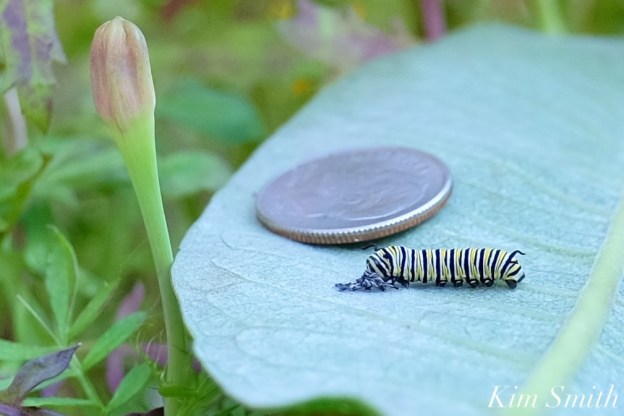
More teenies found in the garden! I thought we had seen the last Monarch eggs but while cutting milkweed in the garden for the larger caterpillars, we found four more! I can’t recall when was the last time I saw this many Monarchs in our garden and in meadows.
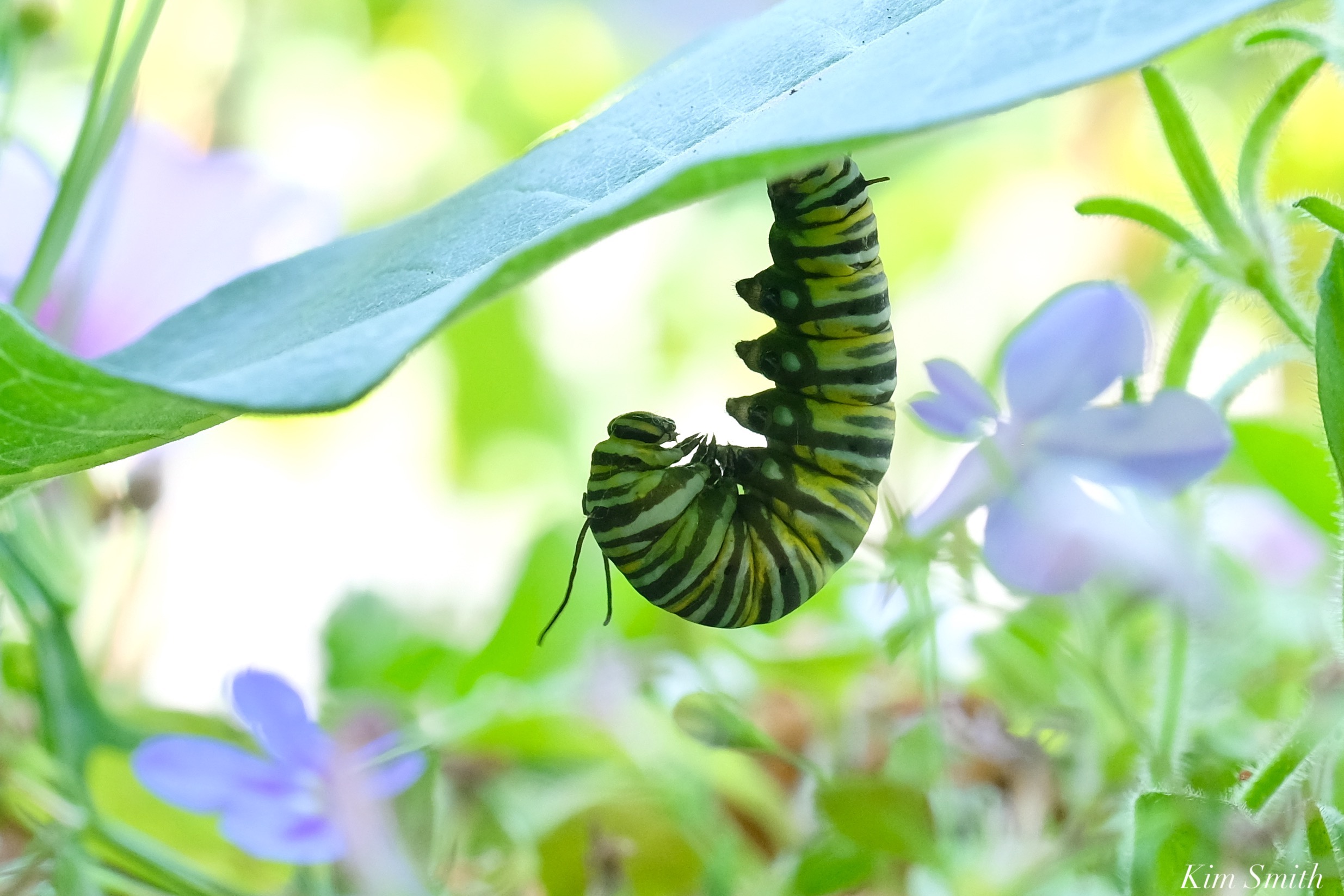
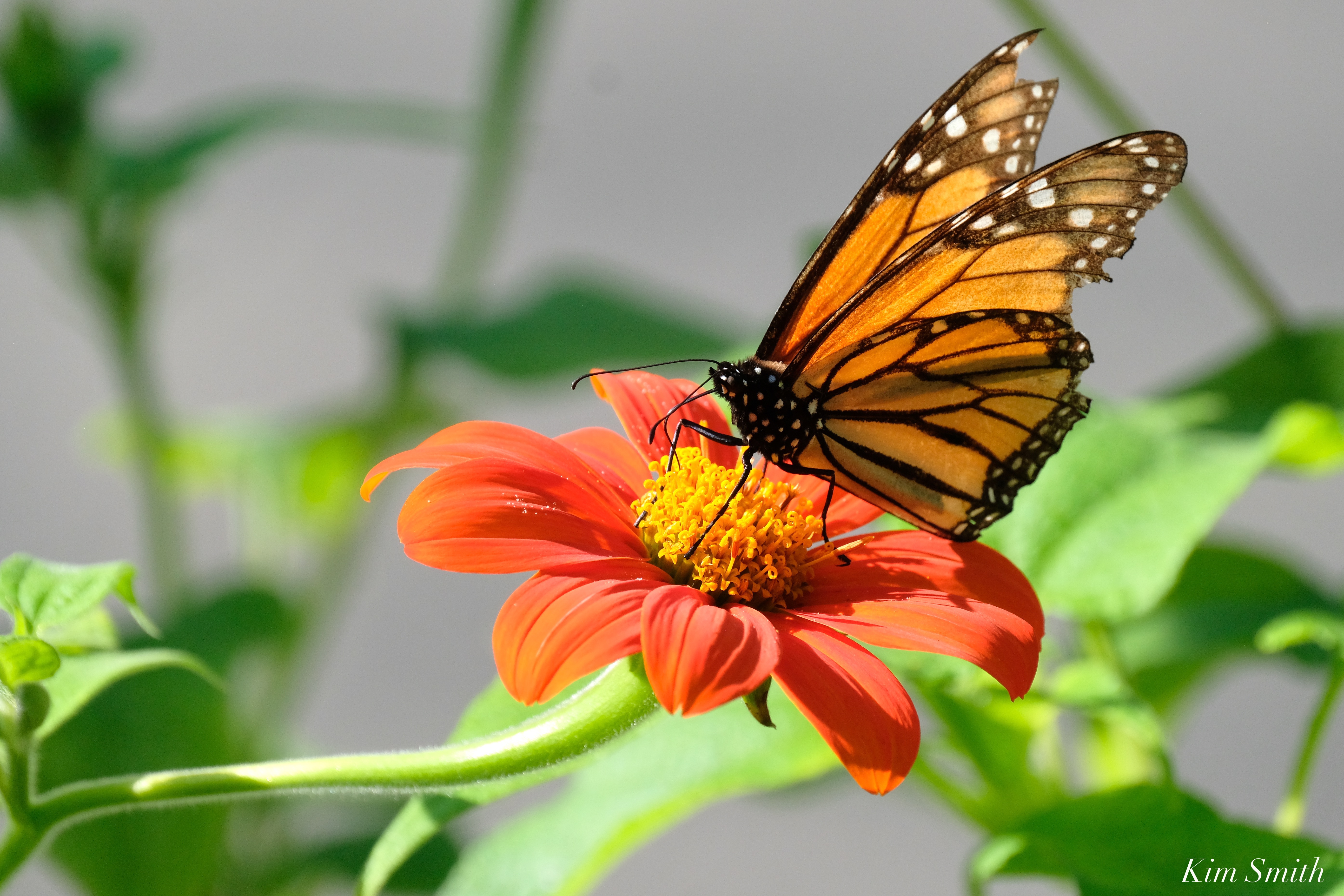
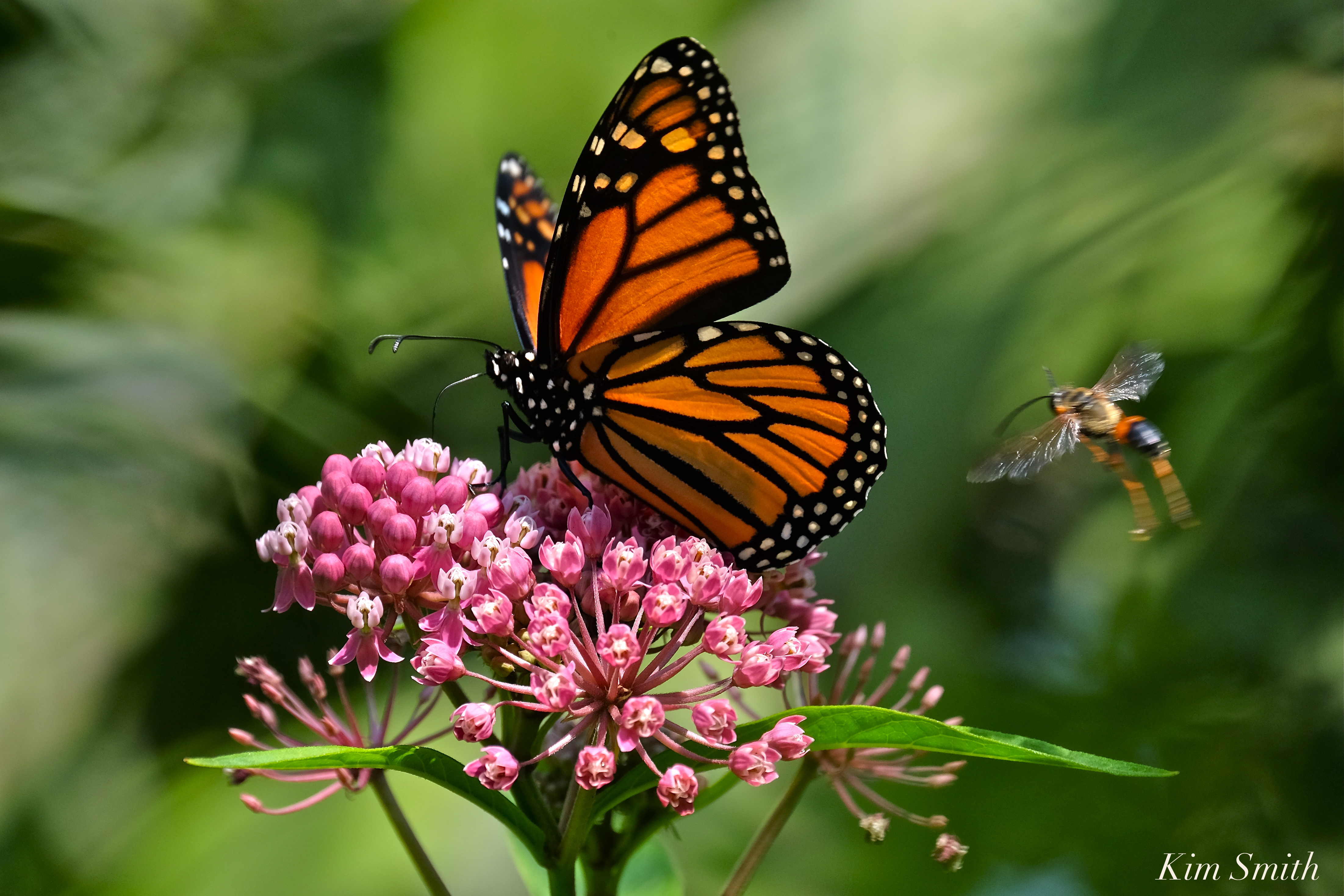
For your daily Monarch photo, today we have a range of Monarchs in our garden in different stages, from minuscule first instars to J-shapes readying to pupate to an old worn out boy winding down.
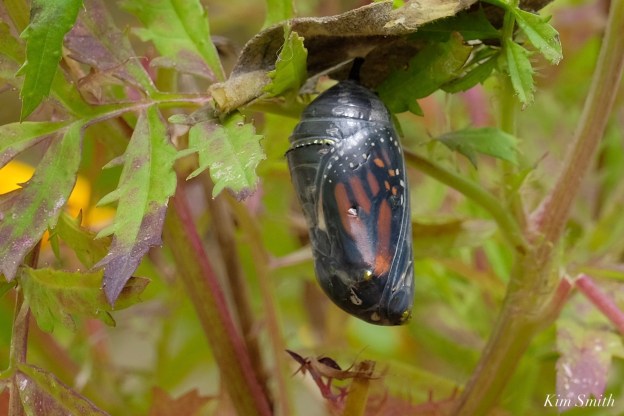
1st instar3rd InstarJ-shape readying to pupateChrysalisNewly emerged zipping together proboscis Female newly emerged drying wet wings and readying for take offAn old boy – note his tattered and fading wings
Please consider making a tax deductible donation, or becoming an underwriter, to bring our Monarch Butterfly documentary Beauty on the Wing: Life Story of the Monarch Butterfly to American Public Television. To Learn More go here and to DONATE go here. For the latest update from PBS, please go here: Over the Moon.Thank you!
Recently I had the joy to present a screening of Beauty on the Wing to the Pennsylvania Bucks County Audubon, in collaboration with several conservation and environmental organizations. It was a fantastically engaged audience and one of the attendees wrote to the region’s nature reporter, Pam Baxter, where the story appeared in a number of Pennsylvania newspapers.
From the Ground Up: Preserving beauty on the wing
THE REPORTER By Pam Baxter For MediaNews Group
I want to share with you an email that I received in response to my column last week in which I reviewed a new book, by Sara Dykman, titled “Bicycling with Butterflies.” (2021, Timber Press)
The reader wrote:
“I read your article today about monarchs. My wife and I recently saw a film created over a several year period by Kim Smith. It has won many awards as listed on her website. It was sponsored by local environmental groups and others for a local showing via Zoom. I thought I knew everything about the monarch, but her video of the life cycle was amazing, with incredible detail.” (The film is tentatively scheduled to air on PBS in February 2022.)
I clicked on the website link provided (see below), and discovered that it contains a short, free video designed for children, titled, “The Marvelous Magnificent Migrating Monarch.” The detail of the close-ups of the various stages of the monarch’s life-cycle is captivating, and a young child featured in the video demonstrates how easy it is to make a monarch habitat to be able to observe and help restore the number of monarchs in the wild. The message is that anyone can raise monarchs, even pre-schoolers.
As I mentioned in my previous column, helping monarchs is really as simple as planting monarch-sustaining milkweed plants, along with other native, nectar plants. Milkweed is the only plant that monarchs feed on. There are many species, and it’s important to plant the ones suited to this area. The best ones for the Delaware Valley are Swamp Milkweed (Asclepias incarnata), and Butterfly Weed (Asclepias tuberosa). Swamp Milkweed has lavender-pink flowers and a lovely evening fragrance. It can grow fairly large, and works well in a stand-alone planting bed or in a naturalized border. With its bright orange or yellow flowers and more refined habit, Butterfly Weed is a knockout in any flower bed or container.
Marsh Milkweed (Asclepias incarnata)
A monarch “habitat” only really needs to comes into play if you want to go the next step — and if you want to get up close to nature. All that is required — in addition to some care and curiosity — is a large aquarium with a screen cover, some cheesecloth, a glass jar with a lid (make holes in the lid), and water. When you find monarch caterpillars on your milkweed, cut the stem they are on, and place it through the holes in the jar lid, so that the stem is in the water. Cover the aquarium with the cheesecloth and then the screen. Caterpillars can eat a huge amount for their size, so be prepared to add/replace milkweed stems as needed.
In his email, the reader also explained that donations are needed to enable Kim Smith’s film, “Beauty on the Wing,” to appear on PBS:
“[The film] has been accepted by PBS, but requires a fee for distribution to get it shown. She has a link for donations to reach the amount she needs. It is tentatively scheduled for February 2022. The web-site explains how to donate to get it on PBS. I recommend this highly and thought you might like to keep an eye out for it when hopefully it will appear on PBS. (https://monarchbutterflyfilm.com/)”
Last week, I discovered that monarchs are at risk not just from habitat loss in their breeding and over-wintering grounds, both here and in Mexico. The larvae are vulnerable to predation by stink bugs, both the nymphs and the adults. Sadly, we discovered this just last week in our own garden, with two of four monarch caterpillars killed by stink bugs. More incentive to “adopt” at least some of the monarch caterpillars, to keep them safe from these predators. I’ve done this with black swallowtails, and it’s a fascinating process.
Pam Baxter is an avid organic vegetable gardener who lives in Kimberton. Direct e-mail to pamelacbaxter@gmail.com, or send mail to P.O. Box 80, Kimberton, PA 19442. Share your gardening stories on Facebook at “Chester County Roots.” Pam’s book for children and families, Big Life Lessons from Nature’s Little Secrets, is available on Amazon.
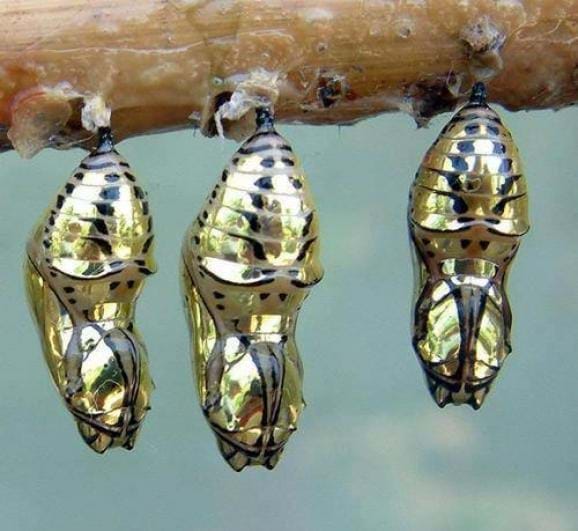
Glimmering sparkly gold in the sunlight, a question often asked is why is the Monarch chrysalis adorned with metallic dots and dashes? The gold dots serve the function of oxygen exchange but that doesn’t answer how and why the dots are gold.
Since time immemorial people have noticed the brilliant golden dots, dashes, and gold leafing of many species of butterfly chrysalides. The word chrysalis originates from the Greek word “chrysos,” which means gold.
There are are several hypotheses. The two that make the most sense are deterrents to predators and camouflage.
For the same reason the iridescent scales of the Blue Morpho Butterfly flash light when the butterfly is in flight, the golden markings of the chrysalis catch light, confusing and deterring predators.
Butterfly pupae are protein-rich easy targets. They are too busy rearranging their insides while undergoing metamorphosis to fend off predators. For the most part, throughout a butterfly’s life cycle, from caterpillar to chrysalis to adult, each species has evolved with specific-to-that-species warning and/or camouflage markings.
The chrysalis of the Black Swallowtail Butterfly is a perfect example. When the butterfly pupates in the spring and summer, the chrysalis has a soft golden green hue, which blends beautifully with the lush green of summer foliage.
When the butterfly pupates late in the summer, the chrysalis turns woody brown, taking on the same hues of bare tree branches.
Golden studs, dashes, and leafing reflect the surrounding area, create flashes of light, look like drops of dew, shafts of light, and is some cases, such as that of the Tigerwing Butterfly, may frighten a predator when it sees its own reflection.
Tigerwing Butterfly (Tithorea harmonia) Photo by Desus Mortus
How the gold is formed is easier to pinpoint. Metallic and iridescent markings in butterflies are created when both pigmented cells (in this case yellow carotenoids) and structural cells are present. You see carotenoids present when trees turn yellow, gold, and orange in autumn. The Monarch caterpillar gets its carotenoids from the plant it eats, milkweed.
The crown of the Monarch pupa is called a diadem. If you look closely at the diadem, it’s a raised structure, a line of tiny hills. The combination of the raised hills and carotenoids present both absorb and reflects the light, creating the appearance of shiny gold.
Please consider making a tax deductible donation, or becoming an underwriter, to bring our Monarch Butterfly documentary Beauty on the Wing: Life Story of the Monarch Butterfly to American Public Television. To Learn More go here and to DONATE go here. Thank you!
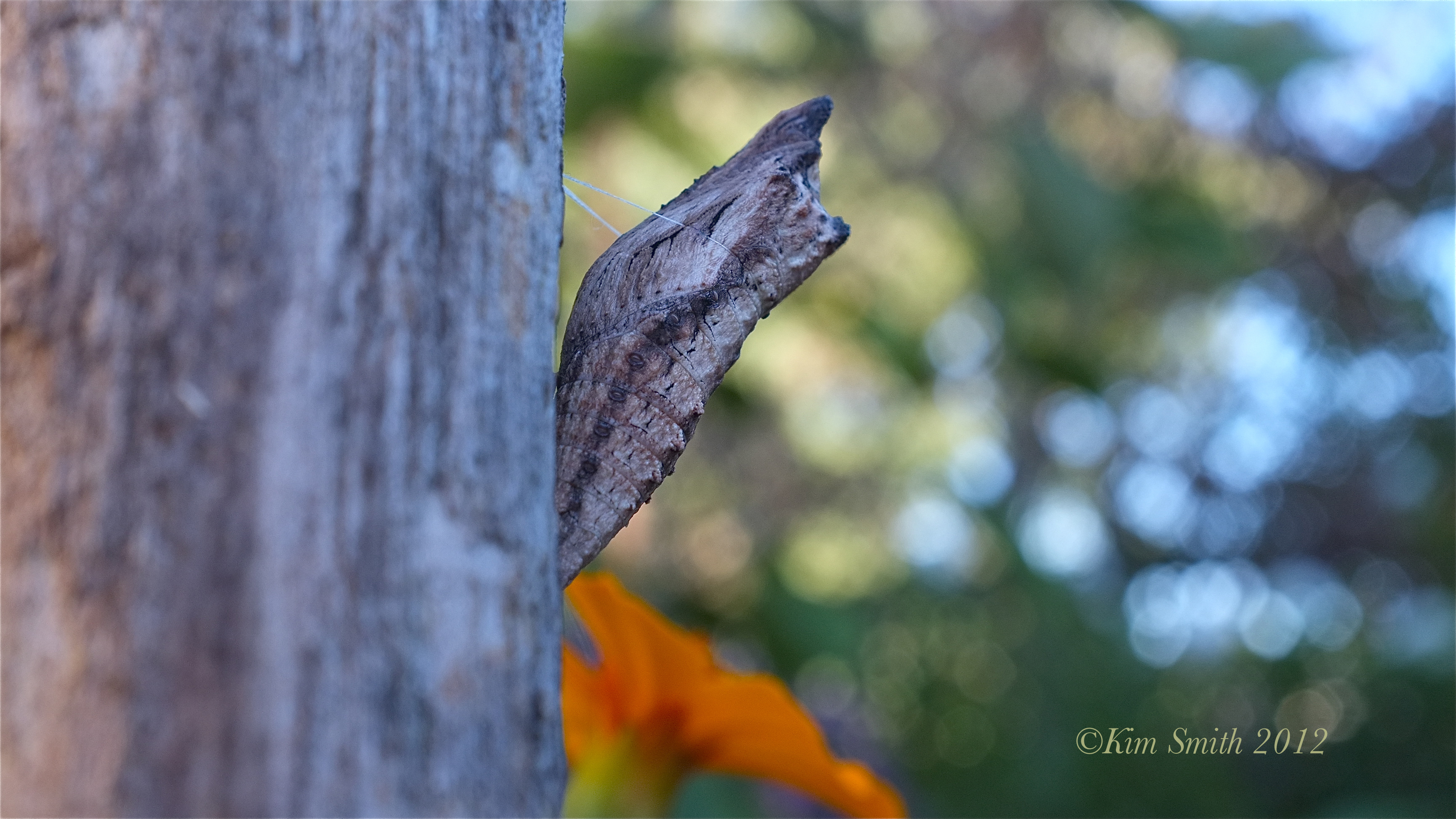
The pupating Monarch caterpillar spins a fine mat of silky threads, to which the little black post, called the cremaster, attaches during pupation. Thirty or so of these jade-like pendants are in the garden and readying to emerge.
Twins!
Please consider making a tax deductible donation, or becoming an underwriter, to bring our Monarch Butterfly documentary Beauty on the Wing: Life Story of the Monarch Butterfly to American Public Television. To Learn More go here and to DONATE go here. Thank you!
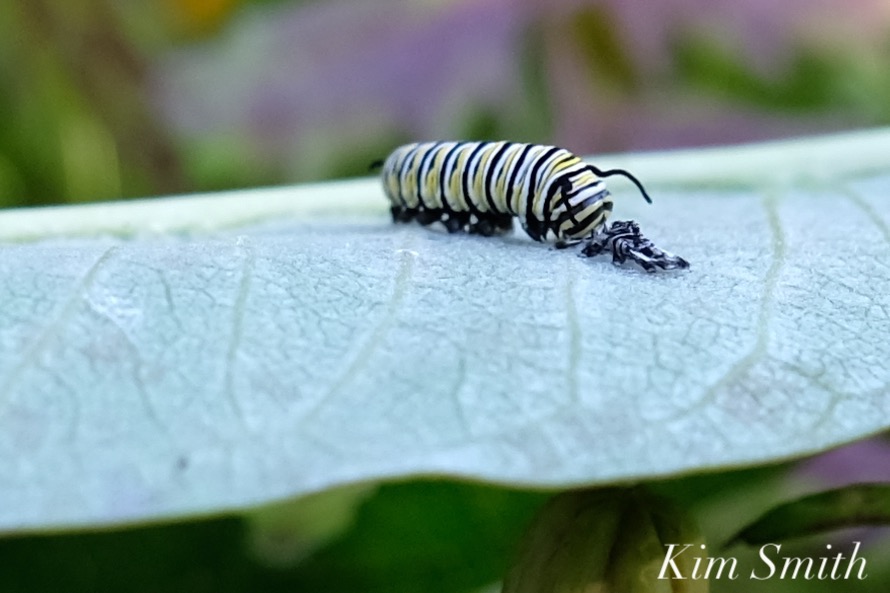
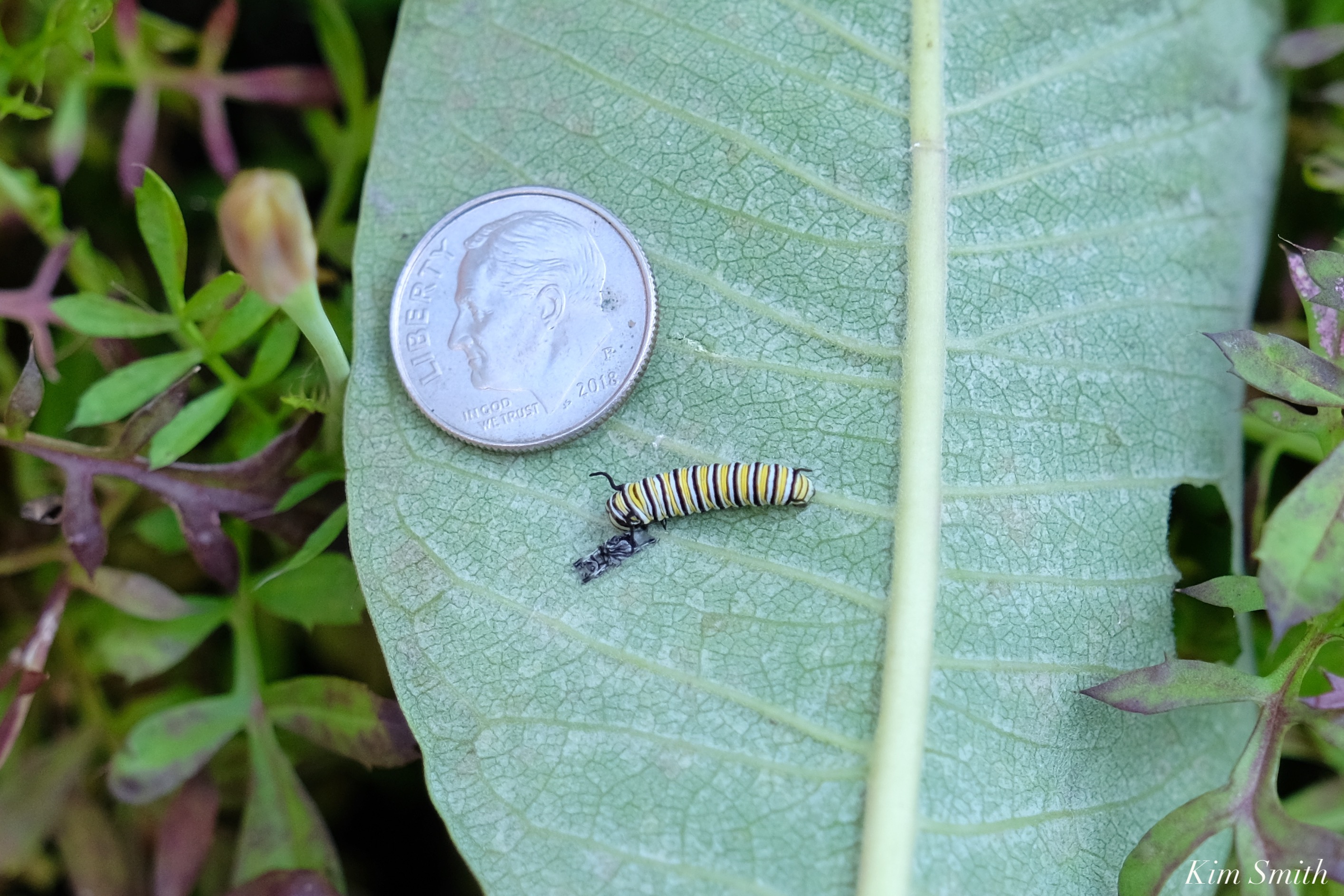
Did you ever wonder how a caterpillar fits into its new suit after shedding the old? The caterpillar in the photo has just shed its skin, or molted, and you can see its discarded and shriveled skin.
After molting, the caterpillar rests quietly for a bit, sucking in great deal of air, which expands the new suit. After molting and resting, the caterpillar eats its old skin.
The caterpillar feeds and feeds, expanding and growing into its baggy suit until it again feels a sense of tightening and will molt again.
Caterpillars molt four to five times and each stage is called an instar, for example, 1st instar, 2nd instar, 3rd instar, etc.
I haven’t seen a female depositing eggs for a week or so. Perhaps this is our last batch of caterpillars and these will grow to become the Super Monarchs, the Monarchs that journey to Mexico.
Last of the teeny tinies?
Please consider making a tax deductible donation, or becoming an underwriter, to bring our Monarch Butterfly documentary Beauty on the Wing: Life Story of the Monarch Butterfly to American Public Television. To Learn More go here and to DONATE go here. Thank you!
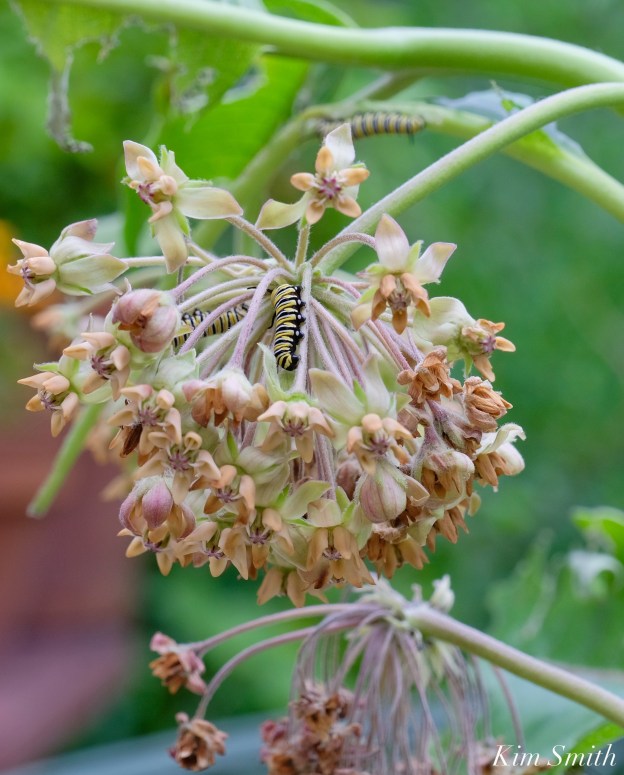
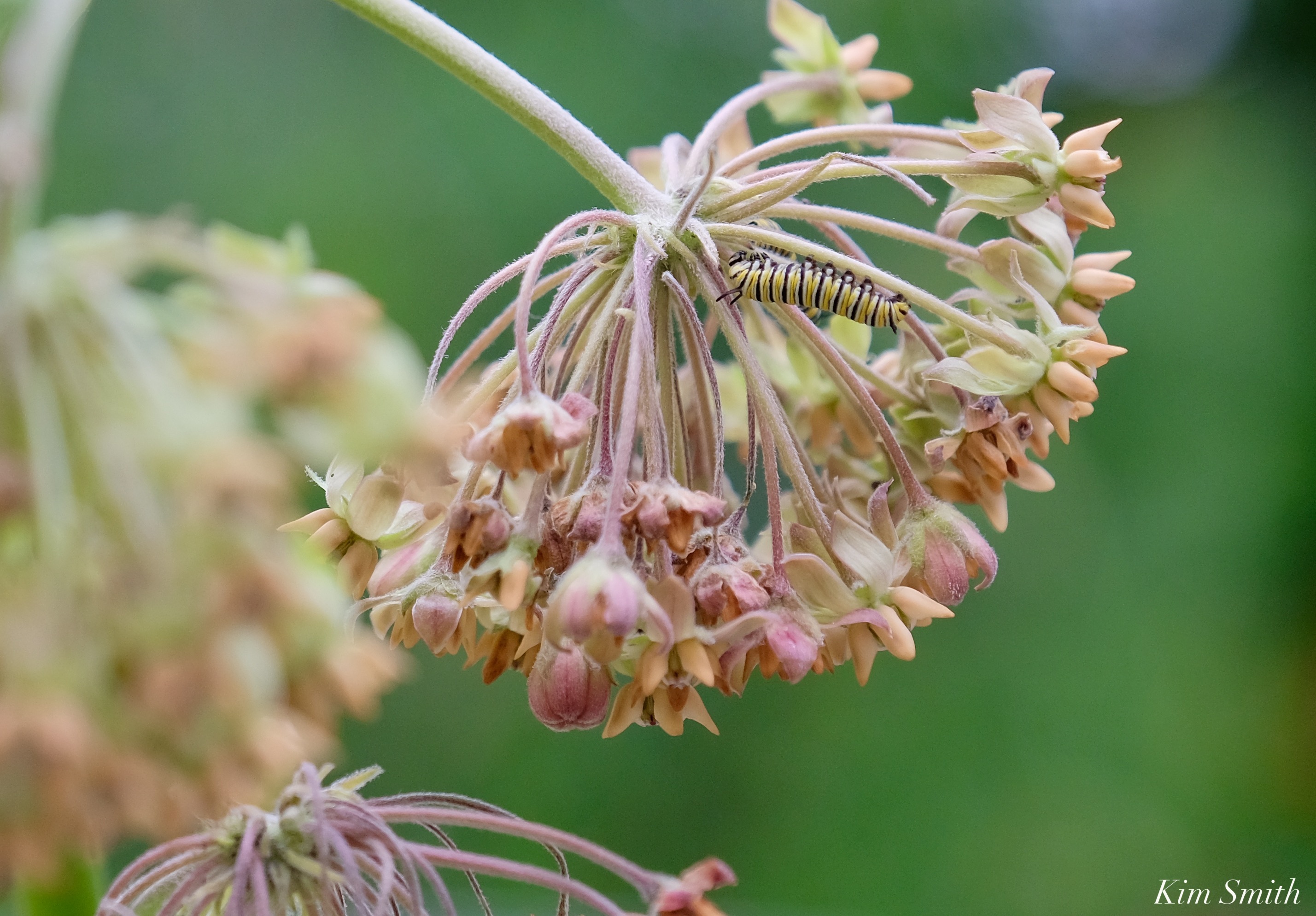
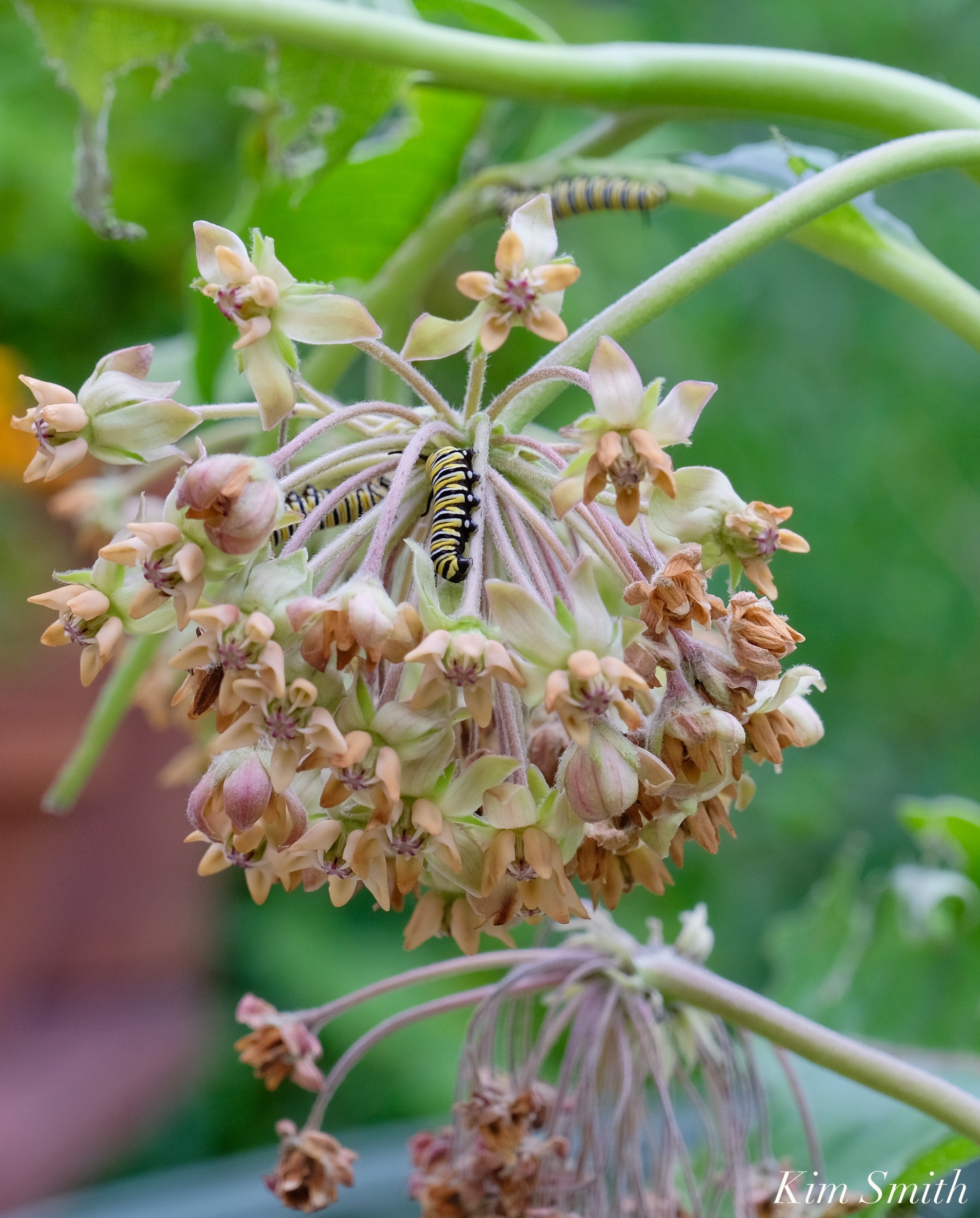
The Mama Monarch of these three early instar caterpillars deposited her eggs on the buds of Common Milkweed. I see this behavior often, not as much as on the leaves, but often enough.
The three hatched and stayed foraging on the flowers, where they were well camouflaged in their early instar paler colors. By the third molt, they had all three moved off the blossoms and were foraging on foliage.
Please consider making a tax deductible donation, or becoming an underwriter, to bring our Monarch Butterfly documentary Beauty on the Wing: Life Story of the Monarch Butterfly to American Public Television. To Learn More go here and to DONATE go here. Thank you!
Missed chatting with friends and neighbors about the films you saw at this year’s Providence Children’s Film Festival? Join us for a Zoom discussion! This evening, anytime between 5:30-7:00 pm and share. Link is https://zoom.us/j/93126124781
IT’S NOT JUST MEXICO’S FORESTS THAT NEED PROTECTING FOR BUTTERFLY MIGRATION
THEIR ROUTE FROM CANADA IS THREATENED BY OVERUSE OF HERBICIDES AND CLIMATE CHANGE, AMONG OTHER FACTORS
Monarch and Marsh Milkweed (Asclepias incarnata)
MEXICO NEWS DAILY
PUBLISHED ON WEDNESDAY, FEBRUARY 26, 2020
Mexico, the United States and Canada must share responsibility for the conservation of the monarch butterfly, according to a biologist who warns that the insect’s North American migratory path is at risk of becoming a thing of the past.
Víctor Sánchez-Cordero, a researcher at the National Autonomous University’s Institute of Biology and Mexico’s lead representative on a tri-national scientific committee that studies the monarch, said that the butterflies’ route from southeastern Canada to the fir tree forests of Michoacán and México state is under threat.
He blames the excessive use of herbicides, changes in the way land is used, climate change and a reduction in the availability of nectar and pollen.
“The commitment to conserve this migratory phenomenon not only focuses on Mexico; it’s a shared responsibility between our country, Canada and the United States,” Sánchez-Cordero said.
The researcher, who along with his team developed a system to monitor the migration of the monarch, said that there is a misconception that the most important – almost exclusive – factor in ensuring the continuation of the phenomenon is the conservation of forests in the Monarch Butterfly Biosphere Reserve (RBMM), located about 100 kilometers northwest of Mexico City.
That idea “has placed great international pressure on Mexico,” Sánchez-Cordero said before adding that he and his team published an article in the journal Frontiers in Environmental Science that shows that the decline in the number of monarch butterflies migrating to Mexico is not due to deforestation in the RBMM.
Deforestation has been drastically reduced in the past 10 years but butterfly numbers have continued to decline, he said.
“The dramatic reduction in the density of monarch butterflies that arrive at overwintering sites in Mexico doesn’t correlate with the loss of forest coverage, which shows that this factor is not responsible for the population reduction. … Other hypotheses to explain the decrease must be sought,” Sánchez-Cordero said.
One possible cause for the decline, he explained, is that the excessive use of herbicides is killing milkweed, a plant that is a main food source for monarch butterflies and on which females lay their eggs. Less nectar and pollen in the United States and Canada as a result of deforestation is another possible cause, Sánchez-Cordero said.
He added that large numbers of migrating butterflies have perished in Texas and the northeast of Mexico due to drought linked to climate change.
To conserve the migratory phenomenon of the monarch – butterflies fly some 4,500 kilometers to reach Mexican forests from Canada over the course of three to four generations – a network of conservation areas along their migration routes needs to be developed, Sánchez-Cordero said. He also said that the routes followed by the butterflies should be declared protected areas.
“A new conservation paradigm is needed. … It’s something that we [Mexico, the United States and Canada] should build together,” the researcher said.
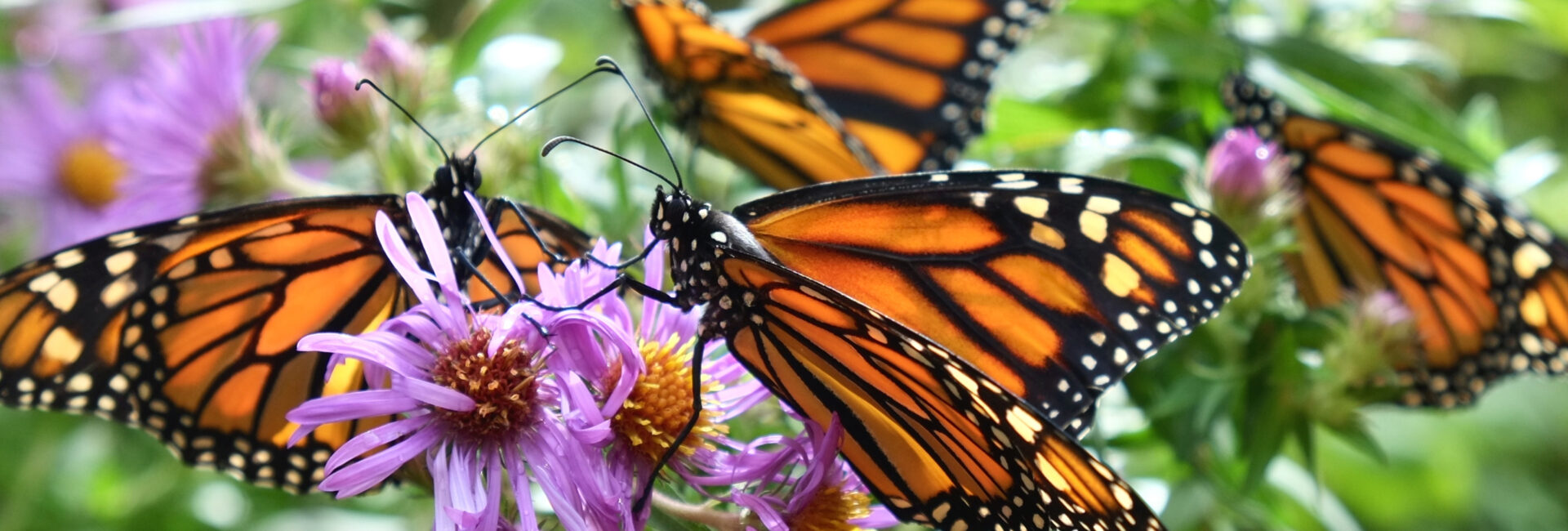
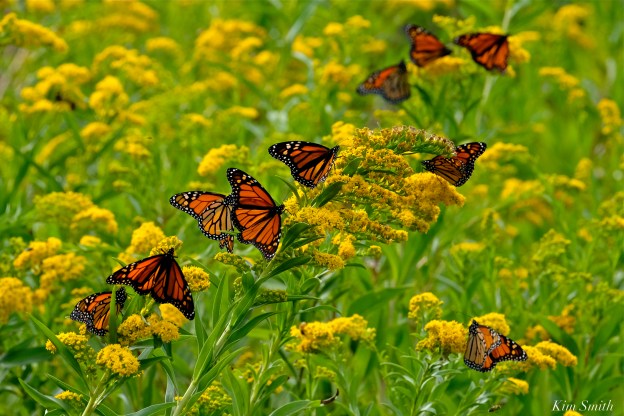
Another banner weekend for butterflies on Cape Ann with Yellow Sulphurs, Painted Ladies, and American Ladies joining the streams of Monarchs migrating along our shores.
Butterflies struggle at this time of year to find sources of nectar. Whatever you do, please do not cut back your garden until mid-November or so. Best NOT to cut back at all and to leave the drying seed heads for the songbirds and leaf litter and plant stalks for hibernating bees and caterpillars, but if one really must cut back, wait as long as possible.
If you click on the photos in the gallery, each picture is labeled with the name of the butterfly and the names of the late-blooming plants on which they are drinking nectar and building their fat reserves for the journey ahead . Butterflies will even fight over a Dandelion to try to get nectar when nothing much else is available (the best reason of all not to use Roundup on the Dandelions in a lawn).
HORRAY FOR THIS BANNER SUMMER OF MONARCHS!!!! I hope it translates to a great migration this fall 🙂
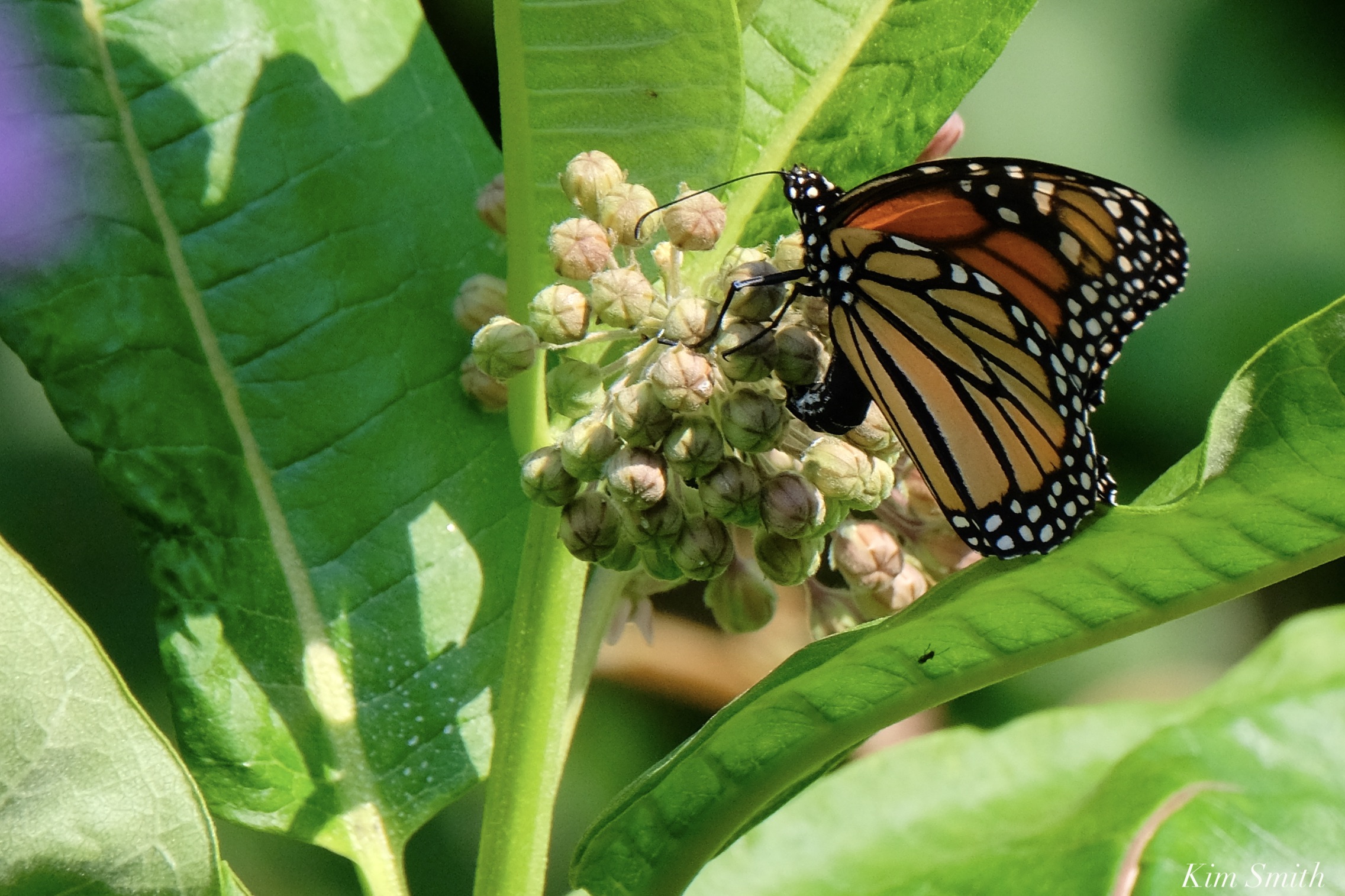
I went to my garden to gather a sprig of milkweed to feed a single caterpillar. I checked the leaves for eggs and didn’t see any. A few days later I had dozens of teeny weeny caterpillars munching away on the sprig. The Mama Monarch laid her eggs all around the milkweed buds and it’s nearly impossible to see eggs on buds.
Keep your eyes peeled for eggs on the leaves, and also on the flower buds of your milkweed plants, especially Marsh Milkweed.














 Beauty on the Wing