So looking forward to tonight’s opening of the Boston International Kids Film Festival! The show’s opener is the outstanding film, The Biggest Little Farm, and there is a full lineup of over 65 films scheduled from now through Sunday.See the schedule and how to purchase tickets here.
Beauty on the Wing is playing during Block #3 at noon on Saturday, November 21st, followed by a Q and A.
Who doesn’t love The Cranberries “Dreams,” and one of my favorite covers of this beautiful song is by Mandy Lee and MisterWives. I edited a rough cut of Monarch Dreams this afternoon, with clips from Beauty on the Wing and set to “Dreams.” That my film is at last finding an audience is a dream come true for me.
I dream about Monarchs and other creatures nightly and am thinking about ways to make Monarch Dreams more dream-like, but in the meantime, I hope you enjoy this cut ❤
In case you missed previous posts and emails, if you would like to see my Monarch Butterfly film documentary, please consider watching Saturday, November 21st, from the comfort and safety of your own home, via the Boston International Kids Film Festival and WGBH. 100 percent of the ticket sales goes to support this outstanding festival! There will be a Q and A following the screening, with me in the role of director, and hosted by WGBH and Filmmakers Collaborative.
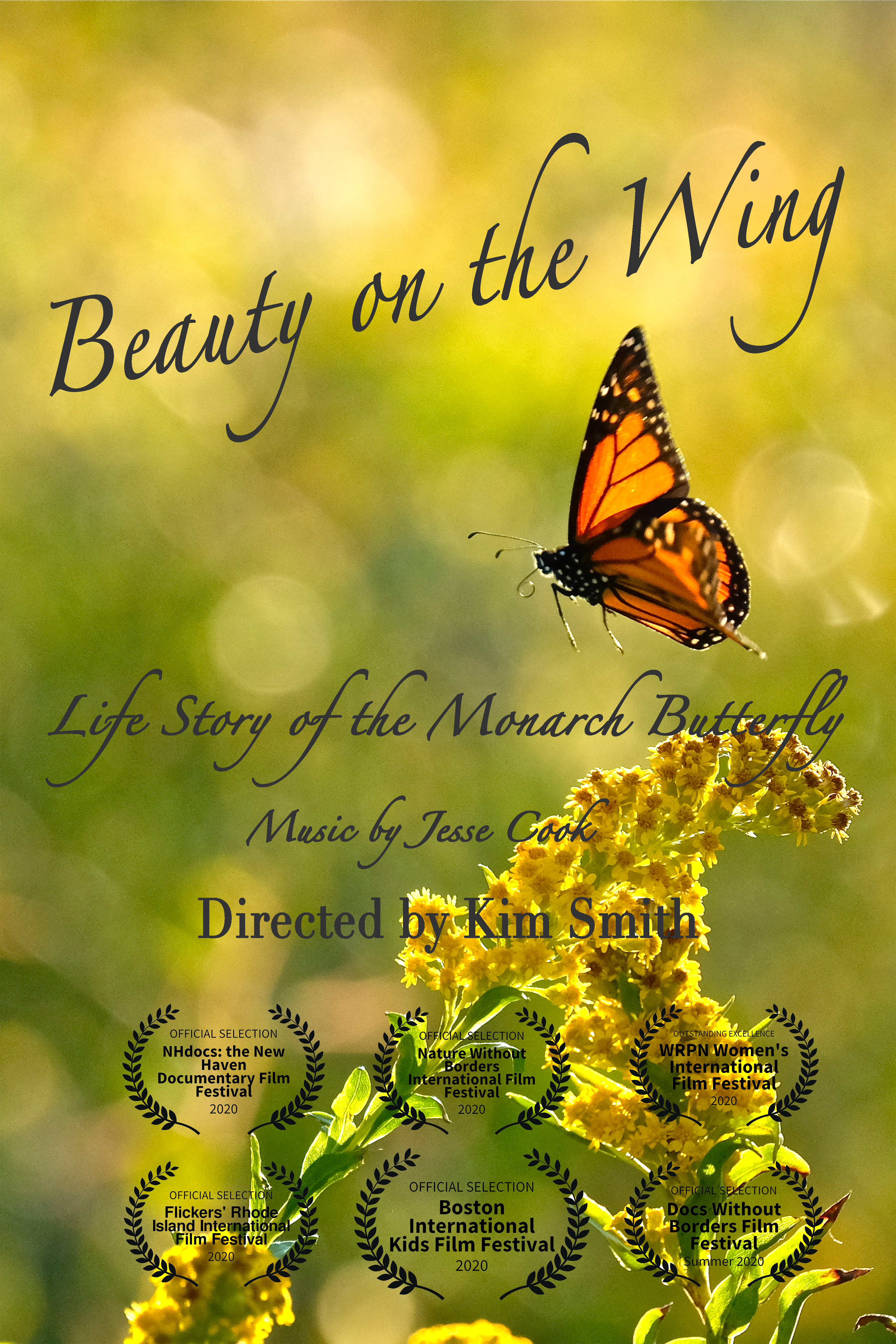
With beautiful music by Jesse Cook and filmed on Cape Ann, Cape May, Santa Barbara, and the butterfly sanctuaries at Cerro Pelon and Angangueo, Mexico. Please share with friends and click the link below to learn more.
Block #3 Beauty on the Wing: Life Story of the Monarch Butterfly
TICKETS TO THE 8th ANNUAL Boston International Kids Film Festival NOW ON SALETHIS YEAR IN PARTNERSHIP WITH GBH!Screen both Professionally and Student-Made films!Meet filmmakers from around the world!Take a workshop in filmmaking or stop-motion animation!ALL FROM THE COMFORT OF YOUR OWN HOME!FRIDAY, NOVEMBER 20 – SUNDAY, NOVEMBER 22, 2020 FILM BLOCKS INCLUDE:
Family-Friendly Features
SHORT films for ages 10 and under
STUDENT-MADE films
FOREIGN LANGUAGE films
SHORT films for middle-schoolers ( and above!)
ALL GEARED TOWARDS KIDS! $55 INDIVIDUAL FESTIVAL PASS ( watch everything!)$75 FESTIVAL PASS two or more viewers ( honor system!)$20 per film block VISIT WWW.BIKFF.ORG FOR TICKETS AND MORE INFO!
The Monarch Butterfly migration is at tremendous risk. Herbicides such as Bayer’s/Monsanto’s Roundup and Roundup Ready crops have already had a profoundly negative on the Monarch population as well as myriad spices of bees and other butterflies.
The current administration’s EPA is recklessly promoting use of some of the world’s most dangerous pesticides and has approved over 100 products with pesticides banned in multiple countries or slated for US phase out.
For example, and just the tip of the iceberg, the current administration gave a green light to Chlorpyrifos an insecticide with origins in Nazi Germany, which was set to be banned by the EPA over health and environmental concerns. The current administration reversed the decision after Dow Chemicals, a manufacturer of the chemical, donated one million dollars to his inauguration fund.
Vote for the Monarch Migration!
For all our winged wonders,
For the birds, the butterflies, the bees,
And mostly
For the future of the littlest human wonders that we so cherish.
Excerpt from Beauty on the Wing: Life Story of the Monarch Butterfly
Thank you, thank you, thank you to Joann Mackenzie, Andrea Holbrook, and the Gloucester Times for the beautifully written story“Butterfly Film Takes Flight”.
Ten years in the making, Kim Smith’s butterfly film takes flight
Kim Smith’s monarch movie 10 years in the making
GLOUCESTER TIMES OCTOBER 28, 2020
By Joann Mackenzie Staff Writer
Every story has a back story, and Kim Smith’s back story began in her backyard.
In the mid 1990s, Smith — an award-winning landscape designer — filled her Gloucester garden with native and pollinator plantings that attract all manner of winged creatures. These, thanks to lots of milkweed, included lots of magnificent monarch butterflies. “I just loved them,” says Smith, “I wanted more and more of them.”
There began a tale that this year saw Smith complete a 10-year project, the making of the 56-minute documentary “Beauty on the Wing — Life Story of the Monarch Butterfly.” In a few short months, and despite the pandemic canceling its local premiere, the film has seen its way to six film festivals, all virtual, the latest of which — the Boston International Kids Film Festival — runs Nov. 20 to 22.
American Public TV Worldwide —the world’s largest distributor of educational television has just signed the documentary for global distribution.
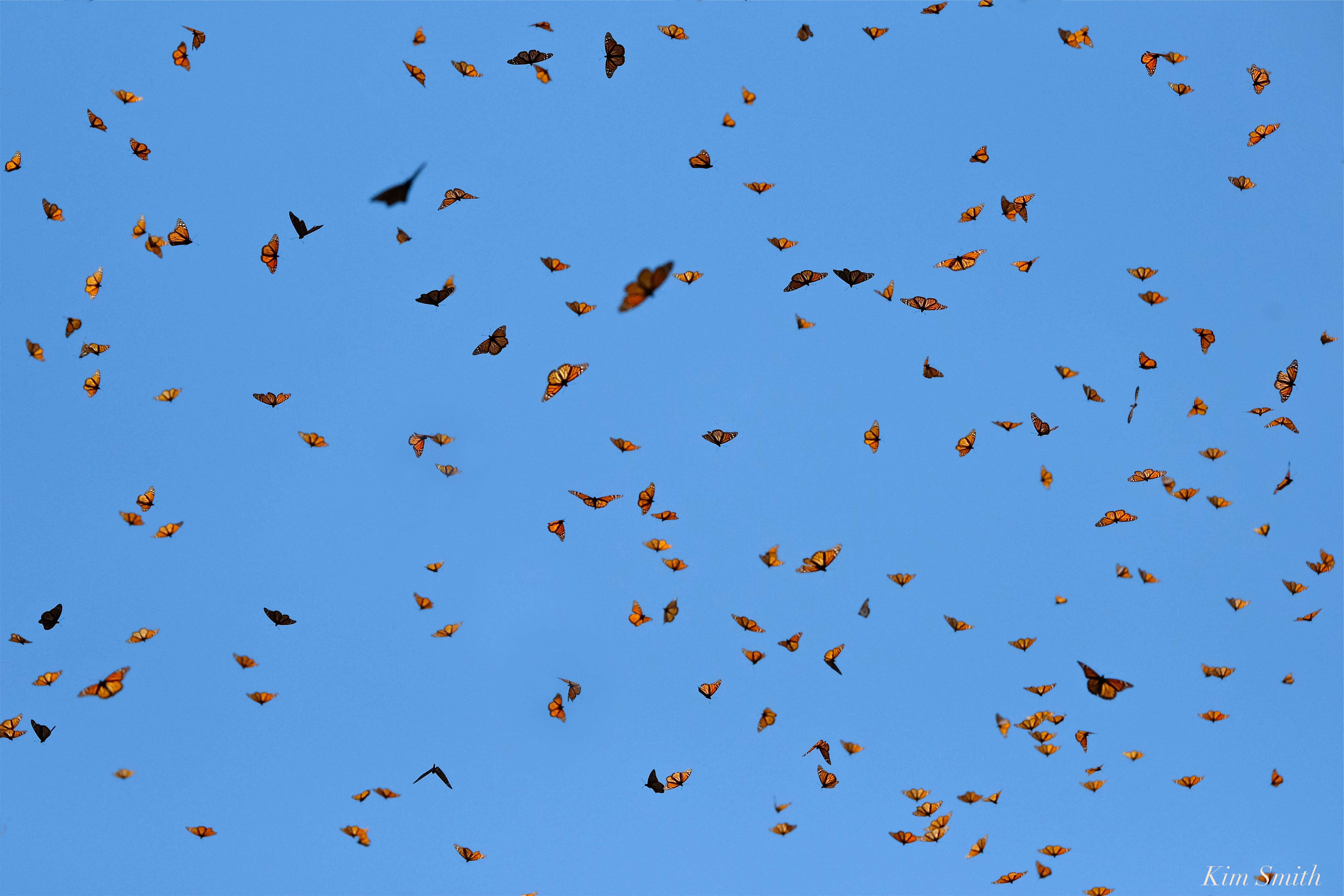
Armed with a handheld digital camera, an artist’s eye, and a love of her subject, Smith has captured the life, work and world of what she calls “this charismatic little creature,” beginning with its metamorphosis from a tiny egg, to its amazing annual journey from the summer shores of its Gloucester habitats to its winter habitats in the Mexican mountains and forests of Michoacán, where the monarchs annual arrival has long been regarded as something of a miracle: the returning of the souls of the dead descending from the sky in fluttering orange clouds, to roost by the millions in the trees.
When she began the project in 2006, Smith knew nothing about filmmaking. Photographing the monarchs, first as “a record,” she was urged on by family and friends. One of them, Gloucester’s late historian Joe Garland, was particularly encouraging. “Oh, I thought, I have to learn to make a film,” she recalls, of her early days learning the basics with Andrew Love and Lisa Smith at Cape Ann TV (now Studio 1623).
Investing in a hand-held HD Canon video camera, Smith began shooting digital. “It was small and so easy to use that I could crouch down, or lie down to capture extreme close-ups,” she says. Supported by community fundraising that covered the $35,000 production budget, she shot “tons of footage over the years,” wrote and recorded the narrative script, and saved on post production costs by teaching herself to digitally edit her film.
Her goal, she says, was not just to celebrate the monarch, but to educate viewers about the plight of this creature that is loved around the world. Indigenous to North America, these light, bright orange butterflies have through the centuries been blown by wind and weather to other continents, including England, where, in the late 17th century, they were named in honor of King William III of England, also known as the Prince of Orange.
In the last 20 years, however, the butterflies’ numbers have plummeted worldwide from a billion to 30 million, as the excessive use of herbicides has killed off much of their main food source —milkweed— while climate change has confused their flight patterns. And in Mexico, the logging of trees has sabotaged the delicate ecosystem of their annual return.
Smith’s film joins a growing body of environmental activism on behalf of the monarch butterfly. Gardeners across the nation have, like Smith, filled flower beds with milkweed to feed their numbers. The Obama administration, concerned by its alarming decline, allocated $3.2 million to protect it.
In making her documentary, Smith traveled to Mexico twice to film, and learned firsthand just how endangered the monarchs have become. Over time, she says, she came to see monarchs as “little gateway creatures that can open the way to for people to learn about other endangered creatures.”
At Good Harbor Beach, a favorite early morning photographic haunt, Smith began to turn her camera to another local endangered species, piping plovers. Like the monarchs, the little shore birds rely on a fragile ecosystem that Smith began to take an active role in protecting, while filming them. With her monarch documentary now in worldwide release, the piping plovers are on their way to star billing in a new documentary, now in production.
Meanwhile, the Boston International Kids Film Festival, a program of Filmmakers Collaborative, will screen Smith’s documentary as “one of best that the world of independent filmmaking has to offer.” Shown for one week to schoolchildren across the city, the festival, which describes her documentary as “illuminating how two regions, separated by thousands of miles, are ecologically interconnected,” will then host a Zoom author event in which the students can engage in a Q&A which Smith herself.
Smith, by the way, doesn’t just train her talents on winged creatures. In yet another ongoing film project, she captures the aerial antics of Gloucester’s falling Greasy Pole walkers. That documentary, which celebrates the spirit of the city’s annual St Peters Fiesta, is well underway.
Gloucester resident Kim Smith is a documentary filmmaker, environmental conservationist, photojournalist, author, illustrator and award-winning landscape designer.
Her documentary “Beauty on the Wing: Life Story of the Monarch Butterfly” was released in February. It has been chosen as an official selection at New Haven Documentary, Nature Without Borders International, Flickers’ Rhode Island International , Docs Without Borders , WRPN Women’s International, and Conservation Wildlife film festivals.
It next shows at the Boston International Kids Film Festival (https://bikff.org/schedule/) on Nov. 20 to 22; tickets start at $20. Links to view the film will be provided upon ticket purchase.
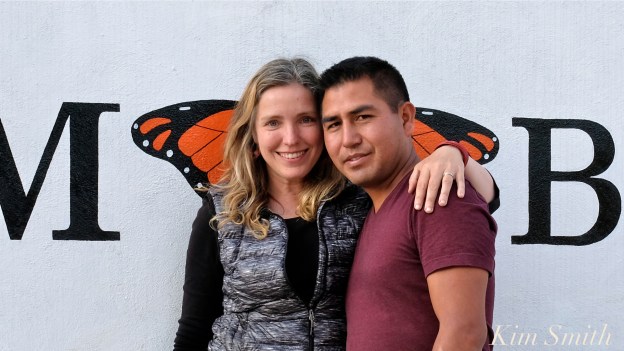
Last spring my husband Tom and I traveled to the Monarch Butterfly Biosphere Reserve at Cerro Pelón to continue filming Beauty on the Wing: Life Story of the Monarch Butterfly. We stayed in the magically beautiful tiny rustic town of Macheros at the equally as beautiful JM Butterflies Bed and Breakfast. The hotel is owned and operated by a visionary husband and wife team, Joel Moreno Rojas and Ellen Sharp. In five short years, the dynamic duo turned a four room home into a wonderfully accommodating 14 room inn, replete with a new restaurant, swimming pool, ensuite bathrooms, internet, mountain view roof top cocktail area, yoga studio, with many more amenities.
Macheros is located at the base of Cerro Pelón, the location where the butterflies overwintering grounds were first documented by Mexican citizen scientist Catalina Aguado Trail, working with Canadian and US scientists (1975). The trail leading up to the sanctuary is mere footsteps from JM Butterflies B and B.
Cerro Pelón is the most pristine of all the reserves. The beautiful natural state in which the sanctuary is kept is only made possible by a group of highly dedicated arborists. The arborists daily patrol the forest to prevent illegal logging and provide information to the guides on the butterfly’s current location (Monarchs move around the mountains during their winter stay). The arborists are working to protect the existing forest. Some organizations focus on replanting trees after they have been logged, but it can take 30 to 40 years for a tree to become a special “butterfly tree,” one on which the butterflies roost during the winter.
Monarchs and Snakeroot, Cerro Pelon
The arborists are paid through the forest conservation non-profit organization created by Ellen and Joel appropriately called Butterflies and Their People. The mission of Butterflies and Their People is to support the Monarchs while also providing livelihoods for members of the community. Much of the village of Macheros depends on visitors to the sanctuary. Additionally, the Inn provides well paying jobs including restaurant work, trail guides, drivers, and inn keeping.
As you can imagine, a tiny town such as Macheros has been devastated by the pandemic. Gratefully so, no one in Macheros has caught the disease however, the local town officials have closed the sanctuary to the public for fear that someone may contract Covid from visitors to the sanctuary. Cerro Pelón will be shuttered for the entire year, a devastating blow to the tiny township and all her citizens. As has happened to so many in the US and around the world, overnight the people of Macheros lost their livelihoods.
A fundraiser has been organized by Carlotta James and the Monarch Ultra Team. So far, they have raised $1,900.00, nearly two thirds of the $3,000.00 goal.
Please consider donating to the 50km pop-up fundraiser at:
Any donation of any amount will be tremendously appreciated. Thank you for our consideration.
Butterflies and Their People Mission Statement: To preserve the butterfly sanctuary by creating jobs for local people in forest and monarch butterfly conservation.
In thinking about where have all the butterflies gone, I am reminded of the poignant song written by Pete Seeger “Where Have All the Flowers Gone,” which although a song about the futility of war, sums up much about the environmental impact of habitat loss. Without wildflower habitat, there will be no pollinators of any sort.
Where have all the flowers gone?
Long time passing
Where have all the flowers gone?
Long time ago.
Buckeye and Seaside Goldenrod
Where have all the butterflies gone? Different species of butterfly populations fluctuate from year to year. For example, some years you may see far greater numbers of Buckeyes, the next year not so much. That same year you may hardly see any Tiger Swallowtails but will the following.
That being said, everyone must realize that every year there are fewer butterflies than the year before. Butterflies thrive in meadows, the very same topography that is the easiest to build upon. Every time a new house or shopping mall is built on a meadow, we decrease not just butterfly habitat, but a whole community of wildlife habitat.
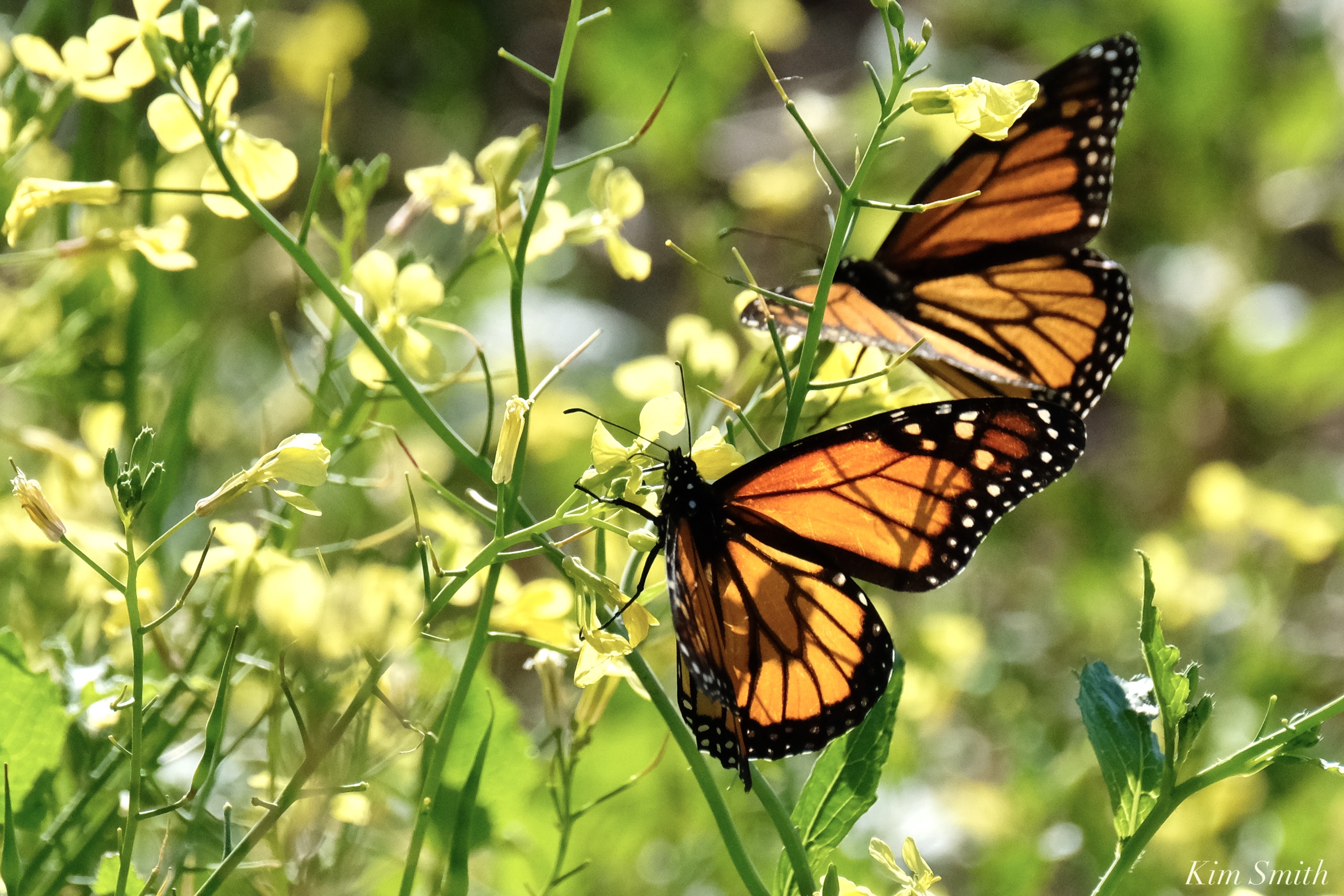
In the above photo you can see a Monarch with a Black Swallowtail flying overhead. This stunning patch of wildflowers and nectar plants was sited in Gloucester at a prime spot for Monarchs to rest and refuel after migrating across Massachusetts Bay. The new home owners ripped out most of the wildflowers and planted the site in a more formal style, with non-native perennials and shrubs. At this location, I would often see Monarchs, Tiger Swallowtails, Black Swallowtails, Painted and American Ladies, Sulphurs, and many other species. That is no longer true.
Tiger Swallowtail drinking nectar from Joe Pye-weed at the same wildflower patch, no longer in existence.
Butterfly and bee populations are declining overall, not only because of habitat loss, but because of the unbridled use of herbicides and pesticides in agriculture and home lawn care.
Butterflies are especially sensitive to fluctuations in weather, and also to overall climate change. This year we had a long, cold wet spring. The inclement weather is continuing, too, from a butterflies perspective, because although we are seeing some warmer temperatures the past few days, it has mostly been rainy, foggy, or overcast. Butterflies thrive during long stretches of sunny, hot weather. Their wings don’t work very well in the damp and cold. Because of global climate change, we have seen a seven percent increase in precipitation worldwide.
One of the best years I have ever seen for dozens and dozens of species of butterflies, including Monarchs, in the Northeast, was the summer and fall of 2012. That year, we had a warm winter followed by a warm spring, then a warm, dry summer, and a long, warm Indian summer. It was butterfly bonanza that summer and autumn!
Adding to people’s concern is the fact that last year, there was an abundance of spring rain that in turn created an extraordinary wildflower bloom in Texas, which got all the butterflies off to a good start. In 2019, we were seeing Monarchs as early as early June, which was very unusual for Cape Ann. Folks are comparing this year to that of 2019, however, 2019 was not an average year.
Monarchs are a case unto themselves. Their spring and summer numbers largely depend upon an additional variety of conditions, including how successful was the previous year’s autumn migration, whether or not there were nectar providing wildflowers on their northward and southward migrations, and wind and weather conditions all along their route, from Canada to Mexico.
Note the bar graph in that the eastern population of the Monarchs plummeted by half, according to this year’s spring count by the World Wildlife Fund Mexico.
Particularly in the northeast, the wind patterns during the Monarchs spring northward migration matter tremendously. My friend Charmaine at Point Pelee, in southern Ontario, which is 49 degrees latitude (we are 43 degrees latitude) has been raising and releasing Monarchs for over a month now, while most of us on Cape Ann have only seen a smattering. The Monarchs moved this year in a straight northward trajectory. If the wind does not blow from west to east during some part of their northward migration, far fewer will end up along the eastern shores.
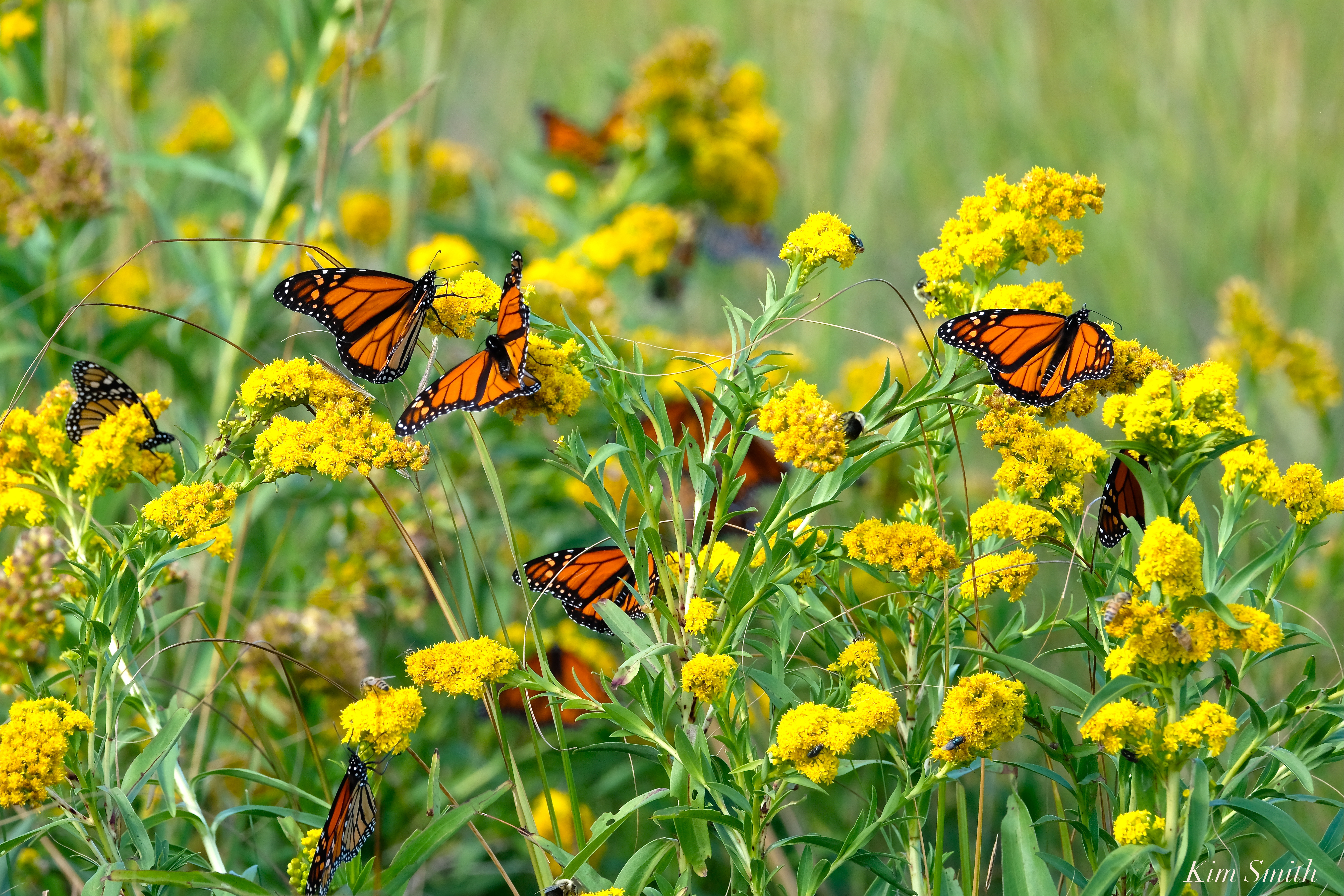
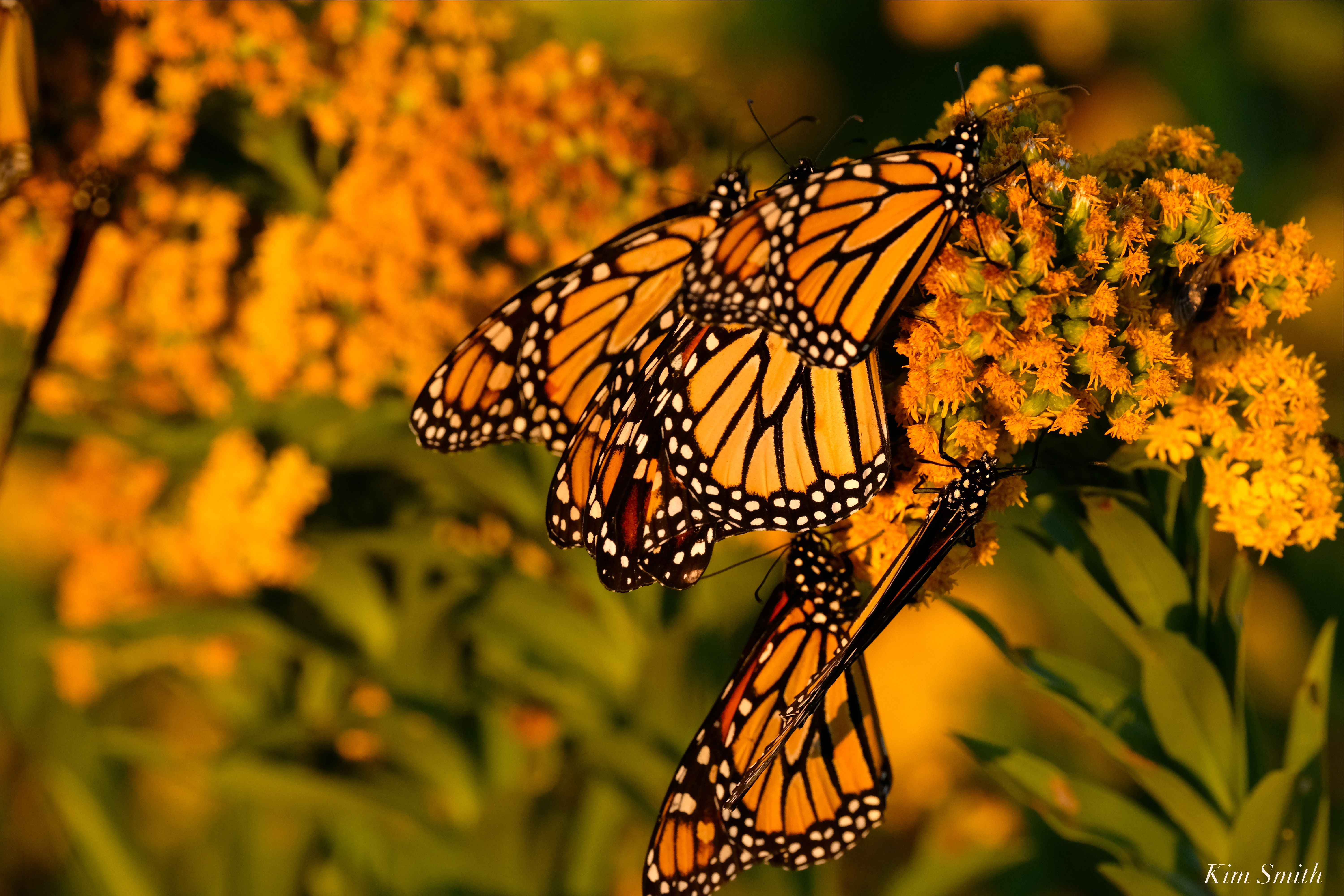
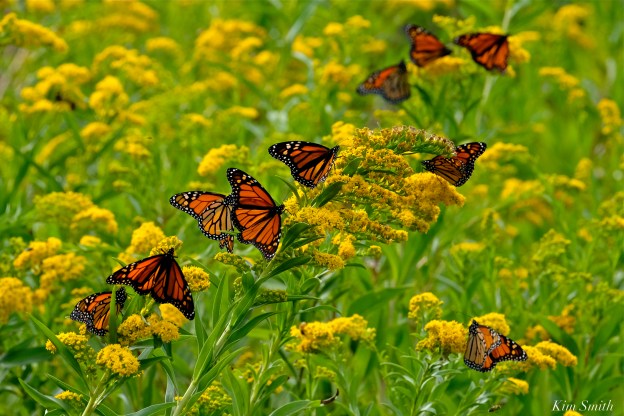
Monarchs and Seaside Goldenrod
All is not lost. I am 90 percent certain we will soon be seeing some of our migratory and non-migratory local populations, we just need some good weather. They are later than usual, but not gone entirely.
For so many more reasons, I am hopeful for the future of wildlife and their habitats and see such tremendous, positive change. Despite the current administration’ s extremely harmful stance against the environment, many, many individuals and organizations are gaining a deeper appreciation about the importance of habitats and taking positive action. Many have made it their life’s work. These individuals and organizations are creating wildlife sanctuaries and conserving existing habitats. If the Monarch is declared an endangered species, that will surely bring an added awarenesses and increased federal spending for protecting and creating habitats.
How can you help species such as the Monarchs, which in turn will help myriad species of other butterflies and pollinators)? Plant wildflowers! Both Marsh and Common Milkweed for their northward migration, and lots of nectar-rich later summer blooming wildflowers for their southward migration, including New England Aster, Smooth Aster, Purple-stemmed Aster, Seaside Goldenrod, and Canada Goldenrod.
IT’S NOT JUST MEXICO’S FORESTS THAT NEED PROTECTING FOR BUTTERFLY MIGRATION
THEIR ROUTE FROM CANADA IS THREATENED BY OVERUSE OF HERBICIDES AND CLIMATE CHANGE, AMONG OTHER FACTORS
Monarch and Marsh Milkweed (Asclepias incarnata)
MEXICO NEWS DAILY
PUBLISHED ON WEDNESDAY, FEBRUARY 26, 2020
Mexico, the United States and Canada must share responsibility for the conservation of the monarch butterfly, according to a biologist who warns that the insect’s North American migratory path is at risk of becoming a thing of the past.
Víctor Sánchez-Cordero, a researcher at the National Autonomous University’s Institute of Biology and Mexico’s lead representative on a tri-national scientific committee that studies the monarch, said that the butterflies’ route from southeastern Canada to the fir tree forests of Michoacán and México state is under threat.
He blames the excessive use of herbicides, changes in the way land is used, climate change and a reduction in the availability of nectar and pollen.
“The commitment to conserve this migratory phenomenon not only focuses on Mexico; it’s a shared responsibility between our country, Canada and the United States,” Sánchez-Cordero said.
The researcher, who along with his team developed a system to monitor the migration of the monarch, said that there is a misconception that the most important – almost exclusive – factor in ensuring the continuation of the phenomenon is the conservation of forests in the Monarch Butterfly Biosphere Reserve (RBMM), located about 100 kilometers northwest of Mexico City.
That idea “has placed great international pressure on Mexico,” Sánchez-Cordero said before adding that he and his team published an article in the journal Frontiers in Environmental Science that shows that the decline in the number of monarch butterflies migrating to Mexico is not due to deforestation in the RBMM.
Deforestation has been drastically reduced in the past 10 years but butterfly numbers have continued to decline, he said.
“The dramatic reduction in the density of monarch butterflies that arrive at overwintering sites in Mexico doesn’t correlate with the loss of forest coverage, which shows that this factor is not responsible for the population reduction. … Other hypotheses to explain the decrease must be sought,” Sánchez-Cordero said.
One possible cause for the decline, he explained, is that the excessive use of herbicides is killing milkweed, a plant that is a main food source for monarch butterflies and on which females lay their eggs. Less nectar and pollen in the United States and Canada as a result of deforestation is another possible cause, Sánchez-Cordero said.
He added that large numbers of migrating butterflies have perished in Texas and the northeast of Mexico due to drought linked to climate change.
To conserve the migratory phenomenon of the monarch – butterflies fly some 4,500 kilometers to reach Mexican forests from Canada over the course of three to four generations – a network of conservation areas along their migration routes needs to be developed, Sánchez-Cordero said. He also said that the routes followed by the butterflies should be declared protected areas.
“A new conservation paradigm is needed. … It’s something that we [Mexico, the United States and Canada] should build together,” the researcher said.
In March I had the tremendous joy of interviewing Ellen Sharp and Joel Moreno Rojas, founders of the nonprofit organization “The Butterflies and Their People Project.” We filmed the interview from the rooftop of their hotel, JM Butterfly B&B, which is located at the base of Cerro Pelon Monarch Butterfly Reserve in Macheros, Mexico. Cerro Pelon is the old volcanic mountain where the Monarchs wintering home was first located by Mexican citizen scientist Catalina Aguado Trail, on January 2, 1975. Trail was at the time time working under the direction of zoologist Doctor Fred Urquhart of the University of Toronto.
Joel and Ellen are simply an amazing dynamic duo. They have built a beautiful and welcoming bed and breakfast at Cerro Pelon, the most pristine and least trafficked of Monarch sanctuaries. Largely through the conservation efforts of The Butterflies and Their People Project they have helped provide economic opportunities that have in turn dramatically reduced illegal logging and deforestation of the core protected areas of the forest.
The mission of The Butterflies and Their People Project is to “preserve the butterfly sanctuary by creating jobs for local people in forest and monarch butterfly conservation. The Butterflies & Their People Project is an Asociación Civil (non-profit organization) registered and located in the village of Macheros in the State of Mexico.”
I hope you’ll watch and will be equally as enamored of Joel and Ellen as were we. You’ll learn more about how The Butterflies and Their People Project came to be, the importance of protecting the existing Monarch Butterfly forest sanctuaries, and how jobs and economic growth go hand and hand with protecting the vitally important temperate forests of the Monarch Butterfly Biosphere Reserve. And a bit about how this extraordinary couple met and began their journey in Monarch conservation.
My husband Tom and I returned from filming Monarchs in Mexico very late Monday night. The first day back was pasta making for Saint Joseph Day at the Groppos and spending time with our son Alex and granddaughter Charlotte. Yesterday and today I’ve been pouring through the footage to add to the film. I’ll write some posts about beautiful Mexico, the fantastic JM Butterfly B and B, and the magnificent Monarchs as soon as I have time to sort through the photos. It was an adventure of a lifetime!
I was most worried about torturing Tom and wasn’t entirely sure we would have uninterrupted internet access so he could work remotely, but he had the best time meeting new people, riding horses up the mountain, climbing Cerro Pelon, and practicing his Spanish!













 Beauty on the Wing