Tag Archives: Monarch Butterfly Migration

WHY ARE THERE GOLD DOTS ON A MONARCH CHRYSALIS?

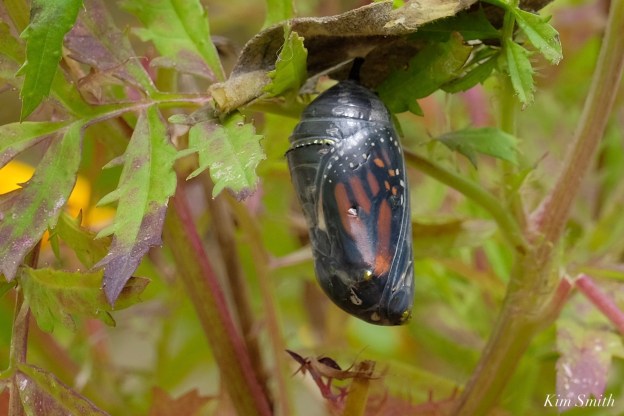
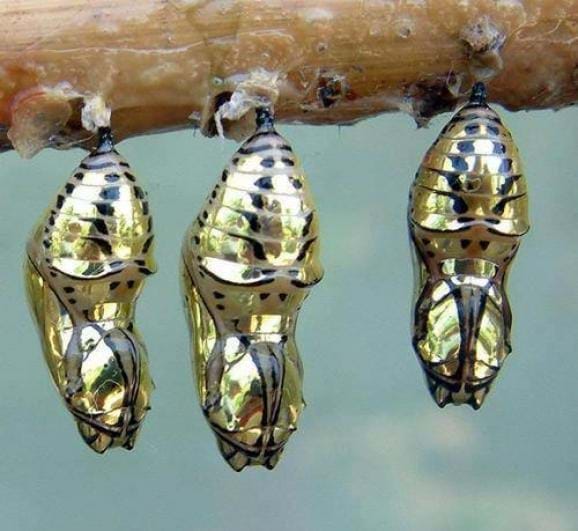
Glimmering sparkly gold in the sunlight, a question often asked is why is the Monarch chrysalis adorned with metallic dots and dashes? The gold dots serve the function of oxygen exchange but that doesn’t answer how and why the dots are gold.

Since time immemorial people have noticed the brilliant golden dots, dashes, and gold leafing of many species of butterfly chrysalides. The word chrysalis originates from the Greek word “chrysos,” which means gold.

There are are several hypotheses. The two that make the most sense are deterrents to predators and camouflage.

For the same reason the iridescent scales of the Blue Morpho Butterfly flash light when the butterfly is in flight, the golden markings of the chrysalis catch light, confusing and deterring predators.

Butterfly pupae are protein-rich easy targets. They are too busy rearranging their insides while undergoing metamorphosis to fend off predators. For the most part, throughout a butterfly’s life cycle, from caterpillar to chrysalis to adult, each species has evolved with specific-to-that-species warning and/or camouflage markings.

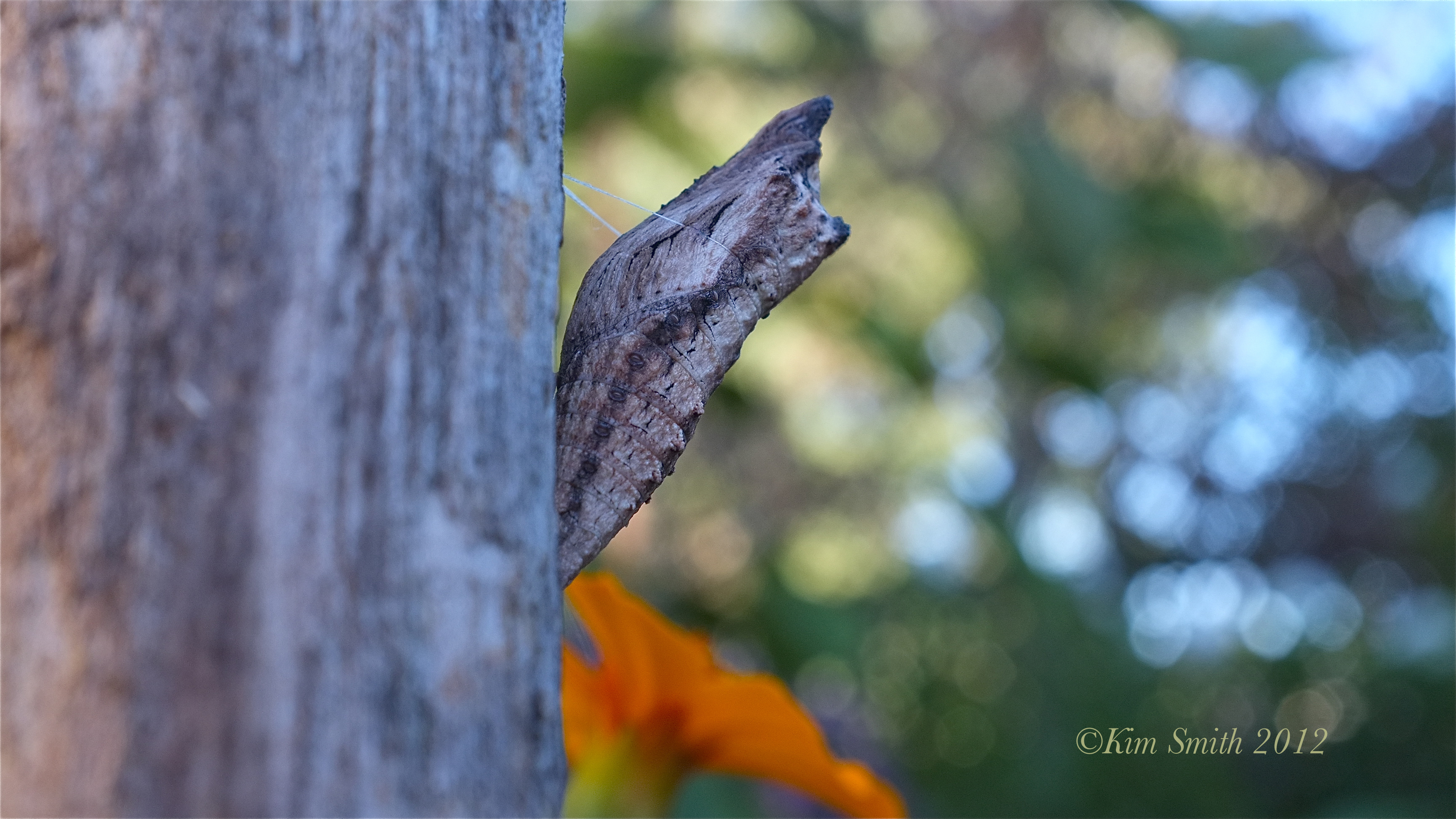
The chrysalis of the Black Swallowtail Butterfly is a perfect example. When the butterfly pupates in the spring and summer, the chrysalis has a soft golden green hue, which blends beautifully with the lush green of summer foliage.

When the butterfly pupates late in the summer, the chrysalis turns woody brown, taking on the same hues of bare tree branches.

Golden studs, dashes, and leafing reflect the surrounding area, create flashes of light, look like drops of dew, shafts of light, and is some cases, such as that of the Tigerwing Butterfly, may frighten a predator when it sees its own reflection.

Tigerwing Butterfly (Tithorea harmonia) Photo by Desus Mortus

How the gold is formed is easier to pinpoint. Metallic and iridescent markings in butterflies are created when both pigmented cells (in this case yellow carotenoids) and structural cells are present. You see carotenoids present when trees turn yellow, gold, and orange in autumn. The Monarch caterpillar gets its carotenoids from the plant it eats, milkweed.

The crown of the Monarch pupa is called a diadem. If you look closely at the diadem, it’s a raised structure, a line of tiny hills. The combination of the raised hills and carotenoids present both absorb and reflects the light, creating the appearance of shiny gold.

Please consider making a tax deductible donation, or becoming an underwriter, to bring our Monarch Butterfly documentary Beauty on the Wing: Life Story of the Monarch Butterfly to American Public Television. To Learn More go here and to DONATE go hereThank you!

PRECIOUS GEMS IN THE GARDEN!

Gems more precious than jade.

The pupating Monarch caterpillar spins a fine mat of silky threads, to which the little black post, called the cremaster, attaches during pupation. Thirty or so of these jade-like pendants are in the garden and readying to emerge. 

Twins!

Please consider making a tax deductible donation, or becoming an underwriter, to bring our Monarch Butterfly documentary Beauty on the Wing: Life Story of the Monarch Butterfly to American Public Television. To Learn More go here and to DONATE go hereThank you!


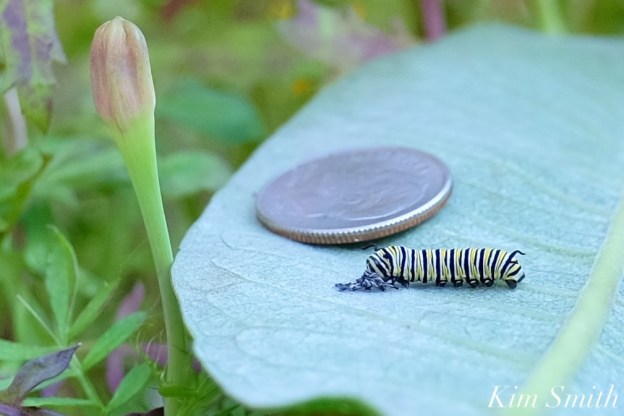
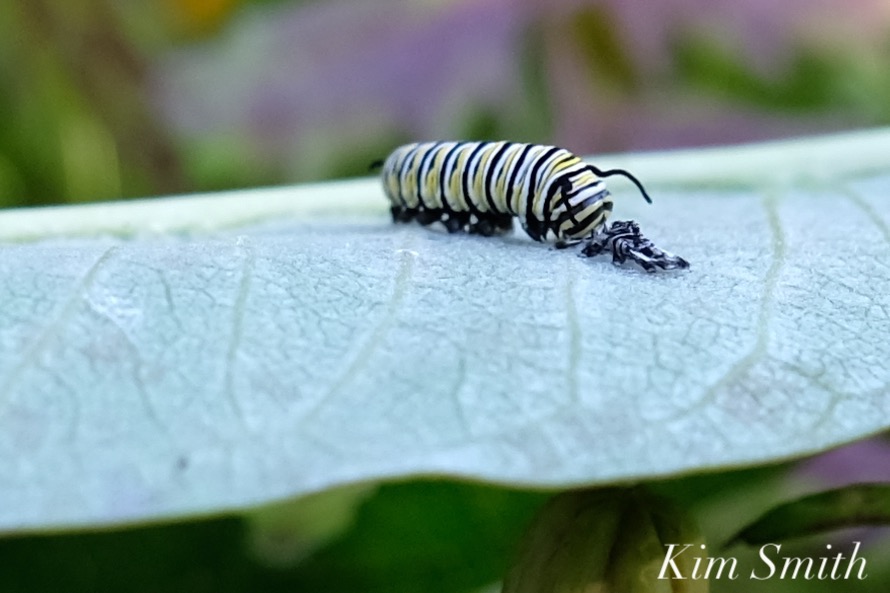
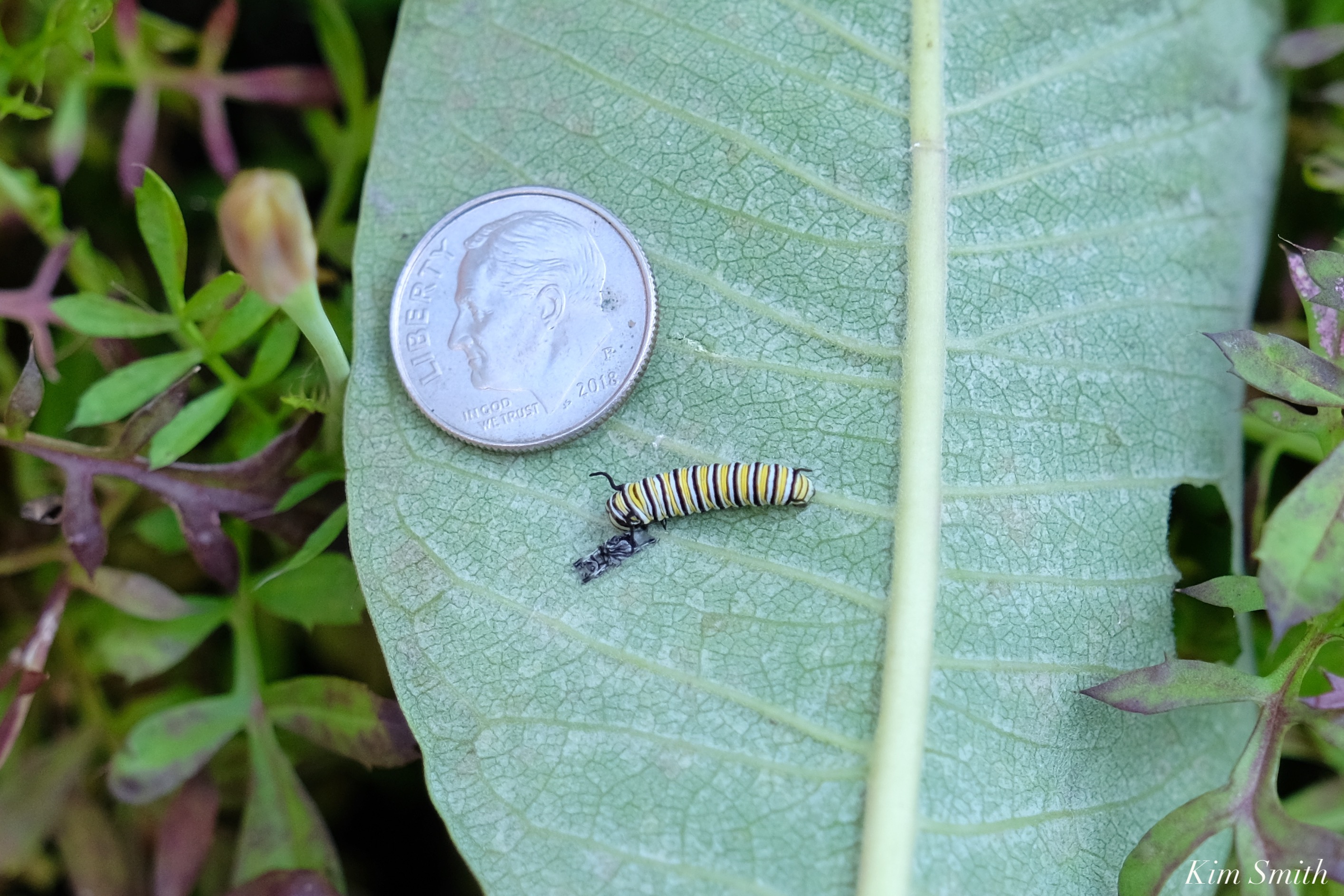
TINY CATERPILLAR MOLTING

Did you ever wonder how a caterpillar fits into its new suit after shedding the old? The caterpillar in the photo has just shed its skin, or molted, and you can see its discarded and shriveled skin.

After molting, the caterpillar rests quietly for a bit, sucking in great deal of air, which expands the new suit. After molting and resting, the caterpillar eats its old skin.

The caterpillar feeds and feeds, expanding and growing into its baggy suit until it again feels a sense of tightening and will molt again.

Caterpillars molt four to five times and each stage is called an instar, for example, 1st instar, 2nd instar, 3rd instar, etc.

I haven’t seen a female depositing eggs for a week or so. Perhaps this is our last batch of caterpillars and these will grow to become the Super Monarchs, the Monarchs that journey to Mexico.

Last of the teeny tinies?

Please consider making a tax deductible donation, or becoming an underwriter, to bring our Monarch Butterfly documentary Beauty on the Wing: Life Story of the Monarch Butterfly to American Public Television. To Learn More go here and to DONATE go hereThank you!

MONARCH FLOWER BUD BABIES

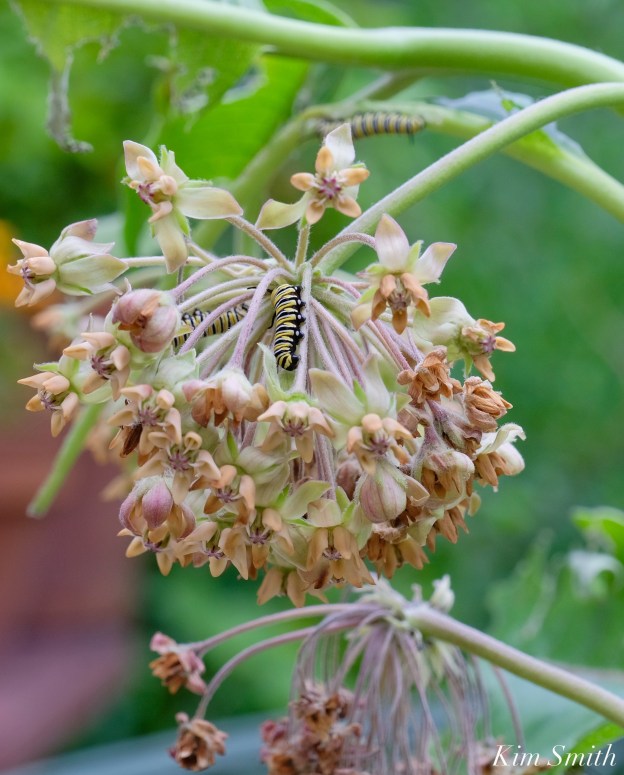
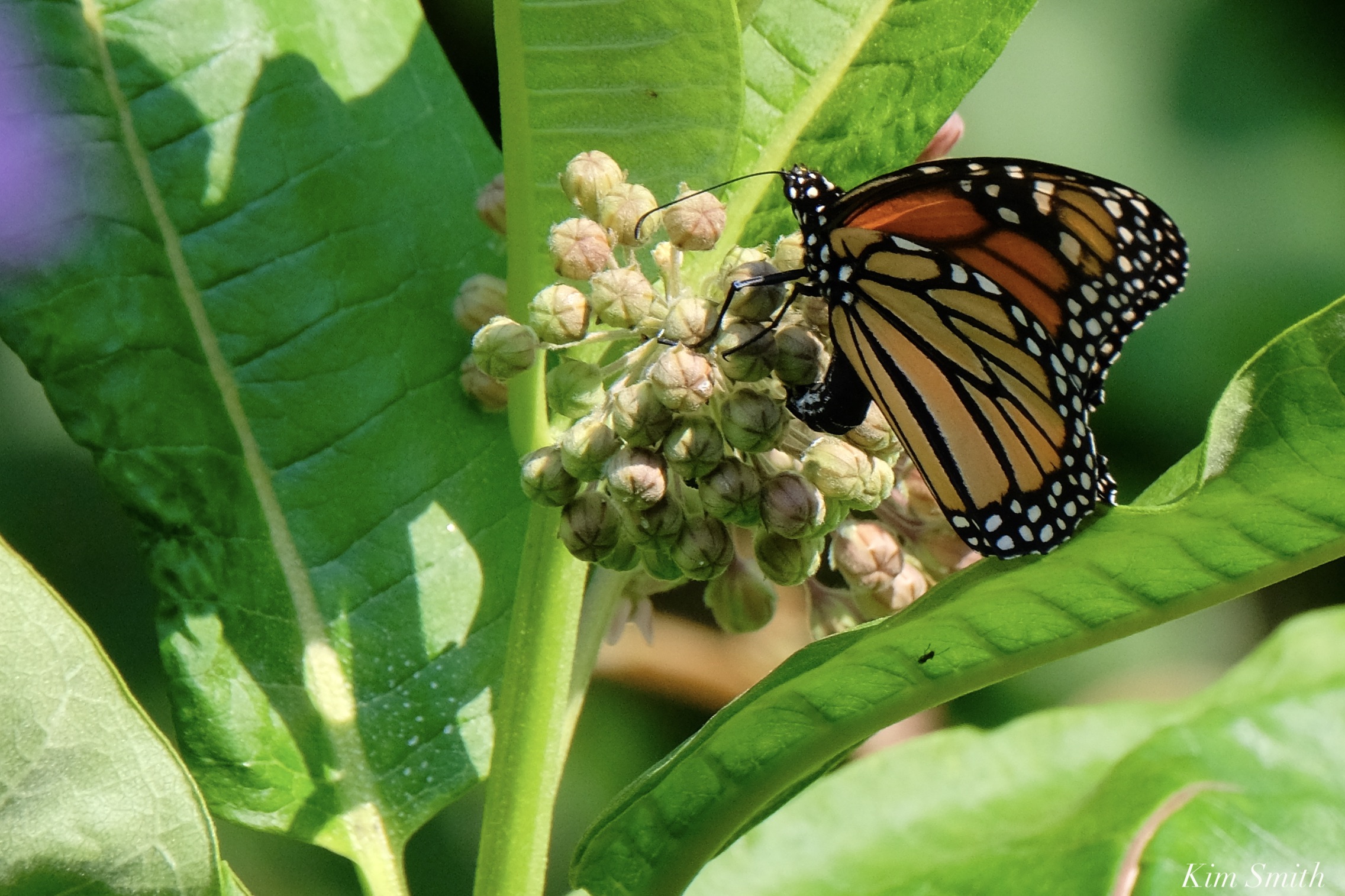
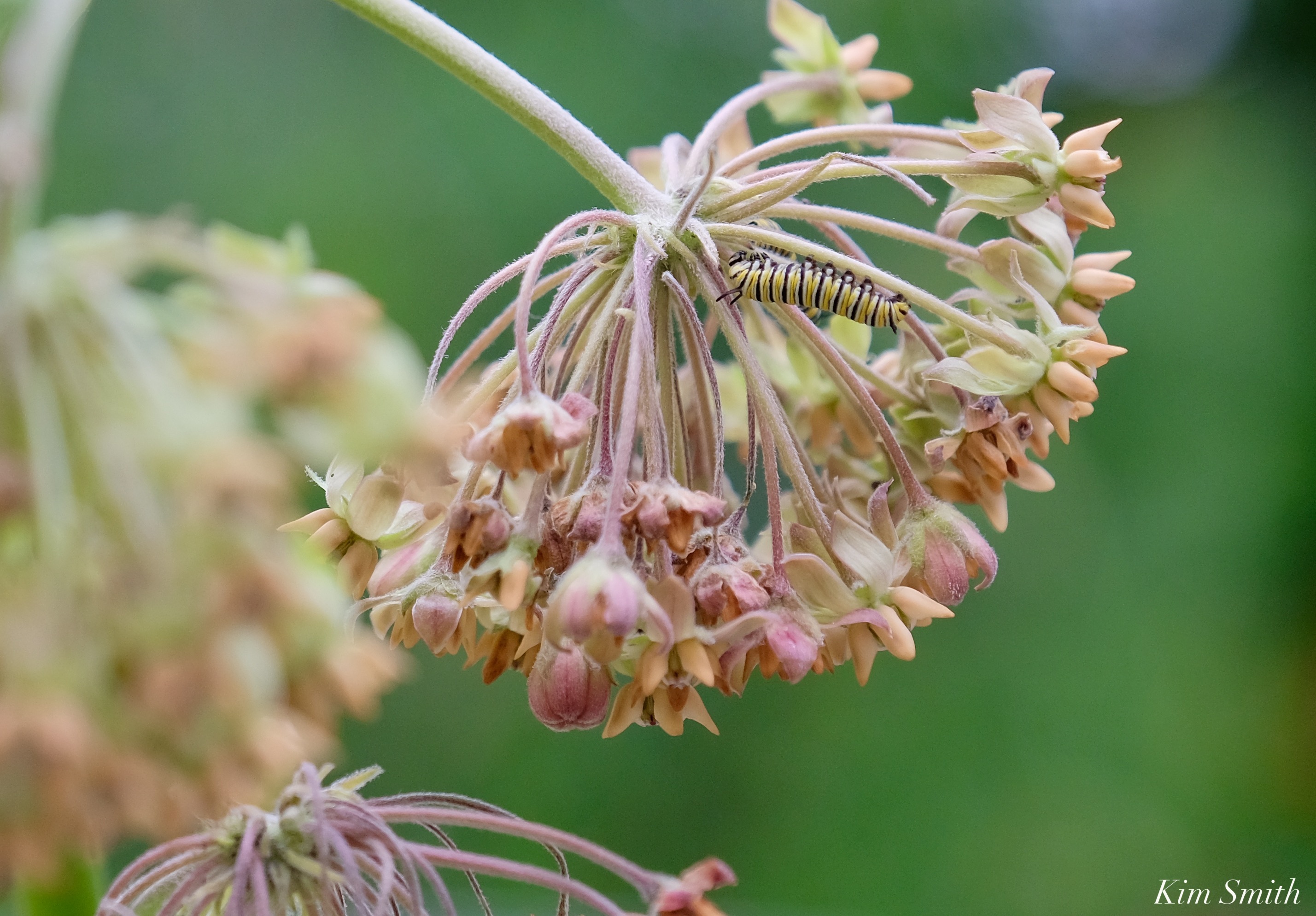
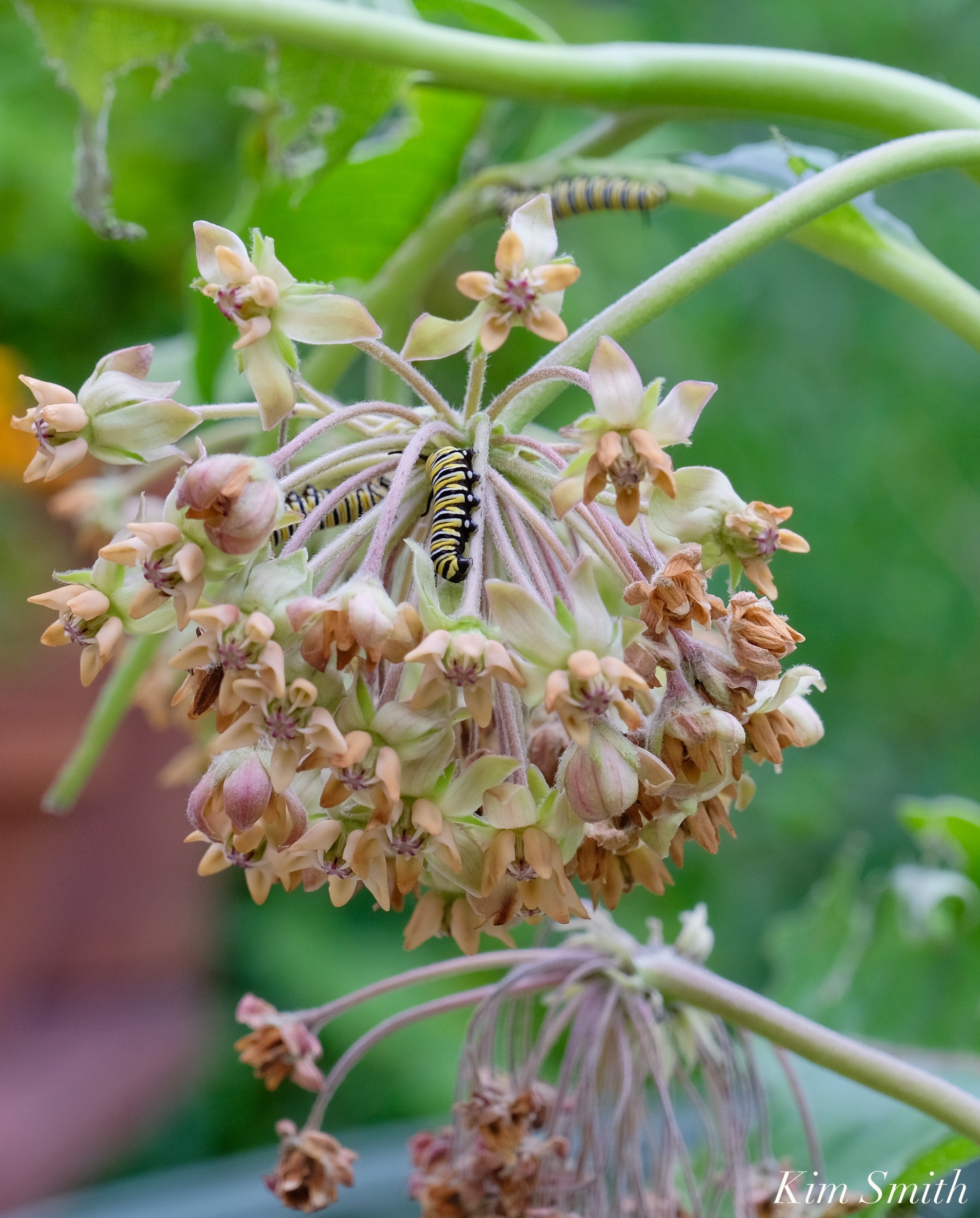
The Mama Monarch of these three early instar caterpillars deposited her eggs on the buds of Common Milkweed. I see this behavior often, not as much as on the leaves, but often enough.

The three hatched and stayed foraging on the flowers, where they were well camouflaged in their early instar paler colors. By the third molt, they had all three moved off the blossoms and were foraging on foliage.

Please consider making a tax deductible donation, or becoming an underwriter, to bring our Monarch Butterfly documentary Beauty on the Wing: Life Story of the Monarch Butterfly to American Public Television. To Learn More go here and to DONATE go hereThank you!

MONARCHS EMERGING AT BREAKFAST

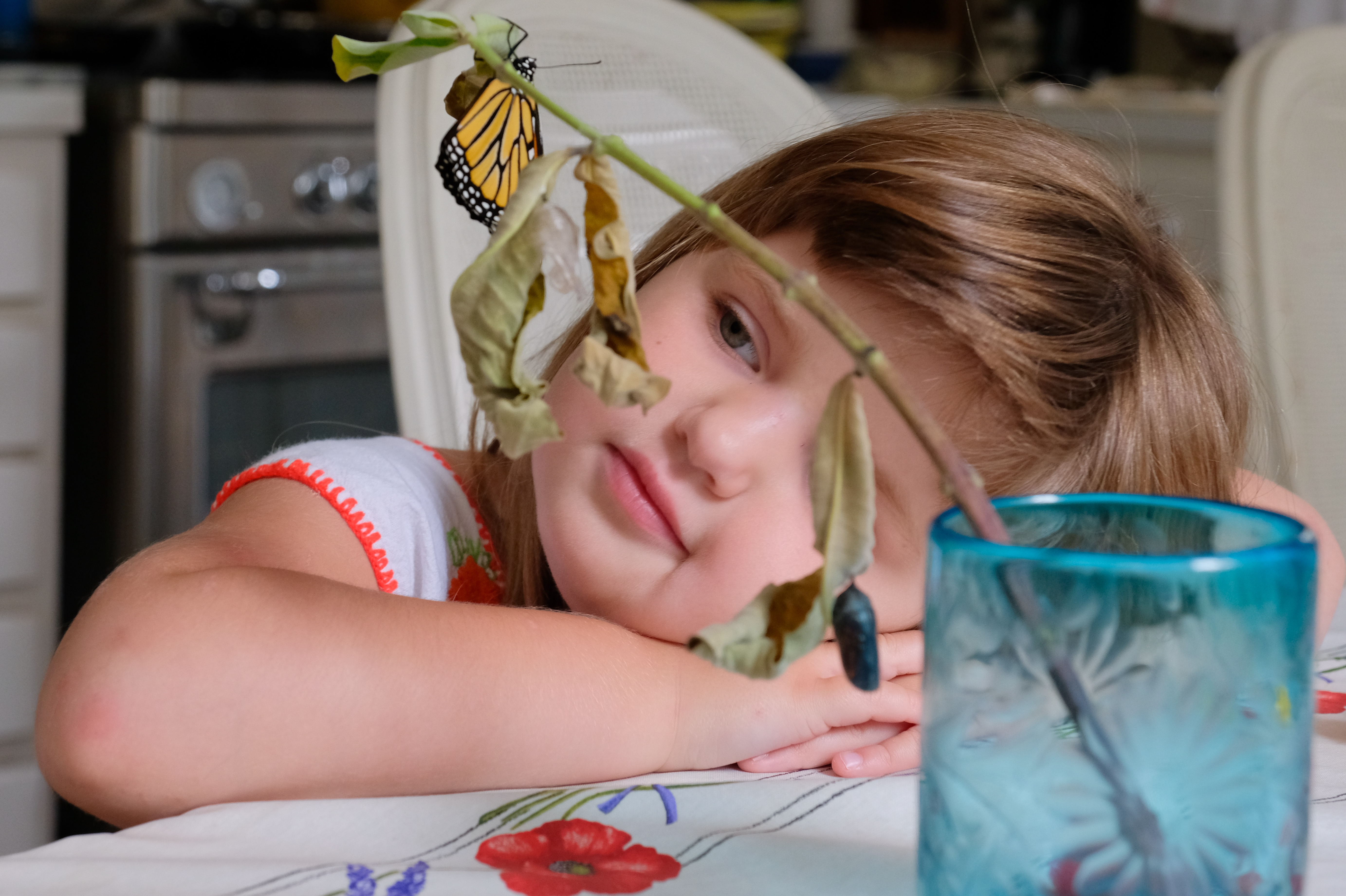
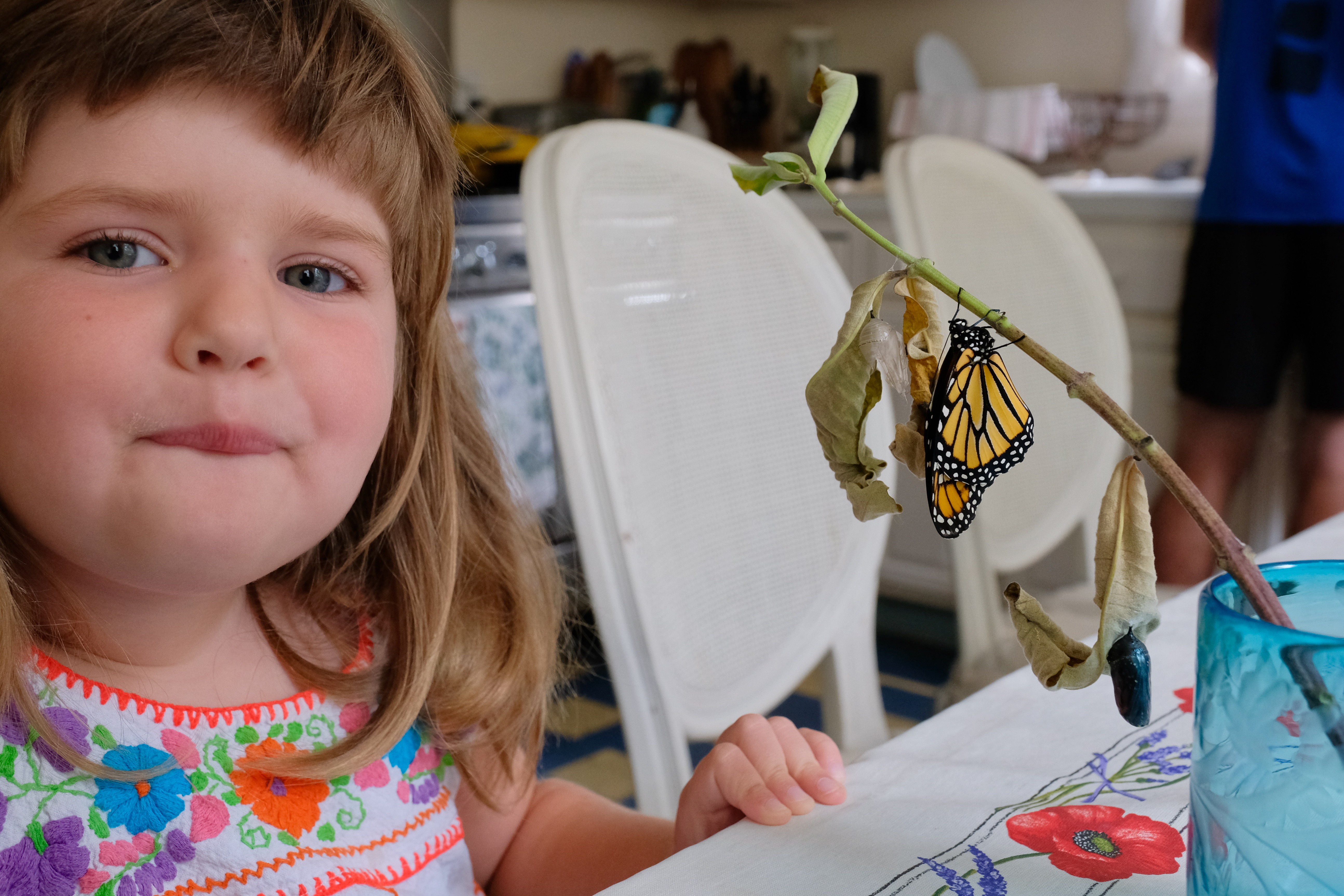
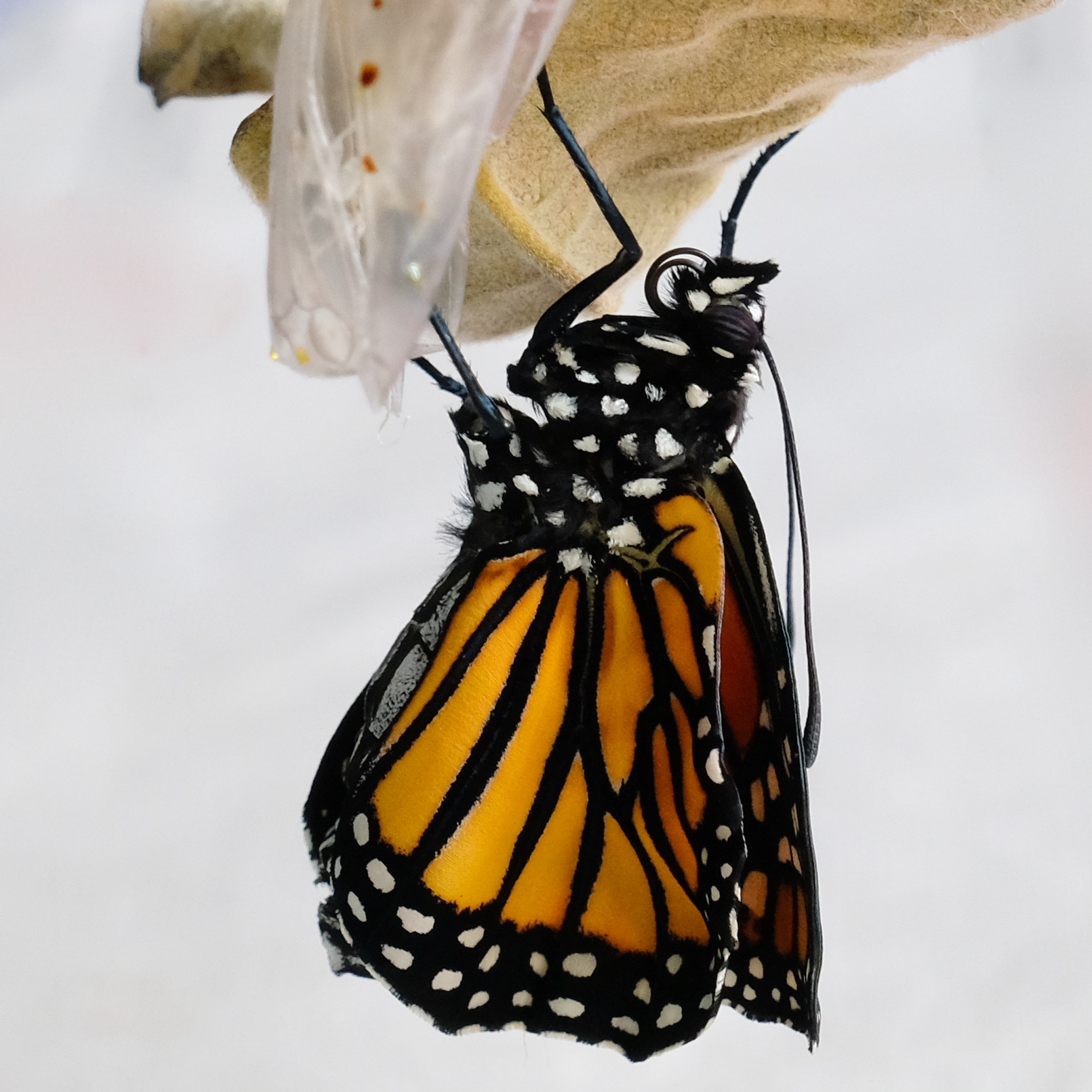
Last weekend watching the Monarchs emerge at breakfast – I think Charlotte loves butterflies nearly as much as do I ❤

CATS IN THE GARDEN, MONARCH CATS THAT IS!

Milkweeds, as most know, are the host plant for Monarch Butterflies. A host plant is another way of saying caterpillar food plant.

Monarchs deposit eggs on milkweed plants. Some milkweeds are more productive than other species. For the Northeast region, the most productive milkweed is Common Milkweed (Asclepias syriaca). The second most productive is Marsh Milkweed (Asclepias incarnata), also known as Swamp Milkweed.

What is meant by productive? When given a choice, the females choose these plants over other species of milkweed and the caterpillars have the greatest success rate. In our own butterfly garden and at at my client’s habitat gardens, I grow both Common and Marsh side-by-side. The females flit from one plant to the next, freely depositing eggs on both species.

Please consider making a tax deductible donation, or becoming an underwriter, to bring our Monarch Butterfly documentary Beauty on the Wing: Life Story of the Monarch Butterfly to American Public Television. To Learn More go here and to DONATE go hereThank you!

With thanks and gratitude to our growing list of wonderful folks for their kind contributions

Lauren Mercadante, Jonathan and Sally Golding, James Masciarelli, Pete and Bobbi Kovner, Karrie Klaus (Boston), Sally Jackson, Marion Frost (Ipswich), JoeAnn Hart and Gordon Baird, Joy Van Buskirk (Florida), Lillian and Craig Olmstead, Suki and Fil Agusti (Rockport), Janis Bell, Nina Groppo, Nubar Alexanian, Marguerite Matera, Claudia Bermudez, Thomas Hauck, Judith Foley (Woburn), Jane Paznik-Bondarin (New York), Paul Vassallo (Beverly), Stella Martin, Liv Hauck (California), Julia Williams Robinson (Minnesota), Cynthia Dunn, Diane Gustin, Heidi Shiver (Pennsylvania), John Ronan, Karen Maslow,Fernando Arriaga (Mexico City), Holly Nipperus (Arizona), Kristina Gale (California), Maggie Debbie, Kate and Peter Van Demark (Rockport), Mia Nehme (Beverly), Chicki Hollet, Alice Gardner (Beverly), Therese Desmarais (Rockport), Jennie Meyer, Kathy Gerdon Archer (Beverly), Melissa Weigand (Salem), Duncan Todd (Lexington), Catherine Ryan, Linda Bouchard (Danvers), Elaine Mosesian, Paul Wegzyn (Ipswich), Catherine Bayliss, Jan Waldman (Swampscott), Alessandra Borges (Rhode Island), Nancy Mattern (New Mexico), Carolyn Constable (Pennsylvania), and Ian Gardiner.

BUTTERFLY FRIENDS STOPPING BY FOR MONARCHS!

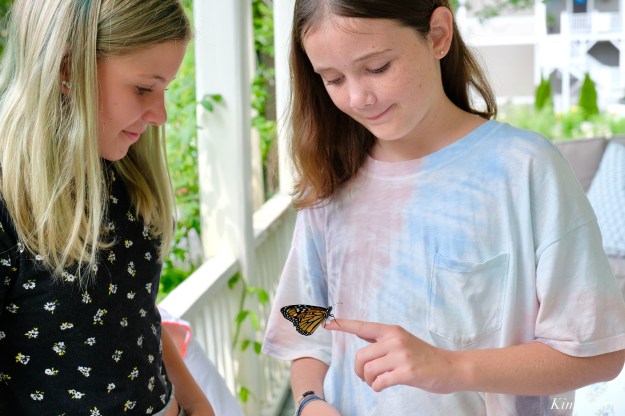
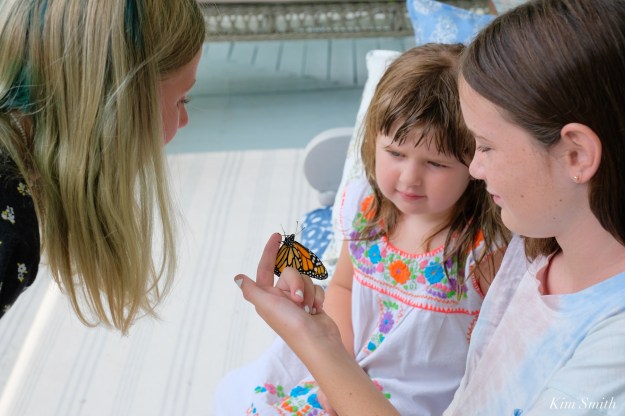
Walking past our front porch, butterfly friends Meadow, Frieda, and Ruby stopped by to see a batch of newly emerged Monarchs. Both Frieda and Meadow are featured in Beauty on the Wing: Life Story of the Monarch Butterfly, filmed when they were several years younger. It’s so wonderful to see all three girls are growing into the bright, beautiful young woman they are becoming.

Love our neighborhood kids ❤

YOUR DAILY MONARCH BUTTERFLY PHOTO AND WHY WE LOVE JOE-PYE WILDFLOWER!

With wonderfully exuberant pollinator friendly flower clusters atop 7 -12 foot tall stalks, what is not to love! Plant Joe-pye in a sunny location at the back of the border and enjoy the array of bees and butterflies that will flock to the nectar-rich blossoms.

More reasons to love Joe-pye is that it is low maintenance, attracts pollinators, is deer resistant, not flattened by rain, not bothered by diseases, blooms when Monarchs are on the wing, and is super easy to grow.

Coming in for a landing

Please consider making a tax deductible donation, or becoming an underwriter, to bring our Monarch Butterfly documentary Beauty on the Wing: Life Story of the Monarch Butterfly to American Public Television. To Learn More go here and to DONATE go hereThank you!

HOW TO TELL THE DIFFERENCE BETWEEN A MALE AND FEMALE MONARCH BUTTERFLY

Newly eclosed female in the petunia patch

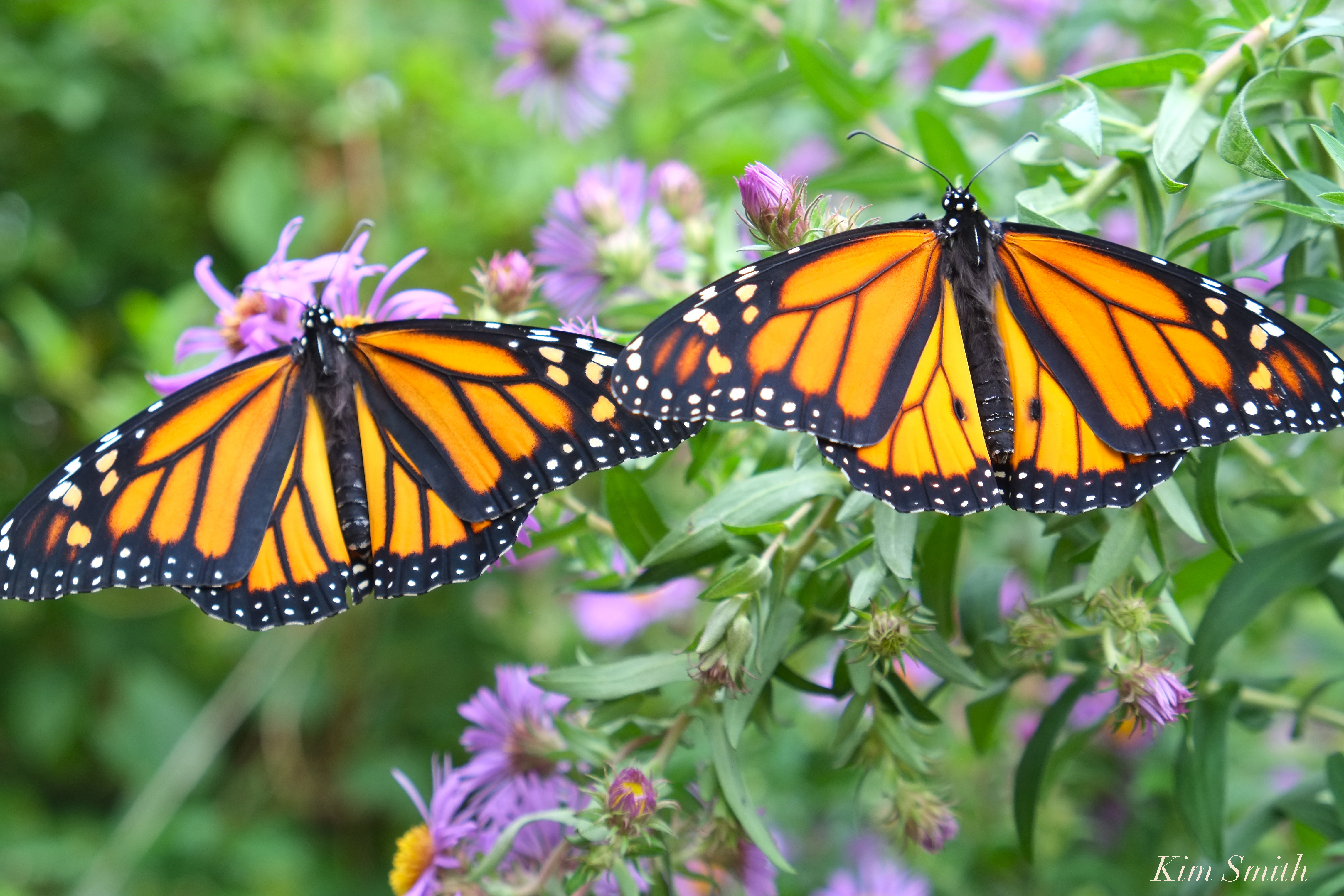
You can tell she is a female Monarch because of her smokier and thicker wing venation. The male’s wing veins are narrower . The male also sports to black dots, or sacs, one on each hind wing. The sacs are filled with a pheromone, which the male sprinkles on the female during courtship. If she is receptive, the pair will mate. The pheromones are sometimes referred to by scientists as “love dust.”

In the above photo taken during the fall migration last year, you can easily see the difference. The female is on the left, the male on the right.

Please consider contributing to our online fundraiser to bring the feature length documentary Beauty on the Wing: Life Story of the Monarch Butterfly to American Public Television. Thank you! 

NEW FILM FOR MONARCH KIDS: THE MARVELOUS MAGNIFICENT MIGRATING MONARCH! AVAILABLE TO VIEW FOR FREE

Dear Monarch Friends,

Last week the short film about Monarchs created for the Sawyer Free Library children’s program had lots of interest. The Marvelous Magnificent Migrating Monarch! finished its run at the SFLibrary and I thought I would love to share it with you and the youngest members of your family. Many, many thanks to Justine Vitale, Sawyer Free Library Department Supervisor, for encouraging me to create this short film for children!!

At about four minutes in, Charlotte demonstrates an uncomplicated and fun method of raising  Monarchs caterpillars. She has been doing this with me since she was two, and you can see how simple it is to set up a terrarium.

The number of Monarchs in gardens, meadows and dunes over the past month has been nothing but extraordinary. Simply going no further than on our front porch and in my garden (not quite recovered from broken leg yet), I have photographed countless females depositing eggs along with many battles of male to male combat as they stake out their patch of wildflowers and milkweed while patrolling for females.

Battle Royale over the Joe-pye wildflower (Eupatorium). What makes this patch of Joe-Pye so attractive to the males is that is it located adjacent to a patch of Marsh Milkweed (Asclepias incarnate)

Over the past few days, the Monarchs have been settling down a bit, which happens every year toward the mid to end of August. I think the butterflies we have been seeing battling and depositing eggs may be the parents of the Methuselah Monarchs. This newly emerging batch of caterpillars may very well be the generation of Super Monarchs, the ones that journey to Mexico.

I am so hopeful for the future of this tiny marvel of nature. I hope The Marvelous Magnificent Migrating Monarch is easy for your youngsters to follow along and to understand, and also provides you with some tips on how we can all help the butterflies. Safe travels Monarchs!

My deepest gratitude and thanks to all who are contributing to the second phase of launching Beauty on the Wing: Life Story of  the Monarch Butterfly out into the world, the world of Public Television. To date we have raised close to $18,000.00 toward our goal of $51,000.00.

For more information on how you can help launch Beauty on the Wing to the American Public Television audience, please go here.

DONATE HERE

Thank you so very much to all these kind contributors:

Lauren Mercadante, Jonathan and Sally Golding, James Masciarelli, Pete and Bobbi Kovner, Karrie Klaus (Boston), Sally Jackson, Marion Frost (Ipswich), Joy Van Buskirk (Florida), Lillian and Craig Olmstead, Suki and Fil Agusti (Rockport), Janis Bell, Nina Groppo, Nubar Alexanian, Marguerite Matera, Claudia Bermudez, Thomas Hauck, Judith Foley (Woburn), Jane Paznik-Bondarin (New York), Paul Vassallo (Beverly), Stella Martin, Liv Hauck (California), Julia Williams Robinson (Minnesota), Cynthia Dunn, Diane Gustin, Heidi Shiver (Pennsylvania), John Ronan, Karen Maslow, Fernando Arriaga (Mexico City), Holly Nipperus (Arizona), Kristina Gale (California), Maggie Debbie, Kate and Peter Van Demark (Rockport), Mia Nehme (Beverly), Chicki Hollet, Alice Gardner (Beverly), Therese Desmarais (Rockport), Jennie Meyer, Kathy Gerdon Archer (Beverly), Melissa Weigand (Salem), Duncan Todd (Lexington), Catherine Ryan, Linda Bouchard (Danvers), Elaine Mosesian, Paul Wegzyn (Ipswich), Catherine Bayliss, Jan Waldman (Swampscott), Alessandra Borges (Rhode Island), Nancy Mattern (New Mexico), Carolyn Constable (Pennsylvania), and Ian Gardiner.

Female Monarch depositing eggs on Common Milkweed seedpod