Tag Archives: Gloucester

MONARCHS HERE, THERE, AND EVERYWHERE! PLEASE REPORT YOUR MONARCH BUTTERFLY SIGHTINGS (EDITED)

Reports of Monarch Butterfly sightings are coming in from all around Cape Ann, and beyond. I have seen more this this year than in recent summers. I wonder if higher numbers in July indicates a stronger migration in September. We can hope!

At this time of year, the females are depositing the eggs of the next generation.  You can find Monarchs at wildflower meadows, dunes, and gardens, where ever milkweed and nectar-rich flora grow. Typically, the eggs and caterpillars are found on the undersides of the uppermost leaves.

If you would, please report any Monarch activity that you have seen–eggs, flight, caterpillars, nectaring, mating, whatever you discover. Please share the approximate date and place. Even if you have shared previously in a comment, I hope to keep all the sightings in one place, so please re-comment. Thank you! 

*EDIT:

Thank you everyone for writing! How exciting that so many are being spotted, many more than the past several years. One was in my garden this morning, again, and two at Good Harbor Beach dunes earlier this morning.

Adding JoeAnn Hart, Susan Burke and Michele Del, as they commented on Facebook.

Patti, do you have caterpillars?? I’d love to stop by and see.

Please keep your comments coming. Thank you!!!!

When watching, note that the first two minutes of the film were shot in Gloucester. I think you will be dazzled by the numbers of Monarchs that travel through Cape Ann’s backyards and meadows during the peak of migration.

MONARCHS WEAPONIZE MILKWEED TOXINS

Monarch Caterpillars Eating Common Milkweed ©Kim Smith 2012JPGMilkweed Munching Monarchs

Although scientists have long known that the toxic sap that flows through milkweed veins, called cardenolides, can make a bird very sick if it attempts to eat a Monarch caterpillar, it was unclear whether the butterfly’s acquired adaption to the toxicity was a side effect that allowed the caterpillar to eat the milkweed or had developed separately as a defensive mechanism against predators. A Cornell University study recently published in Proceedings B of The Royal Society Publishing reveals that they have indeed evolved to weaponize milkweed toxins! Thank you so much to Maggie Rosa for sharing “The Scientist” article and you can read more about it here. 

“Monarch butterfly caterpillars have evolved the ability to store toxins known as cardenolides, obtained from their milkweed diet, specifically to make themselves poisonous to birds, as has at least one other species of milkweed-munching caterpillar, according to a study published Wednesday (November 4) in Proceedings of the Royal Society B.

“This finding is fascinating and novel,” Stephen Malcolm, a professor at Western Michigan University who studies cardenolides but was not involved in the new research, wrote in an email to The Scientist. “It is exciting to have evidence for the importance of top-down influences from predators.” Continue Reading

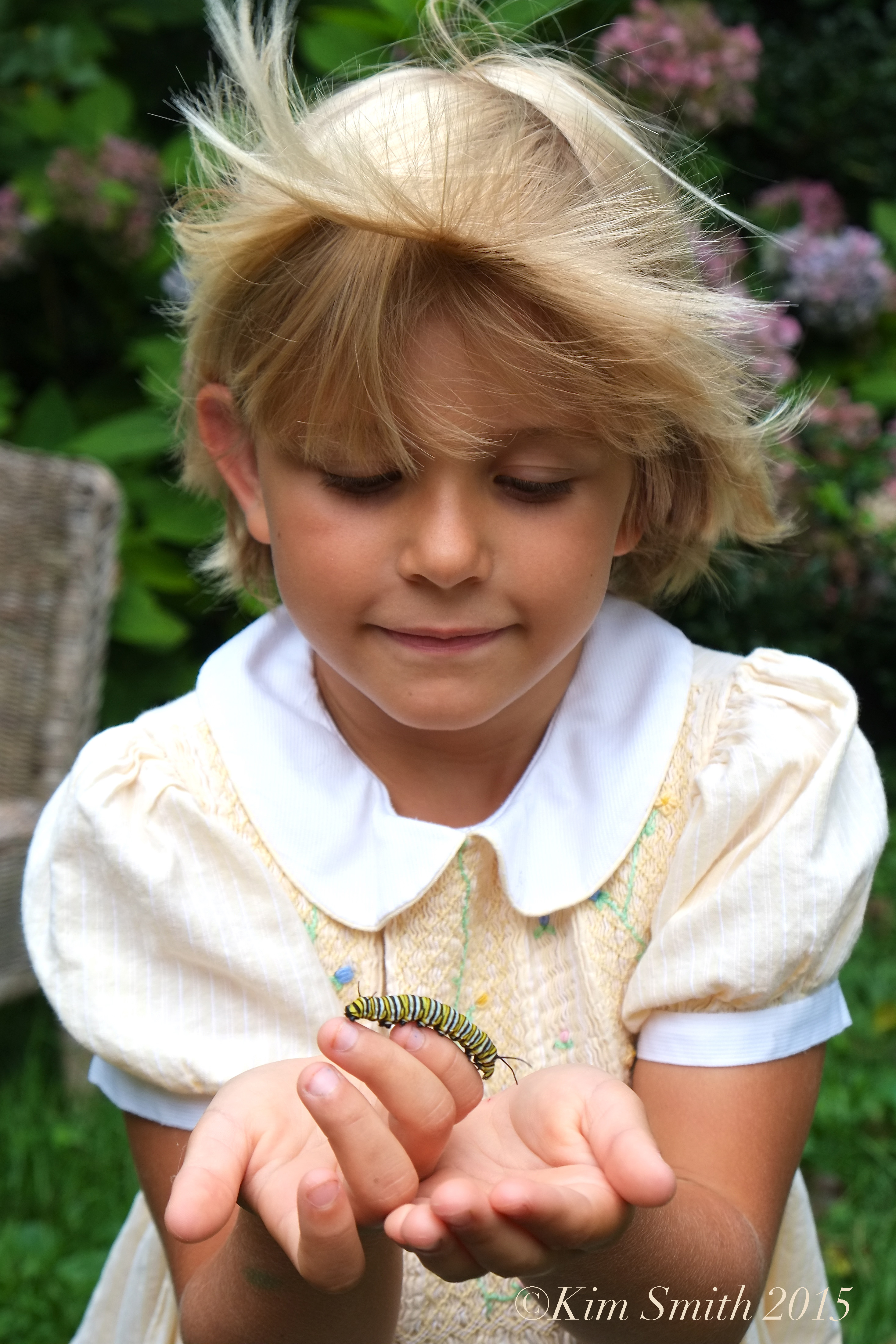
Please join me Thursday evening, November 12th, at 7pm at the Sawyer Free Library for my illustrated talk, Beauty on the Wing ~ Life Story of the Monarch Butterfly. Looking forward to seeing you there!Meadow monarch caterpillar ©Kim Smith 2015
Meadow Anderson and Milkweed Caterpillar

MY MONARCH BUTTERFLY PROGRAM AT THE SAWYER FREE LIBRARY

Dear Friends,

Please join us at the Sawyer Free Library on Thursday November 12th at 7:00 pm for my Monarch butterfly program. I am especially, especially excited to present to our community. I hope to see you there! Please note that this is my photo and lecture program, not the new film, which will be coming soon.

For more information visit my website Kim Smith Designs.

2- Monarch New England Aster ©Kim Smith 2013


NEW FILM: A FLIGHT OF MONARCHS

When watching, know that the first two minutes of the film were shot in Gloucester. I think you will be dazzled by the sheer numbers of Monarchs that travel through Cape Ann’s backyards and meadows during the peak of migration.

I began photographing the Monarchs in 2006, which was a year when we had an extraordinary number of Monarchs visiting our shores. At that time, I became determined that if ever again this phenomenon were to occur on Cape Ann, I was going to have the ability to document on film, rather than only through still images, this beautiful event for my community. It’s hard to imagine without observing and here you can see what I have wanted to share.

A Flight of Monarchs begins on a September day as first one and then passels of Monarchs begin to arrive to the fields and meadows of Cape Ann, carried across Massachusetts Bay on a tailwind. By the early evening light they begin to pour into the surrounding trees, clustering to stay warm in the branches furthest away from the prevailing breezes. The following morning as the sun begins to touch their wings, they alight from the trees, seeking the freshest wildflowers from which to drink nectar to help build their lipid reserves for the several thousand mile journey south. They drink and drink until the last of the sun’s rays dip below the tree line. As they arrived on a tailwind, they again depart, and are carried to the next gathering area. For coastal Monarchs, Allens Pond, which is located in Westport, Massachusetts is often the next stop.

In the next scene, the butterflies have arrived to the sacred oyamel fir forests of Angangueo, Michoacán, deep in the heart of the Trans-Mexican Volcanic Belt. It’s early morning and the butterflies are suspended in great primordial branched clusters that may become so heavy from the weight of so many butterflies the boughs of the trees bend to the breaking point. Later in the day, as the sun begins to warm their wings, the butterflies begin to stir. During the winter, it is imperative that the Monarch’s body temperature remains relatively low. They leave the sunniest branches in search of shade and a drink of water from nearby mountain streams. Occasionally in late February, as the air temperatures begin to warm with the coming springtime, for a short period during the day, the butterflies leave the trees all at once. This phenomenon is called a butterfly “explosion,” and is a truly magnificent event to observe.

A Flight of Monarchs is set to the evocative and tender “Fields of Blue,” written and performed by composer and guitarist Jesse Cook and his band, to which permission was granted by the artist for the purpose of this short film. Here is a link to Cook’s website. I highly, highly recommend attending a live performance of Jesse Cook and Company. As was I, you will be completely taken by their gorgeous music, exquisite artistry, and with Cook’s songwriting, will travel in beautiful melodies inspired from around the world.

I am currently editing my feature length documentary, Beauty on the Wing, which after months and months of organizing and editing three years of footage, is currently running at approximately twelve hours in length. At eleven hours too long, I have a great deal of editing to accomplish in the coming winter months!

A Flight of Monarchs presented here is the shorter version of the film that I created for the Berkshire Museum’s “Butterflies” exhibit. The first version is six minutes long and played on a continuous loop in the main gallery of the exhibit hall. The longer version will soon be posted on Vimeo.


Request for Help and Monarch Film Update

For the past three years I have been filming the life story of the Monarch Butterfly in backyards and along the shores of Cape Ann. My original intent was to tell the story of the butterflies primarily as it relates to their northern breeding grounds and specifically here in our community. Prior to filming, I wrote a children’s story about the Monarchs and during this entire time I have had an ongoing inner debate as to whether or not to travel to Mexico. While editing the film these past few months, I determined that capturing the butterfly’s story in their winter sleeping grounds as they are awakening in Mexico would only add to the film’s depth and beauty. To film in Mexico would be a dream come true.

In February I am going to Mexico to film the Monarchs!!! This all has come about very quickly! I have to practice walking five miles a day, recall how to ride a horse, and learn enough Spanish so that if I am separated from my group or kidnapped by bandits, I can at least inquire as to where is the bathroom.

Does anyone know of a local outfit that gives lessons in trail riding? And does anyone have experience with a Spanish language lesson CD (basic)? If so, can you please recommend in the comment section. Thank  you!!!!!!!

Stay tuned for adventures from Mexico! Beauty on the Wing ~ Life Story of the Monarch Butterfly will premiere  in the summer of 2014.

Rather than wait until the film was complete, this weekend I made a new website for the film-in-progress. When you have a moment, I hope you’ll visit my website and read more about Beauty on the Wing here.

Monarch Butterfly milkweed Good harbor Beach ©Kim Smith 2011Monarch Butterfly Nectaring at Common Milkweed ~ Good Harbor Beach, Gloucester

Beauty on the Wing celebrates the poetry and majesty of the uniquely North American phenomenon of the Monarch butterfly and its migration. There are no other butterflies the world over that travel this distance and it is a fascinating ecological link that connects Mexico with nearly every geographic region within the United States and Canada. How well the forested habitats of Michoacán are taken care of is as of equal importance to the Monarchs as how we in Gloucester conserve our habitats.