Category Archives: Monarch Butterfly Migration in crisis

MONARCHS HERE, THERE, AND EVERYWHERE! PLEASE REPORT YOUR MONARCH BUTTERFLY SIGHTINGS (EDITED)

Reports of Monarch Butterfly sightings are coming in from all around Cape Ann, and beyond. I have seen more this this year than in recent summers. I wonder if higher numbers in July indicates a stronger migration in September. We can hope!

At this time of year, the females are depositing the eggs of the next generation.  You can find Monarchs at wildflower meadows, dunes, and gardens, where ever milkweed and nectar-rich flora grow. Typically, the eggs and caterpillars are found on the undersides of the uppermost leaves.

If you would, please report any Monarch activity that you have seen–eggs, flight, caterpillars, nectaring, mating, whatever you discover. Please share the approximate date and place. Even if you have shared previously in a comment, I hope to keep all the sightings in one place, so please re-comment. Thank you! 

*EDIT:

Thank you everyone for writing! How exciting that so many are being spotted, many more than the past several years. One was in my garden this morning, again, and two at Good Harbor Beach dunes earlier this morning.

Adding JoeAnn Hart, Susan Burke and Michele Del, as they commented on Facebook.

Patti, do you have caterpillars?? I’d love to stop by and see.

Please keep your comments coming. Thank you!!!!

When watching, note that the first two minutes of the film were shot in Gloucester. I think you will be dazzled by the numbers of Monarchs that travel through Cape Ann’s backyards and meadows during the peak of migration.

Save the Date for My Upcoming Program “Beauty on the Wing: Life Story of the Monarch Butterfly”

On Thursday, May 4th at 7pm, I am giving my lecture with photos, “Beauty on the Wing: Life Story of the Monarch Butterfly,” along with several short film screenings, for the Salem Garden Club. For more information, see the events page of my website. I hope to see you there!

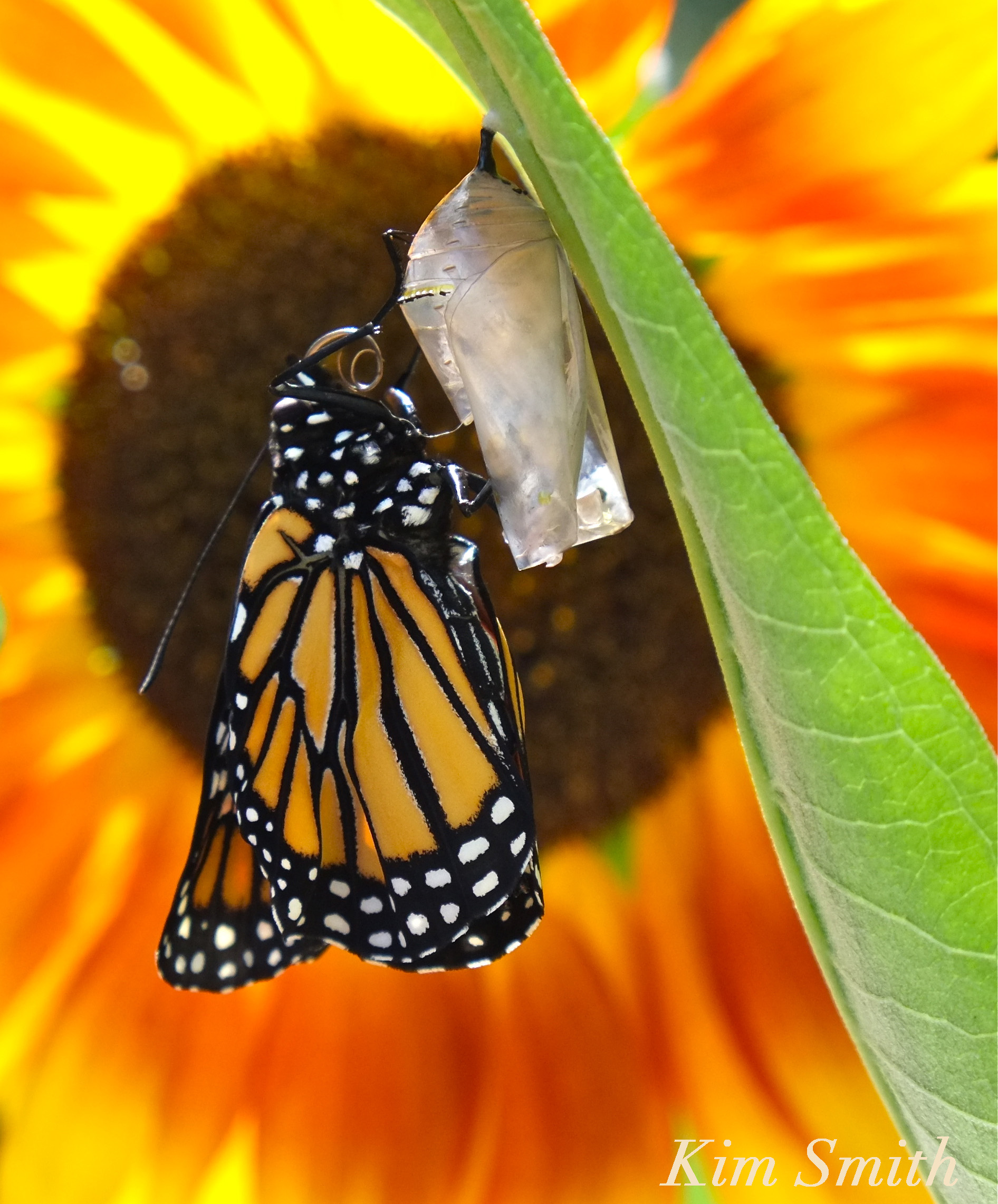
Newly Emerged Monarch Butterfly and Sunflower, Gloucester

Beauty on the Wing ~ Life Story of the Monarch Butterfly

The Monarch’s life story is one of nature’s most incredible examples of adaptation and survival. But the Monarch migration is in great peril. Learn how you can help. Through photographs and discussion, Beauty on the Wing tells the life story of the Monarch Butterfly, the state of the butterflies migration and why they are in sharp decline, and the positive steps we can take as individuals and collectively to help the Monarchs recover from the devastating effects of habitat loss and climate change.  (1-1.5 hours).

Monarch Butterfly Chrysalis and Marsh Milkweed

Monarchs Awakening

NRCS, USFWS Partner to Accelerate Conservation on Agricultural Lands for the Monarch Butterfly

NRCS, USFWS Partner to Accelerate Conservation on Agricultural Lands for the Monarch Butterfly


Download the Monarch Butterfly Conference Report.
NEW Working Lands for Wildlife National project bounderies
See a map of Working Lands for Wildlife National Project Boundaries.

The monarch butterfly is a new national priority species of Working Lands for Wildlife (WLFW), a partnership between the U.S. Department of Agriculture’s Natural Resources Conservation Service (NRCS) and the U.S. Fish and Wildlife Service (USFWS). Populations of monarchs, a pollinator species cherished across North America, have declined significantly during the past two decades. This collaboration aims to help the species recover by working with agricultural producers to make wildlife-friendly improvements on their farms, ranches and forests.

“Producers can make simple and inexpensive tweaks on working lands that provide monumental benefits to monarch butterflies and a variety of other insects and wildlife,” said NRCS Chief Jason Weller. “By adding the monarch to Working Lands for Wildlife, we can accelerate conservation for the species at the heart of its migration corridor.”

NRCS and USFWS recently completed a conference report that explains how conservation practices can help the eastern monarch population, a species known for its remarkable annual, multi-generational migration between central Mexico and the United States and Canada. This report is an initial step toward adding the monarch to WLFW, which uses a science-based, targeted approach to help a variety of at-risk species.

“We need to make every effort to help ensure monarchs don’t become endangered now and in the long term,” said USFWS Midwest Regional Director Tom Melius. “Conservation efforts on agricultural lands across the nation can have a significant positive impact on monarchs as well as many other pollinator insects and birds. Working with farmers and other private landowners, we can ensure a future filled with monarchs.”

The monarch butterfly joins an array of wildlife species across the country already part of WLFW, including the greater sage-grouse and New England cottontail, two recent successes in species conservation. The USFWS determined in 2015 that the two species didn’t warrant protections under the Endangered Species Act (ESA) because of voluntary conservation efforts underway to restore habitat.

Through WLFW, NRCS provides technical and financial assistance to help producers adopt conservation practices that benefit the monarch. Meanwhile, through the conference report, the USFWS provides producers with regulatory predictability should the monarch become listed under the ESA. Predictability provides landowners with peace of mind – no matter the legal status of a species under ESA – that they can keep their working lands working with NRCS conservation systems in place.

Work through WLFW centers on 10 states in the Midwest and southern Great Plains that are considered the core of the monarch’s migration route and breeding habitat. Much of this work will focus on planting and enhancing stands of milkweed and other high-value nectar plants for monarchs. Assistance is available to producers in Illinois, Indiana, Iowa, Kansas, Minnesota, Missouri, Ohio, Oklahoma, Texas and Wisconsin.

USFWS has committed significant funding – $20 million over five years – to support monarch conservation efforts. Additionally, USFWS is working with partners, including the National Fish and Wildlife Foundation, National Wildlife Federation and the Mexican and Canadian governments to leverage resources and investments to support and implement conservation actions across the continent.

During the past two years, NRCS has made available $6 million through a variety of Farm Bill conservation programs for monarch conservation in the 10 states. Additionally, NRCS is working with partners, including The Xerces Society and General Mills, to increase staffing capacity to help producers design customized conservation strategies for working lands.

The two agencies’ efforts contribute to a multi-agency, international strategy to reverse the monarch’s population decline in North America, estimated to have decreased from one billion butterflies in 1995 down to an estimated 34 million. Through the National Strategy to Promote the Health of Honey Bees and Other Pollinators, offsite link image     released by the White House, the United States has a goal of increasing the eastern population of monarchs back to 225 million by 2020.

Producers interested in NRCS assistance should contact their local USDA service center to learn more. NRCS accepts landowner enrollment applications on a continuous basis. NRCS offers more than three dozen conservation practices that can provide benefits to monarchs as well as a variety of other pollinators.



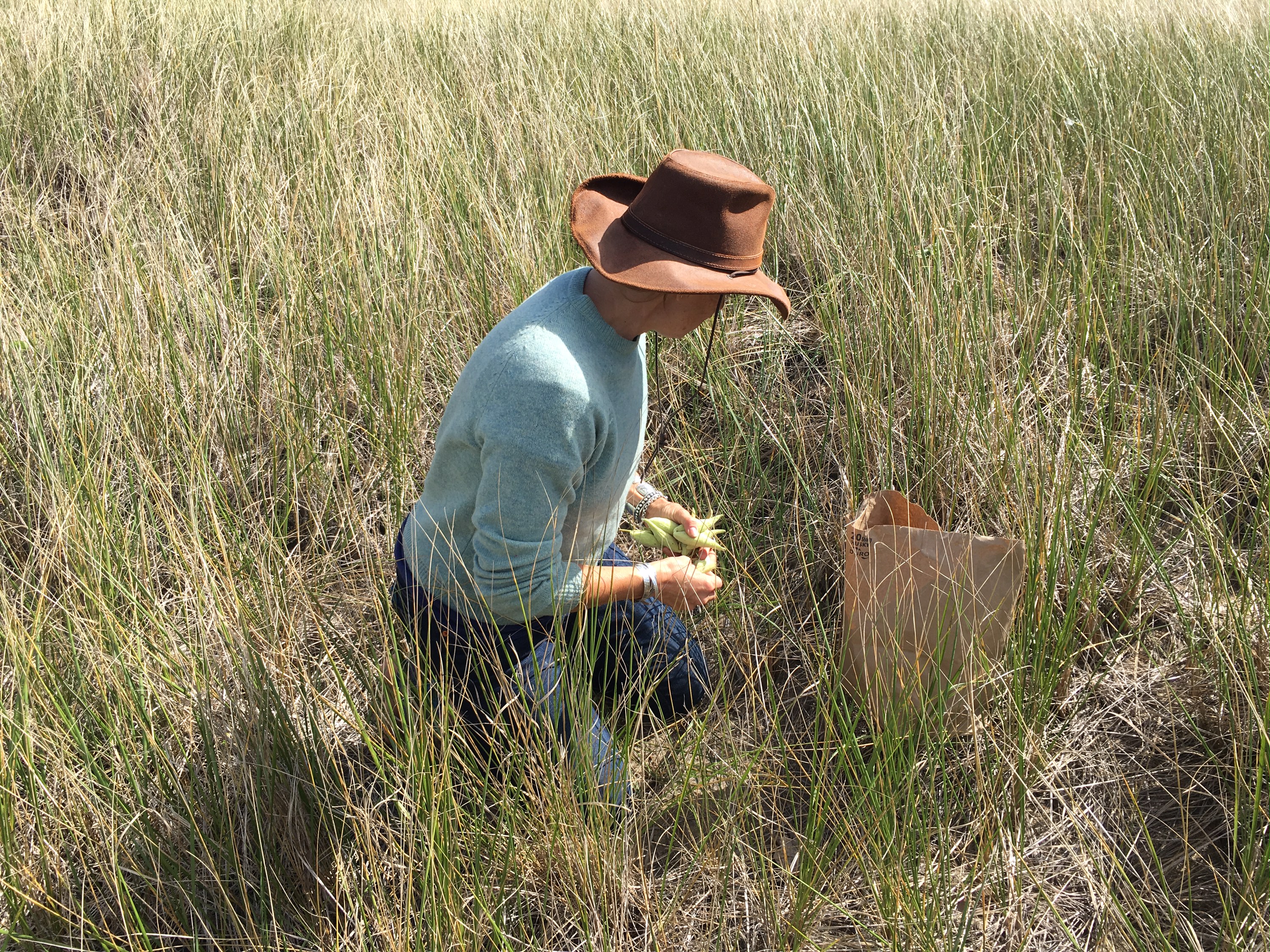
Planting Milkweed with Camilla MacFadyen and The Sarroufs!

img_4937img_4947Thank you to Dawn and John Sarrouf for sharing their milkweed planting photos. They are visiting their friend Camilla at her family home in Small Point Maine, which sounds like, from Dawn’s description, a gorgeously beautiful location, and ideal Monarch habitat. There are fields of wildflowers, and Seaside Goldenrod grows just as easily in the rocky outcroppings there as it does on Eastern Point. After looking at maps, it appears as if you could draw a virtual straight line from Small Point to Eastern Point. Dawn and friends spotted about ten butterflies yesterday. Perhaps we’ll be the next stop (after the predicted rainfall).

img_4946Camilla collected milkweed seed pods and enlisted the Sarroufs to help plant.

DAWN SARROUF PHOTOS

Please Share Your Monarch Sightings – Thank you!

There have been few Monarch sightings this summer but I have been hoping for a strong fall migration. The migration is peaking in Kansas and we are always a little bit behind. Please let me know if you see a Monarch, and where. Thank you very kindly!

https://www.instagram.com/p/BKqhTISjOjG/

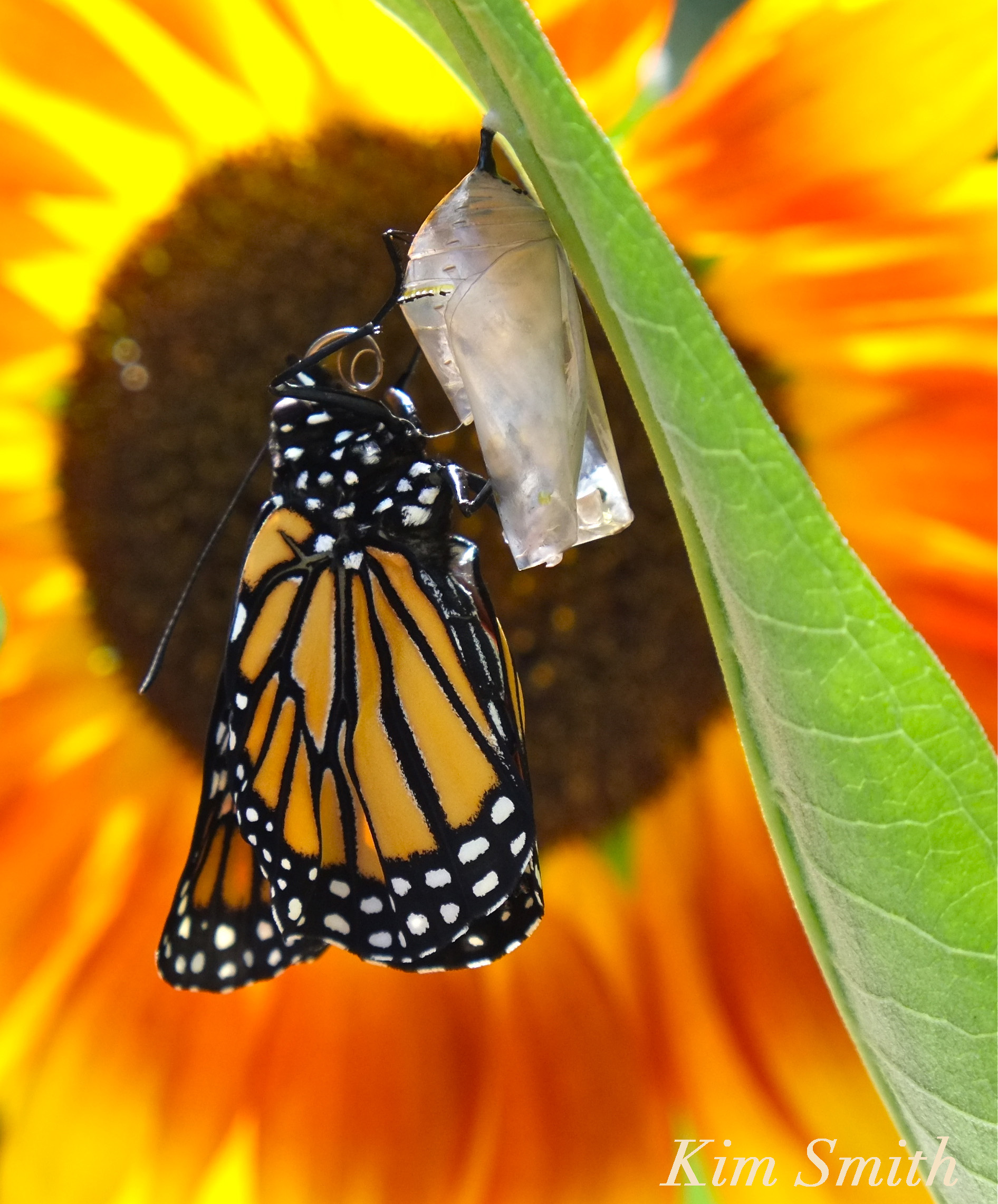
Monarchs are emerging daily in my garden, from eggs collected at my friend Nancy’s field in Salem. This too would be an indication that we may be seeing them soon.newly-emerged-monarch-butterfly-copyright-kim-smith-jpg

This newly eclosed Monarch is clinging to its chrysalis case. Within moments of emerging, the two-part Monarch proboscis must zip together to form a siphoning tube. If the two parts do not join, the butterfly will not be able to drink nectar. In this photo, you can see the proboscis is not yet fully zipped.

Hello Mama Monarch

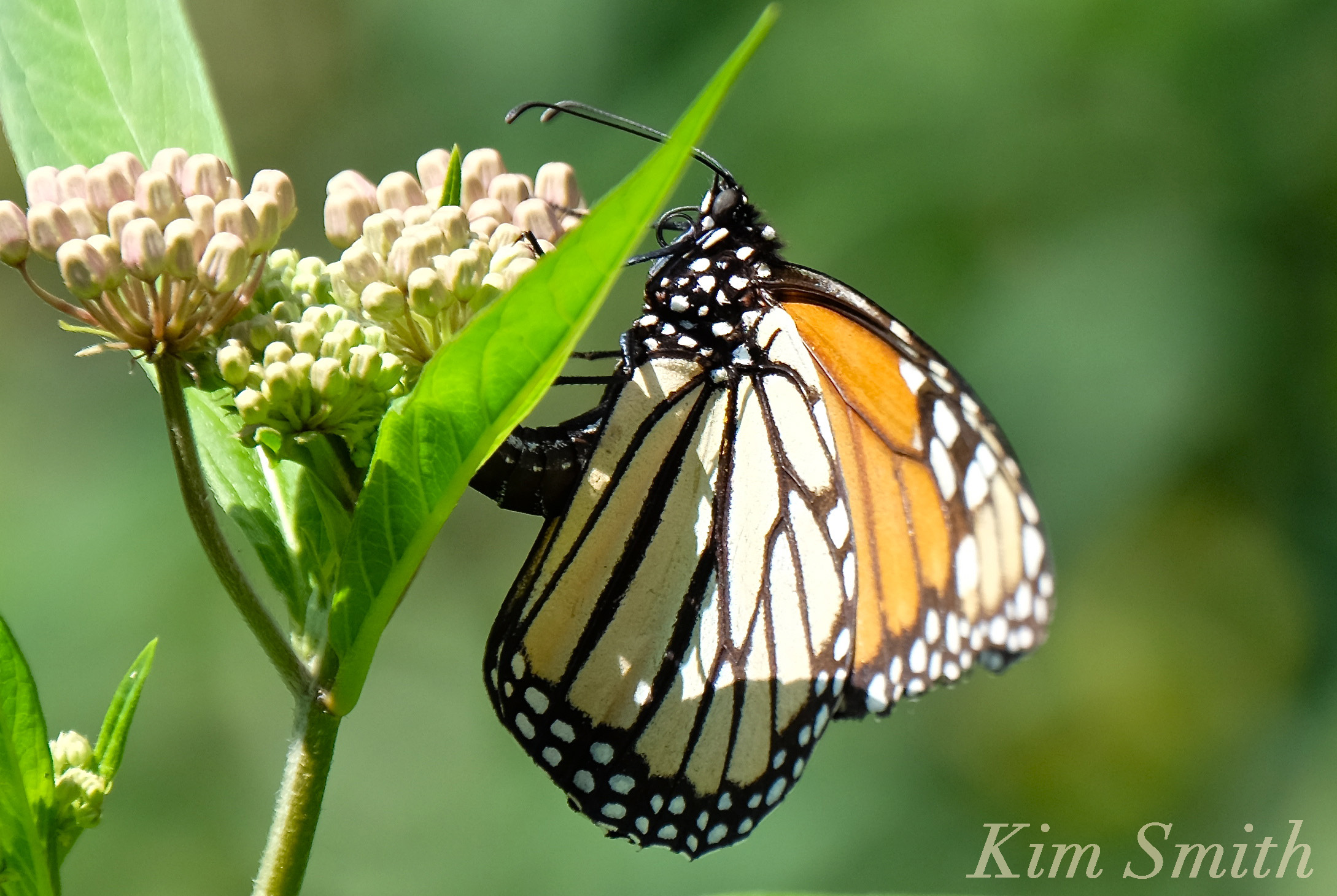
Plant and they will come! Female Monarch depositing eggs -1 copyright Kim Smith Alighting on the buds of our Marsh Milkweed plants, you can see in these photos that the female Monarch is curling her abdomen to the underside to deposit eggs. She will go from bud to bud and leaf to leaf ovipositing one egg at a time. A female, on average, deposits 700 eggs during her lifetime, fewer in hot, dry weather.

Female Monarch depositing eggs copyright Kim SmithFemale Monarch Butterfly and Marsh Milkweed (Asclepias incarnata)

Butterflies do not “lay” eggs; web would say oviposit or deposit. And you wouldn’t describe a caterpillar as hatched, but that it has emerged or eclosed.

Grow Marsh Milkweed and Common Milkweed and you most definitely will have female Monarchs calling your garden home!

Female Monarch depositing eggs -2 copyright Kim Smith
In the above photo you can see how she is contorting her abdomen to correctly position the eggs.

DISCOVERED: THE MONARCHS MEXICAN HAVEN

Forty one years ago today, January 9th is celebrated as the day the Monarchs winter habitat was “discovered.” The woman who led the discovery, Catalina Aguado, was  born in Michoacán, the Mexican state that is home to the butterflies wintering grounds. Catalina is the only living member of the original team featured in the following 1976 National Geographic article.

Excerpt from “Discovered: The Monarchs Mexican Haven”

Doctor Fred Urquhart, the Canadian zoologist who had been studying and tracking the butterflies since 1937 writes the following:

“In our search for the overwintering place, years passed, years of frustration. Norah, late in 1972, wrote to newspapers in Mexico about our project, asking for volunteers to report sightings and to help with tagging.

In response came a letter, dated February 26, 1973, from Kenneth C. Brugger in Mexico City. “I read with interest,” he wrote, “your article on the monarch. It occurred to me that I might be of some help. . . .”

Ken Brugger proved the key that finally unlocked the mystery.

Traveling in his motor home with his dog, Kola, he crisscrossed the Mexican countryside. He searched especially in areas where tagged monarchs had been recaptured, and places where other visitors had reported numerous butterflies. “Go out in the evening,” we instructed him. “That’s when you’ll see the monarchs moving about looking for a place to roost.”

In a letter written in April 1974, Ken reported seeing many monarch butterflies in the Sierra Madre flying at random as if dispersing from a congregating site.

“Your data and observations are exciting,” I replied. “We feel that you have zeroed in on the right area.”

Ken Brugger doubled his field capability by marrying a bright and delightful Mexican, Cathy. Late in 1974 he wrote of finding many dead and tattered butterflies along the roads in a certain area. “You must be getting really close,” we responded. These butterfly remains suggested that birds had been feeding on large flocks of monarchs.

Swiftly came the dramatic conclusion. On the evening of January 9, 1975, Ken telephoned us from Mexico. “We have located the colony!” he said, unable to control the excitement in his voice. “We have found them—millions of monarchs—in evergreens beside a mountain clearing.”

Mexican woodcutters, prodding laden donkeys, had seen swarming butterflies and had helped point the way.”

The complete article is available to read online here.

national-geographic

HOW RELOCATING TREES COULD HELP SAVE THE MONARCH BUTTERFLIES

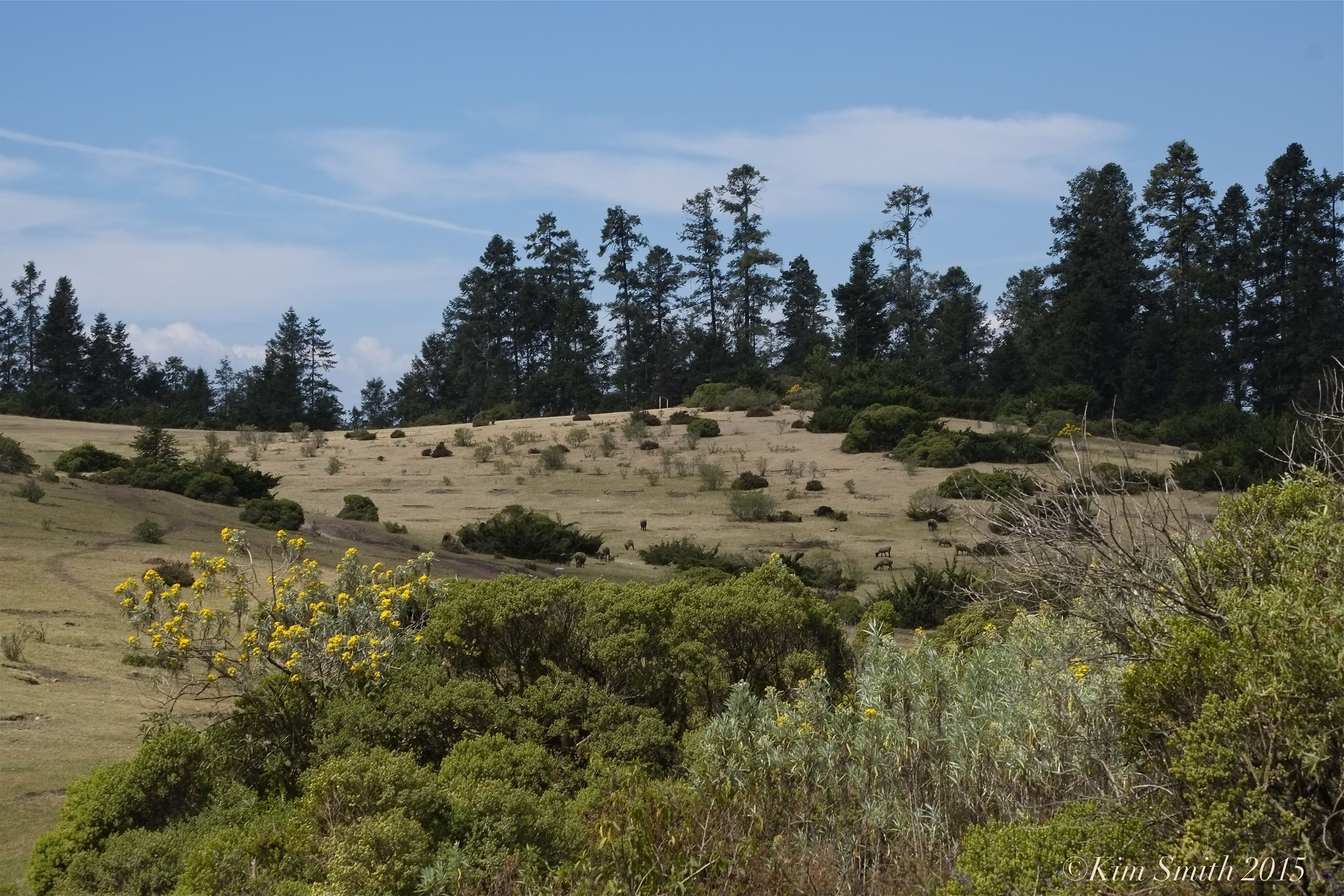
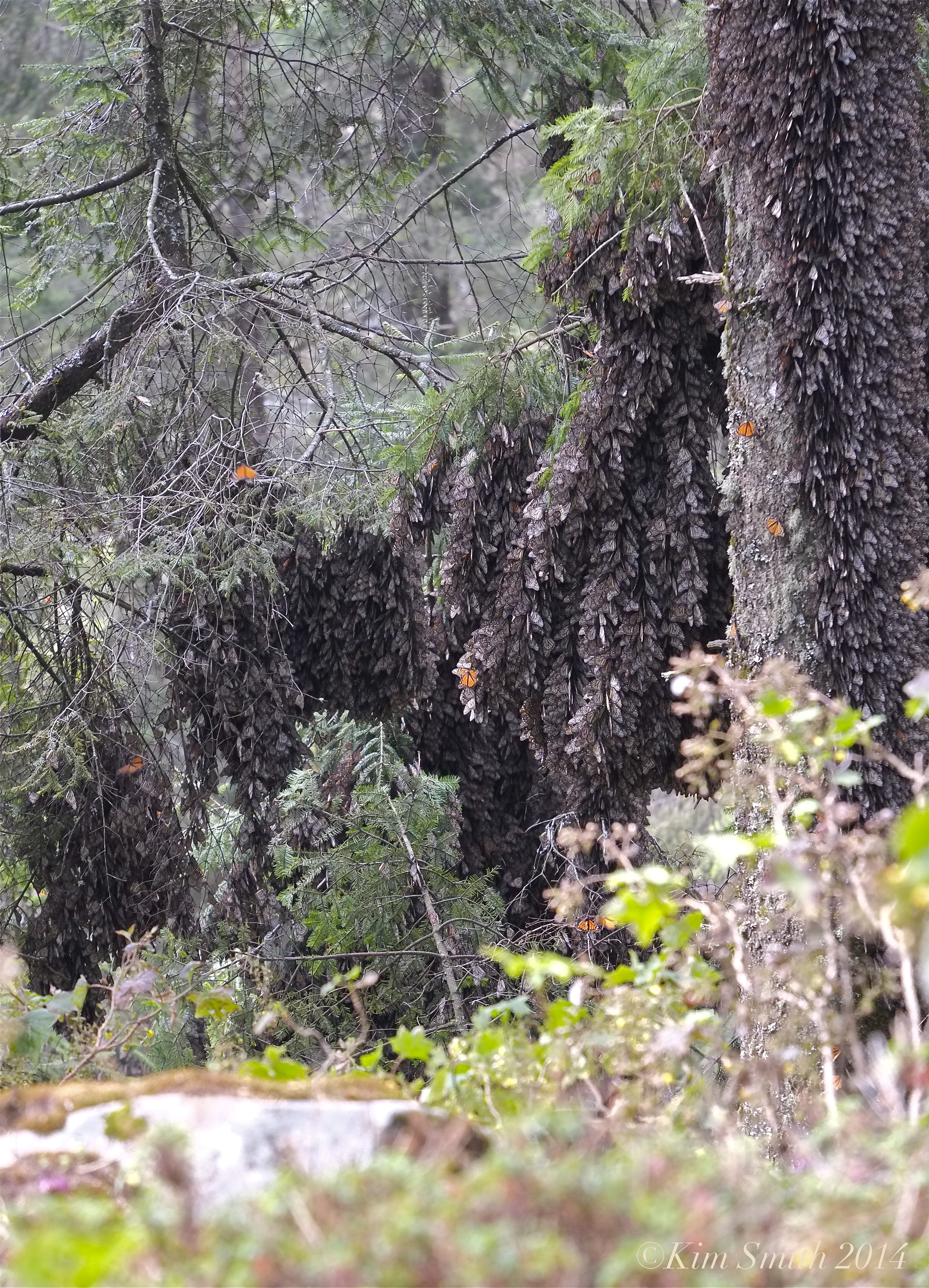
monarchs-el-rosario-©Kim Smith 2014In February of 2014 when I traveled to El Rosario Monarch Butterfly Biosphere Reserve in Angangueo to film the Monarchs, we encountered some difficulty locating the butterflies. Because of global warming conditions the Monarchs had roosted much further up the mountain than was typical. We needed to climb an additional 1500 feet, nearly to the top of the mountain. There was no place higher for the butterflies on this mountain and I wondered at the time, where would they go as the earth becomes increasingly warmer.

Butterflies are heliothermic, which means they gain heat from the sun. During the winter it is imperative that the butterflies remain relatively cool and in a state of sexual immaturity, called diapause. The sheltering boughs of the sacred Oyamel Fir (Abeis religiosa) trees and the cool temperatures at the higher altitudes of the Trans-Mexican Volcanic Mountain Belt, in the past, have provided optimal habitat for the butterflies.

El Rosario ©Kim Smith 2014Leaving the Chaparral and Entering the Oyamel Fir Forest

Oyamel Fir trees Abeis religiosa ©Kim Smith 2014 copyOyamel Fir Forest

The butterflies currently roost at altitudes between 9,500 and 10,800 feet. Mexican scientists are planning to progressively move the trees higher up the mountainsides in a race to save the fir trees. Last summer several hundred seedlings were planted at 11,286 feet where habitat best suited to Monarchs is expected to be by 2030.

Excerpt from “To Protect Monarch Butterfly, a Plan to Save the Sacred Firs”

By Janet Marinelli

“While U.S. biologists urge gardeners to plant milkweeds to help restore the monarchs’ summer habitat, Mexican scientists are pinning their hopes on a plan to move the species progressively higher up local mountainsides in a race to save these firs and the butterflies that depend on them. “We have to act now,” says the plan’s architect, Cuauhtémoc Sáenz-Romero, a forest geneticist at the Universidad Michoacana de San Nicolás de Hidalgo. “Later will be too late, because the trees will be dead or too weak to produce seeds in enough quantity for large reforestation programs.”

When the rainy season arrived last summer, a few hundred seedlings were planted at 11,286 feet, where habitat suited to oyamel fir trees is expected to be by 2030. By then, according to retired U.S. Forest Service geneticist Jerry Rehfeldt, who co-authored a paper with Sáenz-Romero on global warming’s effect on oyamels, temperatures in the reserve could rise above pre-industrial levels by 2.7 degrees Fahrenheit by 2030, and suitable habitat could shrink by nearly 70 percent. The scientists’ research further suggests that by the end of the century, habitat that meets the fir’s needs may no longer exist anywhere inside the reserve. Trees would have to be planted at higher altitudes on peaks more than 100 miles away from the monarch’s migratory home.

The sacred fir is a poster child for the plight of trees around the globe. Trees provide habitat for countless species and underpin ecosystems as well as human economies, but as a group they are highly imperiled. A diagram in the Intergovernmental Panel on Climate Change’s 2014 Working Group II report shows that of all life forms, trees are least able to respond to rapid climate change. Rooted in place, they have not evolved for rapid locomotion. Many take decades to mature and reproduce.

The breakneck speed of current global warming dwarfs anything in the fossil record, even what Lee Kump, professor of geosciences at Penn State University, has called “the last great global warming” 56 million years ago during the Paleocene-Eocene Thermal Maximum. At that time, over the course of a few thousand years, global temperatures soared 9°F as the supercontinent Pangaea broke apart. By comparison, if carbon emissions are not slashed soon, scientists warn it’s possible we could witness that much warming in a matter of centuries, if not decades. Without human help, trees and many other plant and animal species most likely won’t be able to migrate fast enough to keep pace with rapidly changing conditions.”

READ THE COMPLETE ARTICLE HERE

So many thanks to my friend Eric Hutchins for forwarding this article!!

Monarch butterflies oyamel trees Abeis religiosa ©Kim Smith 2014 copyOyamel Boughs Enveloped in Monarchs