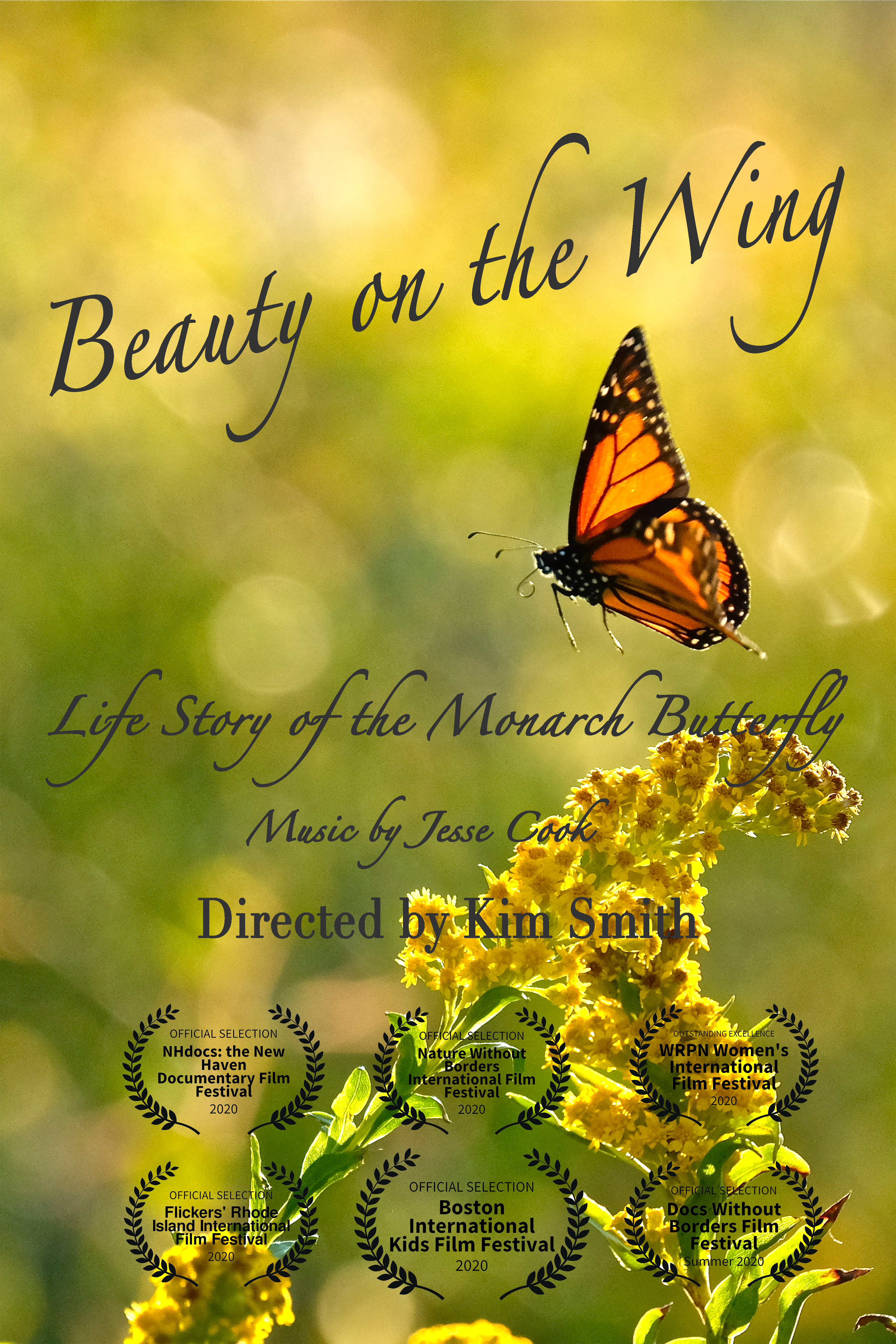
I hope you are doing well and taking good care. I have exciting news to share regarding virtual screening times for Beauty on the Wing at the Providence Children’s Film Festival for my Massachusetts, Connecticut, and Rhode Island friends. The festival opens at 4pm on this coming Friday, the 12th. Tickets may be purchased in advance and you will then have seven days in which to view. Once viewing begins, you have 24 hours to complete the screening. The tickets are only $12.50.Purchase tickets here. I am going to be participating in a Q and A on the afternoon of Saturday, the 20th, and will let you know more in the next few days.
The festival is showcasing a fantastic lineup of films. I plan to purchase a full access pass and there is also a family access pass option for ten films. The festival takes place during February school vacation week and will be a wonderfully inspiring source of entertainment for you and your family. Here is a link to all the films showing at the festival: FILM GUIDE. Just two of the many films I am super excited to see are The Last Lighthouse Keepers and Microplastic Madness.
I hope you’ll have a chance to watch Beauty on the Wing virtually. The Providence Children’s Film Festival is a truly stellar organization devoted to bringing inspiring and educational films to families in Rhode Island and the surrounding region. More information on how to participate in the Q and A to follow.
Take care dear friends and stay well. Warmest wishes, Kim
I hope you are well and staying safe. The happiest of news is that a vaccine is on the way. I am praying with all my heart that you all stay healthy between now and when we will be vaccinated and protected by herd immunity.
On a lighter note, I am delighted to share that Beauty on the Wing received an Outstanding Excellence award from the Nature Without Border’s Film Festival, and even more excited to share that we are an official selection to the Providence Children’s Film Festival. The Providence Children’s Film Festival takes place in mid-February (we don’t yet have the dates to share). The best news is that the film is geo-blocked to Rhode Island, Connecticut, and Massachusetts, which means film friends in Massachusetts will be able to participate in virtual screenings. More information to follow, as soon as the schedule is made public.
I am overjoyed that Beauty on the Wing is finding acceptance at both children’s and conservation festivals; that jurors see it as it was meant to be, a conservation film for people of all ages.
Take care dear Friends and stay well. Better days are sure to come.
Although not the gala premiere event we had envisioned pre-covid, if you would like to see my Monarch Butterfly film documentary, please consider watching Saturday, November 21st, from the comfort and safety of your own home, via the Boston International Kids Film Festival and WGBH. 100 percent of the ticket sales goes to support this outstanding festival. I hope you can come! With music by Jesse Cook. Filmed on Cape Ann, Santa Barbara, Cape May, and the butterfly sanctuaries at Cerro Pelon and Angangueo, Mexico. Please share and click the link below to learn more.
Block #3 Beauty on the Wing: Life Story of the Monarch Butterfly
The Monarch Butterfly migration is at tremendous risk. Herbicides such as Bayer’s/Monsanto’s Roundup and Roundup Ready crops have already had a profoundly negative on the Monarch population as well as myriad spices of bees and other butterflies.
The current administration’s EPA is recklessly promoting use of some of the world’s most dangerous pesticides and has approved over 100 products with pesticides banned in multiple countries or slated for US phase out.
For example, and just the tip of the iceberg, the current administration gave a green light to Chlorpyrifos an insecticide with origins in Nazi Germany, which was set to be banned by the EPA over health and environmental concerns. The current administration reversed the decision after Dow Chemicals, a manufacturer of the chemical, donated one million dollars to his inauguration fund.
Vote for the Monarch Migration!
For all our winged wonders,
For the birds, the butterflies, the bees,
And mostly
For the future of the littlest human wonders that we so cherish.
Excerpt from Beauty on the Wing: Life Story of the Monarch Butterfly
Thank you, thank you, thank you to Joann Mackenzie, Andrea Holbrook, and the Gloucester Times for the beautifully written story“Butterfly Film Takes Flight”.
Ten years in the making, Kim Smith’s butterfly film takes flight
Kim Smith’s monarch movie 10 years in the making
GLOUCESTER TIMES OCTOBER 28, 2020
By Joann Mackenzie Staff Writer
Every story has a back story, and Kim Smith’s back story began in her backyard.
In the mid 1990s, Smith — an award-winning landscape designer — filled her Gloucester garden with native and pollinator plantings that attract all manner of winged creatures. These, thanks to lots of milkweed, included lots of magnificent monarch butterflies. “I just loved them,” says Smith, “I wanted more and more of them.”
There began a tale that this year saw Smith complete a 10-year project, the making of the 56-minute documentary “Beauty on the Wing — Life Story of the Monarch Butterfly.” In a few short months, and despite the pandemic canceling its local premiere, the film has seen its way to six film festivals, all virtual, the latest of which — the Boston International Kids Film Festival — runs Nov. 20 to 22.
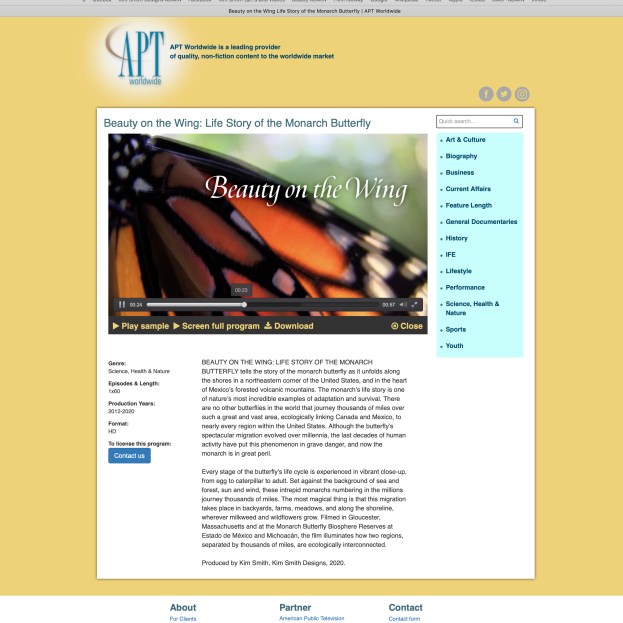
American Public TV Worldwide —the world’s largest distributor of educational television has just signed the documentary for global distribution.
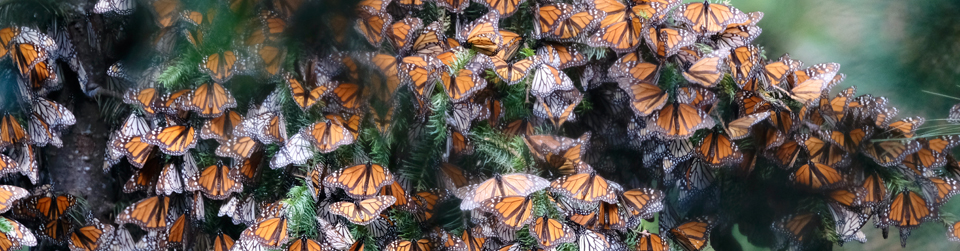
Armed with a handheld digital camera, an artist’s eye, and a love of her subject, Smith has captured the life, work and world of what she calls “this charismatic little creature,” beginning with its metamorphosis from a tiny egg, to its amazing annual journey from the summer shores of its Gloucester habitats to its winter habitats in the Mexican mountains and forests of Michoacán, where the monarchs annual arrival has long been regarded as something of a miracle: the returning of the souls of the dead descending from the sky in fluttering orange clouds, to roost by the millions in the trees.
When she began the project in 2006, Smith knew nothing about filmmaking. Photographing the monarchs, first as “a record,” she was urged on by family and friends. One of them, Gloucester’s late historian Joe Garland, was particularly encouraging. “Oh, I thought, I have to learn to make a film,” she recalls, of her early days learning the basics with Andrew Love and Lisa Smith at Cape Ann TV (now Studio 1623).
Investing in a hand-held HD Canon video camera, Smith began shooting digital. “It was small and so easy to use that I could crouch down, or lie down to capture extreme close-ups,” she says. Supported by community fundraising that covered the $35,000 production budget, she shot “tons of footage over the years,” wrote and recorded the narrative script, and saved on post production costs by teaching herself to digitally edit her film.
Her goal, she says, was not just to celebrate the monarch, but to educate viewers about the plight of this creature that is loved around the world. Indigenous to North America, these light, bright orange butterflies have through the centuries been blown by wind and weather to other continents, including England, where, in the late 17th century, they were named in honor of King William III of England, also known as the Prince of Orange.
In the last 20 years, however, the butterflies’ numbers have plummeted worldwide from a billion to 30 million, as the excessive use of herbicides has killed off much of their main food source —milkweed— while climate change has confused their flight patterns. And in Mexico, the logging of trees has sabotaged the delicate ecosystem of their annual return.
Smith’s film joins a growing body of environmental activism on behalf of the monarch butterfly. Gardeners across the nation have, like Smith, filled flower beds with milkweed to feed their numbers. The Obama administration, concerned by its alarming decline, allocated $3.2 million to protect it.
In making her documentary, Smith traveled to Mexico twice to film, and learned firsthand just how endangered the monarchs have become. Over time, she says, she came to see monarchs as “little gateway creatures that can open the way to for people to learn about other endangered creatures.”
At Good Harbor Beach, a favorite early morning photographic haunt, Smith began to turn her camera to another local endangered species, piping plovers. Like the monarchs, the little shore birds rely on a fragile ecosystem that Smith began to take an active role in protecting, while filming them. With her monarch documentary now in worldwide release, the piping plovers are on their way to star billing in a new documentary, now in production.
Meanwhile, the Boston International Kids Film Festival, a program of Filmmakers Collaborative, will screen Smith’s documentary as “one of best that the world of independent filmmaking has to offer.” Shown for one week to schoolchildren across the city, the festival, which describes her documentary as “illuminating how two regions, separated by thousands of miles, are ecologically interconnected,” will then host a Zoom author event in which the students can engage in a Q&A which Smith herself.
Smith, by the way, doesn’t just train her talents on winged creatures. In yet another ongoing film project, she captures the aerial antics of Gloucester’s falling Greasy Pole walkers. That documentary, which celebrates the spirit of the city’s annual St Peters Fiesta, is well underway.
Gloucester resident Kim Smith is a documentary filmmaker, environmental conservationist, photojournalist, author, illustrator and award-winning landscape designer.
Her documentary “Beauty on the Wing: Life Story of the Monarch Butterfly” was released in February. It has been chosen as an official selection at New Haven Documentary, Nature Without Borders International, Flickers’ Rhode Island International , Docs Without Borders , WRPN Women’s International, and Conservation Wildlife film festivals.
It next shows at the Boston International Kids Film Festival (https://bikff.org/schedule/) on Nov. 20 to 22; tickets start at $20. Links to view the film will be provided upon ticket purchase.
I hope you are all doing well and fortunate enough to have good health.
After a brief cold snap we are having a beautiful Indian Summer here on Cape Ann. I hope you have the opportunity to get outdoors today and enjoy nature. Bird and butterfly migrations are well underway. At Parker River National Wildlife Refuge, rangers shared that they have never seen a migration such as this year’s, with over 180 species sited at the refuge this past week. The birds appear to have benefitted from decreased human activity over the past seven months. On the other hand, the Atlantic Coast Monarch migration seems stalled or nonexistent. Perhaps we will have a late, great migration as we did several years ago. And there are some positive signs for the butterflies, especially through the Mississippi Flyway as Monarch Waystations further north, such as the one at Point Pelee have been reporting that the Monarch migration is doing well. I’ve seen Monarchs migrating through Cape Ann in good numbers as late as the second week of October, so we’ll be ever hopeful.
Good news to share -the page for Beauty on the Wing is up on American Public Television World Wide! Here is the link, including information with a link on how to license Beauty. The page looks great and the line-up of films, stellar. We are so honored to be included in this fine catalogue of Science, Health, and Nature Programming!
And more super good news to share – Beauty on the Wing has been accepted to the Boston International Kids Film Festival! This is an outstanding festival for kids, by kids, and about kids and is organized by a dynamic group of women: Laura Azevedo, Kathleen Shugrue, and Natalia Morgan. A complete list of films for the 2020 BIKFF will be posted in the upcoming days, along with information on how the festival will be organized for safe viewing during the pandemic.
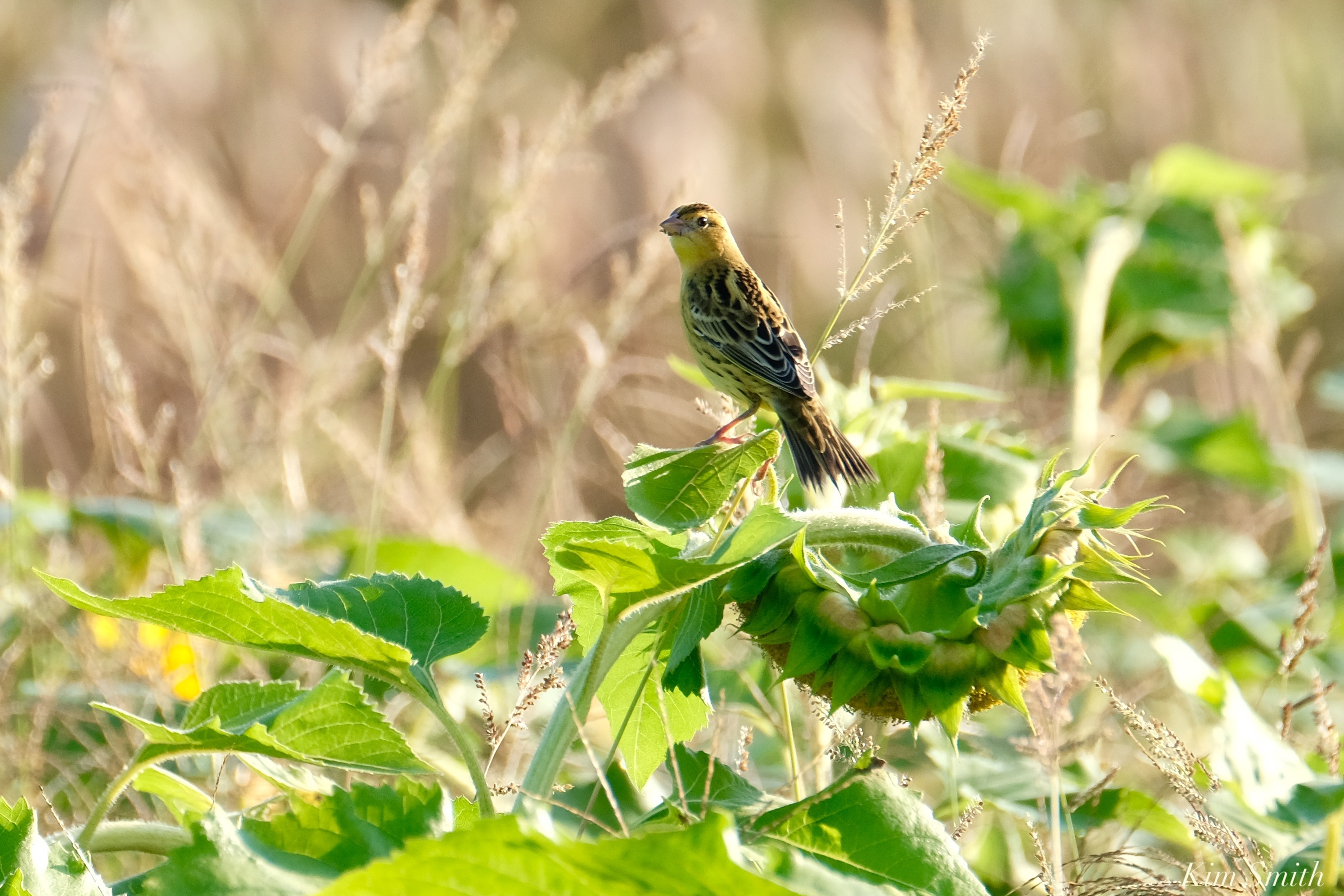
I have been following (or become enchanted is a more accurate description) a small flock of Bobolinks. Click here to read a story posted on my website: Bobolinks Amongst the Sunflowers. While reading about Bobolinks, I came across a link to The Bobolink Project, a truly worthwhile organization. The Bobolink Project habitat conservation plan not only helps Bobolinks, but many species of declining grassland birds.
The sun is coming out and the temperature still summery. Stay well and enjoy the day!
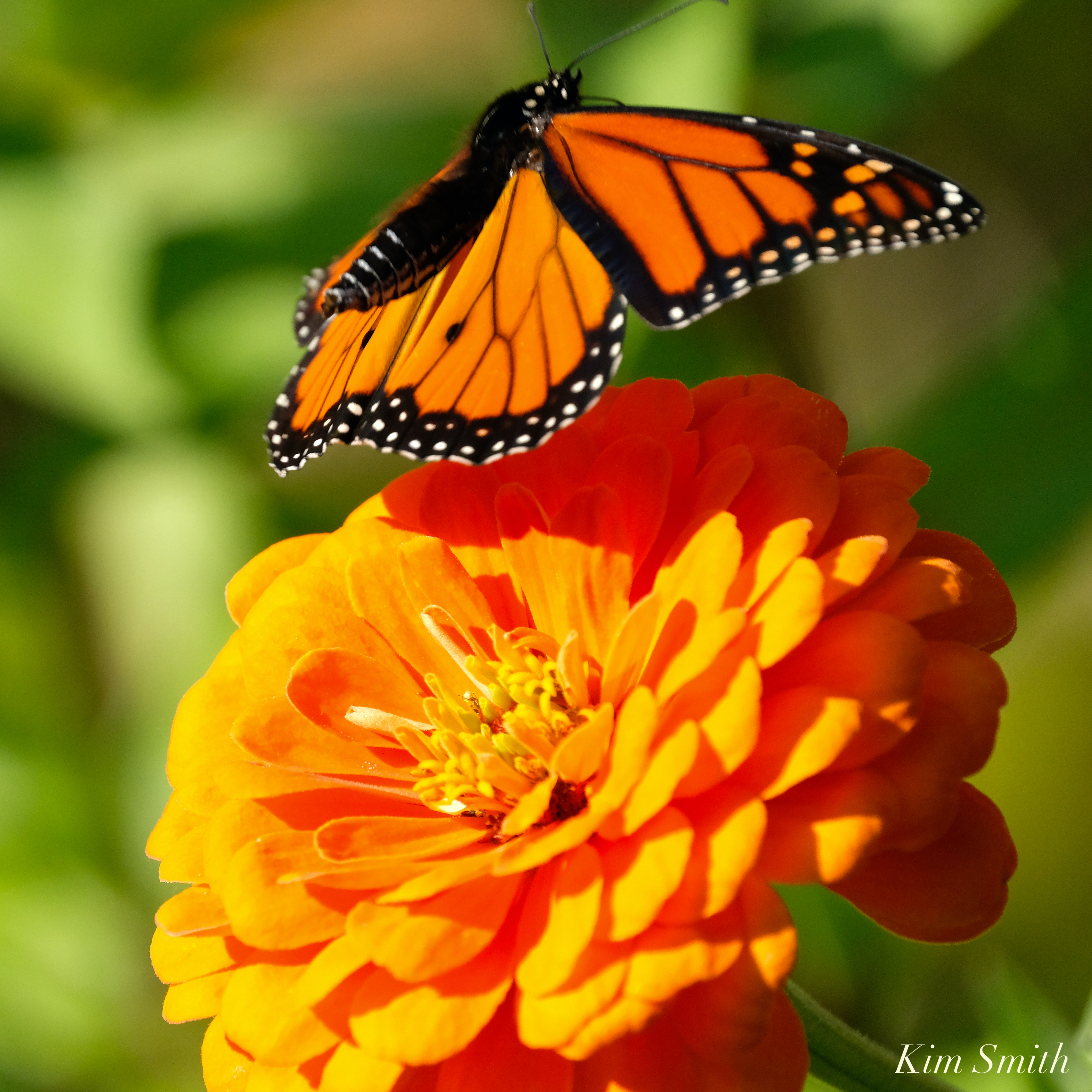
Winds from the north brought a tiny kaleidoscope of Monarchs to our shores over the weekend. Isn’t that a wonderful official word for a group of butterflies! A bunch of caterpillars is officially called an army.
Will there be more waves of Monarchs passing through? Time will tell. Along the Atlantic Coast Flyway, we’ve seen far fewer butterflies so far this year, especially when compared to last year’s numbers. Keeping my hopes up though 🙂
Female Monarch depositing egg on Common Milkweed (Asclepias syriaca)
Evaluating the Migration Mortality Hypothesis Using Monarch Tagging Data
Frontiers in Ecology and Evolution
August 7, 2020
Authors:
Orley Talor, Department of Ecology and Evolutionary Biology, University of Kansas, Lawrence, KS, United States
John M. Pleastant, Department of Ecology, Evolution and Organismal Biology, Iowa State University, Ames, IA, United States
Ralph Grundel, U.S. Geological Survey, Great Lakes Science Center, Chesterton, IN, United States
Samulel D. Pecoraro, U.S. Geological Survey, Great Lakes Science Center, Chesterton, IN, United States
James P. Lovett, Monarch Watch, Kansas Biological Survey, University of Kansas, Lawrence, KS, United States
Ann Ryan, Monarch Watch, Kansas Biological Survey, University of Kansas, Lawrence, KS, United States
The decline in the eastern North American population of the monarch butterfly population since the late 1990s has been attributed to the loss of milkweed during the summer breeding season and the consequent reduction in the size of the summer population that migrates to central Mexico to overwinter (milkweed limitation hypothesis). However, in some studies the size of the summer population was not found to decline and was not correlated with the size of the overwintering population. The authors of these studies concluded that milkweed limitation could not explain the overwintering population decline. They hypothesized that increased mortality during fall migration was responsible (migration mortality hypothesis). We used data from the long-term monarch tagging program, managed by Monarch Watch, to examine three predictions of the migration mortality hypothesis: (1) that the summer population size is not correlated with the overwintering population size, (2) that migration success is the main determinant of overwintering population size, and (3) that migration success has declined over the last two decades. As an index of the summer population size, we used the number of wild-caught migrating individuals tagged in the U.S. Midwest from 1998 to 2015. As an index of migration success we used the recovery rate of Midwest tagged individuals in Mexico. With regard to the three predictions: (1) the number of tagged individuals in the Midwest, explained 74% of the variation in the size of the overwintering population. Other measures of summer population size were also correlated with overwintering population size. Thus, there is no disconnection between late summer and winter population sizes. (2) Migration success was not significantly correlated with overwintering population size, and (3) migration success did not decrease during this period. Migration success was correlated with the level of greenness of the area in the southern U.S. used for nectar by migrating butterflies. Thus, the main determinant of yearly variation in overwintering population size is summer population size with migration success being a minor determinant. Consequently, increasing milkweed habitat, which has the potential of increasing the summer monarch population, is the conservation measure that will have the greatest impact.
Introduction
Since the late 1990s, the monarch butterfly, Danaus plexippus, population has declined significantly based on measurements made at the Mexican overwintering grounds (Brower et al., 2011; Semmens et al., 2016). Identifying the cause or causes of the decline is important in order to focus conservation measures appropriately. Two explanations for the decline in the size of the overwintering population dominate the literature. The first, known as the “milkweed limitation” hypothesis, posits that the decline in the number of milkweed host plants in the major summer breeding area in the Upper Midwest of the U.S. (Figure 1) has led to a reduction in the size of the migratory population (Pleasants et al., 2017). The second, known as the “migration mortality” hypothesis, posits that the resources and conditions during the fall migration have declined resulting in an increase in mortality during the migration and a decline in the overwintering population (Agrawal and Inamine, 2018).
Figure 1. All wild-caught butterflies tagged from north of 40° latitude and east of 100° longitude were included in the study. This area includes the region we are calling the Midwest, encompassing the area from 40 to 50° latitude and 80 to 100° longitude (outlined in red) and the region we are calling the Northeast, encompassing the area from 40 to 50° latitude and 65 to 80° longitude (outlined in blue). What we are calling the Total Area is the Midwest and Northeast combined. The NDVI values (Saunders et al., 2019) come from the region that encompasses the area from 30 to 40° latitude and 90 to 105° longitude (outlined in green). The dark blue square indicates the location of the overwintering colonies. Butterflies were tagged in other sectors besides the Midwest and Northeast but those data are not included in this study.
The milkweed limitation hypothesis is supported by data showing that in the early 2000s the majority of monarch production came from common milkweed, Asclepias syriaca, in corn and soybean fields in the Midwest (Oberhauser et al., 2001) and that the abundance of those milkweeds declined precipitously due to glyphosate herbicide use in those fields (Pleasants and Oberhauser, 2013; Flockhart et al., 2015; Pleasants et al., 2017; Thogmartin et al., 2017a; Saunders et al., 2018). The loss of the milkweeds from corn and soybean fields began in the late 1990s with the adoption of glyphosate-tolerant crops. Milkweeds had been nearly eliminated from these fields by 2006 (Pleasants, 2017). During this period, an estimated 71% of the monarch production potential of milkweeds on the Midwest landscape was eliminated, amounting to 25 million hectares of agricultural habitat that no longer had milkweeds (Pleasants, 2017). The subsequent decrease in the availability of milkweed is thought to have limited the size of the summer breeding population. Support for this hypothesis comes from the pattern of decline in milkweed availability that parallels the decline in the size of the overwintering population (Pleasants et al., 2017). Further support comes from the strong correlation between yearly late summer Midwest monarch egg production and yearly overwintering population size (Pleasants and Oberhauser, 2013; Pleasants et al., 2017).



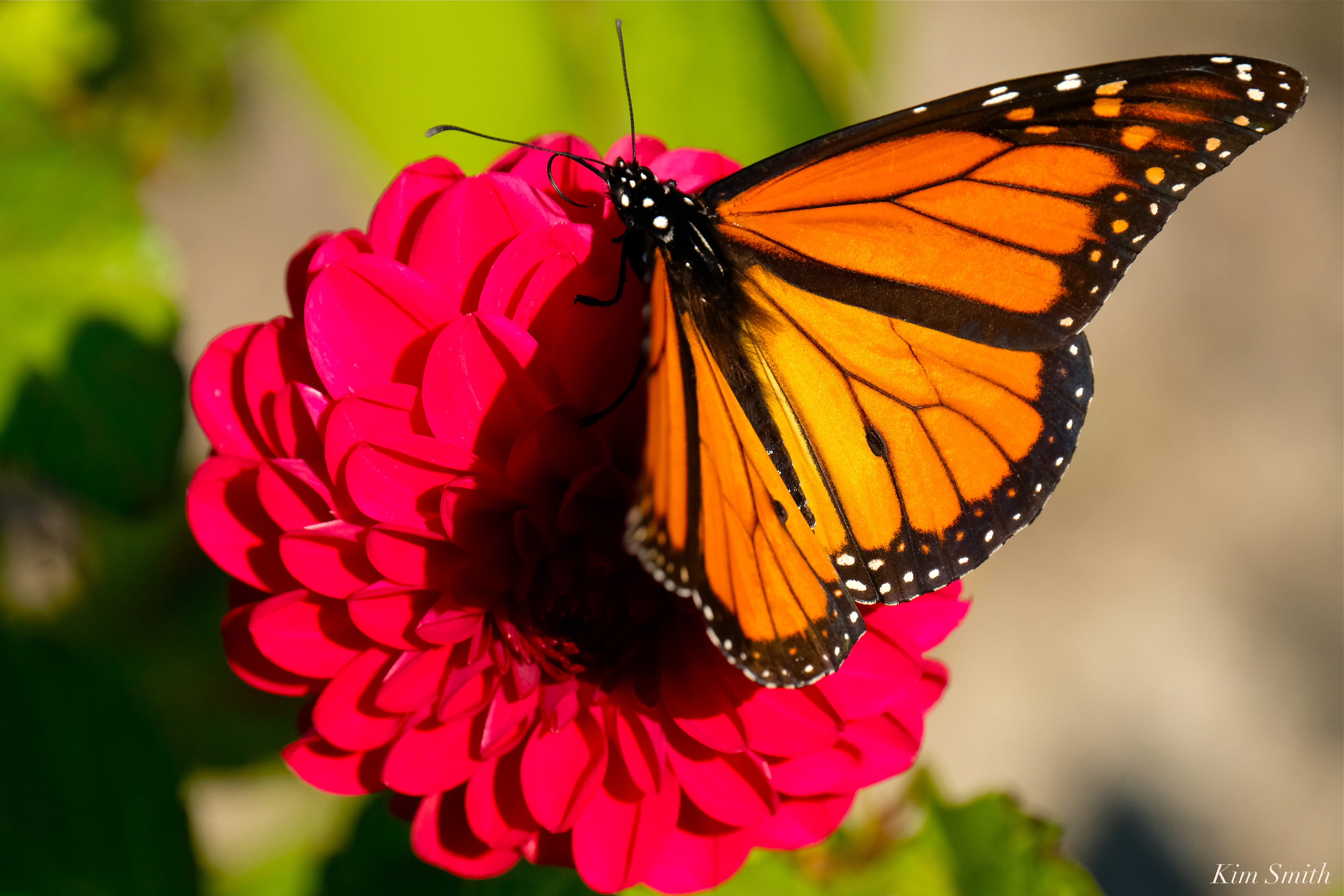
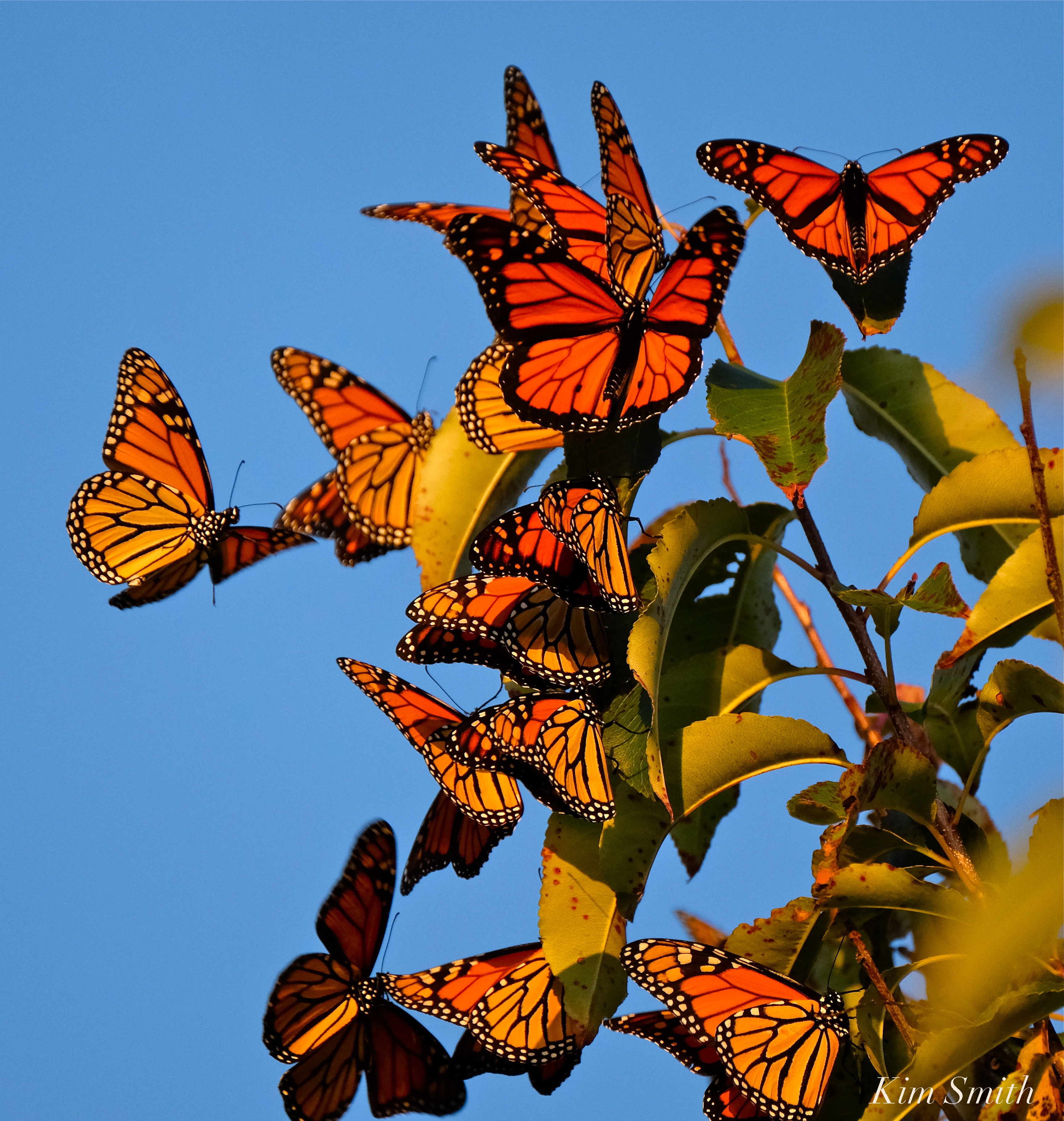
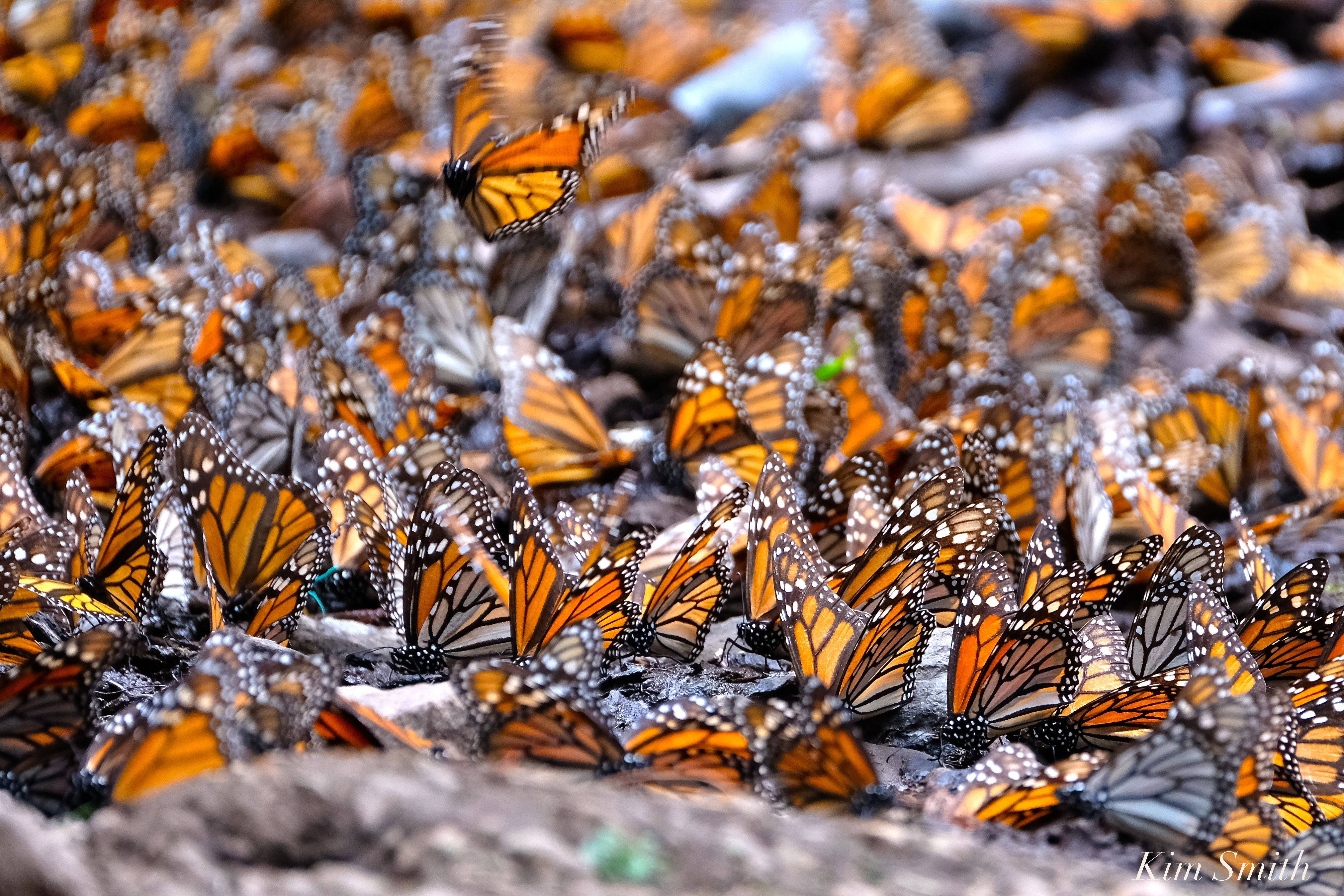


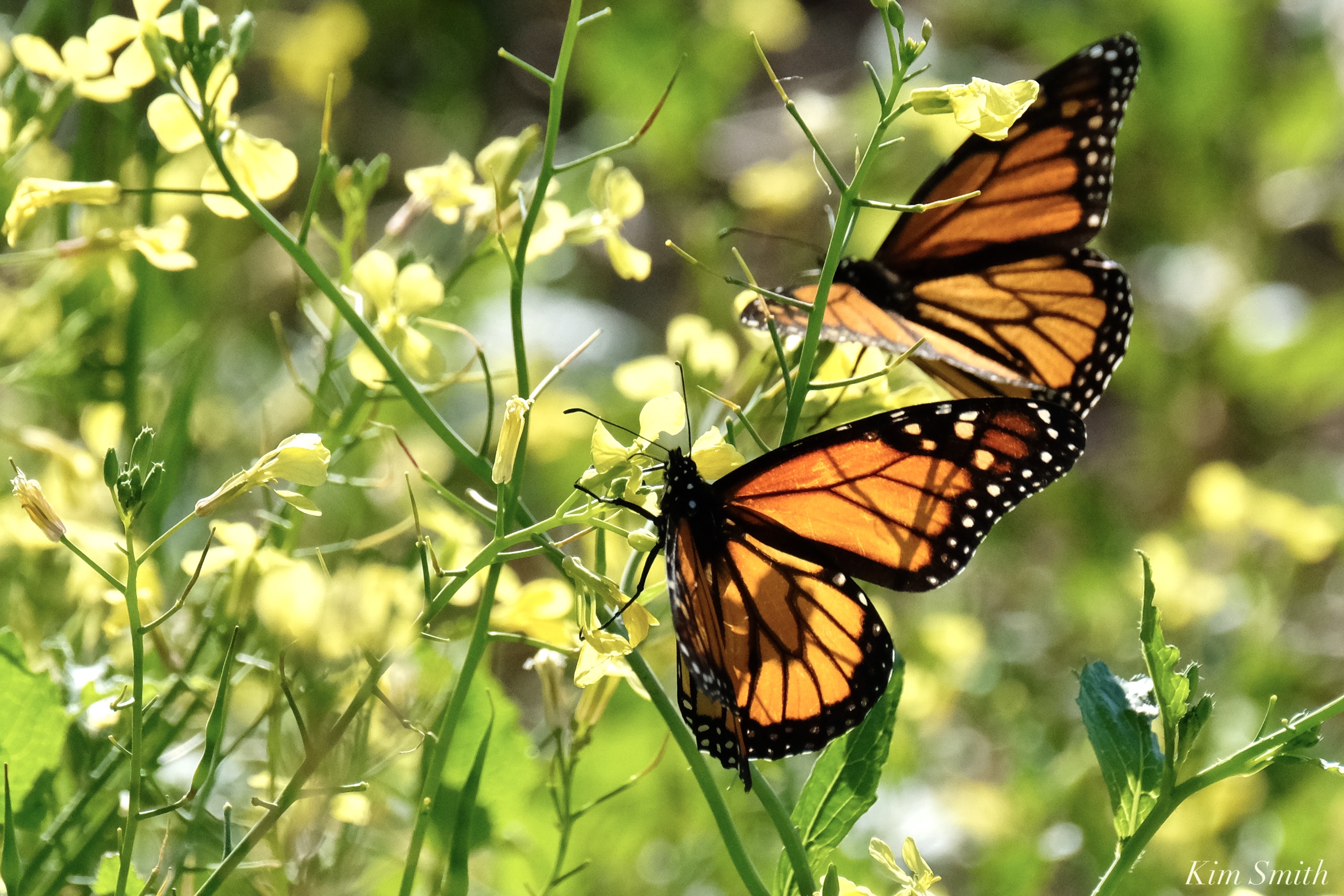







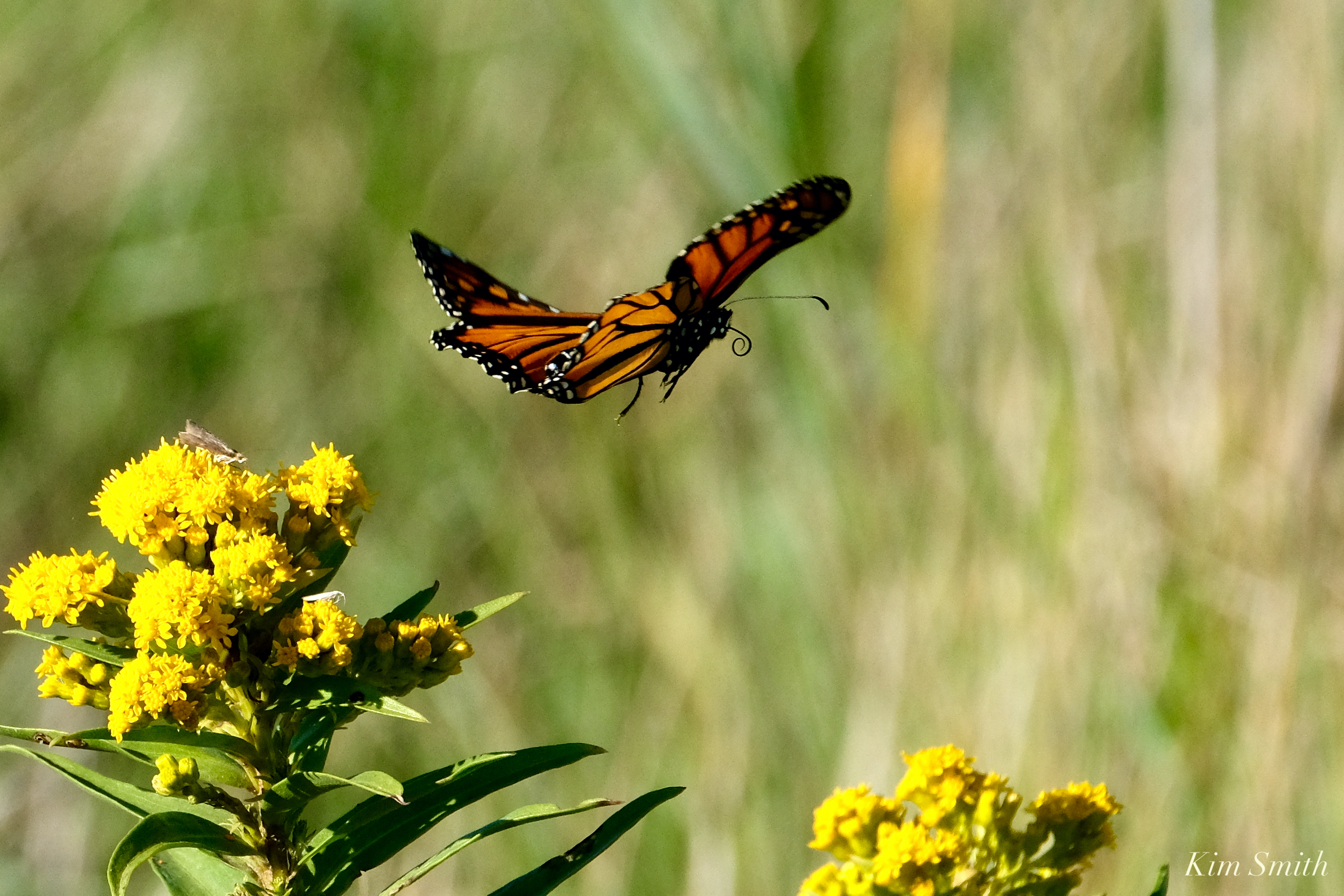
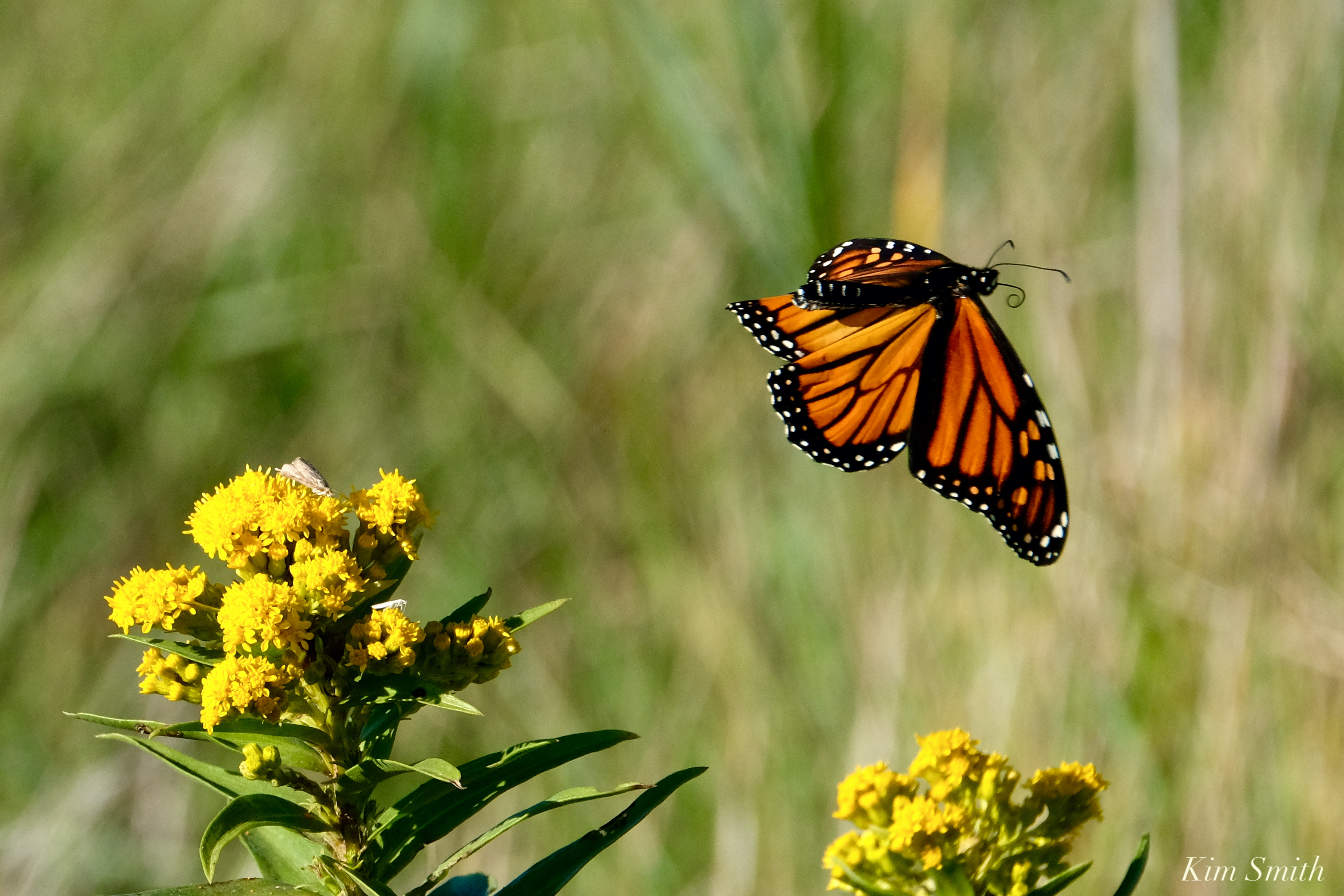


 Beauty on the Wing