Category Archives: Monarch Butterfly in Crisis

MONARCH FILM FUNDRAISING SCREENING PARTY

Dear Friends,

This past spring I had a tremendously inspirational experience. Out of the blue, a lovely woman from Concord, Laura Stevens, contacted me about the possibility of viewing my documentary film about the Monarch butterflies, Beauty on the Wing: Life Story of the Monarch Butterflies. I was reluctant at first, explaining that the film was in a rough cut form. Although the rough cut features the butterflies and Cape Ann in the most beautiful light, the film does need finessing.

Laura comes from a wonderful family and they all love Monarchs! Every year, she and her family gather together for a reunion based around a weekend of learning. Laura explained that it would be an extra special treat for the 27 women and children who attend the reunion to see the film. The more I thought about it the more I thought it would be a super idea, and sent her access to the film.

Several weeks passed when in the mail I received the most heartfelt thank you letters from Laura and her family members who had attended the screening, from the ninety-five year old great auntie to the youngest child there. And soon after that, donations towards the film’s completion arrived from this most generous family. I am so grateful to Laura and her family for the donations, and for their kind encouragement and enthusiasm.

At that time the thought crossed my mind that this would be a wonderful way to continue to raise funds for the documentary. Landscape design work and the story of Little Chick and the Piping Plovers has kept me from doing any recent fundraising, but my work typically slows for a brief period during the end of August and beginning of September.
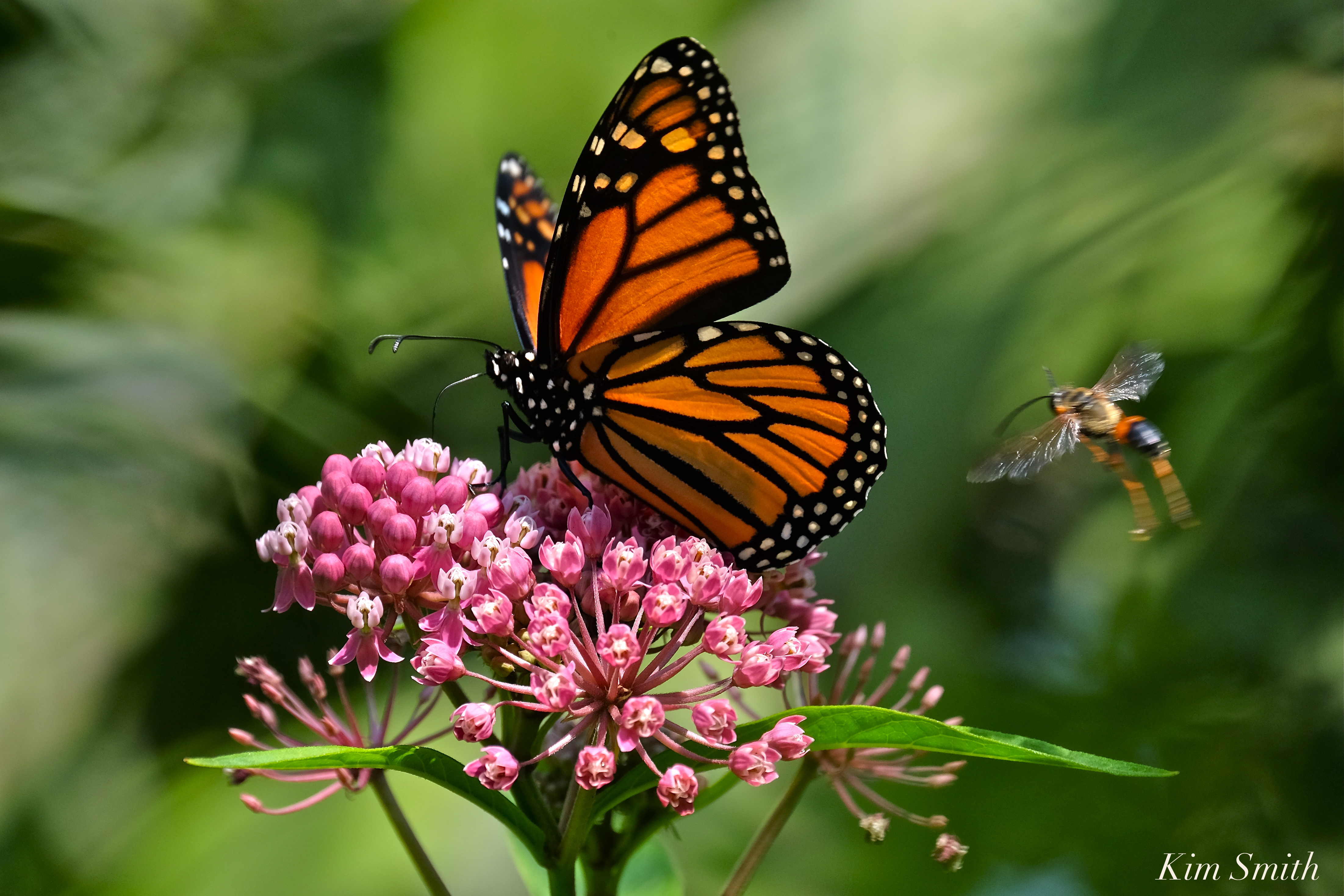
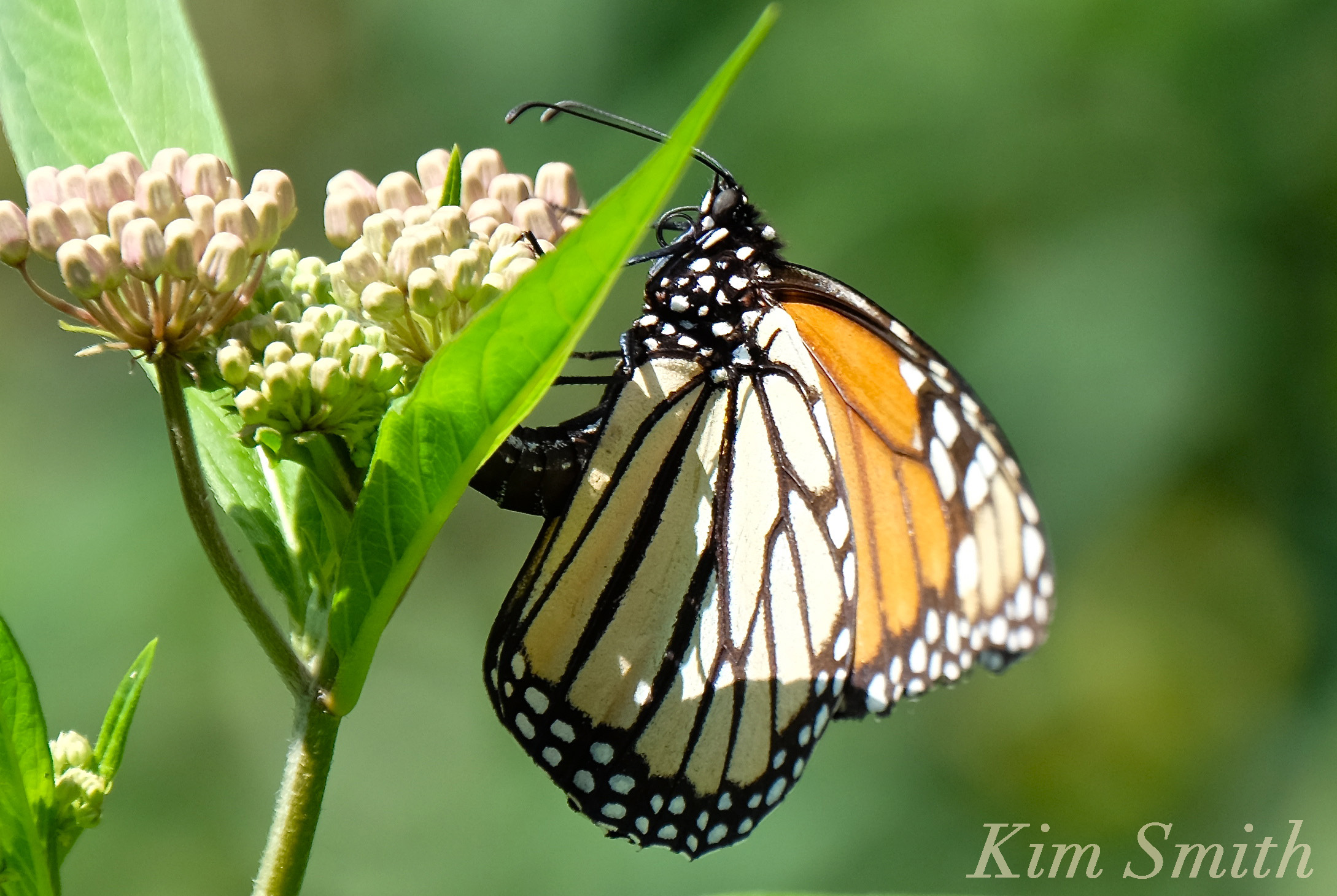
Female Monarch Butterfly and Marsh Milkweed, 2017

Don’t you think it auspicious for my film project that we are seeing so many butterflies this summer? I began documenting the Monarchs in our region in 2006, which was a tremendous year for the Monarch migration through Cape Ann. The year 2012 was quite strong as well, but in the past four years, as the worldwide population has plummeted, so have the Monarchs migrating through our area. Imagine that in 1977 when the Monarchs were first discovered at their winter sleeping grounds, the butterflies were counted by the billions, while today only by the millions.

My hope for Beauty on the Wing is that it will travel to the various conservation and environmental festivals, and then be made available to classrooms around the nation. Another dream for the film is that it will be translated into Spanish and French. Just as American and Canadian children are curious about the butterflies’ winter home after departing their northern breeding grounds, Mexican children are equally curious as to the butterflies’ destination after they leave the butterfly sanctuaries in central Mexico.

The intent of this letter is to learn if amongst our readers there is interest in hosting a screening of the film in its not quite completed form. The purpose of the screening would be to raise money towards the film’s completion and distribution. And, too, I thought it would be a more fun, educational, and personal way to fundraise. To date I have received over $5,000 in generous donations. I am working with the non-profit filmmaker’s assistance group, the Filmmakers Collaborative. Donations made through FC are tax deductible. An itemized budget is available upon request. Beauty on the Wing is 54 minutes long. I thought we could show twenty minutes of highlights and then discuss the current state of the butterflies. Viewer feedback would also be of tremendous help. Screening parties could be so much fun, especially at this time of year during the butterfly’s migration, and especially in 2017 while we are seeing so many Monarchs on the wing.

Readers, what do you think? Please comment on this post or write me at kimsmithdesigns@hotmail. Thank you so very much for your time, thoughts, and interest.

Warmest wishes,

Kim


Links:

Beauty on the Wing: Life Story of the Monarch Butterfly film website

A Flight of Monarchs

Trailer

Film Interview with Doctor Thomas Emmel at the Monarch Butterfly Biosphere Reserve at Sierra Chinqua

https://instagram.com/p/BW7wfw-F5o9/

https://instagram.com/p/BXjLQjZleLY/

https://instagram.com/p/BXjL7HgF2p2/

PLEASE DON’T PURCHASE POISONED MILKWEED PLANTS FROM BIG BOX STORES!

THE FOLLOWING NOTICE ABOUT MILKWEEDS TREATED WITH NEONICOTINOIDS WAS SHARED BY TWO FRIENDS, MEGAN FROM PRIDES CROSSING AND CHERYL MCKEOUGH

FROM: Sandy Robinson, President, National Garden Clubs, Inc.
SUBJECT: Milkweed

It has been brought to my attention that some “Big Stores” have been selling milkweed plants that have been treated with systemic Neonicotinoids. This will kill caterpillars! Please, be aware and be on the lookout for these tags placed in plants. Please pass this information along to your garden club members!

Garden Club member Mary Writes, I purchased a Milkweed plant from Home Depot near my home and it wasn’t until I got home that I noticed the little information stick hidden behind the identification information that the plant had been treated with systemic Neonicotinoids. The container boasted how desirable the plant is for birds and butterflies. Yesterday I went to a different Home Depot and they had just put out an entire rolling cart of these plants, maybe about 100, all poisoned. I contacted the store manager and told him that it is the same as giving poison candy to kids on Halloween. This is THE host plant for the Monarch. My club, Shady Oaks and our junior club, Little Shadows have worked so hard to establish a Monarch Waystation and to educate people on the decline of the Monarch. I hate to think of the millions of poison Milkweed being distributed nationwide by Home Depot.

The container says distributed by Home Depot, 2455 Paces Ferry Rd N. W., Atlanta , Georgia.

I contacted the LSU Ag Agent for New Orleans, Dr Joe Willis. He said the Neonicotinoids will dilute as the plants grow but that only a very small amount will kill the larva of the Monarch. He is contacting the Master Gardeners of the area. I contacted the newsletters of garden clubs to ask that they send a notice to members. I contacted a local GOA club and the president said she would inform her members. I contacted our LGCF President and our Environmental School Chairman with the information.
We need a notice to Home Depot from a national source.

I contacted the Monarch Watch organization www.MonarchWatch.org/waystations at the University of Kansas (1200 Sunnyside Avenue, Lawrence, KS 66045) .
It needs to be sent soon as these plants are being sold now to well meaning people who are wanting to help the Monarch and not kill them. I hate to think of the billions of plants being sold nationwide and how that will cancel the efforts of so many to stop the demise of the Monarch. Could you please help?

GMG Readers, Wednesday I am planning to check to see if our local Home Depots are also selling milkweeds with pesticide. I don’t purchase plants from Home Depot as they are generally of a much poorer quality, however I have in a pinch. 

Milkweed can be purchased from these local sources:

Cedar Rock Gardens

Wolf Hill

Northeast Nursery

Save the Date for My Upcoming Program “Beauty on the Wing: Life Story of the Monarch Butterfly”

On Thursday, May 4th at 7pm, I am giving my lecture with photos, “Beauty on the Wing: Life Story of the Monarch Butterfly,” along with several short film screenings, for the Salem Garden Club. For more information, see the events page of my website. I hope to see you there!

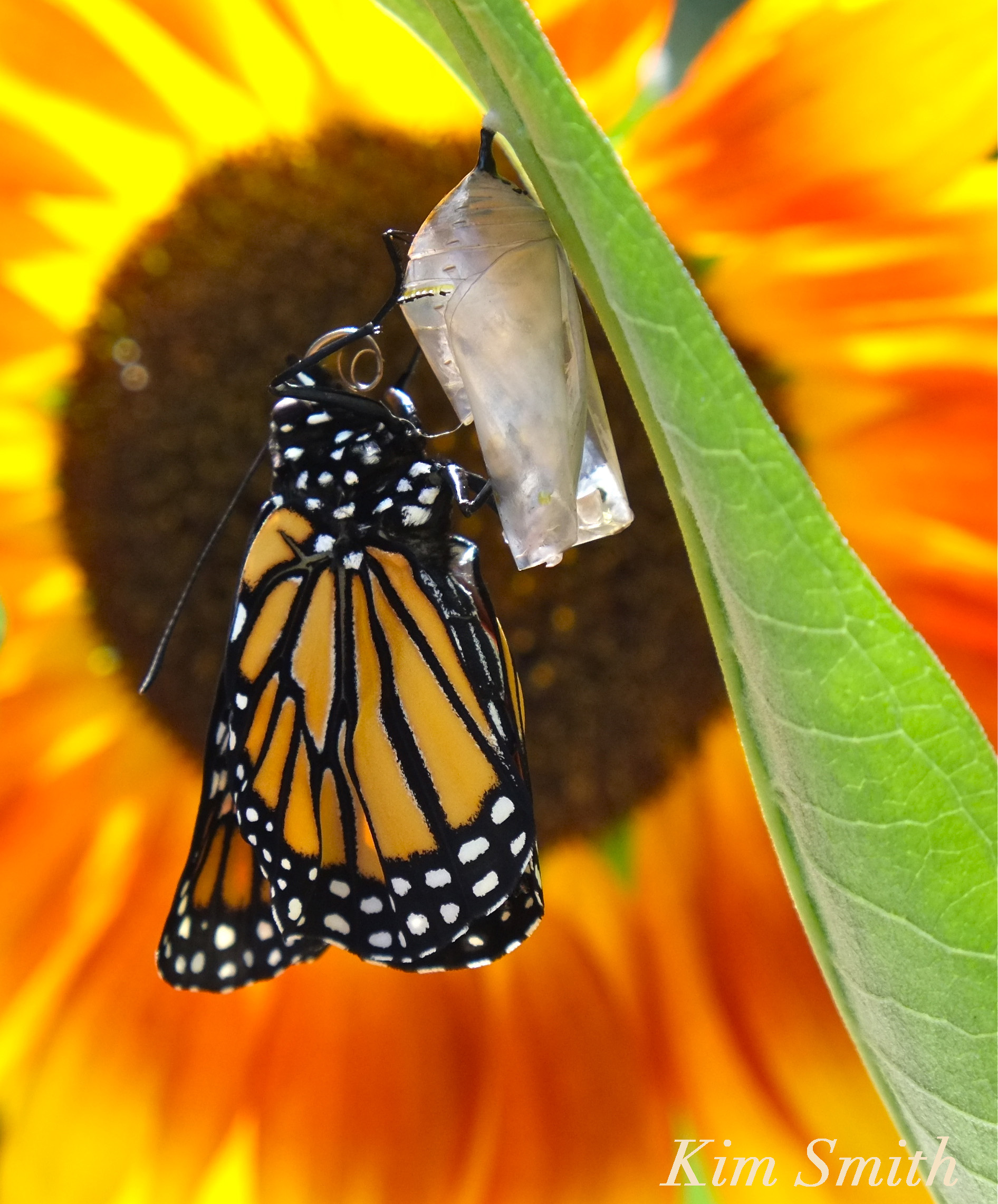
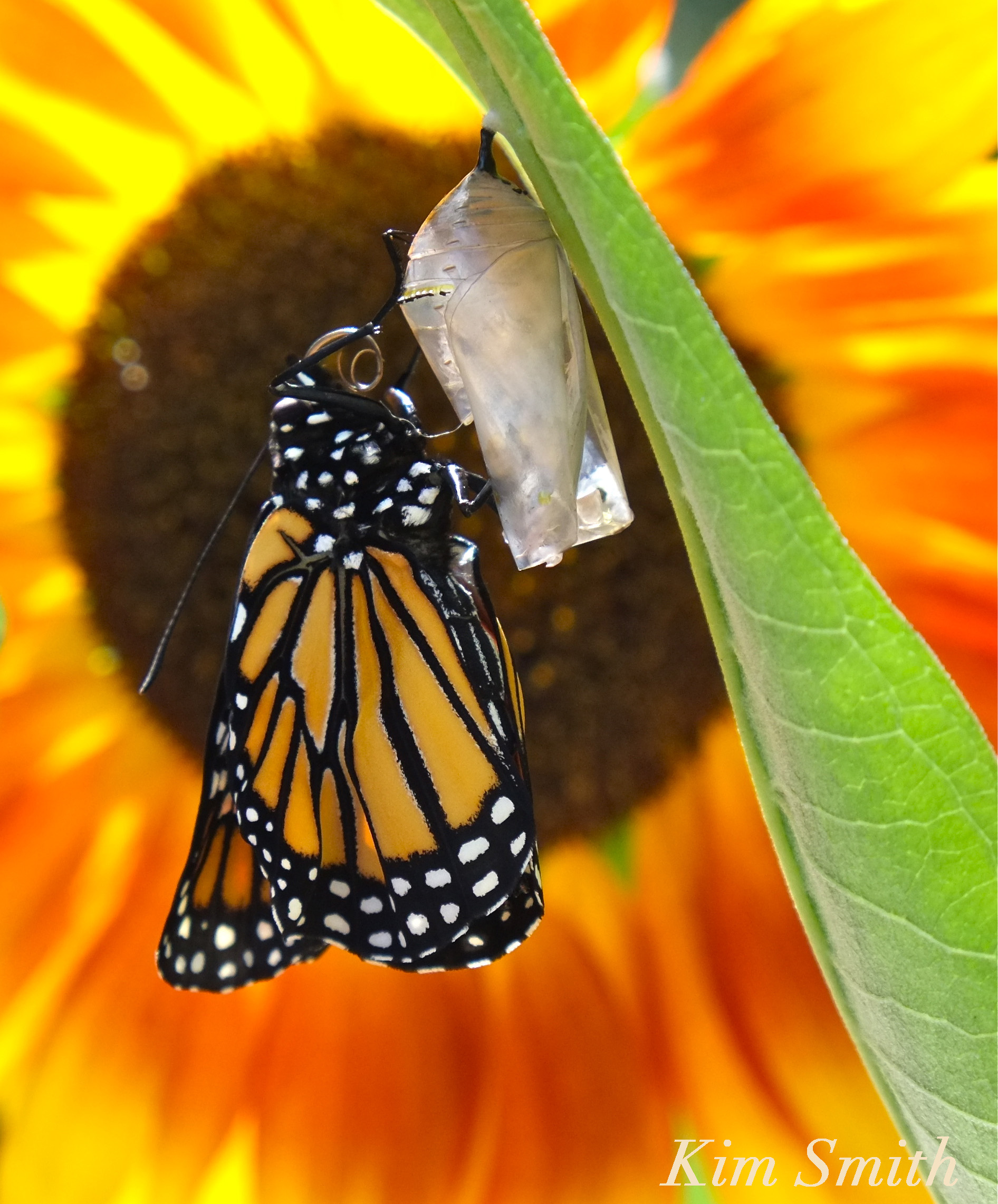
Newly Emerged Monarch Butterfly and Sunflower, Gloucester

Beauty on the Wing ~ Life Story of the Monarch Butterfly

The Monarch’s life story is one of nature’s most incredible examples of adaptation and survival. But the Monarch migration is in great peril. Learn how you can help. Through photographs and discussion, Beauty on the Wing tells the life story of the Monarch Butterfly, the state of the butterflies migration and why they are in sharp decline, and the positive steps we can take as individuals and collectively to help the Monarchs recover from the devastating effects of habitat loss and climate change.  (1-1.5 hours).

Monarch Butterfly Chrysalis and Marsh Milkweed

Monarchs Awakening

NRCS, USFWS Partner to Accelerate Conservation on Agricultural Lands for the Monarch Butterfly

NRCS, USFWS Partner to Accelerate Conservation on Agricultural Lands for the Monarch Butterfly


Download the Monarch Butterfly Conference Report.
NEW Working Lands for Wildlife National project bounderies
See a map of Working Lands for Wildlife National Project Boundaries.

The monarch butterfly is a new national priority species of Working Lands for Wildlife (WLFW), a partnership between the U.S. Department of Agriculture’s Natural Resources Conservation Service (NRCS) and the U.S. Fish and Wildlife Service (USFWS). Populations of monarchs, a pollinator species cherished across North America, have declined significantly during the past two decades. This collaboration aims to help the species recover by working with agricultural producers to make wildlife-friendly improvements on their farms, ranches and forests.

“Producers can make simple and inexpensive tweaks on working lands that provide monumental benefits to monarch butterflies and a variety of other insects and wildlife,” said NRCS Chief Jason Weller. “By adding the monarch to Working Lands for Wildlife, we can accelerate conservation for the species at the heart of its migration corridor.”

NRCS and USFWS recently completed a conference report that explains how conservation practices can help the eastern monarch population, a species known for its remarkable annual, multi-generational migration between central Mexico and the United States and Canada. This report is an initial step toward adding the monarch to WLFW, which uses a science-based, targeted approach to help a variety of at-risk species.

“We need to make every effort to help ensure monarchs don’t become endangered now and in the long term,” said USFWS Midwest Regional Director Tom Melius. “Conservation efforts on agricultural lands across the nation can have a significant positive impact on monarchs as well as many other pollinator insects and birds. Working with farmers and other private landowners, we can ensure a future filled with monarchs.”

The monarch butterfly joins an array of wildlife species across the country already part of WLFW, including the greater sage-grouse and New England cottontail, two recent successes in species conservation. The USFWS determined in 2015 that the two species didn’t warrant protections under the Endangered Species Act (ESA) because of voluntary conservation efforts underway to restore habitat.

Through WLFW, NRCS provides technical and financial assistance to help producers adopt conservation practices that benefit the monarch. Meanwhile, through the conference report, the USFWS provides producers with regulatory predictability should the monarch become listed under the ESA. Predictability provides landowners with peace of mind – no matter the legal status of a species under ESA – that they can keep their working lands working with NRCS conservation systems in place.

Work through WLFW centers on 10 states in the Midwest and southern Great Plains that are considered the core of the monarch’s migration route and breeding habitat. Much of this work will focus on planting and enhancing stands of milkweed and other high-value nectar plants for monarchs. Assistance is available to producers in Illinois, Indiana, Iowa, Kansas, Minnesota, Missouri, Ohio, Oklahoma, Texas and Wisconsin.

USFWS has committed significant funding – $20 million over five years – to support monarch conservation efforts. Additionally, USFWS is working with partners, including the National Fish and Wildlife Foundation, National Wildlife Federation and the Mexican and Canadian governments to leverage resources and investments to support and implement conservation actions across the continent.

During the past two years, NRCS has made available $6 million through a variety of Farm Bill conservation programs for monarch conservation in the 10 states. Additionally, NRCS is working with partners, including The Xerces Society and General Mills, to increase staffing capacity to help producers design customized conservation strategies for working lands.

The two agencies’ efforts contribute to a multi-agency, international strategy to reverse the monarch’s population decline in North America, estimated to have decreased from one billion butterflies in 1995 down to an estimated 34 million. Through the National Strategy to Promote the Health of Honey Bees and Other Pollinators, offsite link image     released by the White House, the United States has a goal of increasing the eastern population of monarchs back to 225 million by 2020.
Producers interested in NRCS assistance should contact their local USDA service center to learn more. NRCS accepts landowner enrollment applications on a continuous basis. NRCS offers more than three dozen conservation practices that can provide benefits to monarchs as well as a variety of other pollinators.


Please Share Your Monarch Sightings – Thank you!

There have been few Monarch sightings this summer but I have been hoping for a strong fall migration. The migration is peaking in Kansas and we are always a little bit behind. Please let me know if you see a Monarch, and where. Thank you very kindly!

https://www.instagram.com/p/BKqhTISjOjG/

Monarchs are emerging daily in my garden, from eggs collected at my friend Nancy’s field in Salem. This too would be an indication that we may be seeing them soon.newly-emerged-monarch-butterfly-copyright-kim-smith-jpg

This newly eclosed Monarch is clinging to its chrysalis case. Within moments of emerging, the two-part Monarch proboscis must zip together to form a siphoning tube. If the two parts do not join, the butterfly will not be able to drink nectar. In this photo, you can see the proboscis is not yet fully zipped.

Hello Mama Monarch

Plant and they will come! Female Monarch depositing eggs -1 copyright Kim Smith Alighting on the buds of our Marsh Milkweed plants, you can see in these photos that the female Monarch is curling her abdomen to the underside to deposit eggs. She will go from bud to bud and leaf to leaf ovipositing one egg at a time. A female, on average, deposits 700 eggs during her lifetime, fewer in hot, dry weather.

Female Monarch depositing eggs copyright Kim SmithFemale Monarch Butterfly and Marsh Milkweed (Asclepias incarnata)

Butterflies do not “lay” eggs; web would say oviposit or deposit. And you wouldn’t describe a caterpillar as hatched, but that it has emerged or eclosed.

Grow Marsh Milkweed and Common Milkweed and you most definitely will have female Monarchs calling your garden home!

Female Monarch depositing eggs -2 copyright Kim Smith
In the above photo you can see how she is contorting her abdomen to correctly position the eggs.

HOW RELOCATING TREES COULD HELP SAVE THE MONARCH BUTTERFLIES

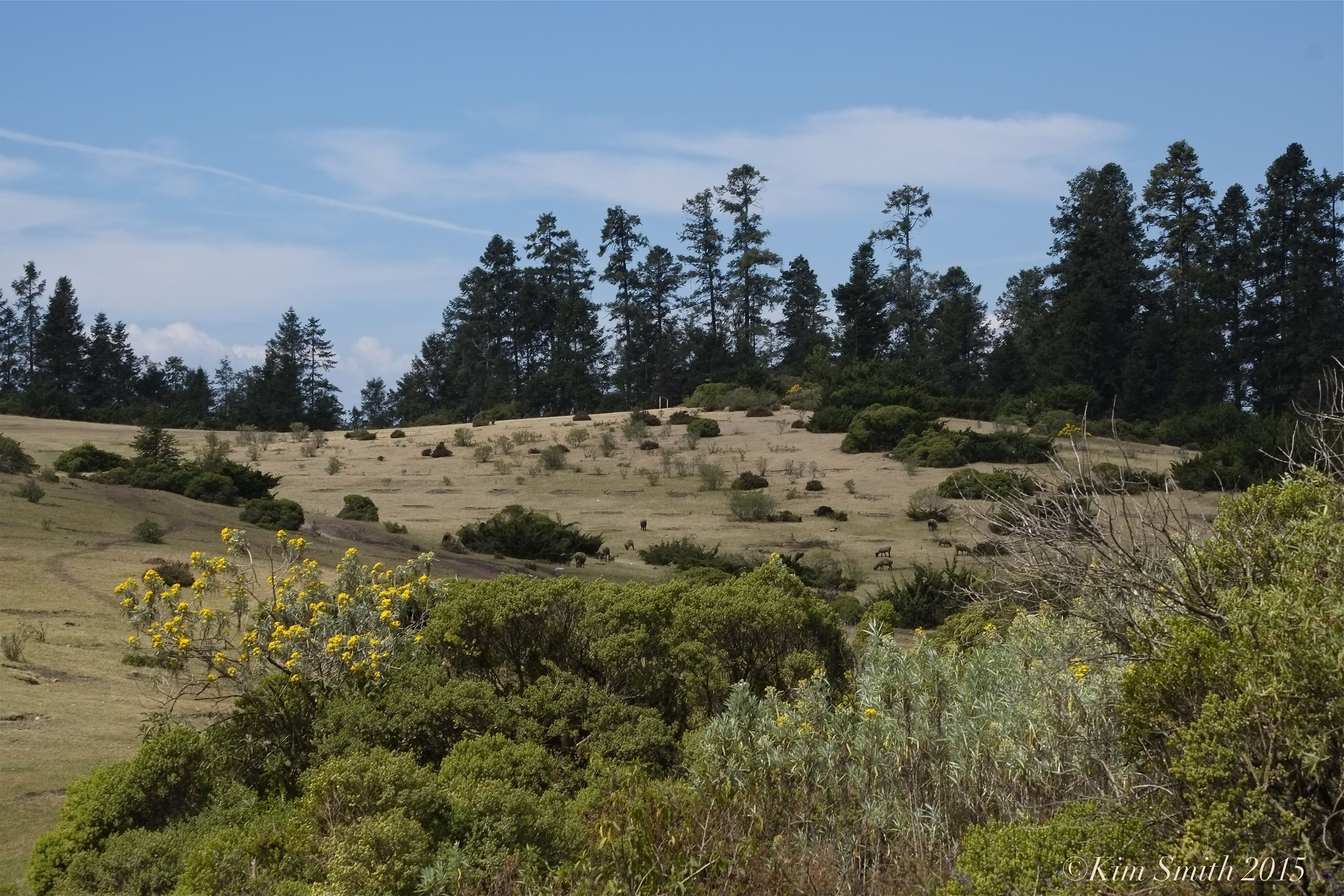
monarchs-el-rosario-©Kim Smith 2014In February of 2014 when I traveled to El Rosario Monarch Butterfly Biosphere Reserve in Angangueo to film the Monarchs, we encountered some difficulty locating the butterflies. Because of global warming conditions the Monarchs had roosted much further up the mountain than was typical. We needed to climb an additional 1500 feet, nearly to the top of the mountain. There was no place higher for the butterflies on this mountain and I wondered at the time, where would they go as the earth becomes increasingly warmer.

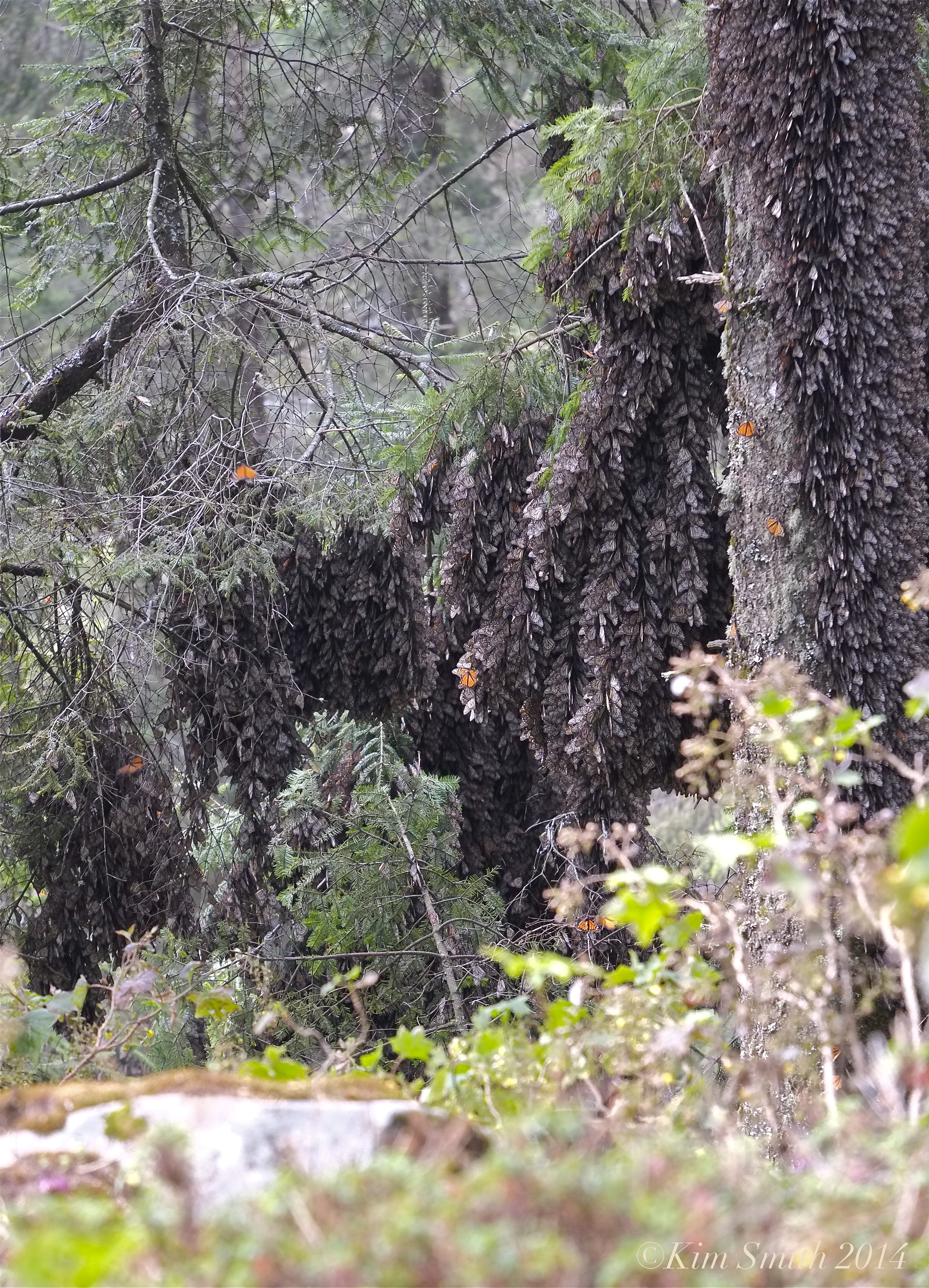
Butterflies are heliothermic, which means they gain heat from the sun. During the winter it is imperative that the butterflies remain relatively cool and in a state of sexual immaturity, called diapause. The sheltering boughs of the sacred Oyamel Fir (Abeis religiosa) trees and the cool temperatures at the higher altitudes of the Trans-Mexican Volcanic Mountain Belt, in the past, have provided optimal habitat for the butterflies.

El Rosario ©Kim Smith 2014Leaving the Chaparral and Entering the Oyamel Fir Forest

Oyamel Fir trees Abeis religiosa ©Kim Smith 2014 copyOyamel Fir Forest

The butterflies currently roost at altitudes between 9,500 and 10,800 feet. Mexican scientists are planning to progressively move the trees higher up the mountainsides in a race to save the fir trees. Last summer several hundred seedlings were planted at 11,286 feet where habitat best suited to Monarchs is expected to be by 2030.

Excerpt from “To Protect Monarch Butterfly, a Plan to Save the Sacred Firs”

By Janet Marinelli

“While U.S. biologists urge gardeners to plant milkweeds to help restore the monarchs’ summer habitat, Mexican scientists are pinning their hopes on a plan to move the species progressively higher up local mountainsides in a race to save these firs and the butterflies that depend on them. “We have to act now,” says the plan’s architect, Cuauhtémoc Sáenz-Romero, a forest geneticist at the Universidad Michoacana de San Nicolás de Hidalgo. “Later will be too late, because the trees will be dead or too weak to produce seeds in enough quantity for large reforestation programs.”

When the rainy season arrived last summer, a few hundred seedlings were planted at 11,286 feet, where habitat suited to oyamel fir trees is expected to be by 2030. By then, according to retired U.S. Forest Service geneticist Jerry Rehfeldt, who co-authored a paper with Sáenz-Romero on global warming’s effect on oyamels, temperatures in the reserve could rise above pre-industrial levels by 2.7 degrees Fahrenheit by 2030, and suitable habitat could shrink by nearly 70 percent. The scientists’ research further suggests that by the end of the century, habitat that meets the fir’s needs may no longer exist anywhere inside the reserve. Trees would have to be planted at higher altitudes on peaks more than 100 miles away from the monarch’s migratory home.

The sacred fir is a poster child for the plight of trees around the globe. Trees provide habitat for countless species and underpin ecosystems as well as human economies, but as a group they are highly imperiled. A diagram in the Intergovernmental Panel on Climate Change’s 2014 Working Group II report shows that of all life forms, trees are least able to respond to rapid climate change. Rooted in place, they have not evolved for rapid locomotion. Many take decades to mature and reproduce.

The breakneck speed of current global warming dwarfs anything in the fossil record, even what Lee Kump, professor of geosciences at Penn State University, has called “the last great global warming” 56 million years ago during the Paleocene-Eocene Thermal Maximum. At that time, over the course of a few thousand years, global temperatures soared 9°F as the supercontinent Pangaea broke apart. By comparison, if carbon emissions are not slashed soon, scientists warn it’s possible we could witness that much warming in a matter of centuries, if not decades. Without human help, trees and many other plant and animal species most likely won’t be able to migrate fast enough to keep pace with rapidly changing conditions.”

READ THE COMPLETE ARTICLE HERE

So many thanks to my friend Eric Hutchins for forwarding this article!!

Monarch butterflies oyamel trees Abeis religiosa ©Kim Smith 2014 copyOyamel Boughs Enveloped in Monarchs

SAFE TRAVELS MONARCHS!

Cape Ann Monarch Butterfly Migration Update

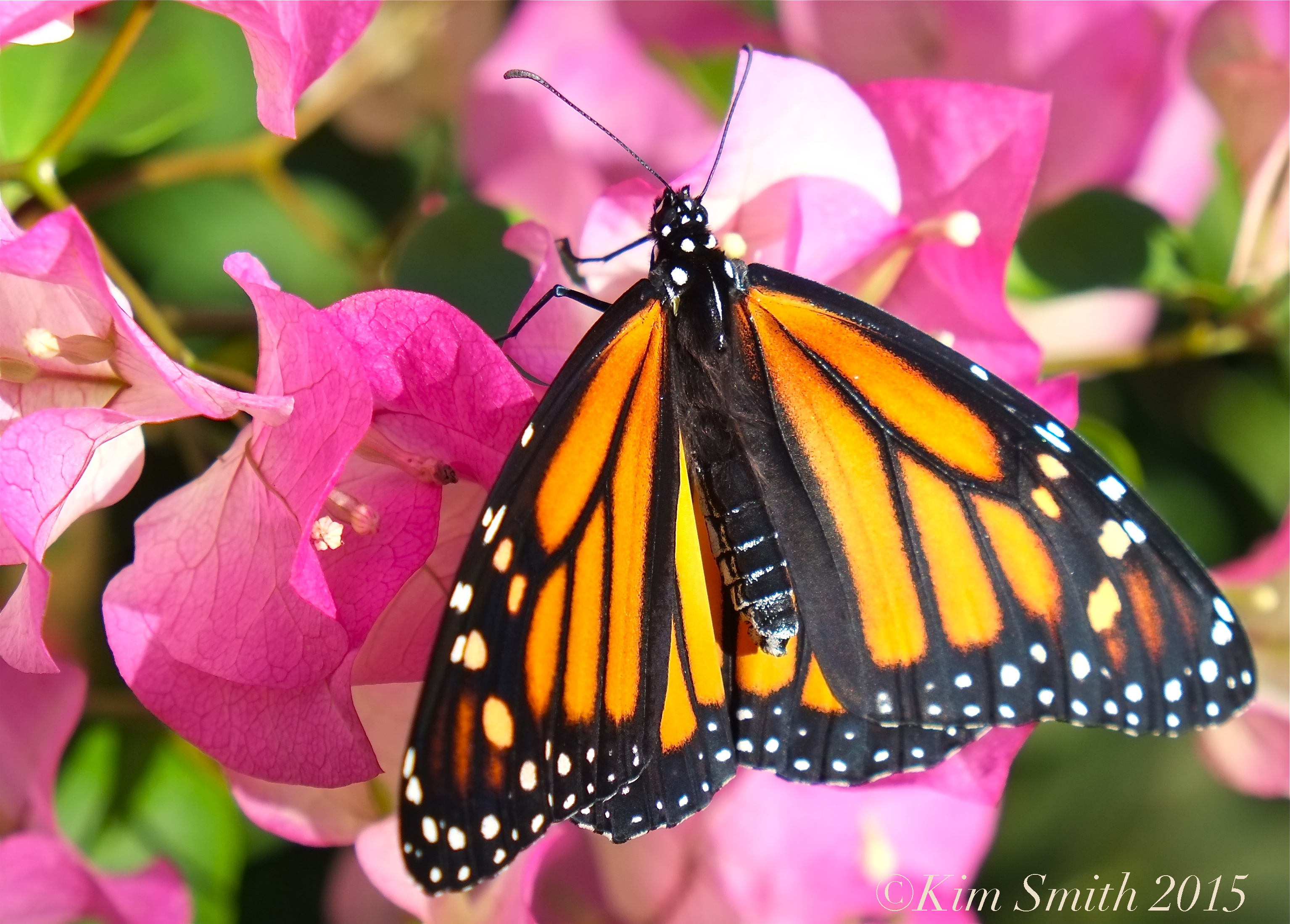
Monarch Butterfly bougainvillea ©Kim Smith 2015Female Monarch and Bougainvillea

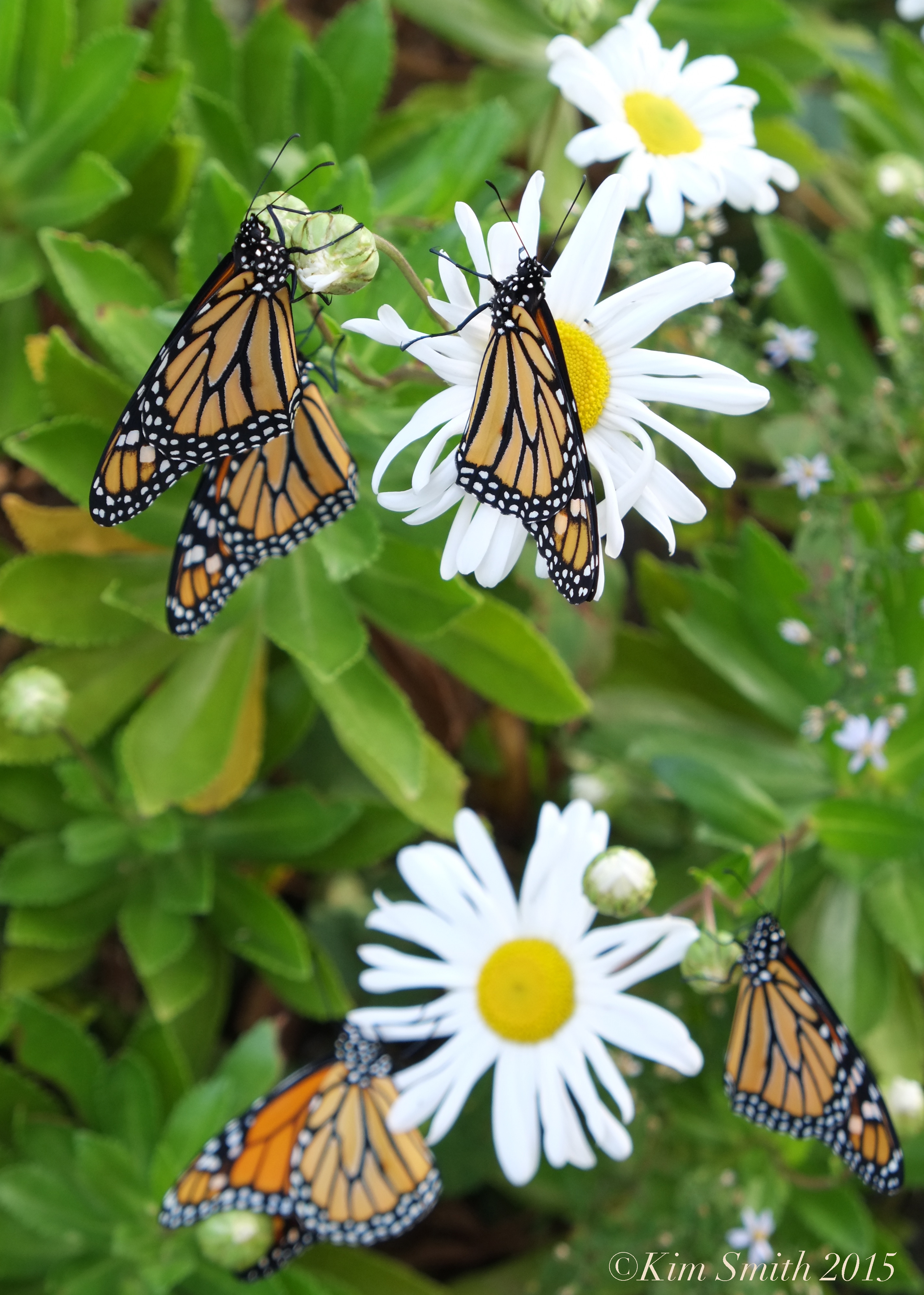
Monarch Butterflies Daisies ©Kim Smith 2015Methuselah Monarchs Heading to Mexico

Our last batch of Monarchs emerged from their chrysalides, dried their wings, and caught the tailwinds to Michoacán. I hope they arrive to their winter roosting sites at the trans-Mexican volcanic mountaintops safely!

Although not many migrating Monarchs were reported on the shores of Cape Ann, a great batch was seen migrating over Lake Erie in late summer. Cape May, which is 400 miles south of Cape Ann, also had a strong showing. Keep on the lookout though because on Election Day in 2007, I photographed a Monarch refueling at Korean Daisies.

The Monarchs are counted by the Mexican scientists in December and the numbers released in January. Last year a tiny increase from 2013 was noted (2013 was the year the lowest numbers were ever recorded). Lets keep our hopes up that the population will continue to improve.

Monarch Butterfly sunflower ©Kim Smith 2015Last Sunflowers of the Season

Monarch Butterfly daisy ©Kim Smith 2015Monarch Butterfly pink bougainvillea ©Kim Smith 2015

MY MONARCH BUTTERFLY PROGRAM AT THE SAWYER FREE LIBRARY

Dear Friends,

Please join us at the Sawyer Free Library on Thursday November 12th at 7:00 pm for my Monarch butterfly program. I am especially, especially excited to present to our community. I hope to see you there! Please note that this is my photo and lecture program, not the new film, which will be coming soon.

For more information visit my website Kim Smith Designs.

2- Monarch New England Aster ©Kim Smith 2013


Monarchs Eyed for Possible Inclusion Under US Endangered Species Protection

Cape Ann Milkweed and Monarch Habitat, Eastern Point

The U.S. Fish and Wildlife Service is considering adding Monarchs as a threatened species under the Endangered Species Act. A one-year review is underway to monitor the butterfly’s status. Since the 1990s the population has plummeted from about one billion to approximately 35 million. That may seem like a substantial number, but the Monarchs need stronger numbers to be resilient to other threats such as harsh weather.

The reason for the decline is primarily because of loss of milkweed habitat in the agricultural heartland of the United States. With the development of Monsanto’s Roundup and Roundup Ready (glyphosate resistant) seed, farmers are now able to spray glyphosate directly on their corn, soybean, and sorghum crops. Roundup also destroys milkweed. Secondly, with the push for ethanol, farmers have begun to plant corn on conservation land.

If the Fish and Wildlife Service determines that the Monarchs are threatened, they will set aside land for milkweed.

You can read more about the the Monarch Butterfly Endangered Species Act here:

FAQs on the Monarch Butterfly Endangered Species Act Petition

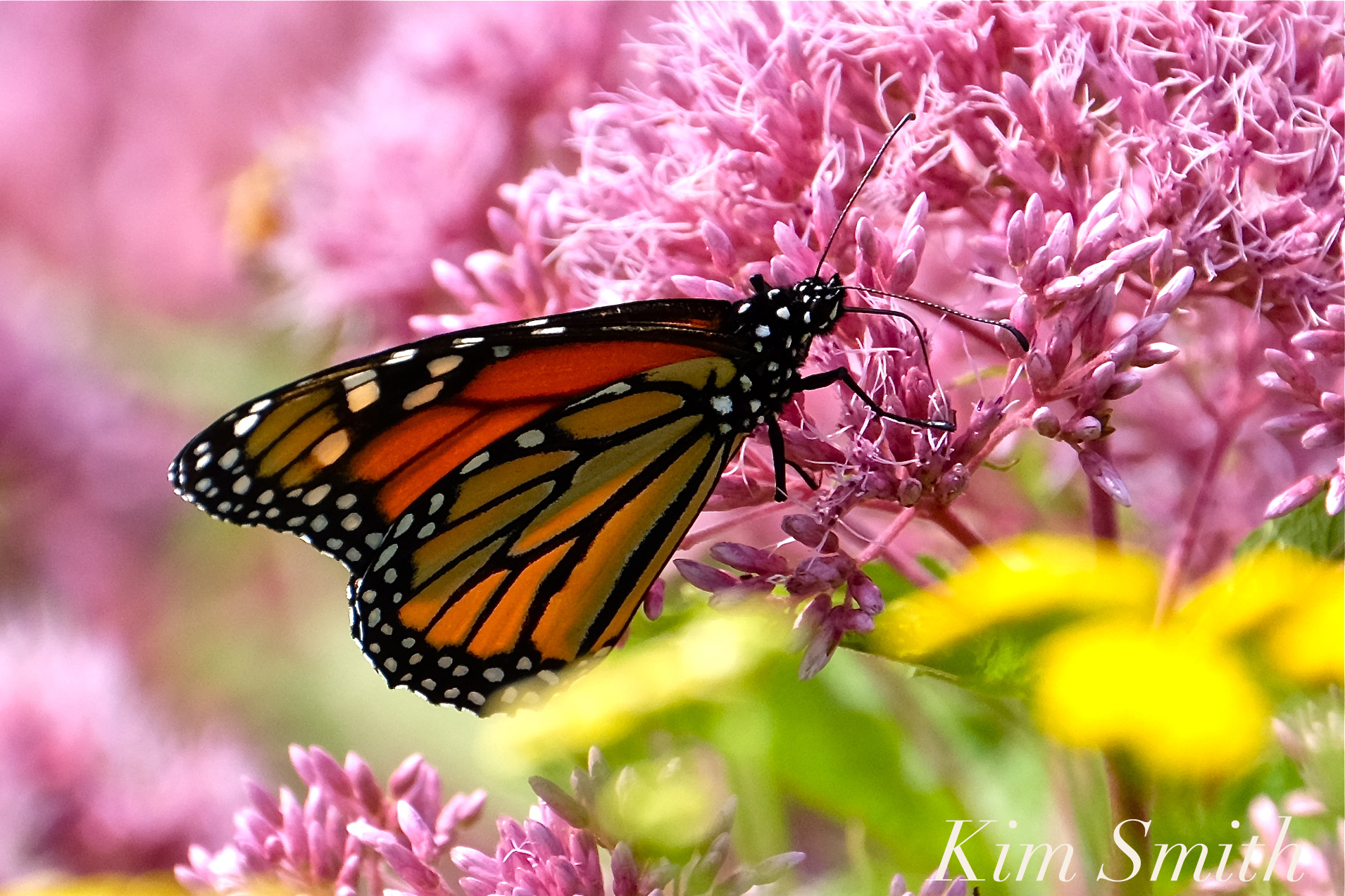
Monarch Butterfly Wildflower Joe-pye ©Kim Smith 2012Monarch Butterfly Drinking Nectar from Native Wildflower Joe-pye Weed

You can learn more about the Monarch migration and the loss of Monarch habitat from Professor Tom Emmel here ~