The festival went very, very well. The organizers, Laura Azevedo and Natalia Morgan from Filmmakers Collaborative, working with WGBH, did an extraordinary and outstanding job producing an online film festival, no easy feat, but especially during a global pandemic! I was able to view many of the films and they were wonderfully entertaining and inspiring. I am so proud Beauty on the Wing was a part of the BIKFF 2020!
Wishing you a Happy Thanksgiving, wherever that may be during these most challenging of days.
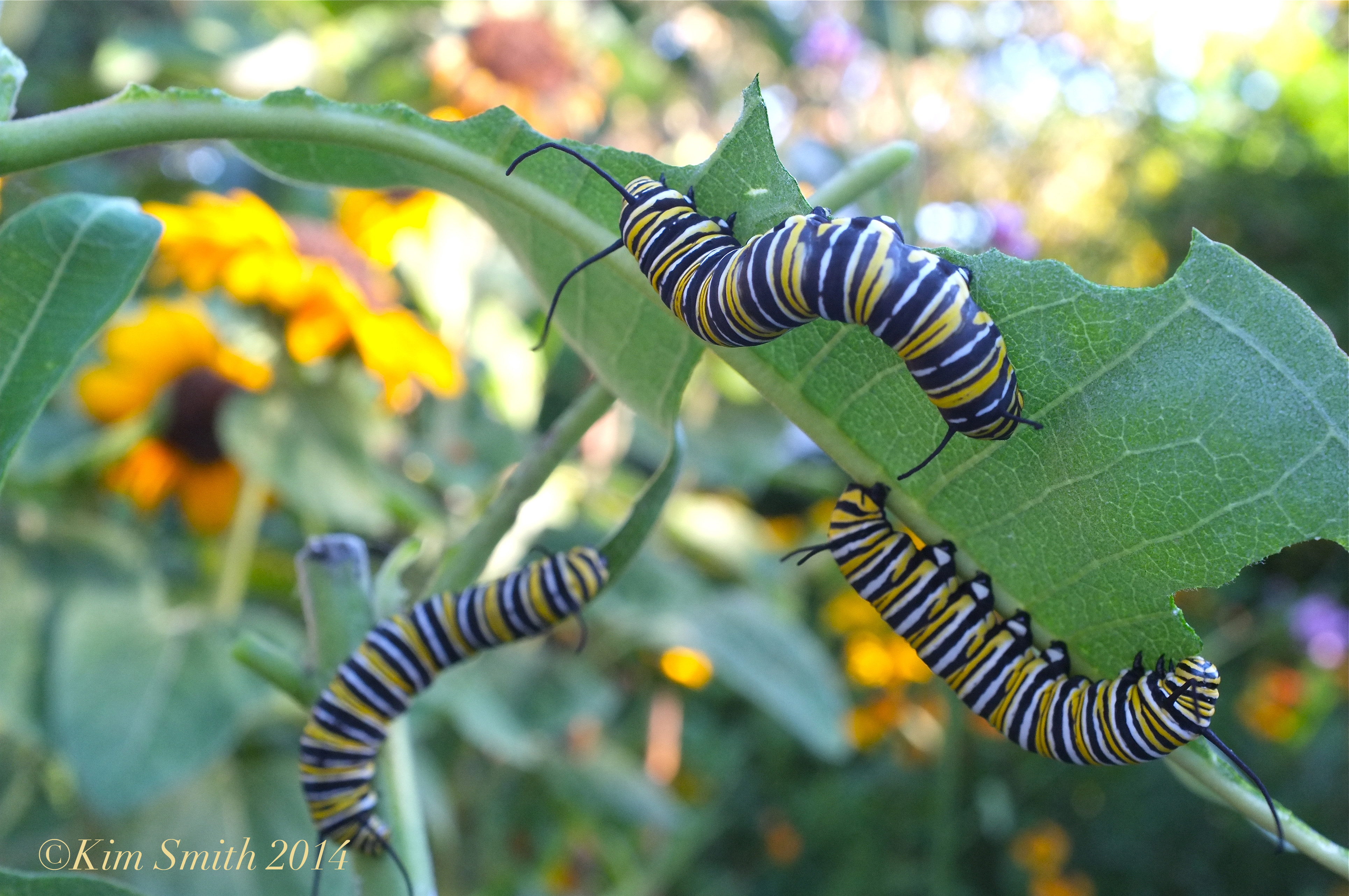
A recent article in the NYTimes, “Don’t Get Between a Caterpillar and Its Milkweed,” reviews the paper, “Aggression Is Induced by Resource Limitation in the Monarch Caterpillar,” authored by Collie, Granola, Brown, and Keene. Monarchs raised in a laboratory were given varying amounts of milkweed. Monarch caterpillars, they claim, lunge aggressively towards each other in greater and greater frequency as their milkweed supply was decreased.
In all the years I have been filming Monarch butterflies and caterpillars in gardens and in the wild, I would never have thought to describe the caterpillar’s behavior as fighting, aggressive, hangry, lunging, or head butting.
Monarch caterpillars use their sense of touch smell, and taste to eat their way from leaf to leaf. When another of its own kind is encountered on the same milkweed leaf, Monarchs in the wild pull back and reposition themselves on the leaf, barely missing a beat.
Monarch caterpillars do this same “pulling back” when brushed up against. I think it is more of a sensory response because caterpillars can barely see. Their simple eyes, called ocelli, only differentiate light from dark and cannot form an image. When a group are feeding in the same area, their behavior upon encountering one of their own kind is more characteristic of bumping into each other rather than aggressively defending their territory.
Towards the end of the summer, when milkweed leaves may be in shorter supply, caterpillars in the wild will eat the seedpods and even the stems of milkweed plants rather than aggressively battle for food.
Monarch caterpillars do not have the ability to “fight.” Their greatest defense against predators is the the caterpillar’s bright color and striped patterning, warning birds of its toxicity.
Every species of caterpillar has evolved with its own species-specific form of visual self-defense, visual against birds that is. Camouflage, mimicry, pokey spikes and spines, or brilliant colors and patterning are examples of defensive visual cues. Some caterpillars look like they are a sploge of bird poop (discouraging an attack from an avian predator) and some like leaves on a tree.
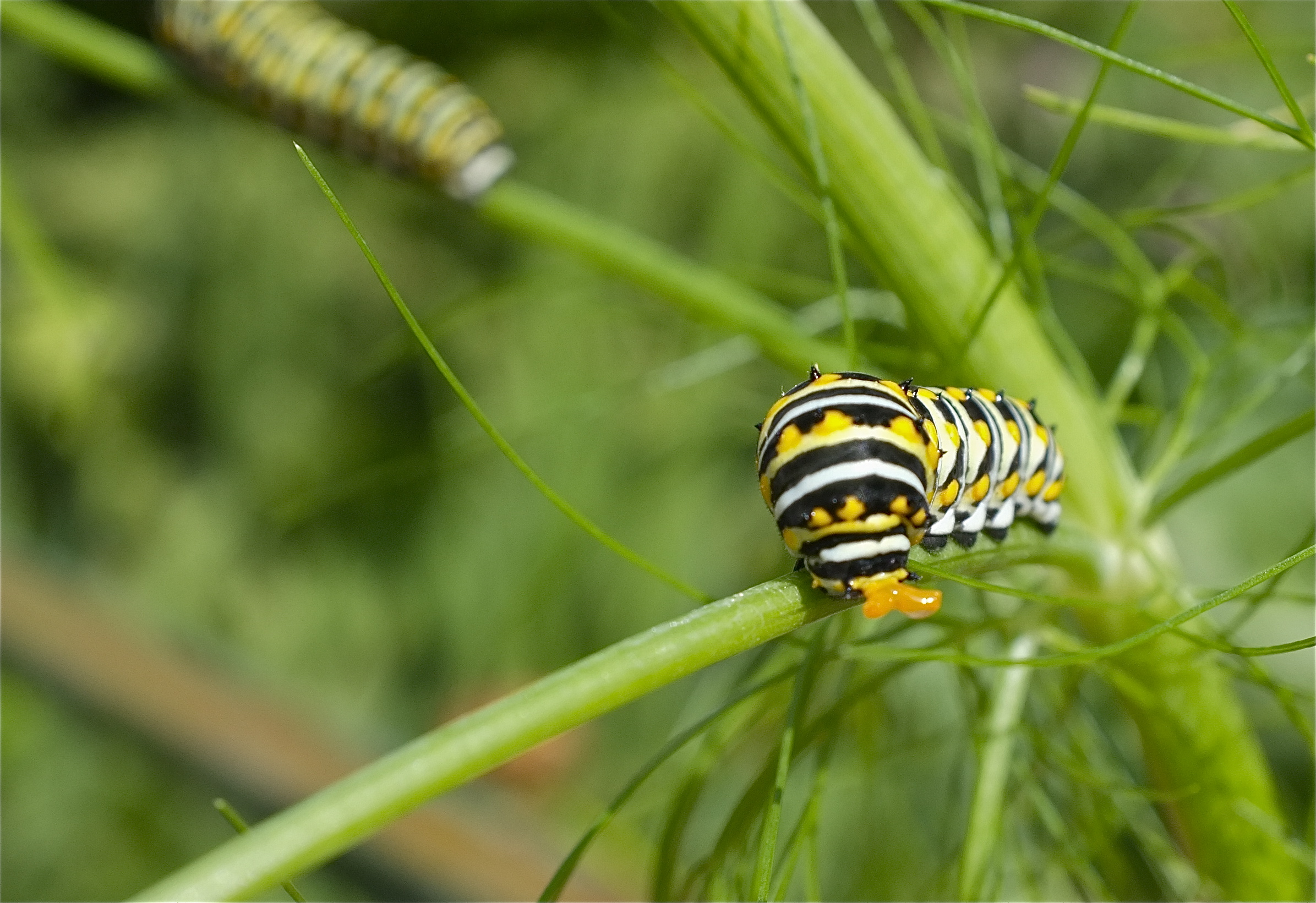
Swallowtail caterpillars have evolved with an osmeterium, a sort of forked appendage that everts when the creature feels threatened. The osmeterium resembles a snake’s tongue, also discouraging avian predation.
Black Swallowtail orange osmeterium
Some caterpillars are thought to be cannibalistic however, I am not sure cannibalism is the correct word because that suggests the act of willfully eating one of their own kind.
Pipevine Swallowtail eggs are deposited by the female butterfly in clusters and the early instars continue to feed in a group.
Pipevine Swallowtail eggs and caterpillars
Around the third or fourth instar, they will devour each other if not enough food for is available. Caterpillars taste like the leaves they eat. Doesn’t it seem natural that if a caterpillar cannot see what it is eating, it would simply eat whatever is in front of it if the ‘whatever’ tasted of its food plant? I wouldn’t call this aggressive behavior, the cat is simply using its sense of taste, smell and touch to locate readily available food.
Aggression is triggered by limited food availability
Aggression peaks during the late stages of caterpillar development
Summary
Food represents a limiting resource for the growth and developmental progression of many animal species. As a consequence, competition over food, space, or other resources can trigger territoriality and aggressive behavior. In the monarch butterfly, Danaus plexippus, caterpillars feed predominantly on milkweed, raising the possibility that access to milkweed is critical for growth and survival. Here, we characterize the role of food availability on aggression in monarch caterpillars and find that monarch caterpillars display stereotyped aggressive lunges that increase during development, peaking during the fourth and fifth instar stages. The number of lunges toward a conspecific caterpillar was significantly increased under conditions of low food availability, suggesting resource defense may trigger aggression. These findings establish monarch caterpillars as a model for investigating interactions between resource availability and aggressive behavior under ecologically relevant conditions and set the stage for future investigations into the neuroethology of aggression in this system.
Gloucester resident Kim Smith will showcase her film on butterflies at the Boston International Kids Film Festival on Saturday, Nov. 21
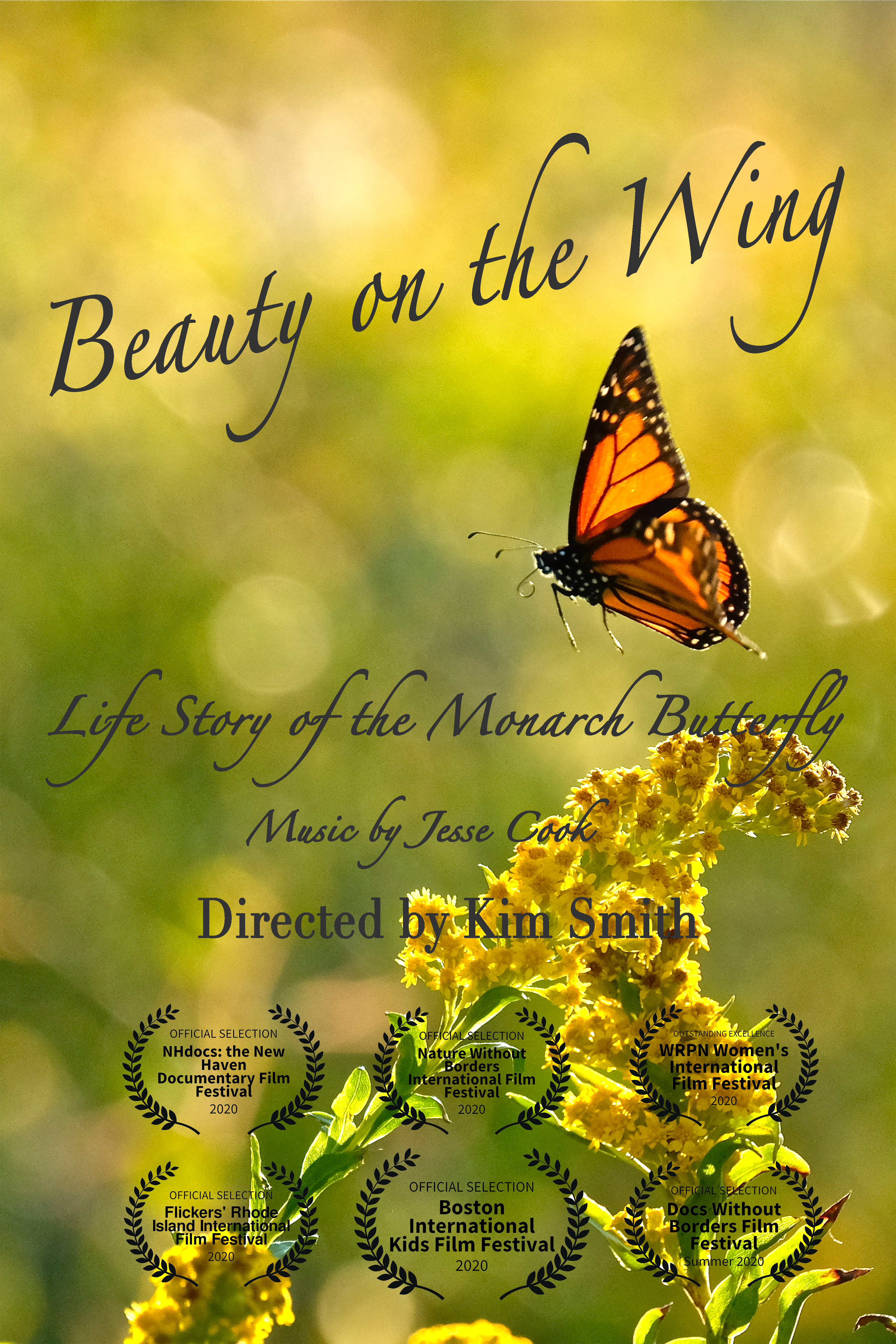
Smith’s “Beauty on the Wing: Life Story of the Monarch Butterfly” is a 56-minute narrated film featuring visuals of Cape Ann and Mexico’s volcanic mountains.
The film explores the life journey of the monarch butterfly from birth, and talks about environmental impacts that led to it being an endangered species.
“I think butterflies are beautiful. They make a garden come to life,” Smith said.
The picture will not only share information about monarchs, but will bring attention to other endangered species as well, said Smith.
The film is 10 years in the making, she said. The idea of the film came to her in 2006 when Smith was writing a book about monarch butterflies and taking pictures of them.
“It was a phenomenal migration that year and they just kept pouring in,” Smith said. “Over the years, I just kept at it.”
Smith bought a video camera and took it with her wherever she went.
Smith traveled to Mexico twice to film, and other parts of the project were shot in Gloucester. She said she enjoys incorporating Cape Ann because it’s a “special and unique place” that’s full of hardworking people.
“I love my community, I love the people in my community. It’s truly my home,” Smith said.
Smith then reached out to the Boston International Kids Film Festival, who helped her through the process of presenting her film.
The festival, taking place November 20-22, will be held virtually due to the coronavirus.
The festival includes 70 animated short and narrative films from 17 countries, all directed towards children.
Laura Azevedo is the executive director of the festival, who said it’s important to help creators get their stories out to the world.
“We’ve been a resource for independent filmmakers all over the country,” Azevedo said. “It’s a lot of fun and I’m looking forward to it.”
Azevedo said Smith’s film will do a great job connecting with children. Kids will get access to the movie and a zoom link to interact with Smith about butterflies and the filmmaking process.
“Kim’s film is an example of one where we work with schools as well,” Azevedo said.
Smith hasn’t just helped the environment on-screen. Kim Smith Designs was launched in 1985, and Smith has designed and maintained gardens in locations such as Gloucester, Cambridge, and Andover.
The award-winning landscape designer now brings her talents to the screen, and said she appreciates the Boston International Kids Film Festival for highlighting her findings.
“It’s grown and grown and grown over the past eight years,” Smith said. “Filmmakers are provided an opportunity to showcase their work.”
Her film will be during block #3 of the festival on Saturday, Nov. 21 at noon. To purchase tickets to the festival, visit this link: https://bikff.org/schedule/
“Filmmaking is one of the best ways in the world to communicate,” Smith said.
Joseph Barrett is a senior communication student at Endicott College.
Sheltering At Home, Families Get Creative With Entries For Boston International Kids Film Festival
The ARTery
November 17, 2020
By Erin Trahan
The Boston International Kids Film Festival (BIKFF) typically celebrates films made by, for, or about kids with an annual in-person festival. But this year, as with so much else, the festival had to pivot to a virtual presentation. The mostly short films can introduce kids to nature, help them think critically about race, or see what remote learning looks like in other parts of the world. Some are educational, some have a message, and plenty are just plain funny.
The festival was started eight years ago by the Filmmakers Collaborative, a Melrose-based organization that provides support to media makers. Executive director Laura Azevedo says that a lot of members made documentaries “with hopes of getting into schools or libraries and hoping young people would see them and discuss them.” BIKFF gave them, and youth filmmakers, an outlet for their work. The youth-made films quickly became the most popular, she says, because kids bring lots of friends and families into the theater.
Though this year the festivities will happen entirely online from Nov. 20-22, Azevedo still expects great attendance over the 10 blocks of film screenings. Since independent films are not rated, BIKFF breaks down viewing in various ways — by suggested viewer age, movie form and language. All of the films with English subtitles stream together, for example, as do all of the student-made films. At press time, each block will stream once, at a scheduled time, and is followed by a live Q&A.
…On Saturday, Nov. 21, in Block #3, the fest showcases an excellent pick for nature lovers. Screening at noon, Beauty on the Wing: Life Story of the Monarch Butterfly, gets up close and personal with the remarkable molting, migrating insect. With footage gathered over more than 10 years, some from her own back yard, Gloucester’s Kim Smith has become not just a nearly one-woman documentary crew but also a vocal Monarch expert and advocate.
Beauty on the Wing especially excels in patient, extreme close-ups of the caterpillar releasing its exoskeleton, as well as the butterflies sleeping and mating. In addition to its scheduled screening, schools can sign up to stream this documentary Nov. 16-Nov. 20 and also participate in a Q&A with the director.
So looking forward to tonight’s opening of the Boston International Kids Film Festival! The show’s opener is the outstanding film, The Biggest Little Farm, and there is a full lineup of over 65 films scheduled from now through Sunday.See the schedule and how to purchase tickets here.
Beauty on the Wing is playing during Block #3 at noon on Saturday, November 21st, followed by a Q and A.
Who doesn’t love The Cranberries “Dreams,” and one of my favorite covers of this beautiful song is by Mandy Lee and MisterWives. I edited a rough cut of Monarch Dreams this afternoon, with clips from Beauty on the Wing and set to “Dreams.” That my film is at last finding an audience is a dream come true for me.
I dream about Monarchs and other creatures nightly and am thinking about ways to make Monarch Dreams more dream-like, but in the meantime, I hope you enjoy this cut ❤
In case you missed previous posts and emails, if you would like to see my Monarch Butterfly film documentary, please consider watching Saturday, November 21st, from the comfort and safety of your own home, via the Boston International Kids Film Festival and WGBH. 100 percent of the ticket sales goes to support this outstanding festival! There will be a Q and A following the screening, with me in the role of director, and hosted by WGBH and Filmmakers Collaborative.
With beautiful music by Jesse Cook and filmed on Cape Ann, Cape May, Santa Barbara, and the butterfly sanctuaries at Cerro Pelon and Angangueo, Mexico. Please share with friends and click the link below to learn more.
Block #3 Beauty on the Wing: Life Story of the Monarch Butterfly
TICKETS TO THE 8th ANNUAL Boston International Kids Film Festival NOW ON SALETHIS YEAR IN PARTNERSHIP WITH GBH!Screen both Professionally and Student-Made films!Meet filmmakers from around the world!Take a workshop in filmmaking or stop-motion animation!ALL FROM THE COMFORT OF YOUR OWN HOME!FRIDAY, NOVEMBER 20 – SUNDAY, NOVEMBER 22, 2020 FILM BLOCKS INCLUDE:
Family-Friendly Features
SHORT films for ages 10 and under
STUDENT-MADE films
FOREIGN LANGUAGE films
SHORT films for middle-schoolers ( and above!)
ALL GEARED TOWARDS KIDS! $55 INDIVIDUAL FESTIVAL PASS ( watch everything!)$75 FESTIVAL PASS two or more viewers ( honor system!)$20 per film block VISIT WWW.BIKFF.ORG FOR TICKETS AND MORE INFO!
Although not the gala premiere event we had envisioned pre-covid, if you would like to see my Monarch Butterfly film documentary, please consider watching Saturday, November 21st, from the comfort and safety of your own home, via the Boston International Kids Film Festival and WGBH. 100 percent of the ticket sales goes to support this outstanding festival. I hope you can come! With music by Jesse Cook. Filmed on Cape Ann, Santa Barbara, Cape May, and the butterfly sanctuaries at Cerro Pelon and Angangueo, Mexico. Please share and click the link below to learn more.
Block #3 Beauty on the Wing: Life Story of the Monarch Butterfly
The Monarch Butterfly migration is at tremendous risk. Herbicides such as Bayer’s/Monsanto’s Roundup and Roundup Ready crops have already had a profoundly negative on the Monarch population as well as myriad spices of bees and other butterflies.
The current administration’s EPA is recklessly promoting use of some of the world’s most dangerous pesticides and has approved over 100 products with pesticides banned in multiple countries or slated for US phase out.
For example, and just the tip of the iceberg, the current administration gave a green light to Chlorpyrifos an insecticide with origins in Nazi Germany, which was set to be banned by the EPA over health and environmental concerns. The current administration reversed the decision after Dow Chemicals, a manufacturer of the chemical, donated one million dollars to his inauguration fund.
Vote for the Monarch Migration!
For all our winged wonders,
For the birds, the butterflies, the bees,
And mostly
For the future of the littlest human wonders that we so cherish.
Excerpt from Beauty on the Wing: Life Story of the Monarch Butterfly
Thank you, thank you, thank you to Joann Mackenzie, Andrea Holbrook, and the Gloucester Times for the beautifully written story“Butterfly Film Takes Flight”.
Ten years in the making, Kim Smith’s butterfly film takes flight
Kim Smith’s monarch movie 10 years in the making
GLOUCESTER TIMES OCTOBER 28, 2020
By Joann Mackenzie Staff Writer
Every story has a back story, and Kim Smith’s back story began in her backyard.
In the mid 1990s, Smith — an award-winning landscape designer — filled her Gloucester garden with native and pollinator plantings that attract all manner of winged creatures. These, thanks to lots of milkweed, included lots of magnificent monarch butterflies. “I just loved them,” says Smith, “I wanted more and more of them.”
There began a tale that this year saw Smith complete a 10-year project, the making of the 56-minute documentary “Beauty on the Wing — Life Story of the Monarch Butterfly.” In a few short months, and despite the pandemic canceling its local premiere, the film has seen its way to six film festivals, all virtual, the latest of which — the Boston International Kids Film Festival — runs Nov. 20 to 22.
American Public TV Worldwide —the world’s largest distributor of educational television has just signed the documentary for global distribution.
Armed with a handheld digital camera, an artist’s eye, and a love of her subject, Smith has captured the life, work and world of what she calls “this charismatic little creature,” beginning with its metamorphosis from a tiny egg, to its amazing annual journey from the summer shores of its Gloucester habitats to its winter habitats in the Mexican mountains and forests of Michoacán, where the monarchs annual arrival has long been regarded as something of a miracle: the returning of the souls of the dead descending from the sky in fluttering orange clouds, to roost by the millions in the trees.
When she began the project in 2006, Smith knew nothing about filmmaking. Photographing the monarchs, first as “a record,” she was urged on by family and friends. One of them, Gloucester’s late historian Joe Garland, was particularly encouraging. “Oh, I thought, I have to learn to make a film,” she recalls, of her early days learning the basics with Andrew Love and Lisa Smith at Cape Ann TV (now Studio 1623).
Investing in a hand-held HD Canon video camera, Smith began shooting digital. “It was small and so easy to use that I could crouch down, or lie down to capture extreme close-ups,” she says. Supported by community fundraising that covered the $35,000 production budget, she shot “tons of footage over the years,” wrote and recorded the narrative script, and saved on post production costs by teaching herself to digitally edit her film.
Her goal, she says, was not just to celebrate the monarch, but to educate viewers about the plight of this creature that is loved around the world. Indigenous to North America, these light, bright orange butterflies have through the centuries been blown by wind and weather to other continents, including England, where, in the late 17th century, they were named in honor of King William III of England, also known as the Prince of Orange.
In the last 20 years, however, the butterflies’ numbers have plummeted worldwide from a billion to 30 million, as the excessive use of herbicides has killed off much of their main food source —milkweed— while climate change has confused their flight patterns. And in Mexico, the logging of trees has sabotaged the delicate ecosystem of their annual return.
Smith’s film joins a growing body of environmental activism on behalf of the monarch butterfly. Gardeners across the nation have, like Smith, filled flower beds with milkweed to feed their numbers. The Obama administration, concerned by its alarming decline, allocated $3.2 million to protect it.
In making her documentary, Smith traveled to Mexico twice to film, and learned firsthand just how endangered the monarchs have become. Over time, she says, she came to see monarchs as “little gateway creatures that can open the way to for people to learn about other endangered creatures.”
At Good Harbor Beach, a favorite early morning photographic haunt, Smith began to turn her camera to another local endangered species, piping plovers. Like the monarchs, the little shore birds rely on a fragile ecosystem that Smith began to take an active role in protecting, while filming them. With her monarch documentary now in worldwide release, the piping plovers are on their way to star billing in a new documentary, now in production.
Meanwhile, the Boston International Kids Film Festival, a program of Filmmakers Collaborative, will screen Smith’s documentary as “one of best that the world of independent filmmaking has to offer.” Shown for one week to schoolchildren across the city, the festival, which describes her documentary as “illuminating how two regions, separated by thousands of miles, are ecologically interconnected,” will then host a Zoom author event in which the students can engage in a Q&A which Smith herself.
Smith, by the way, doesn’t just train her talents on winged creatures. In yet another ongoing film project, she captures the aerial antics of Gloucester’s falling Greasy Pole walkers. That documentary, which celebrates the spirit of the city’s annual St Peters Fiesta, is well underway.
Gloucester resident Kim Smith is a documentary filmmaker, environmental conservationist, photojournalist, author, illustrator and award-winning landscape designer.
Her documentary “Beauty on the Wing: Life Story of the Monarch Butterfly” was released in February. It has been chosen as an official selection at New Haven Documentary, Nature Without Borders International, Flickers’ Rhode Island International , Docs Without Borders , WRPN Women’s International, and Conservation Wildlife film festivals.
It next shows at the Boston International Kids Film Festival (https://bikff.org/schedule/) on Nov. 20 to 22; tickets start at $20. Links to view the film will be provided upon ticket purchase.








 Beauty on the Wing