We are overjoyed to share Beauty on the Wing: Life Story of the Monarch Butterfly wins an environmental award at the Toronto International Women Film Festival!
Last week we were accepted to the Montreal Independent Film Festival. It’s very meaningful to me that audiences in Toronto and Montreal are finding Beauty relevant as southeastern Canada is an important breeding area for the Monarchs.
I hope so much you will consider making a tax-deductible donation. We are seeking $51,000.00 to cover the cost of distribution and only have a few short months to raise the funds. We are looking for underwriters and donors for the next phase, to distribute Beauty to a national public television audience. All contributions, large and small, will be listed on the film’s website and on American Public Television’s website. For more information, please go here:
Underwriters, those donating substantial sums, will be featured at the beginning and end of the film. For more information about underwriting, please email me at kimsmithdesigns@hotmail.com
Thursday I am super excited to be presenting Beauty on the Wing to the Spanish students at O’Maley Innovation Middle School. This program was organized by Heidi Wakeman. I plan to do more of these screenings and QandAs with young people and will let you know how it goes!
I have the most wonderful, exciting news to share. Our documentary Beauty on the Wing: Life Story of the Monarch Butterfly has been accepted for distribution by the American Public Television Exchange market, which means that within the year, you will be watching Beauty from your living room, on your local public television station!
American Public Television Exchange is the largest source of free programming to US public television stations, covering virtually every market in the country (nearly 350 stations). APT writes that they expect the documentary “to engage and delight public television viewers of all ages who are interested in nature, conservation, and our planet’s amazing ecosystems.”
What happens next? Beauty on the Wing needs underwriters and donors! The total distribution cost to bring the documentary to public television is just over $51,000.00. We only have several months to raise the funds. Please consider donating to the distribution of Beauty through my tax deductible online fundraiser at Network for Good. The link is here.
If you have donated previously to the fundraiser for the post-productions costs, I am so grateful for your generosity. Because of your kind contribution, Beauty on the Wing is doing exceptionally well at film festivals and has received a number of awards. If the distribution phase of the project is of interest, please consider a second donation.
Film screenings and awards to date include:
Winner Best Documentary Boston International Kid’s Film Festival
Winner Best Feature Film Providence International Children’s Film Festival
Environment Award Toronto International Women Film Festival
Outstanding Excellence Nature Without Borders Documentary Film Festival
Outstanding Excellence Women’s International Film Festival
New Haven Documentary Film Festival
Montreal Independent Film Festival
Flicker’s Rhode Island International Film Festival
Docs Without Borders International Film Festival
The names of supporters contributing $10,000.00 and over will be featured in the film’s underwriting credit pod. What does it mean to be an underwriter? As an example, when you watch a show on public television and the announcer says, “This show was brought to you by Katherine and Charles Cassidy, by The Fairweather Foundation, by Lillian B. Anderson, and by The Arnhold Family, in Memory of Clarisse Arnhold,” that’s where your name, or the name of your foundation, will appear. APT allows for up to 30 seconds per film and your name or promo will appear at both the beginning and at the end of the film.
Please write and let me know if you would like more information about underwriting, including a complete budget, along with APT’s underwriting guidelines. Email at kimsmithdesigns@hotmail.com.
All donors, no matter how large or small the donation, will be listed on the film’s website and on APT’s website. Any amount contributed is tremendously appreciated!
Thank you for being part of launching Beauty on the Wing: Life Story of the Monarch Butterfly onto the national television stage!
With gratitude,
Kim
A brief overview of the film – Beauty on the Wing: Life Story of the Monarch Butterfly is a 56-minute narrated documentary film that takes place along the shores of Cape Ann and in the heart of Mexico’s forested volcanic mountains. Filmed in Gloucester, Massachusetts and the Monarch Butterfly Biosphere Reserves at Estado de México and Michoacán, the film illuminates how two regions, separated by thousands of miles, are ecologically interconnected. See more at monarchbutterflyfilm.com
Missed chatting with friends and neighbors about the films you saw at this year’s Providence Children’s Film Festival? Join us for a Zoom discussion! This evening, anytime between 5:30-7:00 pm and share. Link is https://zoom.us/j/93126124781
All this school vacation week, the Providence Children’s Film Festival is airing an outstanding collection of wonderfully educational and interesting films for families and kids of all ages. Tickets are only $12.50 per film for the entire family. Or you can do as I did and buy a pass, which allows for viewing all films all week long. Beauty on the Wing is playing through Saturday and I will be part of a Q and A at 3:00 on Saturday afternoon. Please vote for BotWing after watching the film. Thank you!
At this moment I am currently watching The Last Lightkeepers. This is a film I have been especially super excited to see largely because I think here in Gloucester we should form a Friends of Gloucester Lighthouses Association. Our lighthouses are in increasingly deplorable condition. I would like very much for we in Gloucester to follow in the footsteps of Rockort’s Paul St. Germain and the Thacher Island Association in restoring our lighthouses and the surrounding grounds.
The Last Lightkeepers – This stunning documentary explores lighthouses across New England (including in Rhode Island) and the sadly decaying condition of many of them. Many abandoned lighthouses haven’t been tended to in decades or since they were replaced by updated tools of navigation. Director Rob Apse captures the beauty of these American sentinels that once defined a nation’s coastline. The Last Lightkeepers highlights stories of individuals currently fighting to preserve these structures while capturing their folklore before the lights go dim forever.
Scene from Beauty on the Wing – Standing atop Cerro Pelón and looking down into a valley of exploding Monarchs
For further reading and some terrific background information, see the following article, published by the NRDC in early February of this year. Scenes from Beauty on the Wing were filmed at the stunning forest at the Cerro Pelón Monarch Butterfly sanctuary.
NRDC Profiles:
For a Family in Mexico, a Mission to Protect Monarchs
Siblings Joel, Anayeli, and Patricio Moreno see the future of their community and that of the butterflies that migrate annually to the local Cerro Pelón forest as being intimately connected.
If there’s something that the Moreno family agrees on, it’s that monarch butterflies changed their lives. And not just their own but the lives of most in Macheros, Mexico. The agricultural village of 400 people—whose name translates to “stables” in Spanish, because of the 100 horses that also make their home here—sits at the entrance to Cerro Pelón, one of four sanctuaries in Mexico’s Monarch Butterfly Biosphere Reserve, established by the federal government in 1986.
It started when Melquiades Moreno de Jesus secured a job as a forest ranger, or guardabosque, in 1982. Six years earlier, National Geographic had run a feature on monarch migration, bringing international attention to the butterflies’ overwintering sites in the mountainous oyamel fir forests some 80 miles west of Mexico City—though locals had discovered the colonies long before outsiders descended on the area. Soon after that publication, the State of Mexico’s Commission of Natural Parks and Wildlife (Comisión Estatal de Parques Naturales y de la Fauna, or CEPANAF) established the local forest ranger positions, employing men from Macheros to patrol the part of the sanctuary that’s in the state of Mexico. (Part of the butterfly reserve also lies in the state of Michoacán.) CEPANAF hired Melquiades several years later and he stayed on, monitoring the butterflies and deterring illegal loggers, for more than three decades.
The village of Macheros; Cerro Pelón is the tallest peak on the right. Ellen Sharp Photo
“When my dad got the job as a forest ranger, it changed our lives,” says Joel Moreno Rojas, the fourth-born of Melquiades’s 10 children. His father’s steady income brought the family out of poverty and afforded the children the chance to go to school. It also instilled a sense of local pride and inspired his family’s commitment to caring for the natural wonder at their doorstep.
Among the Moreno siblings, three have continued their father’s legacy: Joel, Anayeli, and sixth-born Patricio (“Pato”). Pato took over Melquiades’s forest ranger position after his dad’s retirement in 2014. When the monarchs are roosting in Cerro Pelón, roughly from November to March, he spends many days near the overwintering colonies, monitoring them and asking visitors not to disturb the impressive clusters. The butterflies, which have migrated thousands of miles from the eastern part of the United States, are drawn to the oyamel canopy—which provides insulation and keeps out the elements—for their winter rest. “I love it,” says the father of two. “It’s the most marvellous thing that could have happened in my life to have a job like this.”
Pato Moreno at work in Cerro Pelón after a rainstorm. Ellen Sharp Photo
Being among hundreds of thousands of butterflies sparks such an intense emotional reaction that the Moreno siblings say it is impossible to name. When they do find the words, they describe experiencing the monarchs as powerful, beautiful, and emotional. Joel has seen visitors drop to their knees and pray or break out in tears when they first see the butterflies, who some locals believe are the souls of their ancestors, since the migrating monarchs arrive in Macheros right around the first of November, el Día de los Muertos, or the Day of the Dead.
“As Mexicans, we should all be proud of the butterflies,” Pato continues. “I’d like everyone to understand the value of the forest, because it helps us and it helps the butterflies.”
I hope you are doing well and taking good care. I have exciting news to share regarding virtual screening times for Beauty on the Wing at the Providence Children’s Film Festival for my Massachusetts, Connecticut, and Rhode Island friends. The festival opens at 4pm on this coming Friday, the 12th. Tickets may be purchased in advance and you will then have seven days in which to view. Once viewing begins, you have 24 hours to complete the screening. The tickets are only $12.50.Purchase tickets here. I am going to be participating in a Q and A on the afternoon of Saturday, the 20th, and will let you know more in the next few days.
The festival is showcasing a fantastic lineup of films. I plan to purchase a full access pass and there is also a family access pass option for ten films. The festival takes place during February school vacation week and will be a wonderfully inspiring source of entertainment for you and your family. Here is a link to all the films showing at the festival: FILM GUIDE. Just two of the many films I am super excited to see are The Last Lighthouse Keepers and Microplastic Madness.
I hope you’ll have a chance to watch Beauty on the Wing virtually. The Providence Children’s Film Festival is a truly stellar organization devoted to bringing inspiring and educational films to families in Rhode Island and the surrounding region. More information on how to participate in the Q and A to follow.
Take care dear friends and stay well. Warmest wishes, Kim
This beautiful keepsake for my documentary Beauty on the Wing from the Boston International Kids Film Festival arrived in the mail. I am so deeply honored to be awarded Best Documentary and highly recommend filmmaker friends join, support, and participate in BIKFF and Filmmakers Collaborative.
Butterfly wings come in all shapes, sizes, and degree of flexibility. They have evolved with a range of mechanisms and strategies in flight. Butterflies such as the Silver-washed Fritillary (see video below) and Yellow Sulphur clap their wings frequently, but other butterflies, the Monarch Butterfly for example, does not “clap” their wings every time they take flight. The Monarch’s wings create an open cup shape, operating in more of a figure eight pattern.
Scientist have known about butterfly wing clapping for more than fifty years. I don’t think a mystery has been solved nonetheless, the study from Sweden’s Lund University and articles are interesting to read.
In the above video you can see in the first few frames when the Monarch is taking off that its wings do not clap.
In 2015, when my daughter Liv was living in Santa Monica, she and I took a day trip to the Goleta Butterfly Grove, just outside of Santa Barbara.
Goleta Butterfly Grove
The butterflies were, for the most part, sleeping quietly in the Eucalyptus trees. A few were fluttering about, drinking nectar from the Cape Honeysuckle (Tecoma capensis) growing nearby.
Non-native nectar source for Monarchs, Cape Honeysuckle
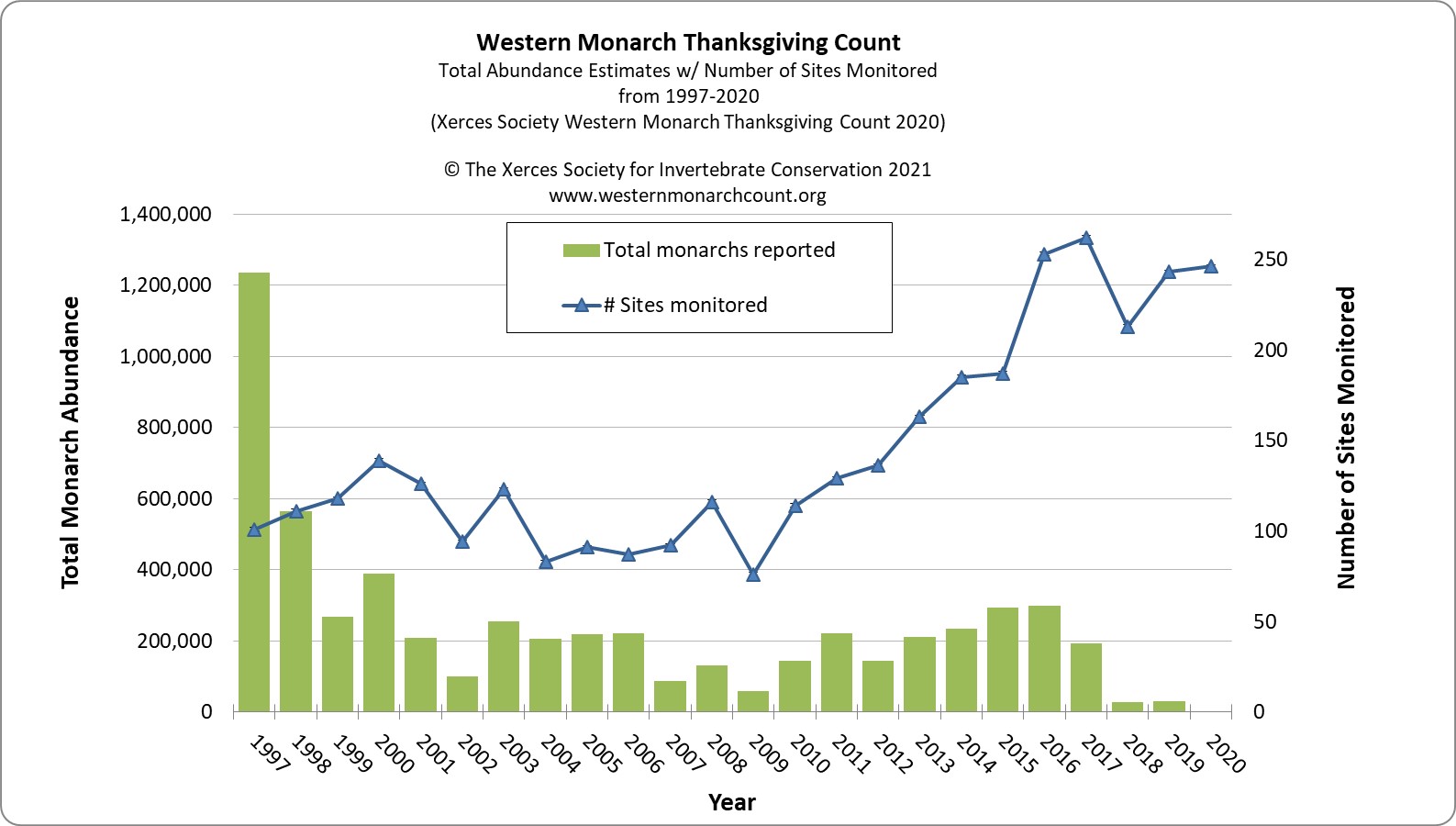
The Western Monarch Butterfly demise has been in the making for decades. The Ecaplytus trees the butterflies were roosting in appeared stressed. Eucalyptus trees are not native to California and are highly flammable. I wondered at the time why the forest couldn’t be underplanted with native tree and also wondered exactly what were the trees the butterflies may have historically roosted in.
With unbridled development that has lead to loss of habitat, forest fires, a warming climate, and the use of deadly pesticides and herbicides in this American breadbasket to the world, is it really a mystery as to why the butterflies are nearly extirpated from California.
Lovely update from the Gloucester Daily Times Gail McCarthy for Beauty on the Wing: Life Story of the Monarch Butterfly. So many thanks to the Times for their continued support for BotWing. I am so grateful and appreciative!
AROUND CAPE ANN: Local artists earn accolades
Around Cape Ann Gail McCarthy January 14, 2020
Gloucester’s Kim Smith, who boasts a love of nature, photography and all things art, has found growing recognition for her film “Beauty on the Wing,” about the life of the monarch butterfly and its intercontinental migration from Canada to Mexico.
Smith spent more than eight years researching and documenting the natural phenomenon, whose more than 3,000 miles includes Cape Ann.
This fall, her documentary was accepted into the Boston International Kids Film Festival, where it earned an award for best documentary.
More recently, “Beauty on the Wing” received an Award of Excellence from the Nature Without Borders International Film Festival and was accepted as an official selection to the Providence Children’s Film Festival, which takes place in February.
“I am overjoyed that ‘Beauty on the Wing’ is finding acceptance at both children’s and conservation festivals; that jurors see it as it was meant to be, a conservation film for people of all ages,” Smith said.
Rockport artist Susan Lynn won the grand prize at the EnPleinAirTEXAS competition with her painting titled “Peace on the River.”
“It was overwhelming to get the grand prize because there is a stellar group of painters in that competition every year,” she said. “It was humbling, and I was very honored to be recognized in that group.”
The festival went very, very well. The organizers, Laura Azevedo and Natalia Morgan from Filmmakers Collaborative, working with WGBH, did an extraordinary and outstanding job producing an online film festival, no easy feat, but especially during a global pandemic! I was able to view many of the films and they were wonderfully entertaining and inspiring. I am so proud Beauty on the Wing was a part of the BIKFF 2020!
Wishing you a Happy Thanksgiving, wherever that may be during these most challenging of days.












 Beauty on the Wing
