Monarch Expedition: Part One ~ Angangueo Michoacán, Mexico

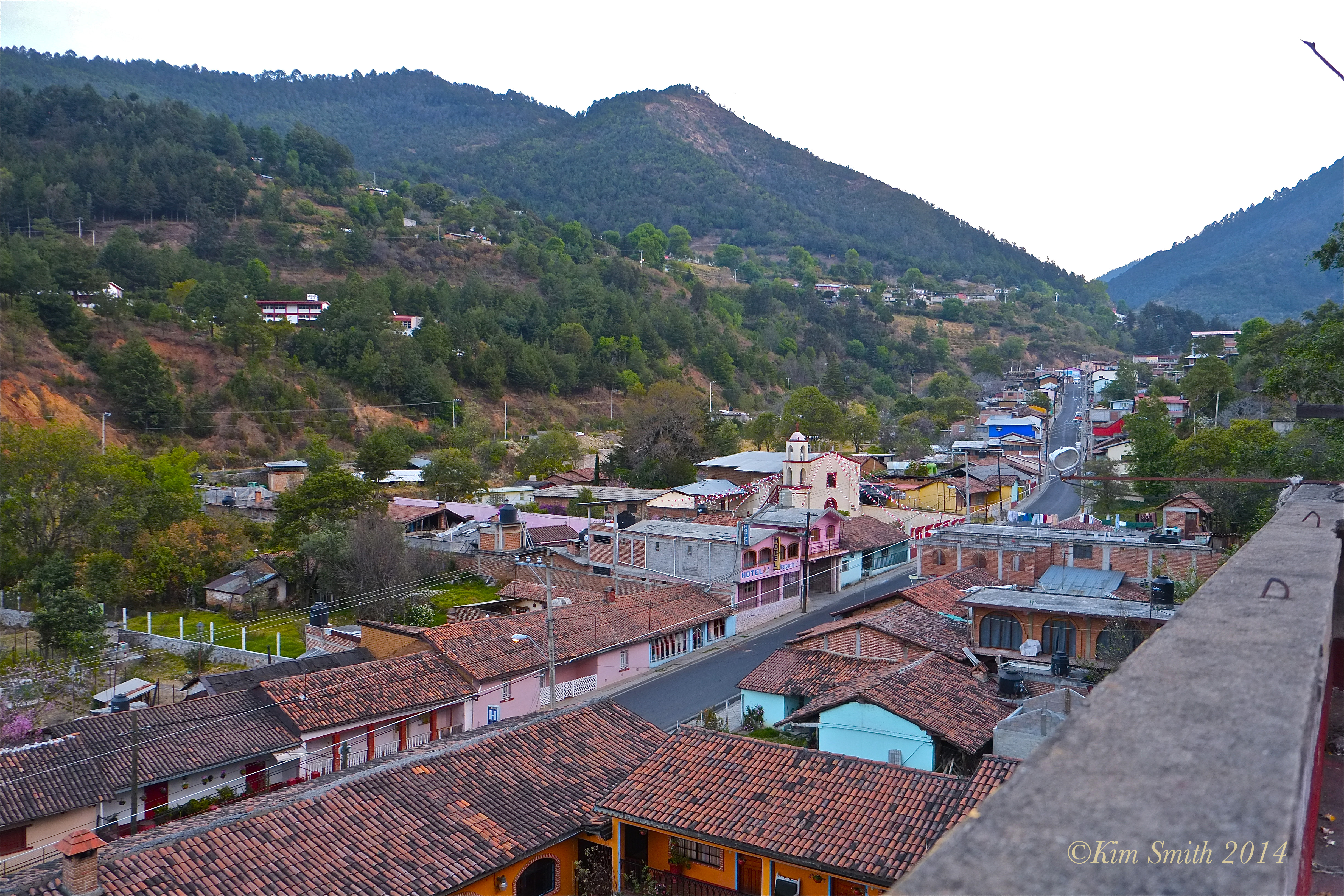
Angangueo Mexico ©Kim Smith 2014After the four-hour drive from Mexico City, across a wide valley of rustic farmland and over and around volcanic mountains, we arrived in the early evening at the sleepy town of Angangueo. Pitched on a steep mountainside, the narrow streets and closely packed buildings with shared stucco walls immediately reminded me of southern European villages. Especially lovely were the modest and many handmade outdoor altars gracing townspeople’s homes and gardens.

Altar Angangueo mexico ©Kim Smith 2014

Angangueo is located in the far eastern part of the state of Michoacán in the central region of Mexico in the Trans-Mexican Volcanic Belt. In the late 1700s minerals were discovered. Large deposits of silver, gold, copper, and iron ore brought a rush of people into the area. Today, Angangueo is noted as home to two of the most beautiful Monarch Butterfly Biospheres, El Rosario and Sierra Chincua.

Hotel Don Bruno Angangueo Mexico ©Kim Smith 2014Our guesthouse, the Hotel Don Bruno, was utterly charming. As with many of the buildings we passed on the way to Angangueo, a cheery row of glazed terra cotta pots brimming with red and pink geraniums lined the hotel entrance. Through the entryway door and past the front office, guests entered the beautiful inner courtyard garden. All the rooms faced into the courtyard and mine had a delightfully fragrant sunny yellow rose just outside the door. I quickly changed for dinner to meet my fellow travelers in the hotel’s second floor dining room. A long dining table arranged family style, running the length of the room, had been set up for our group, with a view onto the flowering courtyard below.

Hotel Don Bruno Restaurant ©Kim Smith 2014 copy

As he did that evening, and every dinner and breakfast, Chef Jean Gabriel Salazar López had prepared an elegant feast of many different entrees, mostly native Mexican dishes, including and combining a fabulous array of local fruits and vegetables. The proprietors and hotel staff could not have been more friendly and accommodating.
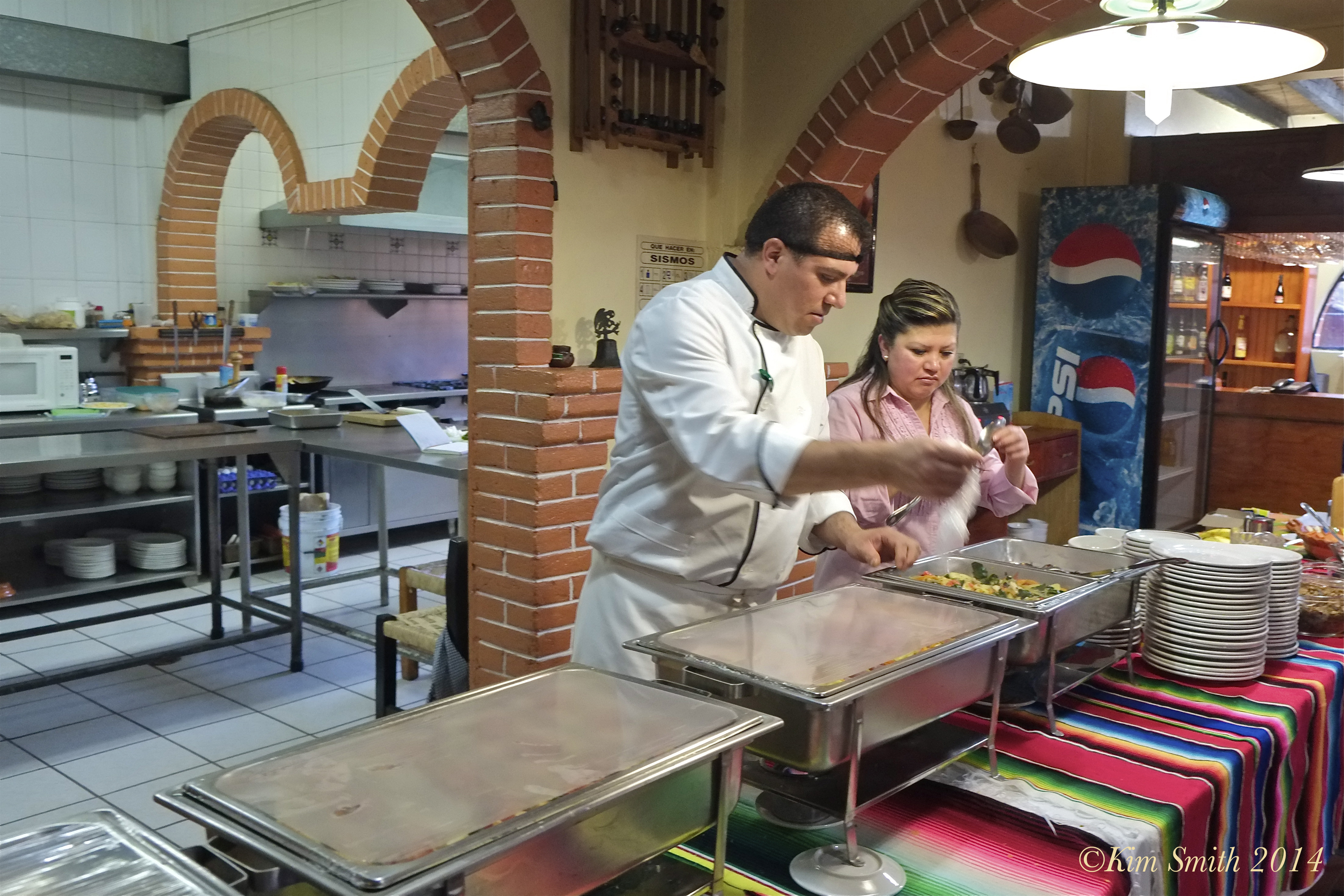
Chef Jean Gabriel Salazar López Hotel Don Bruno Angangueo © Kim Smith 2014.

Dinner was followed by a discussion led by Dr. Emmel. Tom Emmel is the Director of the McGuire Center for Lepidoptera and Biodiversity, which is part of the University of Florida’s Museum of Natural History. He is also a professor of zoology and entomology and the author of 35 books (more about Dr. Emmel in the next installment). I recorded several of Dr. Emmel’s lectures and an interview atop the Sierra Chincua Biosphere and will be posting all on youtube.

Mural Angangueo Mexico ©Kim Smith 2014Mural in the town plaza

At daybreak the following morning, I climbed the central outdoor stairwell to the top of the hotel to film the sleepy town awakening. Roosters crowed and the hotel’s freshly washed and drying sheets whipped to the wind in the crisp mountain air. The morning light did not disappoint. Kitty corner across from my rooftop vantage point was one of the small town’s several churches, with a walled courtyard and red and white banners fluttering in the breeze. The village’s main road leads further up to the mountains and is lined with red tiled roofed-homes and sidewalks swept immaculately clean. The sun was just beginning to peek through the mountains when I had to leave to hurry down to breakfast.
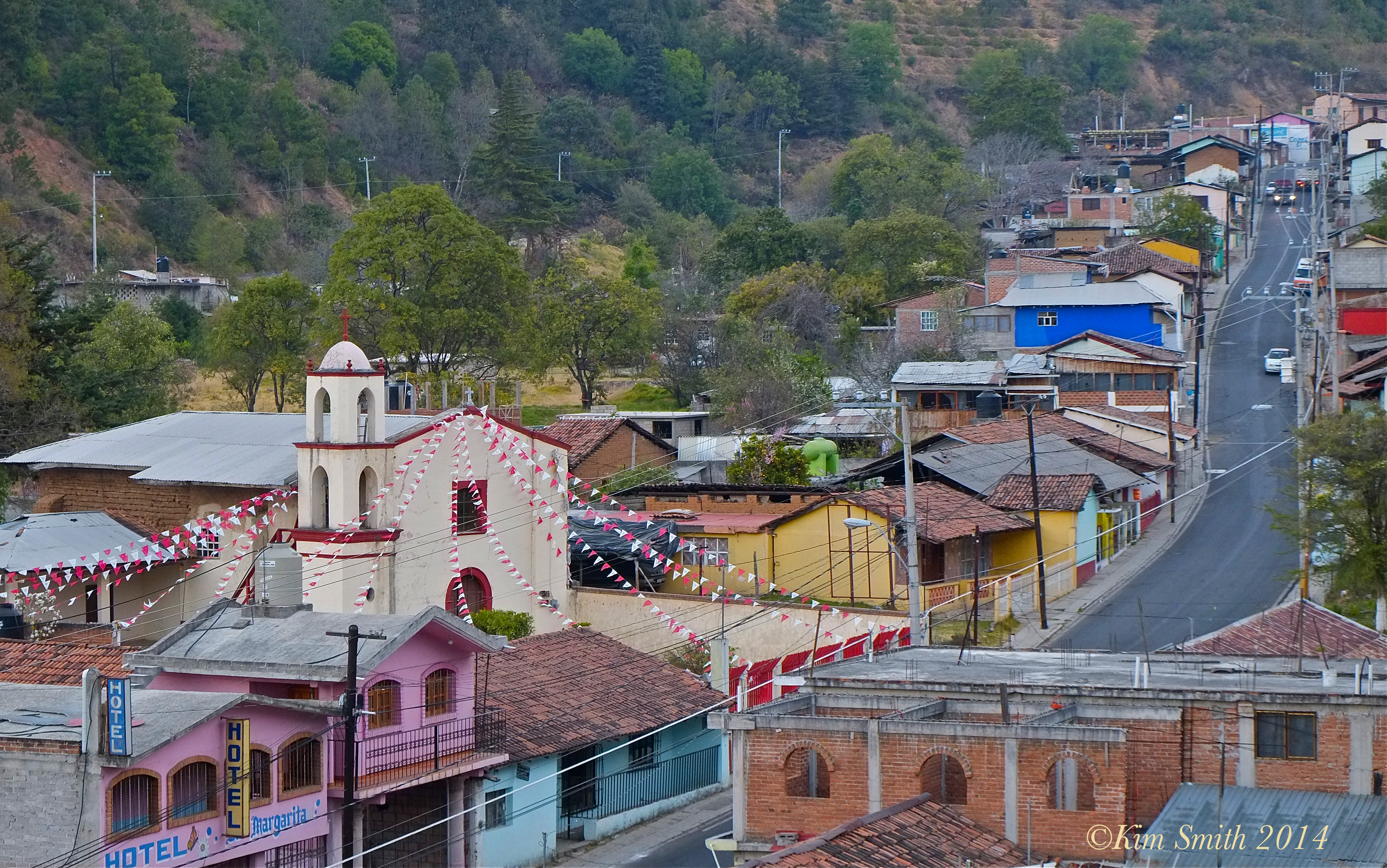
Angangueo ©Kim Smith 2014Despite the beauty and well-kept appearance of Angangueo, and especially of our charming guesthouse, the town and the Hotel Don Bruno were nearly empty of tourists. Reports of mayhem and murder in Michoacán have drastically reduced the number of people traveling to Angangueo to see the Monarchs at the biospheres.

The gang murders are taking place on the far western side of Michoacán, near the Pacific Coast. Angangueo is located on the far eastern side of the state, bordering the state of Mexico. Not traveling to Angangueo for that reason is as uninformed as if someone decided not to travel to San Francisco because of the gang violence that takes place in Los Angeles! The people of Angangueo have stopped logging to protect the Monarch’s habitat and have come to rely heavily on income from tourism. I was deeply saddened to see the lack of visitors, at this time of year especially, when the Monarchs are at their peak activity at the colonies.

San Simón Angangueo Mexico ©Kim Smith 2014San Simon Parish Church

Inmaculada Concepcíon ©Kim Smith 2014Inmaculada Concepcíon

Next installment: Day 1 at the Monarch Colony
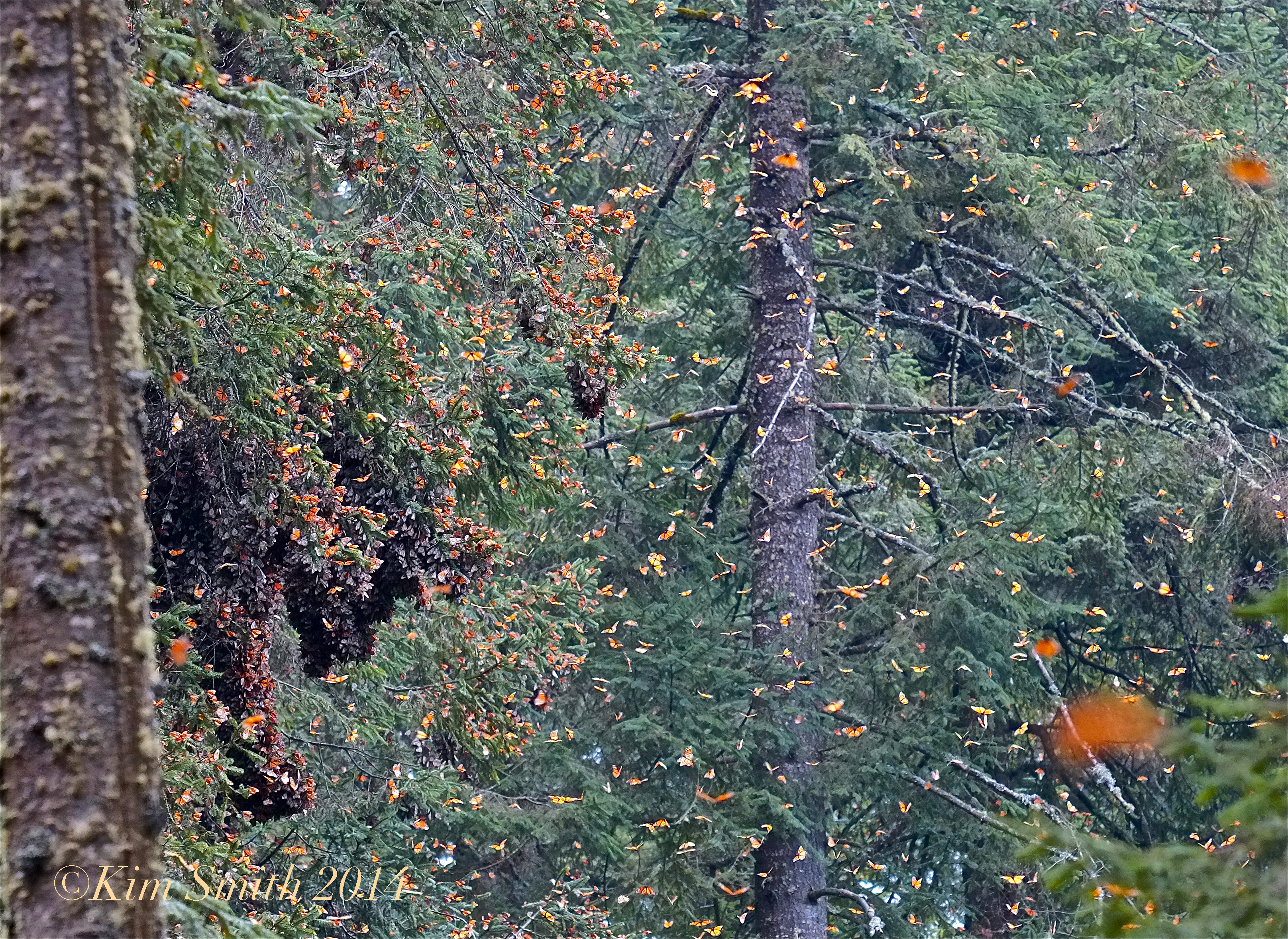
Monarch Butterfly Explosion!

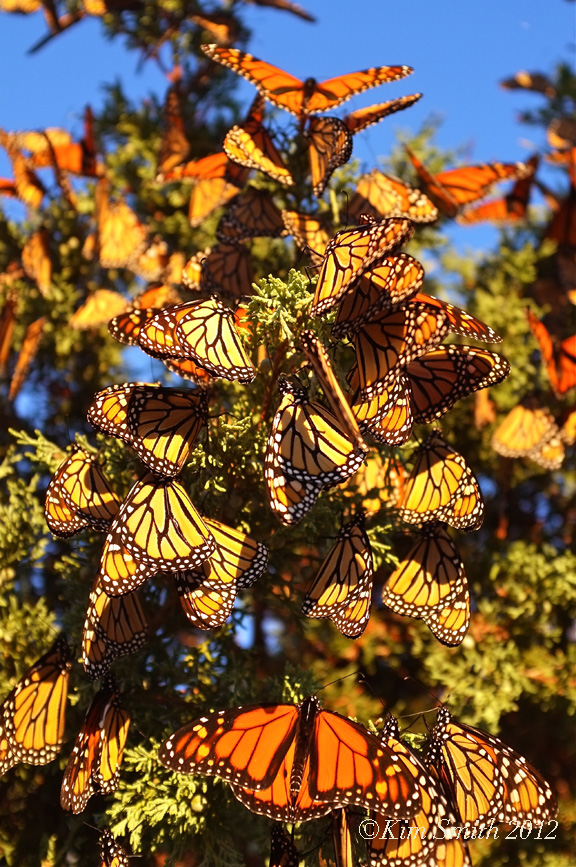
Monarch butterfly explosion ©Kim Smith 2014Monarch Butterfly Explosion!

I am back from Mexico and, although there for less than a week, there was much to take in. My most sincerest thanks to all my readers for your safe-travels well-wishes and kind thoughts!

The butterflies were dazzling and beautiful beyond imagination, but also very sad. This wondrous migration of the Monarchs, which has taken place for over a million years, is in serious peril. If changes are not made very soon, the migration will end. I’ll write more about my trip and the extraordinary scientist that led our expedition, Doctor Tom Emmel, this weekend after I am all caught up with design work and photography projects. Additionally, I interviewed Dr. Emmel at the top of the Sierra Chincua Monarch Colony, located in Michoacán at 10,000 feet above sea level, and will be bringing readers the full interview!

What We Can Do to Help the Monarchs

Everywhere we turn this past month, there is a report in a major newspaper about the declining Monarch butterfly population. This forwarded from one of our readers: “Monarch butterflies keep disappearing. Here’s why” was published in the Washington Post on January 29th, 2014.

The author, Brad Plumer, interviewed Dr. Lincoln Brower, a professor of biology at Sweet Briar College and one of the nation’s leading authorities on the subject. I will be meeting Dr. Brower and interviewing him for my film while at the biosphere this month.

One of Dr. Brower’s suggestions on how we can help the Monarchs is along the millions of miles of roadsides in the eastern United States, if we cold get highway departments to plant for pollinators rather than cutting everything down and spraying herbicides. This would be of great help to the Monarchs, insects in general, and many species of birds.

I’ve thought a great deal about this and it is my foremost reason for creating butterfly and habitat gardens, such as the butterfly gardens at the Gloucester HarborWalk. I think too, of the many patches of unused city-owned land dotted about our community and how we could turn these little patches into habitats for all our winged friends. For several years I have wanted very much to organize this project however, I have my hands full with launching the film. Once the film is complete, my hope and plan is that it will become an inspirational and positive educational tool to help generate interest in community projects such as these.

In the meantime, as many of you may be aware, since 2007, I have been creating exhibits and giving lectures about the life story of the Monarch, on the state of butterflies migration, and how we can help the Monarchs both as individuals and collectively. I purposefully do not publish a price on any of my lecture listings because the cost of my programs are rated based on the size of your group or organization. No group is too small and I don’t want budget constraints to prohibit making the information available to all who are interested.

Here is a link to my Monarch program. If you and your organization would like to learn more about the Monarch Butterfly and how you can help, please contact me at kimsmithdesigns@hotmail.com.

Male Female Monarch Butterfly Marsh Milkweed -2 ©Kim Smith 2012 copyMale and Female Monarch Butterflies Marsh Milkweed


Monarch Butterfly Population in Crisis

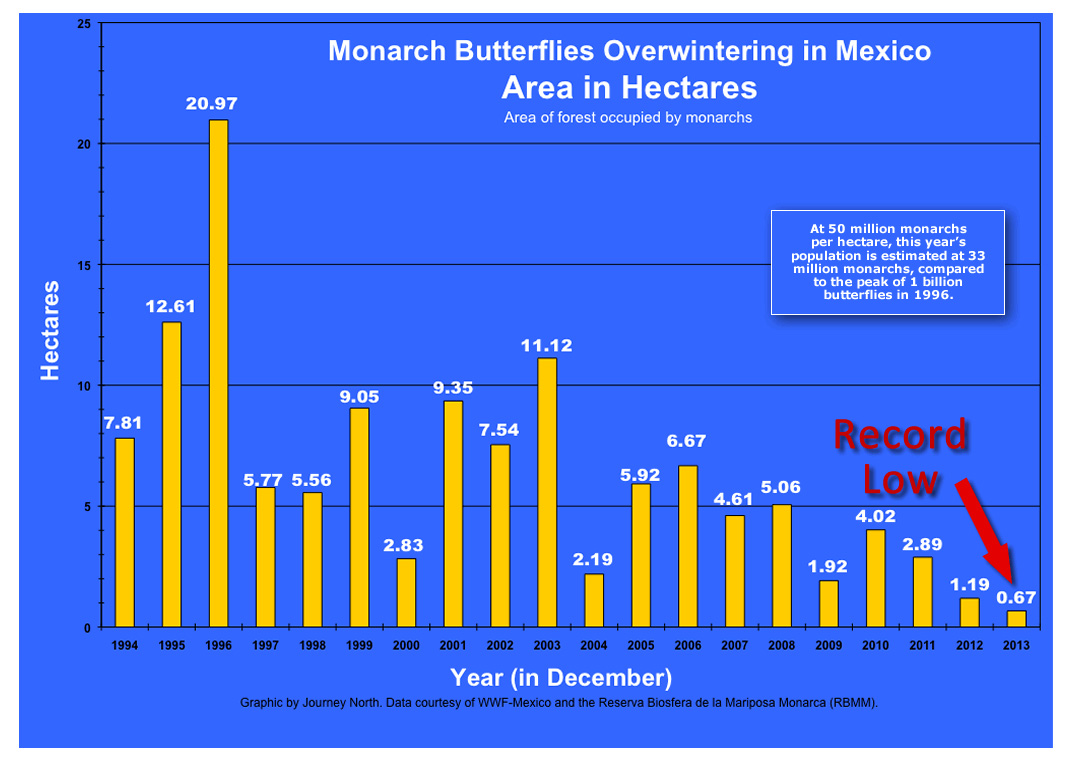
Monarch Butterfly Overwintering Graph Journey NorthEach winter, since I first began photographing the butterflies in 2006, I compare the above graph from Journey North to the number of butterflies observed on Cape Ann. As you can clearly see, this is the worst year on record, which corresponds to the near complete lack of Monarchs in our region this past summer.

Monarchs Gloucester 2012 �Kim Smith
Monarch Butterflies Eastern Point Gloucester

Many thanks to Kathy Chapman and our Readers for forwarding the following New York Times update about the shrinking Monarch Butterfly population.

By Michael Wines

January 29, 2014

Faltering under extreme weather and vanishing habitats, the yearly winter migration of monarch butterflies to a handful of forested Mexican mountains dwindled precipitously in December, continuing what scientists said was an increasingly alarming decline.

The migrating population has become so small — perhaps 35 million, experts guess — that the prospects of its rebounding to levels seen even five years ago are diminishing. At worst, scientists said, a migration widely called one of the world’s great natural spectacles is in danger of effectively vanishing.

The Mexican government and the World Wildlife Fund said at a news conference on Wednesday that the span of forest inhabited by the overwintering monarchs shrank last month to a bare 1.65 acres — the equivalent of about one and a quarter football fields. Not only was that a record low, but it was just 56 percent of last year’s total, which was itself a record low.

At their peak in 1996, the monarchs occupied nearly 45 acres of forest.

The acreage covered by monarchs, which has been surveyed annually since 1993, is a rough proxy for the actual number of butterflies that survive the arduous migration to and from the mountains.

Karen S. Oberhauser, a conservation biologist at the University of Minnesota who has studied monarchs for decades, called the latest estimate shocking.

“This is the third straight year of steep declines, which I think is really scary,” she said. “This phenomenon — both the phenomenon of their migration and the phenomenon of so many individuals doing it — that’s at risk.”

Continue Reading Here

Request for Help and Monarch Film Update

For the past three years I have been filming the life story of the Monarch Butterfly in backyards and along the shores of Cape Ann. My original intent was to tell the story of the butterflies primarily as it relates to their northern breeding grounds and specifically here in our community. Prior to filming, I wrote a children’s story about the Monarchs and during this entire time I have had an ongoing inner debate as to whether or not to travel to Mexico. While editing the film these past few months, I determined that capturing the butterfly’s story in their winter sleeping grounds as they are awakening in Mexico would only add to the film’s depth and beauty. To film in Mexico would be a dream come true.

In February I am going to Mexico to film the Monarchs!!! This all has come about very quickly! I have to practice walking five miles a day, recall how to ride a horse, and learn enough Spanish so that if I am separated from my group or kidnapped by bandits, I can at least inquire as to where is the bathroom.

Does anyone know of a local outfit that gives lessons in trail riding? And does anyone have experience with a Spanish language lesson CD (basic)? If so, can you please recommend in the comment section. Thank  you!!!!!!!

Stay tuned for adventures from Mexico! Beauty on the Wing ~ Life Story of the Monarch Butterfly will premiere  in the summer of 2014.

Rather than wait until the film was complete, this weekend I made a new website for the film-in-progress. When you have a moment, I hope you’ll visit my website and read more about Beauty on the Wing here.

Monarch Butterfly milkweed Good harbor Beach ©Kim Smith 2011Monarch Butterfly Nectaring at Common Milkweed ~ Good Harbor Beach, Gloucester

Beauty on the Wing celebrates the poetry and majesty of the uniquely North American phenomenon of the Monarch butterfly and its migration. There are no other butterflies the world over that travel this distance and it is a fascinating ecological link that connects Mexico with nearly every geographic region within the United States and Canada. How well the forested habitats of Michoacán are taken care of is as of equal importance to the Monarchs as how we in Gloucester conserve our habitats.