NEW FILM: A FLIGHT OF MONARCHS

When watching, know that the first two minutes of the film were shot in Gloucester. I think you will be dazzled by the sheer numbers of Monarchs that travel through Cape Ann’s backyards and meadows during the peak of migration.

I began photographing the Monarchs in 2006, which was a year when we had an extraordinary number of Monarchs visiting our shores. At that time, I became determined that if ever again this phenomenon were to occur on Cape Ann, I was going to have the ability to document on film, rather than only through still images, this beautiful event for my community. It’s hard to imagine without observing and here you can see what I have wanted to share.

A Flight of Monarchs begins on a September day as first one and then passels of Monarchs begin to arrive to the fields and meadows of Cape Ann, carried across Massachusetts Bay on a tailwind. By the early evening light they begin to pour into the surrounding trees, clustering to stay warm in the branches furthest away from the prevailing breezes. The following morning as the sun begins to touch their wings, they alight from the trees, seeking the freshest wildflowers from which to drink nectar to help build their lipid reserves for the several thousand mile journey south. They drink and drink until the last of the sun’s rays dip below the tree line. As they arrived on a tailwind, they again depart, and are carried to the next gathering area. For coastal Monarchs, Allens Pond, which is located in Westport, Massachusetts is often the next stop.

In the next scene, the butterflies have arrived to the sacred oyamel fir forests of Angangueo, Michoacán, deep in the heart of the Trans-Mexican Volcanic Belt. It’s early morning and the butterflies are suspended in great primordial branched clusters that may become so heavy from the weight of so many butterflies the boughs of the trees bend to the breaking point. Later in the day, as the sun begins to warm their wings, the butterflies begin to stir. During the winter, it is imperative that the Monarch’s body temperature remains relatively low. They leave the sunniest branches in search of shade and a drink of water from nearby mountain streams. Occasionally in late February, as the air temperatures begin to warm with the coming springtime, for a short period during the day, the butterflies leave the trees all at once. This phenomenon is called a butterfly “explosion,” and is a truly magnificent event to observe.

A Flight of Monarchs is set to the evocative and tender “Fields of Blue,” written and performed by composer and guitarist Jesse Cook and his band, to which permission was granted by the artist for the purpose of this short film. Here is a link to Cook’s website. I highly, highly recommend attending a live performance of Jesse Cook and Company. As was I, you will be completely taken by their gorgeous music, exquisite artistry, and with Cook’s songwriting, will travel in beautiful melodies inspired from around the world.

I am currently editing my feature length documentary, Beauty on the Wing, which after months and months of organizing and editing three years of footage, is currently running at approximately twelve hours in length. At eleven hours too long, I have a great deal of editing to accomplish in the coming winter months!

A Flight of Monarchs presented here is the shorter version of the film that I created for the Berkshire Museum’s “Butterflies” exhibit. The first version is six minutes long and played on a continuous loop in the main gallery of the exhibit hall. The longer version will soon be posted on Vimeo.


Check Out Rainforest Publications

Rainforest Publications recently licensed one of my Monarch photos, which was shot on Eastern Point, for the cover of their newest pocket field guide, Butterflies of Mexico. You can get a preview of the new field guide by clicking here; look towards the bottom of the page.

Monarchs Gloucester MA ©Kim Smith 2012 -1269I requested their field guide on Mexican Flowers, which Larry, the publisher, kindly sent along. I love it–the guide is beautifully illustrated, and well, just so pocketable! I wished I had it on my trip last winter to Agangueo to film the Monarchs and especially appreciate how the guide is organized by plant family as opposed to alphabetically.

If any of our world traveling GMG readers are planning a trip to Costa Rica, Mexico, Florida, Hawaii, Panama, Peru, California, Nicaragua, Belize, or the Pacific Northwest I recommend checking out their website, Rainforest Publications. Specific to each region, they offer field guides on marine animals, birds, orchids, wildflowers, butterflies, trees, reptiles, amphibians, and more. They even have a field guide for marine mammals of the North Atlantic. At only $5.95. I think this would be ideal for whale watchers (and for whale watching companies like Seven Seas to carry the guides).

Have You Picked Up Your Summer Issue of Cape Ann Magazine?

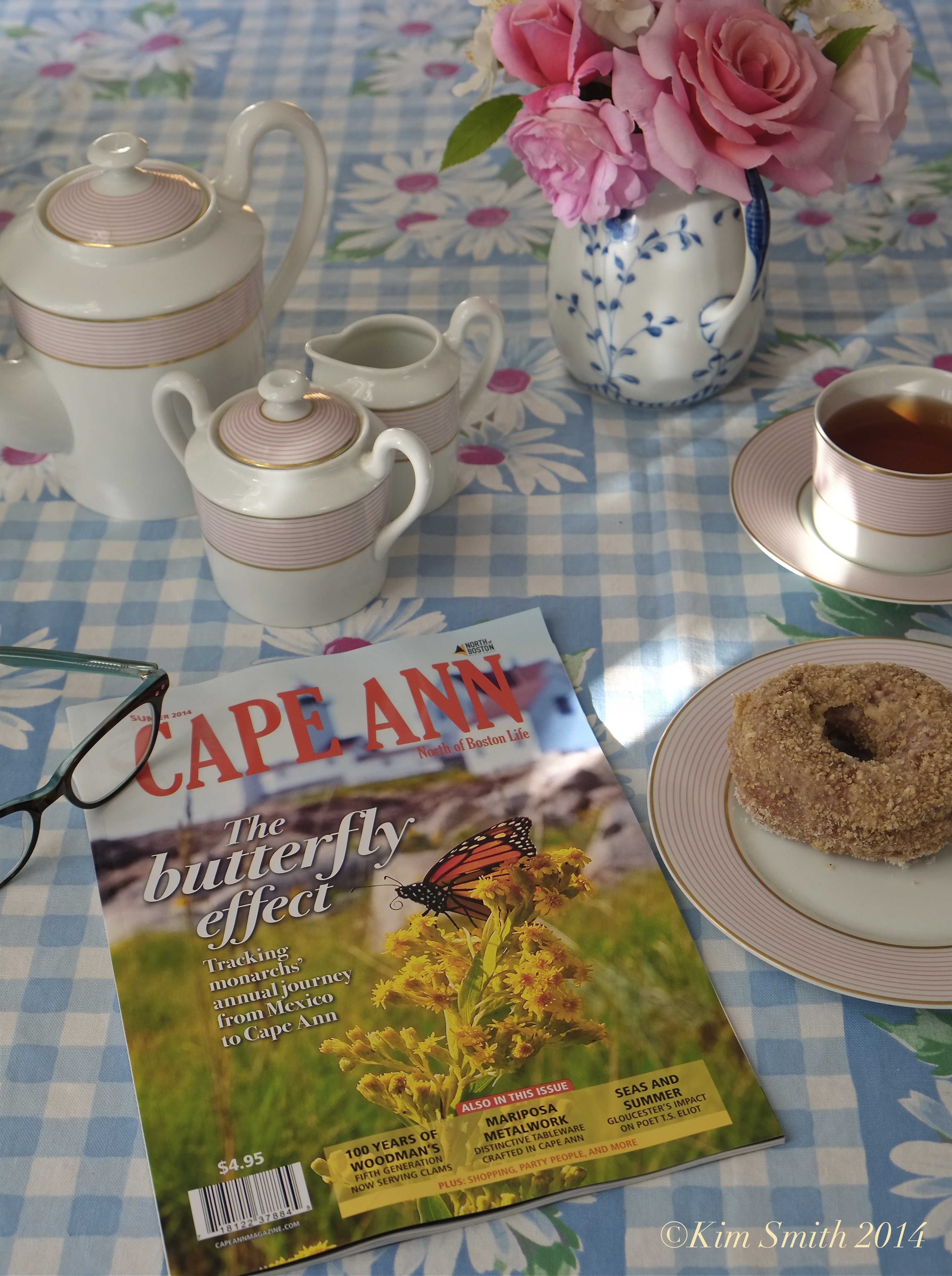
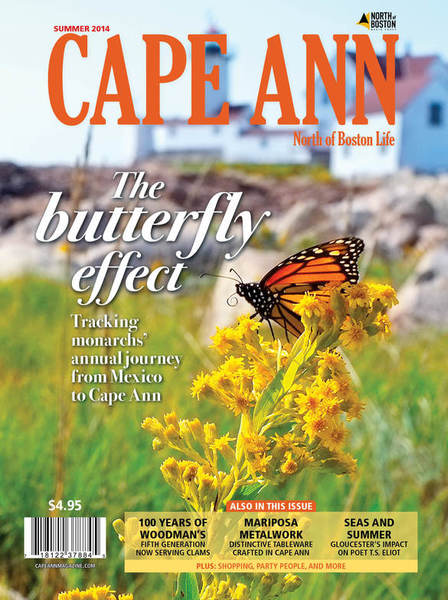
What a terrific issue and the perfect read to bring to the beach (and not just because my story about the Cape Ann to Mexico Monarch connection is featured on the cover!).

Cape Ann Magazine’s Summer 2014 issue provides a wonderful window into summer living on our beautiful North Shore. I throughly enjoyed reading all the articles, including Gail McCarthy’s about Essex sculptor Shelly Bradbury and the beautiful work she does designing for Mariposa; Alexandra Pecci’s two articles, one about Mariposa, aptly titled “Elegance for Everday,” and a second interesting story about Woodman’s celebrating their 100th year in business; Andrea Holbrook’s story featuring Gloucester’s only sailmaker Josh Bevins; and Sean Horgan’s article about tuna-chasing Johnny Johnson. Pick up the Summer 2014 issue of Cape Ann Magazine. I guarantee, you won’t be disappointed!

Cape Ann Magazine Summer 2014 butterfly ©Kim Smith 2014Luxuriating before work with Cape Ann Magazine’s summer issue and Brother’s Brew fab house-made doughnut!

Excerpt from “Cape Ann to Mexico: The Monarch Butterfly Connection”

Like many communities throughout North America, Cape Ann shares in the interconnected web of the wondrous migration of the monarch butterfly. The very same monarchs that we see nectaring in our gardens and along the shoreline in late summer make a journey of over 2,500 miles south to Mexico to spend the winter in the unique and magnificent oyamel fir and pine tree forests of the Trans-Mexican Volcanic Belt, known locally as the Sierra Nevada (Snowy Mountain Range).

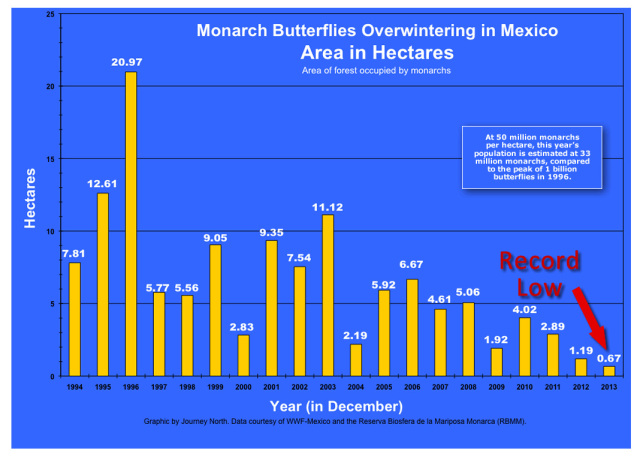
Last December, reports began to pour in from Mexican and American scientists that the number of monarchs overwintering was the lowest ever documented, representing a 90% decline from population numbers recorded in the 1990s. This coincided with the lamentably few monarchs seen breeding and feeding in our Cape Ann gardens during the summer of 2013. For the past three years I have been filming the monarchs in Gloucester, and all around Cape Ann, for my forthcoming film, Beauty on the Wing—Life Story of the Monarch Butterfly. I came to the realization that if I did not travel to Mexico at this moment in time, there may never again be the opportunity to film the monarch butterfly migration.

Read more in the Cape Ann Magazine Summer 2014 issue available at the following shops:

Gloucester

The Gloucester Times, 36 Whittemore St., 978-283-7000

The Book Store, 61 Main St., 978-281-1548

Good Harbor Liquors, 340 Main St., 978-281-7100

Harbor Loop Gifts, 1 Harbor Loop, 978-283-3060

Jeff’s Variety, 71 Eastern Ave., 978-281-5800

Richdale, 410 Washington St., 978-281-4670

Richdale, 120 E. Main St., 978-283-2179

7 Eleven, 50 Bass Ave., 978-283-6868

Savour, 76 Prospect St., 978-282-1455

Rockport

Hershey Frame Shop, 8 Rr Pleasant St., 978-546-2655

Rockport Market, 21 Broadway, 978-546-3684

Toad Hall Book Store, 47 Main St., 978-546-7323

Tucks Candy, 15 Main St., 978- 546-6352

Manchester

Richdale, 8 Beach St., 978-526-7294

Cape Ann Magazine Cover Kim Smith. Summer 2014

Butterflies! at the Berkshire Museum

Paul Villinski Arcus -1 ©Kim Smith 2014

Detail of Paul Villinski’s “Arcus,” made from recycled cans.

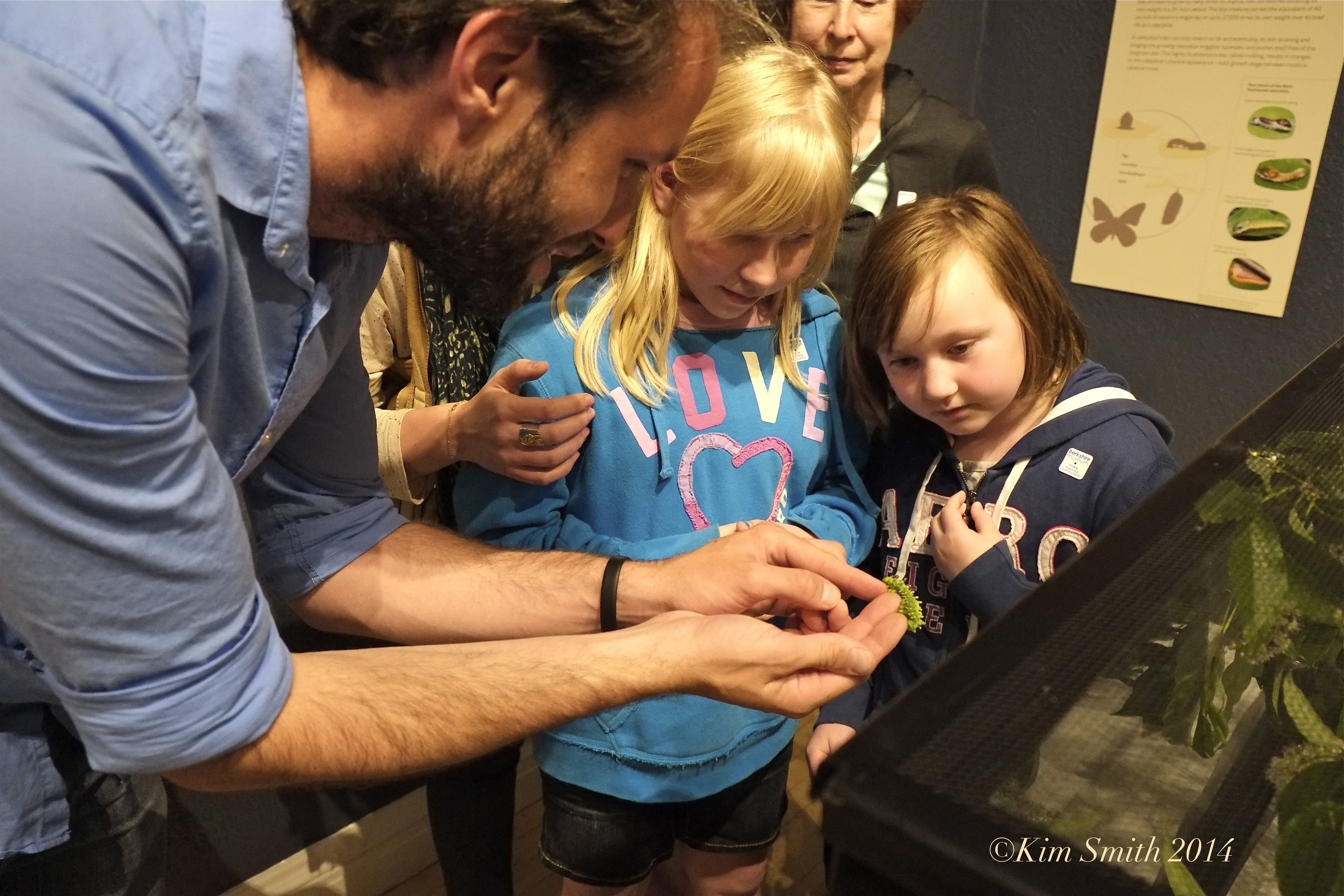
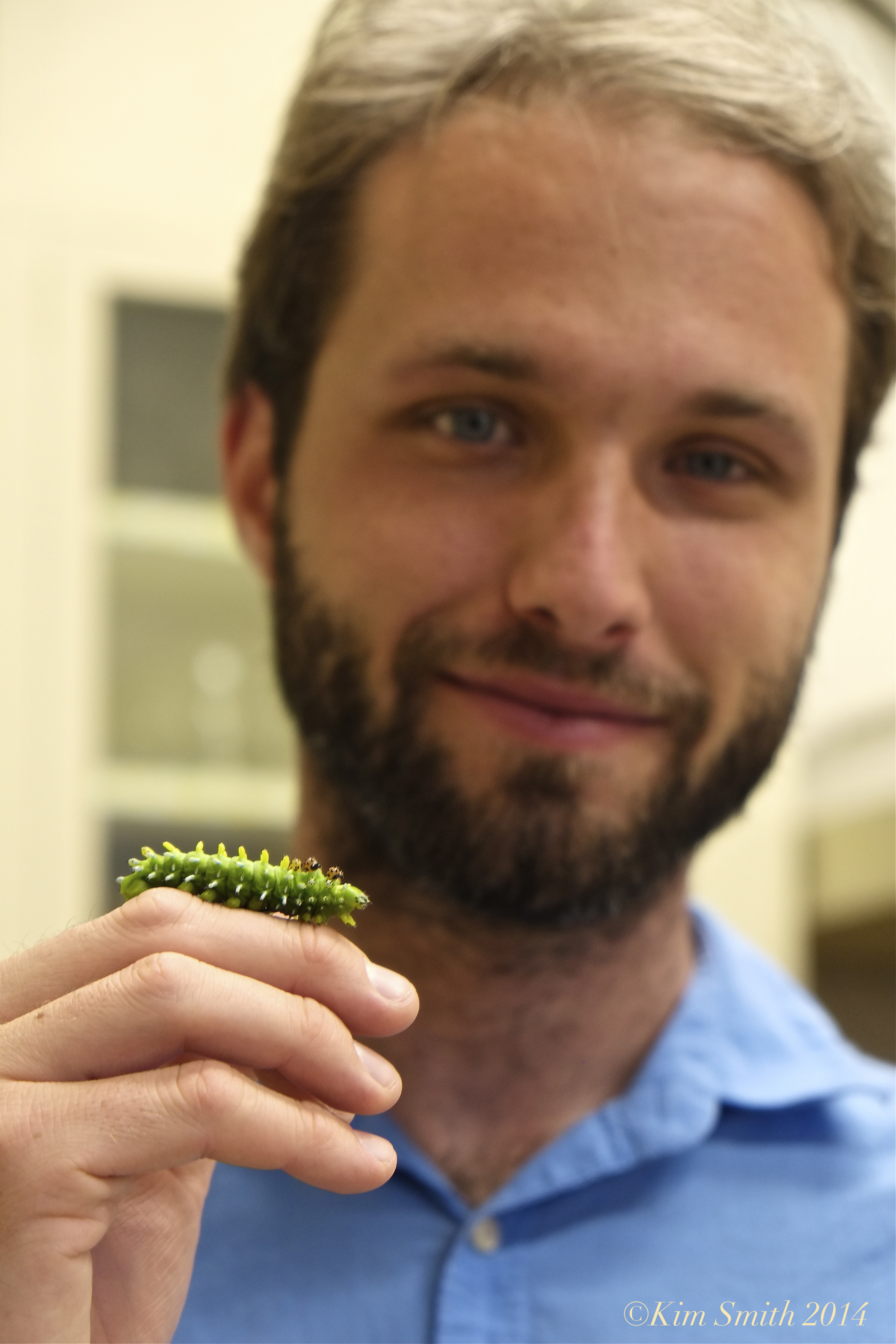
Kim Smith Berkshire Museum Butterflies ©Kim Smith 2014My friend Sam Jaffe talking about caterpillars.

Friday night I had the joy to attend the fabulous new exhibit at the Berkshire Museum titled “Butterflies!” The galleries are filled with hands on art and science activities, contemporary butterfly sculpture, artifacts from the museum’s collections, live caterpillars, and mixed media of photography and film, including an audio track from Dr. Lincoln Brower discussing what happens within a chrysalis. And, as part of the exhibit, one of the galleries houses a large butterfly pavilion with over 200 live tropical butterflies from around the world!

Blue Morpho Butterfly ©Kim Smith 2014Underwings of the Blue Morpho Butterfly from the live butterfly pavilion.

“Butterflies” was curated by Maria Mingalone, the museum’s director of interpretation, and she deftly and beautifully combines science, art, and nature in an exhibit that is sure to inspire and delight the very youngest to the most senior of citizens, and every age in between!

Butterflies Berkshire Museum ©Kim Smith 2014  copyThe opening was very joyful and buoyant—I most certainly felt that way and, judging from the expressions on visitor’s faces, wasn’t alone. I am convinced that butterflies bring out the happy in people!

Kim Smith film Berkshire Museum Butterflies ©Kim Smith 2014JPGThe audience for my short film “Flight of the Monarchs”—I watched as many people watched my film many times over, despite the case that because the galleries were so crowded you couldn’t hear the beautiful music. I think there were several thousand people at the event.

The music that I set my film to is “Fields of Blue,” written and performed by Jesse Cook. I wrote the artist and sent him a copy of my film and the most amazing thing happened where, within only the few day whirlwind to create this little film, we were granted permission to use his song!!!!!!!!

My film opens with a clip of a Monarch flying in front of Eastern Point Lighthouse (you can see our Lighthouse in the above photo). Most of the footage that I used for the movie was of butterflies in flight, shot on Cape Ann, and the audience was stunned at how beautiful the migration is through Gloucester. That opening clip of the Lighthouse and the Monarch took several days to capture the exact shot that I wanted. Butterflies don’t take direction!Berkshire Museum ©Kim Smith 2014 -2

Berkshire Museum Kim Smith 2014 1JPGSome of my photos were used to illustrate Dr. Brower’s audio recording explaining what happens inside a chrysalis.

Sam Jaffe Kathy©Kim Smith 2014 copySam and his fiance Kathy, also a graduate student in environmental studies.

Berkshire Museum © Kim Smith 2014JPGIf you have never been to the Berkshire Museum, their website description reads as follows: “The Berkshire Museum offers a unique array of exhibitions, activities, and attractions for visitors of all ages. From fine art and ancient objects to fossils; from an aquarium of native and exotic creatures to the Feigenbaum Hall of Innovation, we are your community museum: a place where everyone, from toddlers to elders, can learn, play, explore, innovate, be engaged and inspired.”

I arrived early, before “Butterflies” opened its door, and explored the galleries. It’s really a very engaging museum and especially while the exhibit is running, would be a wonderfully fun and interesting day trip with children.

Sam Jaffe ©Kim Smith 2014Sam Jaffe making final adjustments to the chrysalis and cocoon display. To see some of Sam’s stunning photography, click on his website here: Sam Jaffe

Olive Ridley skeleton ©Kim Smith 2014Olive Ridley Skeleton at the Berkshire Museum

_DSF3364Ellsworth Kelly “Grapefruit”

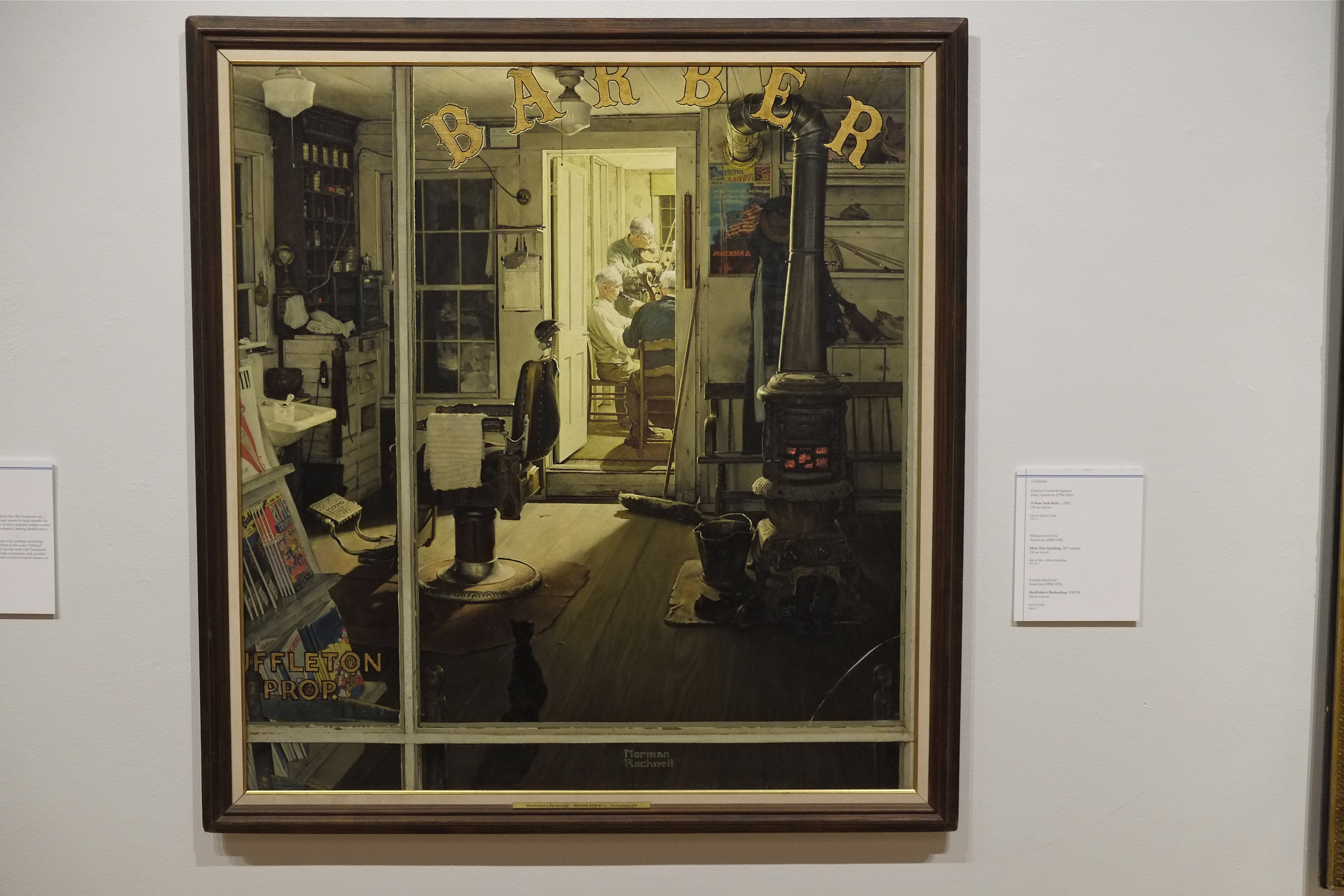
_DSF3362Norman Rockwell

Paul Villinski Arcus ©Kim SAmith 2014Paul Villinski “Arcus”

Sam Jaffe ©Kim Smith 2014 -2Sam Jaffee

Xerces Society letter to President Obama

April 14, 2014

President Barack Obama The Honorable Tom Vilsack, Secretary of Agriculture The Honorable Sally Jewell, Secretary of the Interior

Dear Mr. President, Mr. Secretary of Agriculture, and Madam Secretary of the Interior,

In light of the severe decline of both the eastern and western monarch butterfly populations that has occurred since the late‐1990s, we are writing to ask you to establish a multi‐agency monarch butterfly recovery initiative to restore the habitats that support the extraordinary migrations of this iconic species. We encourage you to direct the Natural Resources Conservation Service (NRCS), Farm Service Agency (FSA), and Forest Service (USFS) of the U.S. Department of Agriculture and the Fish and Wildlife Service (USFWS) and Bureau of Land Management (BLM) of the U.S. Department of the Interior to develop a cooperative, landscape‐ level initiative with the many stakeholders willing to help foster significant monarch recovery.

These migrations can be saved for future generations by restoring to the landscape milkweeds, the host plants for monarch caterpillars, and nectar plants that sustain the adult butterflies. These habitats would support pollinators and a large number of other species as well. The federal agencies that incentivize conservation of wildlife habitat on private lands and that directly manage wildlife habitat on public lands can play key roles in this effort by targeting funding and technical support for such an initiative.

As you know, the eastern monarch population has been declining for more than a decade, and this year scientists observed the lowest numbers ever documented, representing a 90% drop from population numbers recorded in the mid‐1990s. Since then, there has been a significant loss of milkweeds in agricultural areas of the Midwest, which is directly correlated with the declining monarch population. Monarch habitat has also declined sharply in the West.

Monarch Migration MapPaul Mirocha Illustration for Monarch Watch

A landscape‐level monarch butterfly recovery initiative led by the NRCS and FSA on private lands would incentivize the planting of native milkweeds and butterfly nectar sources in places that are protected from pesticide and herbicide use.

Continue reading

New Film: Monarch Migration Interview with Tom Emmel

Horses neigh, bugs crawl across the lens, and Monarchs flutter in the background —interview on the mountaintop and it was all beautiful! Video includes footage from my forthcoming film, Beauty on the Wing ~ Life Story of the Monarch Butterfly.

Monarch Migration Interview with Tom Emmel, filmed at the summit of the Sierra Chincua Monarch Butterfly Biosphere Reserve, Angangueo, Mexico.

This was Tom’s 40th trip to Angangueo to study the Monarchs. In this interview, he provides some historical perspective from those very first trips to the remote Oyamel fir forests atop the Trans-Mexican Volcanic Mountains. We learn how scientists count millions of Monarchs. Tom discusses the state of the Monarch migration today and why it is in crisis.

Tom Emmel is the Director of the McGuire Center for Lepidoptera and Biodiversity at the Museum of Natural History of the University of Florida, Gainesville. Additional footage shot at El Rosario Monarch Butterfly Reserve and at the base of Sierra Chincua.

ORDER YOUR MILKWEED SEEDS TODAY!

Monarch Caterpillars Eating Common Milkweed ©Kim Smith 2012JPGMonarch Caterpillars Munching on Milkweed

Ordering information:

Please note that the milkweed seeds are available in two different species and two different quantities. Please place your order amounts in the comment section of this post as follows:

Your Name, Your Email Address (optional), and Seed Type and Quantity.

For Example:

Pippi Longstocking, villvillakula@gmail.com

1 Packet Common Milkweed 3.50

1 oz. Marsh Milkweed 15.00

2 Packets Pink New England Aster @ 3.50 ea. = 7.00

My order total: $25.50

We are not collecting money ahead of time for the seeds. The orders are placed entirely by the honor system. Last year we did not have a single stiff and I will accept cash or check at the time of pick up. Seed pick up and information day will be Sunday, May 18th, from 9:30 to noon, at Captain Joe and Sons.

The packets of seeds (200-300 seeds) are perfect for a relatively smallish patch.

The larger ounce quantity is ideal for planting larger areas. On average, plan on 50 seeds per square foot. If your patch is 10 feet x 10 feet, that equals 100 square feet, and would require approximately 5,000 seeds.

Additionally, we are also offering pink and purple New England aster seeds. I’ve never grown New England asters from seed, but have read that they are relatively easy to start (although slow to germinate). New England asters make a beautiful border and will not only offer sustenance to southward migrating Monarchs, but in late summer also provide nectar for myriad species of bees and butterflies.

SEEDS

Common Milkweed (Asclepias syriaca)

Seed Packet (300 seeds) 3.50

1 ounce (4900 seeds) 12.00


Marsh Milkweed (Asclepias incarnata)

Seed packet (200 seeds) 3.50

1 oz. (5,200 seeds) 15.00


Pink New England Aster (Aster novae-angliae variation)

Seed Packet (1000 seeds) 3.50


Purple New England Aster (Aster novae angliae)

Seed Packet (1750seeds) 3.50

*    *    *

Why is it so important to plant milkweed for the Monarchs? Milkweed is the only food plant of the Monarch butterfly caterpillar. The Monarch butterfly migration is in serious peril due to loss of habitat in the United States by the use of Monsanto’s genetically modified Roundup Ready corn, soybean, and sorghum crops. Global climate change is also a factor in the weakening migration. We can all help mitigate some of the destruction by planting milkweed and nectar-rich wildflowers.

monarch-caterpillars-common-milkweed-c2a9kim-smith-2011Common Milkweed and Monarch Caterpillars J-shape

Common Milkweed (Asclepias syriaca) is the milkweed we see most typically growing in our dunes, meadows, roadsides, and fields. It grows quickly and spreads vigorously by underground runners. This is a great plant if you have an area of your garden that you want to devote entirely to milkweed. It prefers full sun, will tolerate some shade, and will grow in nearly any type of soil. The flowers are dusty mauve pink and have a wonderful honey-hay sweet scent.

Monarch Butterfly marsh Milkweed ©Kim Smith 2012Marsh Milkweed and Monarch Butterfly

Marsh Milkweed (Aclepias incarnata) is more commonly found in marshy areas, but grows beautifully in gardens. It does not care for dry conditions. These plants are very well-behaved and are more clump forming, rather than spreading by underground roots. The flowers are typically a brighter pink than Common Milkweed.

New England Aster and Monarch Butterfly ©Kim Smith 2014New England Aster

New England Aster (Aster novae-angliae) is a hardy late summer perennial that grows approximately 36 inches to 60 inches. New England asters prefer wet to medium soil, grow well in full sun, and will tolerate part shade.

Cape Ann Milkweed Project Continues ~ Plant Milkweed Seeds to Save the Monarchs!

Monarch Butterfly milkweed Good harbor Beach ©Kim Smith 2011Good Harbor Beach Common Milkweed

Last year was the beginning of our first and wonderfully successful Cape Ann Milkweed Project. My friend Joe Ciaramitaro from Good Morning Gloucester generously offered to hold the plant sale at Captain Joe and Sons, which is very conveniently located on East Main Street, and we had a fantastic turnout. This year I am thinking about doing things a little differently. Rather than shipping and handling live small plants, I am planning to purchase milkweed seeds in bulk. My question is, and this is not the official order form, but just to get a sense of participation, does anyone have an interest in planting milkweed from seed in their gardens, meadows, and/or abandoned areas around our community?

I think I can get good quantities of seed of Marsh Milkweed, Common Milkweed, and Prairie Milkweed. All three are very easy to grow from seed and take about 14 days to germinate. I will provide complete information and tips on growing milkweed from seed.

Please answer in the comment section if you are interested in growing milkweed from seed.

monarch-butterfly-overwintering-graph-journey-north

Why is it so important to plant milkweed for the Monarchs? I’ve written much about that and at the end of the post, please find a list of posts previously published about the importance of milkweed. In a nutshell, milkweed is the only caterpillar food plant of the Monarch Butterfly. The Monarch Butterfly migration is in serious peril. One way we can all take action to is to plant milkweed to help mitigate the loss of habitat, partly due to global climate change and primarily due to the use of Monsanto’s GMO Roundup Ready corn, soybean, and sorghum seed along with the massive use of their herbicide Roundup.

Cape Ann Milkweed Project

News Release: MONARCH WATCH ANNOUNCES ‘BRING BACK THE MONARCHS’ CAMPAIGN

How Exactly is Monsanto’s Roundup Ravaging the Monarch Butterfly Population?

Where Are All the Monarchs?

monarch-butterfly-marsh-milkweed-kim-smith-2011

Make Your Voices Heard for the Monarchs!

This is not a request to donate money. Click here to sign this petition and tell the EPA to protect the Monarchs.

P.S. The photo that is on the NRDC’s Monarch petition page is my photo of a male and female Monarch Butterfly, newly emerged and resting on the foliage of Marsh Milkweed (Asclepias incarntata).

Male Female Monarch Butterfly Marsh Milkweed -2 ©Kim Smith 2012 copyMale and Female Monarch Butterflies


Meet McGuire Center Director Tom Emmel at the Monarch Butterfly Biosphere Reserves

Tom Emmel Angangueo ©Kim Smith 2014Tom Emmel, right

Our expedition to the Monarch Butterfly Biosphere Reserves was led by Tom Emmel, Ph.D. Tom is the Director of the McGuire Center for Lepidoptera and Biodiversity, which is part of the University of Florida’s Museum of Natural History. He is also the university’s professor of zoology and entomology and the author of over 400 publications, including 35 books. Not only is Dr. Emmel a professor and director of the center, he leads expeditions to research biodiversity around the world, including recent trips to Bali to Komodo Island to study the Komodo Dragon (with a great story of how he and his fellow travelers very nearly almost became Komodo Dragon supper), the Galapagos Islands, and Madagascar.

This was Dr. Emmel’s fortieth trip to Angangueo to study the Monarch Butterfly migration. His first trip was in 1980 with Dr. Lincoln Brower who had, at the same time as Dr. Fred Urquhart, discovered the Monarch colonies in 1975. In those first early years of conducting research at the biospheres, Dr. Emmel and Dr. Brower traveled on old mining roads, rode horseback to the colonies, and camped in tents. Today, there are well-marked trails with options for either hiking or horseback riding.

On the second day of our expedition, I interviewed Dr. Emmel at the top of Sierra Chincua Monarch Colony. He was also interviewed by a Mexican television crew at the summit of the Sierra Chincua biosphere. I am in the process of editing the interview footage and will have that ready to post in the near future. Amongst the many aspects of the Monarch’s migration discussed during the interview, Dr. Emmel reveals exactly how one counts millions upon millions of Monarchs and offers several theories as to why the butterflies migrate to the very specific climate zone of the Trans-Mexican Volcanic Belt. We cover the subject of Monarch conservation and precisely how Monsanto’s GMO genetically modified Roundup Ready corn and sorghum, and Bt-corn, are indisputably deadly to the Monarchs. You’ll be surprised at the results of the research that was conducted on our journey in regard to the numbers of Monarchs counted in the biospheres.

Monarch Oyamel tree ©Kim Smith 2014 copyThis photo was taken early in the day, before the butterflies awaken in the sun. You can see that the limb of the Oyamel tree is so heavily laden with butterflies, it appears as though it will snap at any moment. And oftentimes, the limbs do break! The butterflies  scatter and then regroup to another location.

Meeting Dr. Emmel and fellow expedition travelers was one of the most interesting and exciting aspects of the journey. You can’t imagine traveling with a more knowledgeable expert than Dr. Emmel. He is not only a world authority on all aspects of the Monarch’s migration, the history of the development of the biospheres, and the community of Angangueo, he also has extensive knowledge about a wide range of wildlife species and topics relative to biodiversity and the natural world.  He shares the information generously and with a sense of humor, too.

Ian Segebarth Craig Segebarth ©Kim Smith 2014Dr. Emmel’s assistants, brothers Ian and Craig Segebarth, are two of the brightest and most helpful young men you could hope to meet. Marie Emerson, who works in the development department at the museum was a joy and also super helpful, as was Josh Dickinson, who was traveling with his wonderfully fun granddaughter, 5th grader Zoie Dickinson. Josh Dickinson has spent a lifetime consulting on forestry management and he will be helping with forestry management at the Monarch biospheres. Josh also speaks Spanish very well and was tremendously helpful, especially when I locked myself out of my hotel room! Thanks again Josh for your kind assistance!

Zoie Dickinson ©Kim Smith 2014 copyZoie Dickinson